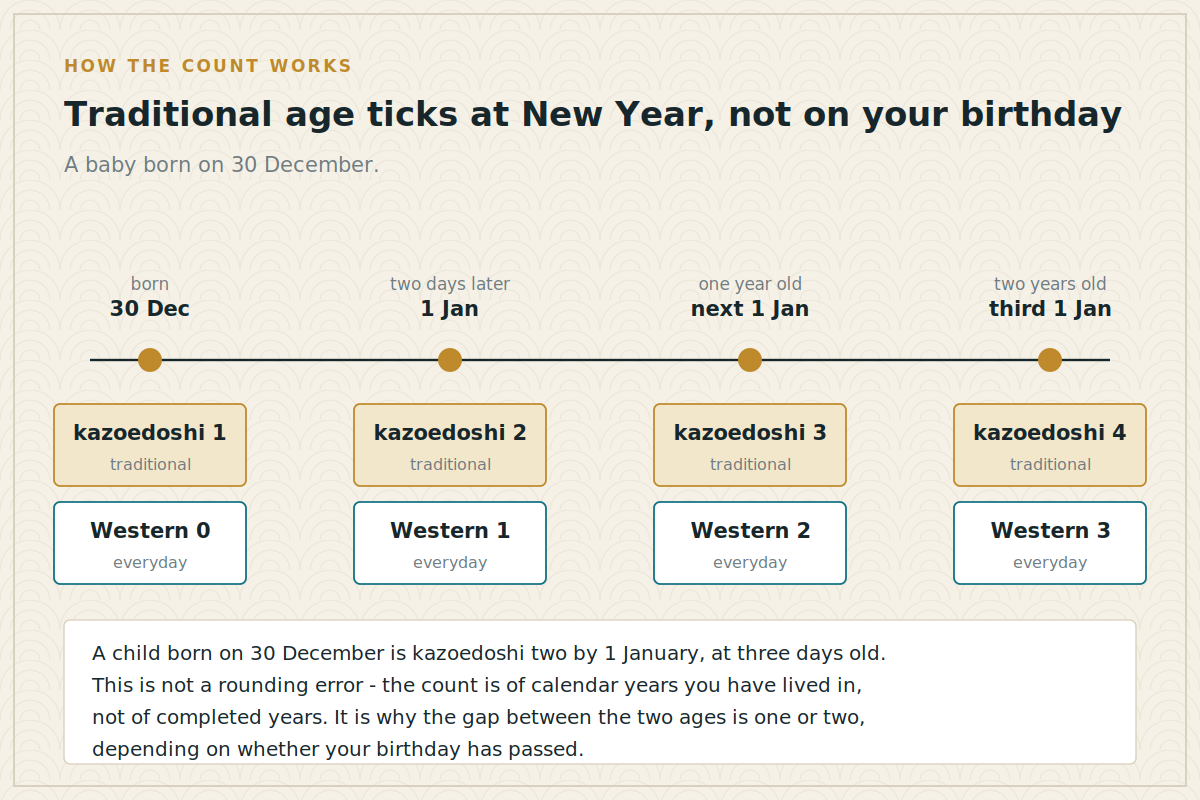
A child born on 30 December is two years old on 2 January. Not by any error, and not by a rounding convention — by the traditional Japanese count, which is still the one that decides when that child visits a shrine for the first time.
Japan has two ages. The everyday one matches yours. The other, kazoedoshi, can put you a full two years higher, and it governs a set of ceremonies and superstitions that are very much alive.
The two counts
満年齢 man-nenrei — the “full” age. Zero at birth, plus one on each birthday. Identical to the Western count, and what Japan uses for everything legal and administrative since a 1950 law made it standard.
数え年 kazoedoshi — the “counted” years. One at birth, plus one for everybody at New Year. Nobody’s birthday is involved.
The logic is different rather than wrong. Kazoedoshi counts the calendar years you have existed in, and you have existed in the year you were born, so that year counts as your first. The same system was used across East Asia and survives in ritual contexts in several countries.
Working out yours
Two cases:
- Birthday already passed this year — kazoedoshi is your Western age plus one.
- Birthday still to come — plus two.
Worked example. Born 3 December 2000, and today is in August 2026. Western age 25, since the birthday hasn’t come round. Kazoedoshi 27, because you have lived in 2000 through 2026 inclusive — twenty-seven calendar years.
| Born | Today | Western age | Kazoedoshi |
|---|---|---|---|
| 3 Dec 2000 | Aug 2026 | 25 | 27 |
| 3 Mar 2000 | Aug 2026 | 26 | 27 |
| 30 Dec 2025 | Aug 2026 | 0 | 2 |
| 1 Jan 1965 | Aug 2026 | 61 | 62 |
The third row is the one that startles people, and it is correct.
Where it still decides things
Shichi-Go-San
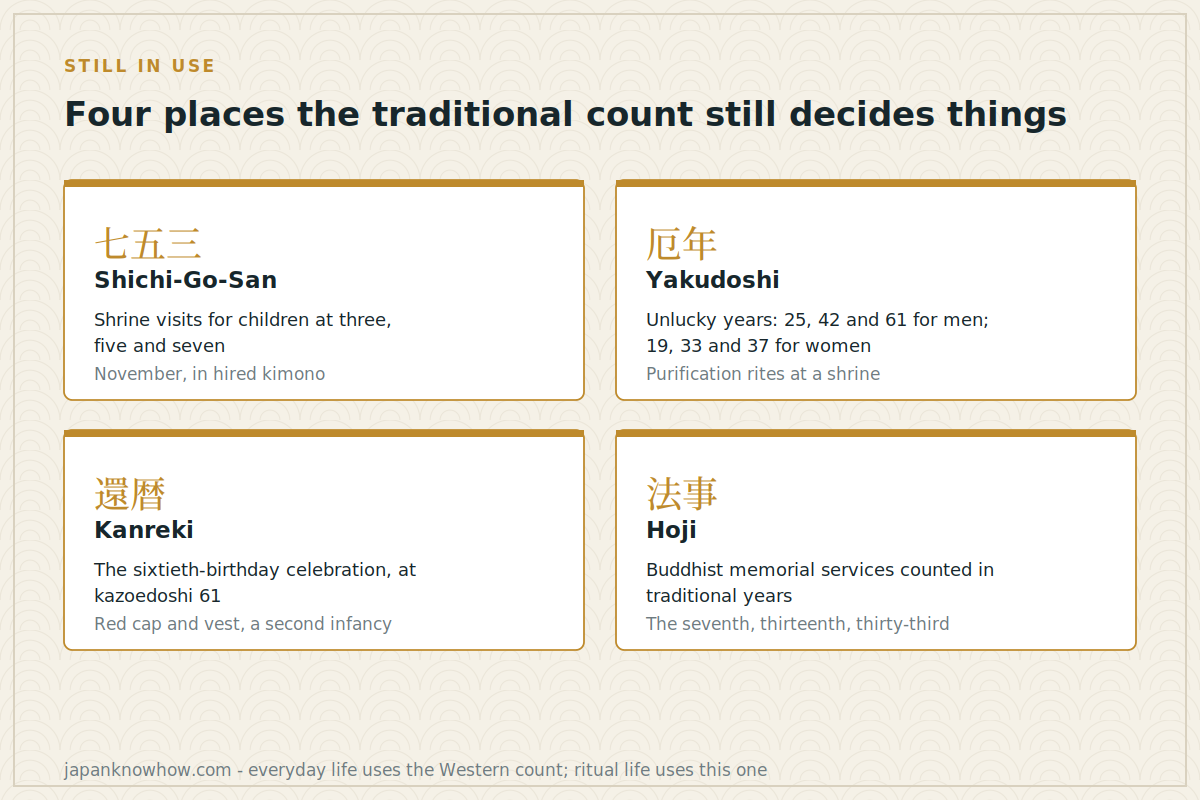
七五三, “seven-five-three.” Children are taken to a shrine in November — traditionally the fifteenth — at ages three, five and seven, dressed formally, often in hired kimono. The photographs are a whole industry.
The ages are traditionally kazoedoshi, which is why a family may take a child who is “five” in a sense that doesn’t match their passport. Many families now use the Western age instead, and shrines accept either; if you’re invited to one, this is why the arithmetic looked odd.
Yakudoshi
厄年, the unlucky years. Specific ages at which misfortune is traditionally more likely, marked by a visit to a shrine for a purification rite.
For men: 25, 42 and 61. For women: 19, 33 and 37. All in kazoedoshi. The heaviest are 42 for men and 33 for women, called 大厄 taiyaku, the great calamity years — 42 because the digits can be read shi-ni, “to death,” and 33 because it can be read san-zan, “disastrous.” The year before and after each is also treated as a lesser risk.
How seriously this is taken varies as much as any superstition, but the rites are common, the shrines are busy, and a great many otherwise unsuperstitious people go anyway.
Kanreki
還暦, “return of the calendar.” At kazoedoshi 61 — sixty by the Western count — you have completed one full cycle of the zodiac and the five elements, and returned to the combination you were born under.
The celebration treats it as a rebirth: the person traditionally wears a red cap and vest, the colour of infancy, and is congratulated on beginning a second cycle. The sixty-year mechanism behind it is explained in our article on the five elements.
Memorial services
法事 hōji, Buddhist memorial services held at intervals after a death — the seventh year, the thirteenth, the thirty-third — are counted in traditional years, so the third anniversary falls two years after the death. This one catches families out regularly.
Everyday life uses the Western count. Ritual life uses this one. The trouble comes when a single family conversation contains both.The practical summary
Why the everyday count changed
Japan made the Western full-age count the legal standard in 1950, mainly for administrative clarity — rationing, pensions and school entry all work better with a count that doesn’t move for the whole population on the same day.
Kazoedoshi didn’t disappear; it retreated into ceremony. Which is a very Japanese outcome, and the same pattern as the era calendar sitting beside the Gregorian one rather than being replaced by it, as described in the era converter guide.
The New Year connection
One detail that makes the system click. Because everyone gained a year together at New Year, the Japanese New Year was historically a shared birthday for the entire country — which is part of why shōgatsu carries the weight it does, and why the greetings exchanged then are about the year turning rather than about any individual.
It also explains a piece of vocabulary. The traditional New Year greeting 明けましておめでとうございます is congratulation on the year having opened, not on anyone’s personal milestone. Under the old count, the opening of the year was the personal milestone.
The same idea elsewhere in East Asia
Japan is not alone in having carried two ages, and the comparison is instructive because one neighbour has recently resolved it differently.
Korea used a closely related count, in which a person is one at birth and gains a year at New Year — long enough established that it was simply “Korean age.” Unusually, three systems coexisted in law and daily life at once, which produced real administrative confusion. South Korea standardised on the international count in June 2023, and the traditional age is now formally out of official use, though it survives in conversation.
China and Vietnam retain the traditional reckoning in ritual and rural contexts while using the international count officially — much the pattern Japan settled into after 1950.
What is striking is how similar the trajectory is: an old count tied to the calendar year, an administrative decision to standardise, and then a long afterlife in ceremony. Japan’s version of that afterlife is unusually visible, because the ceremonies it governs — shrine visits, unlucky years, sixtieth birthdays — are themselves still widely observed.
Two practical notes
Nobody will ask you for your kazoedoshi. If a Japanese form or a person asks your age, they mean the ordinary one. The traditional count only comes up in a ritual context, and then someone will work it out for you.
But it is worth being able to spot. If a shrine notice, a temple leaflet or an older relative gives an age that is one or two higher than you expect, this is why — and knowing it saves a confusing conversation.
Our era converter shows both ages for any birth date, alongside the era year, so you can see the gap directly. What the tool does and where we would not lean on it is on the tools page, and if you need the era year tables rather than a calculator, they are in the year tables article.