The change most visitors notice today has no single official date: many shrines and temples now use their own mixtures and rankings, while Sensō-ji still says it preserves an older fortune system unchanged. That difference is why an omikuji bad fortune can feel unusually common in Asakusa. The traditional set associated with 元三大師御籤, Ganzan Daishi mikuji, “Ganzan Daishi fortunes,” contains 30 凶 results among 100 texts. Sensō-ji’s official FAQ does not publish that percentage, but it confirms that its 観音百籤, Kannon hyakusen, “One Hundred Kannon Lots,” retains the old form and is known for producing many negative results. You have not discovered a uniquely unlucky day; you have drawn from a deliberately severe set.
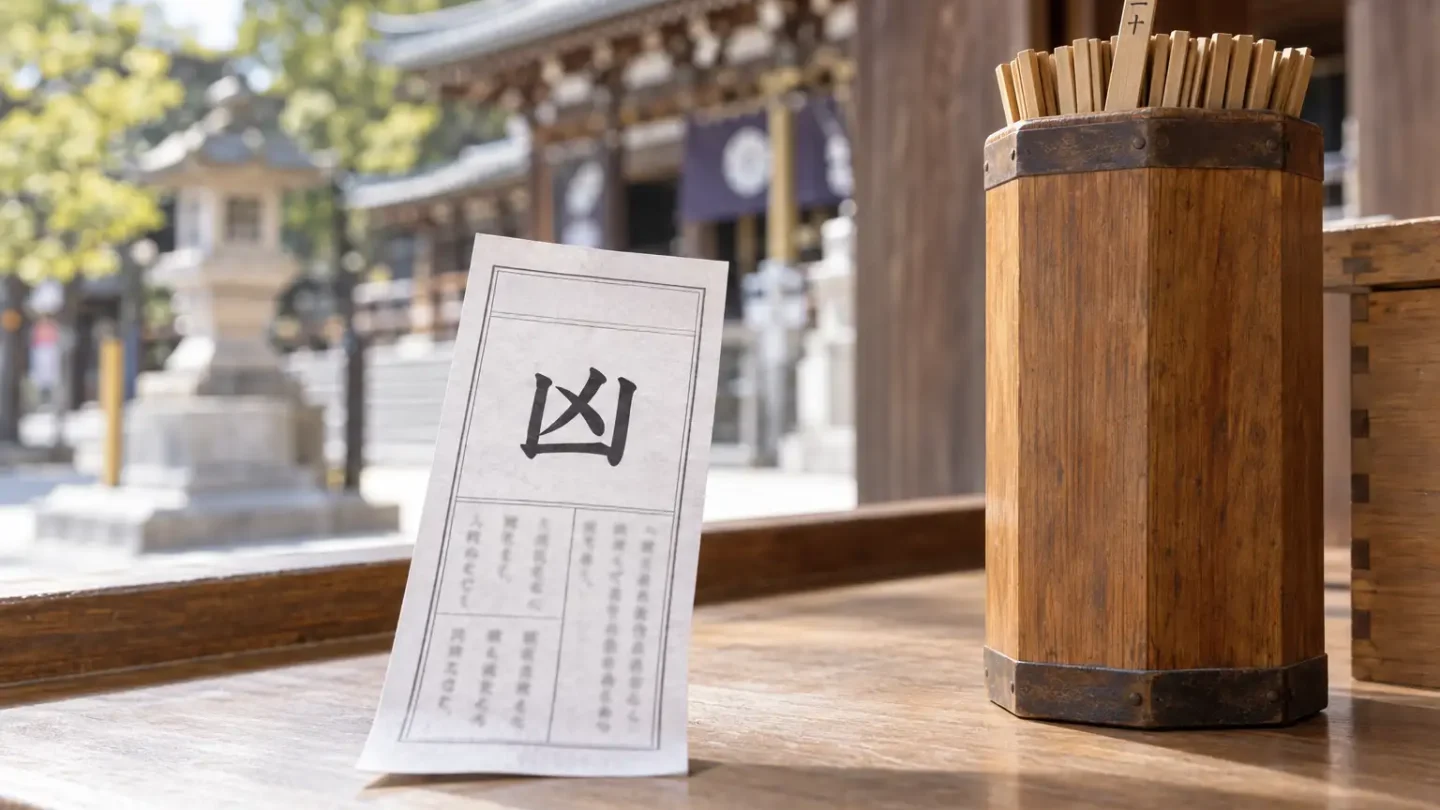
The paper in your hand is 御神籤, omikuji, literally a “sacred lot.” At a Buddhist temple such as Sensō-ji, it is better understood as written religious guidance than as a guaranteed forecast. 凶, kyō, “misfortune” or “bad result,” is the ranking printed prominently at the top, but the smaller sections discuss specific matters such as travel, illness, lost property and waiting for someone. Read those lines before deciding what the paper means. Then follow the instructions of the place where you drew it.
Before temples softened the odds
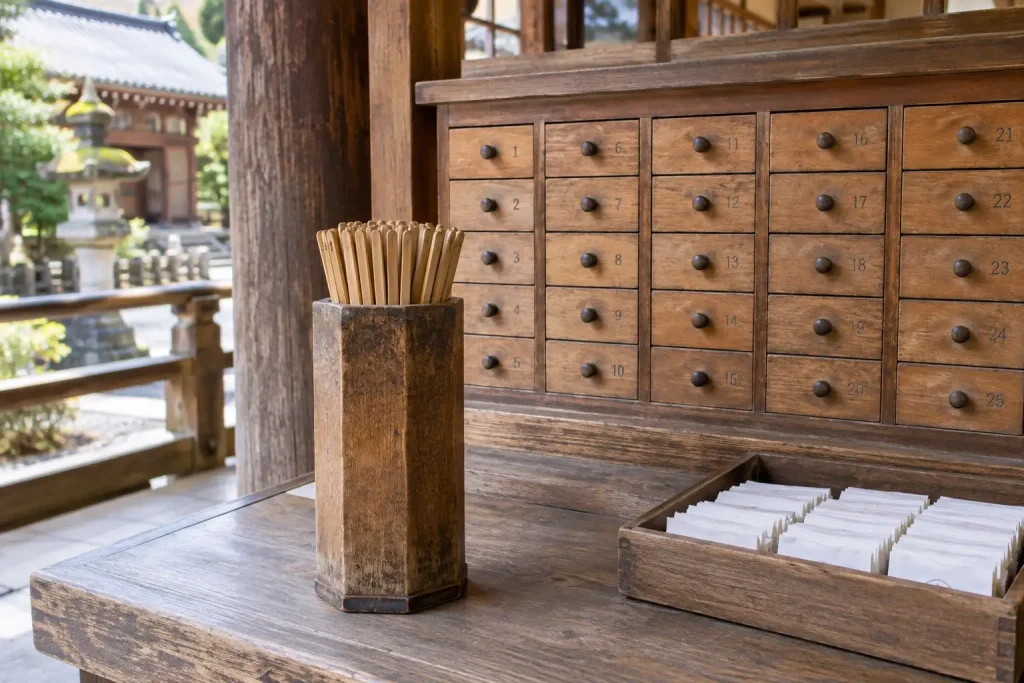
The older model was not designed to make every visitor feel rewarded. Sensō-ji attributes the spread of omikuji in Japan to the Tendai monk 良源, Ryōgen, who is also known as 元三大師, Ganzan Daishi. Later collections associated with him organized 100 numbered poems or texts, each paired with a category and practical interpretation. A person did not choose a paper from a decorative basket. They drew a numbered stick and received the corresponding written result.
Hattasan Soneiji, a Buddhist temple in Shizuoka Prefecture that says it still follows the historical Ganzan Daishi set, publishes the clearest primary-source breakdown. Its collection has 100 results: 17 are 大吉, daikichi, “great blessing,” while 30 are 凶. The temple says this distribution and much of the severe wording have been preserved for centuries. That produces a very different experience from a modern box designed primarily around positive categories.
| Category in the traditional set | Japanese | Number of results | Share of the 100-result set |
|---|---|---|---|
| Great blessing | 大吉 | 17 | 17% |
| Blessing | 吉 | 35 | 35% |
| Half blessing | 半吉 | 5 | 5% |
| Small blessing | 小吉 | 4 | 4% |
| Future small blessing | 末小吉 | 3 | 3% |
| Future blessing | 末吉 | 6 | 6% |
| Misfortune | 凶 | 30 | 30% |
These figures describe the composition of a traditional set, not the mathematical odds at every temple or shrine. They also do not prove that exactly 30% of visitors at Sensō-ji receive 凶 over a particular year. Boxes are shaken, sticks are returned, and visitor behavior is not a controlled random trial. The defensible statement is narrower: Sensō-ji officially says it keeps the old Kannon set, and another temple that publicly documents the traditional Ganzan Daishi composition gives 30 negative texts out of 100. Treat “almost one in three” as a description of the text set, not audited visitor statistics.
This is also where the distinction between a 神社, jinja, “Shinto shrine,” and a 寺, tera or otera, “Buddhist temple,” matters. Sensō-ji is a temple, despite the nearby presence of Asakusa Shrine. Jinja vs Otera: The Five-Second Test shows how to identify which institution you are visiting. For the larger religious setting, How Shinto and Buddhism Actually Show Up explains why practices can appear side by side without becoming one uniform system.
The change did not arrive as one national reform
There was no dated nationwide rule ordering shrines to remove a particular number of negative fortunes. 神社本庁, Jinja Honchō, the Association of Shinto Shrines, says explicitly that the kinds and order of omikuji results vary by shrine. It gives one possible sequence—大吉, 吉, 中吉, 小吉, 末吉, 凶—but does not impose that list as a mandatory national standard. Some institutions offer additional categories, omit certain negative rankings or use original themed papers. Others retain older severe collections.
General guides often turn this variation into a neat story: “shrines reduced the amount of 凶 so visitors would be happier.” The visible result may support that impression at individual sites, but the broad claim that most shrines deliberately reduced the share cannot be verified from a national primary source. No central database publishes the contents or probabilities of every shrine’s box. No official decree provides a date when the alleged reduction happened. The honest timeline is therefore a change from standardized inherited collections to institution-specific modern versions, not a single documented reform.
| Period or current position | What can be verified | What cannot be claimed safely |
|---|---|---|
| Ryōgen tradition | Sensō-ji identifies Ryōgen as the monk who spread omikuji practice | That every surviving set was personally written by him |
| Edo-period transmission | Hattasan says its severe Ganzan Daishi wording has been preserved from the Edo period | One exact publication date for every version |
| Modern shrine practice | Jinja Honchō says categories and ordering vary by shrine | A universal modern ranking |
| Sensō-ji today | Its official FAQ says the old Kannon set remains in use and contains many 凶 results | A currently audited visitor draw rate |
| Other institutions today | They may create different rankings and themed papers | That all or most shrines removed the same percentage of 凶 |
The distinction matters because a result only has meaning within the system that issued it. A 吉 at one place is not necessarily positioned identically to 吉 at another, and some places disagree about whether 吉 sits above or below 中吉. Do not carry a ranking chart from the internet and use it to overrule the wording printed by the institution. If the site provides an English explanation, read it. If it does not, photograph the paper for translation without blocking the drawing station.
Omikuji bad fortune at Sensō-ji: what you do next
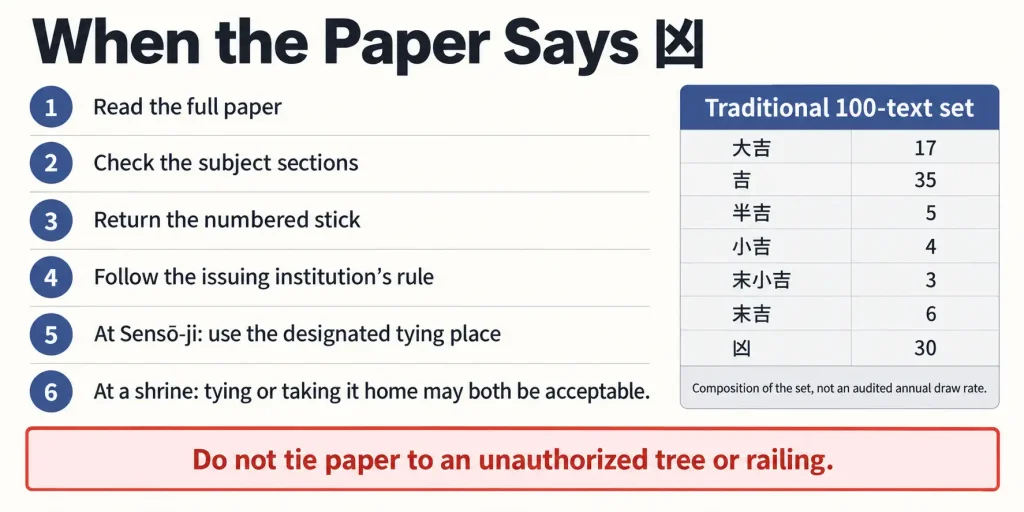
At Sensō-ji, return the numbered stick to the cylinder after finding the matching paper. The temple specifically asks visitors not to walk away with the stick. If the paper says 凶, its official guidance tells you not to be frightened and says that patient, sincere conduct can turn the situation toward 吉. It then instructs you to tie the paper at the designated place in the grounds while asking for Kannon’s protection. That is the local protocol, and it is more reliable than a universal rule copied from another shrine.
Follow the encounter in this order:
- Read the large result, but do not stop there.
- Read the poem or main message and the subject-by-subject entries.
- Return the numbered stick to the container.
- If you drew 凶 at Sensō-ji, take the paper to the designated tying place.
- Tie it carefully without using a tree, railing or unrelated structure.
- Leave after completing your visit rather than buying repeated papers until a better result appears.
The action is simple, but it does not mechanically “erase” the text. Tying the paper is a religious custom and a way of entrusting the troubling result to the sacred place. Sensō-ji describes it as ご縁つなぎ, goen-tsunagi, “forming or connecting a bond.” The temple does not promise that a knot changes objective future events. Its published explanation puts the emphasis on conduct: patience, sincerity and the possibility of turning toward a better outcome.
If you are visiting a Shinto shrine rather than Sensō-ji, check that shrine’s signs. Jinja Honchō says you may tie an omikuji at the designated place, but it also says taking the paper home is acceptable. It emphasizes rereading the message and using it as guidance for your behavior. Before drawing anything, complete the institution’s ordinary worship sequence; Two Bows, Two Claps, One Bow: The Sequence covers the shrine procedure rather than the Buddhist temple procedure. Do not perform shrine claps at Sensō-ji simply because you saw them elsewhere.
The headline is not the whole paper
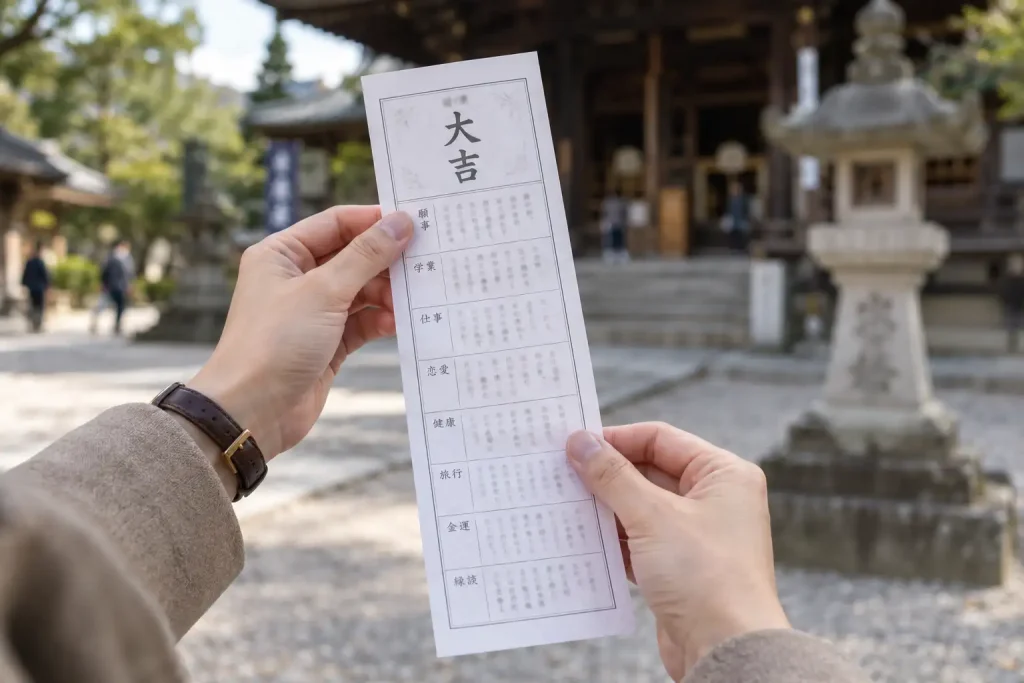
The large 吉 or 凶 character gets photographed because it is easy to recognize. The more useful content is printed below it. Traditional papers divide advice into headings that may cover a wish, an awaited person, lost property, travel, business, study, illness, marriage or disputes. Vocabulary and selection vary by institution, so a paper is not guaranteed to contain every category. The smaller text may be cautious even beneath a favorable headline or contain a workable instruction beneath 凶.
Common headings include the following:
- 願望, ganbō, “wish”: whether a hope is likely to progress and under what conditions.
- 待人, machibito, “the awaited person”: not automatically a romantic partner, but someone or something expected.
- 失物, usemono, “lost item”: whether recovery is likely and where difficulty may arise.
- 旅行, ryokō, “travel”: advice about proceeding, delaying or exercising care.
- 商売, shōbai, “business”: warnings or encouragement concerning trade and transactions.
- 病気, byōki, “illness”: traditional wording that should never replace medical care.
- 縁談, endan, “marriage proposal”: advice about a possible match or negotiations.
The uncomfortable part is that older texts can be blunt. Hattasan notes examples equivalent to “no joyful event,” “the awaited person will not come” and severe warnings about life and death. Those lines came from periods when injury and ordinary illness were more dangerous than they are now. Read them as historical religious language, not clinical advice or a reason to cancel necessary treatment. A paper fortune is not a diagnosis, legal opinion, safety notice or financial forecast.
The same restraint applies to etiquette. Japanese Etiquette for Visitors: What Actually Matters separates practical courtesy from invented lists of taboos. At an omikuji station, what matters is modest: do not take the numbered stick, do not tie paper where the institution has forbidden it and do not obstruct other visitors while translating every line. You are handling a religious item in an active place of worship, not a souvenir dispenser built only for photographs.
Drawing again does not rewrite the first result
Many visitors immediately ask whether they can pay again and keep drawing until they receive 大吉. There is no nationwide law against drawing another omikuji, but repeated attempts defeat the stated purpose described by religious institutions: reading the advice and reflecting on your conduct. A better paper does not retroactively remove the first text. It only gives you another paper from the same or a different set. If the result upset you, read it carefully, follow the local rule and move on.
This is one way the traditional and contemporary versions remain alike. Categories have multiplied and presentation has changed, but an omikuji is still meant to be read rather than treated as a score. Jinja Honchō says the most important point is to use its contents as guidance for future life. Sensō-ji likewise tells recipients of 凶 to proceed patiently and sincerely. Neither official source recommends shopping for a more flattering answer.
A visit around New Year may place omikuji inside a much busier seasonal setting. Japanese Festivals by Season: A Year-Round Guide explains the annual calendar without repeating the drawing procedure here. Opening hours, queues and distribution arrangements may change during major observances. Check the institution’s official website shortly before visiting rather than relying on a travel post from a previous year. A custom can remain stable while the logistics around it change.
What tying does—and does not do
The physical knot is often described online as “leaving bad luck behind.” That is a convenient explanation, but it is not a universal rule for every paper and every institution. At Sensō-ji, the official instruction specifically directs a person who receives 凶 to use the designated tying place. Jinja Honchō gives broader guidance: tying the paper is customary, but taking it home is also acceptable. The apparent contradiction disappears once you follow the rule of the place that issued your paper.
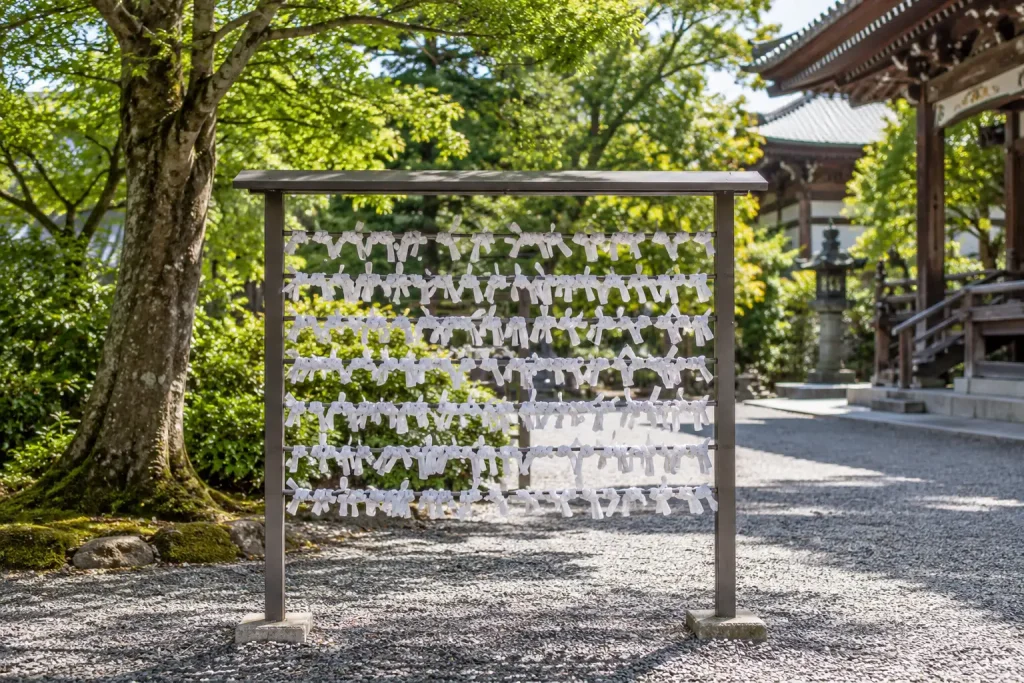
Never attach an omikuji to a living tree unless the institution clearly provides that tree or area for the purpose. Unmanaged paper and tight knots can damage branches and create maintenance work. Modern grounds commonly provide wires, frames or purpose-built racks. If there is no obvious location, ask staff or keep the paper. “Everybody else tied theirs here” is not a substitute for an authorized place.
Keeping the paper does not mean you have chosen to preserve bad events. Jinja Honchō describes taking it home as acceptable because you can reread the advice and compare it with your conduct. Store it respectfully rather than crushing it with trash or leaving it on the grounds. When you no longer want to keep it, ask the issuing institution how it accepts returned religious items. Disposal arrangements vary and should not be invented from a generic online rule.
What remains uncertain after the historical claim
The strongest evidence supports three points. Sensō-ji officially says it uses the old Kannon Hundred Lots and acknowledges that 凶 appears often. Hattasan officially documents a traditional 100-text Ganzan Daishi set containing 30 凶 and 17 大吉 results. Jinja Honchō officially says result categories and rankings vary by shrine. Together, those sources explain why a negative paper at Sensō-ji is less surprising than a general travel guide may suggest.
They do not prove that most Japanese shrines reduced 凶 from exactly 30% to a standard lower percentage. That sentence appears frequently in secondary travel writing, but the national shrine authority publishes no supporting census. Individual institutions control their own sets, and some may not disclose the distribution. The modern situation is variation, not a single before-and-after percentage. Any article claiming a national reduction needs named shrine records, dates and documented earlier sets.
Historical dates also need care. Japanese sources may print them in era years rather than Gregorian years. When an official notice or archival page uses a date such as 令和 or 平成, the site’s era converter covering every year from 1868 through 2050 and all five eras can verify the conversion. That tool is useful for publication dates and notices, not for interpreting the religious content of the paper. Keep those two tasks separate.
What may still change after publication
The old text collection may remain stable while visitor procedures change. A temple can relocate its tying racks, revise multilingual instructions, change the method of payment or temporarily restrict access during construction and crowded observances. It can also update opening hours. None of those operational changes requires altering the traditional 100 texts. This article should therefore distinguish enduring content from visit-day logistics.
| Check before your visit | Why it can change | Best source |
|---|---|---|
| Temple or shrine opening hours | Seasonal and event schedules | Official institution website |
| Location of the omikuji station | Construction or crowd control | On-site signs |
| Current offering amount | Administrative decision | Official sign or website |
| Where papers may be tied | Grounds management | Designated rack and staff guidance |
| Languages available | Reprints and distribution changes | Current papers at the station |
| Fortune categories and ratios | Institution controls its own set | Institution’s own explanation |
No current offering amount is stated here because a primary source accessible during research did not provide a dated price for Sensō-ji’s omikuji. Secondary guides commonly quote a figure, but the house rule requires current primary confirmation. Bring small-denomination yen and read the posted instruction when you arrive. If the system has become cashless or the amount has changed, the sign at the station controls. Do not rely on an undated photograph.
FAQ
Is 凶 the worst possible omikuji result?
Not necessarily. Some sets include 大凶, daikyō, “great misfortune,” while other sets stop at 凶 or use additional mixed categories. Jinja Honchō says the kinds and order of results vary by shrine. You should therefore read the ranking and explanation used at the institution where you drew the paper. A universal chart cannot settle every local system.
Does Sensō-ji really have a 30% chance of 凶?
Sensō-ji officially confirms that it preserves the old Kannon Hundred Lots and is known for having many 凶 results, but its FAQ does not publish an audited draw probability. Hattasan’s official description of the related traditional Ganzan Daishi set lists 30 凶 texts in a collection of 100. That supports the composition claim commonly associated with Sensō-ji. It does not prove that exactly 30% of visitors receive 凶 during any measured period.
Should you tie a bad omikuji at Sensō-ji?
Yes, Sensō-ji’s current official FAQ tells recipients of 凶 to tie the paper at the designated place while asking for Kannon’s protection. It also tells you to return the numbered stick to its cylinder. Use the official rack rather than a tree or railing. If on-site instructions change, follow the current signs.
Can you take a bad fortune home from a shrine?
Jinja Honchō says both tying an omikuji at the shrine and taking it home are acceptable. Keeping it allows you to reread the advice. A particular shrine may provide more specific instructions, so check its signs. Sensō-ji has its own stated protocol for 凶 and should not be used as the rule for every shrine.
Can you draw another omikuji immediately?
There is no national legal restriction stated by the cited religious authorities, but repeatedly drawing until you receive a favorable headline misses the intended use. Read the first paper and consider its advice. A second purchase does not cancel the earlier result. Follow any local limits or instructions.
Does tying the paper remove bad luck?
Neither Sensō-ji nor Jinja Honchō describes the knot as a guaranteed mechanism that changes future events. Sensō-ji connects the act with seeking protection and forming a religious bond. Jinja Honchō emphasizes using the written message as guidance. The practical change comes from what you do after reading it, not from treating the knot as a mechanical reset.
Are omikuji the same at temples and shrines?
No. Both Buddhist temples and Shinto shrines distribute them, but their collections, language, categories and instructions can differ. Sensō-ji uses the Kannon Hundred Lots within a Buddhist setting. A shrine may use another set with another ranking. Always read the local explanation.