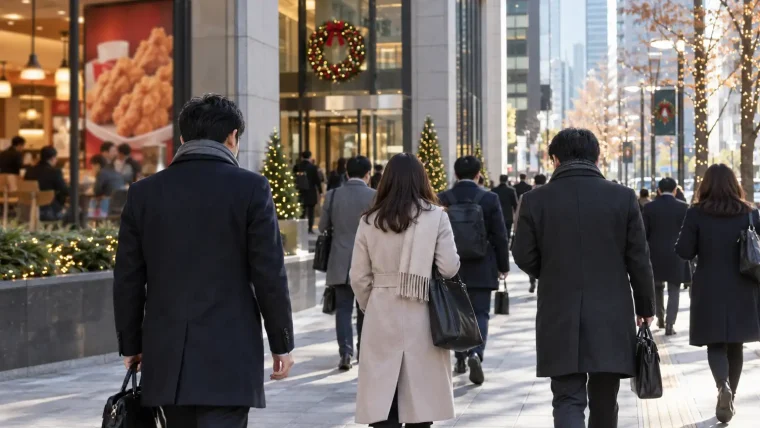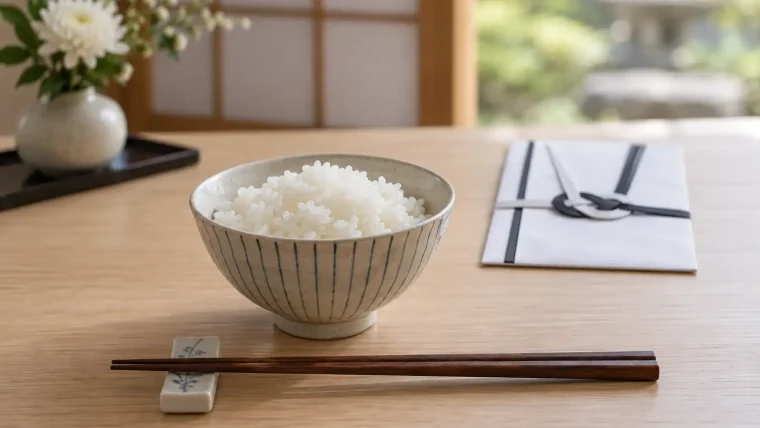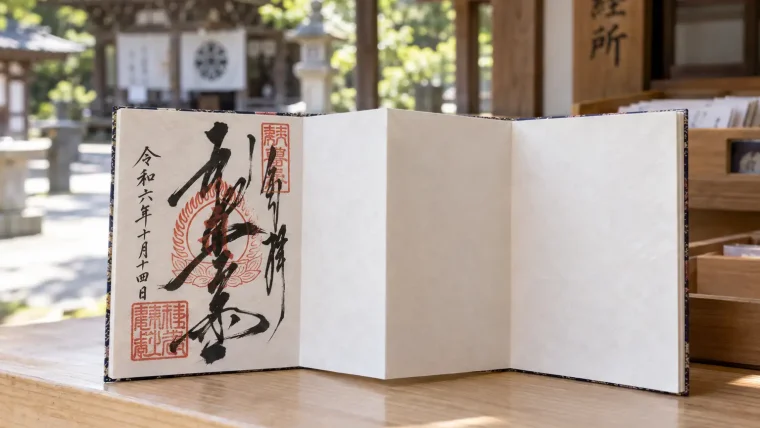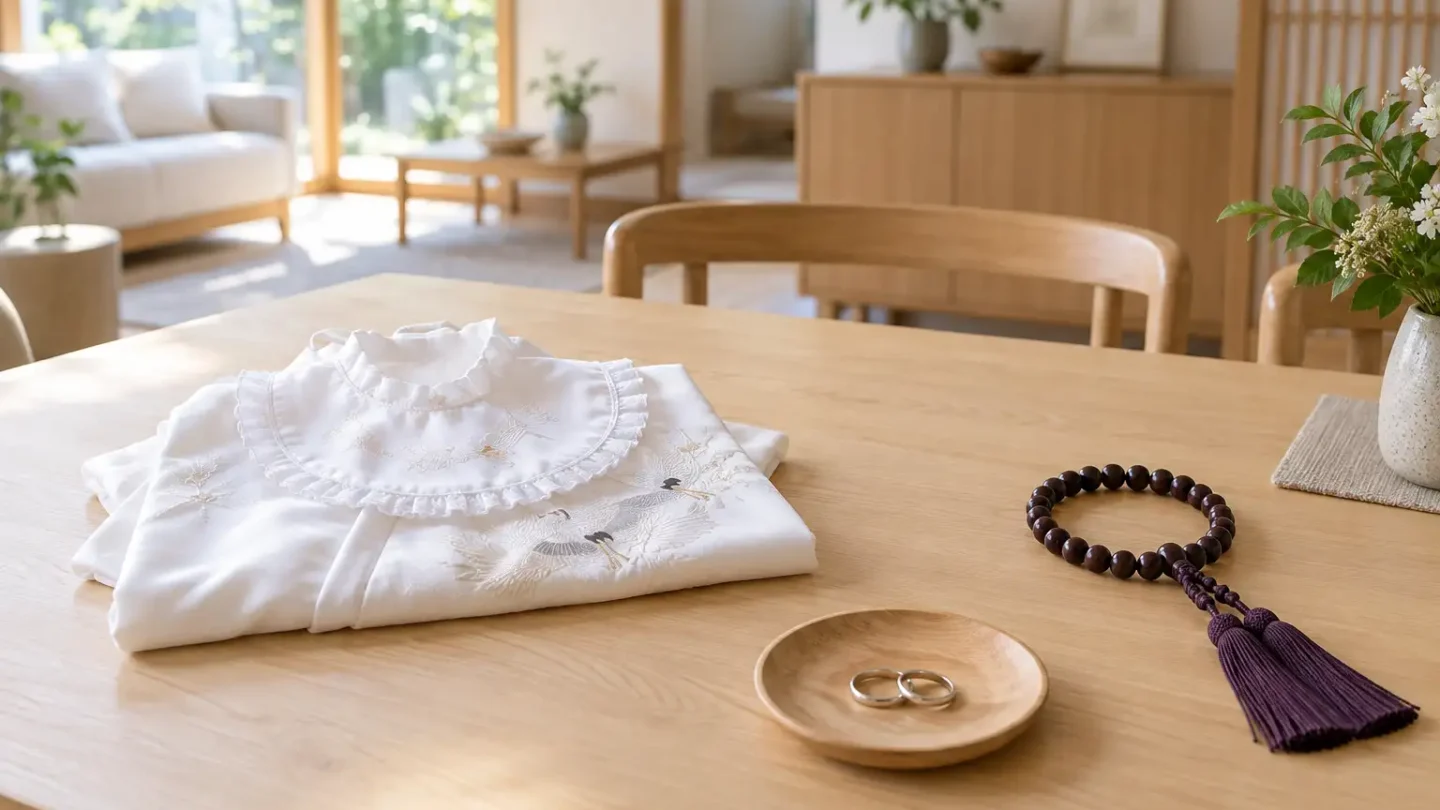
A Japanese family’s religious calendar repeatedly moves between shrines and temples: the baby is presented at a Shinto shrine, ancestors return during the Buddhist Obon period, children visit a shrine again in November, and the year closes with temple bells before the family makes its first shrine visit. Shinto and Buddhism in Japan operate less like rival memberships than institutions assigned different jobs.
A Christian-style chapel may handle the wedding in the middle, often without the couple making any statement of Christian belief. The arrangement looks contradictory only if you assume that participating in a ceremony must declare exclusive religious identity.
For the broader framework behind these ordinary practices, How Shinto and Buddhism Actually Show Up explains where religion appears in daily life. This article follows one family through the year and through the life cycle.
January and February: why does the year begin at a Shinto shrine?
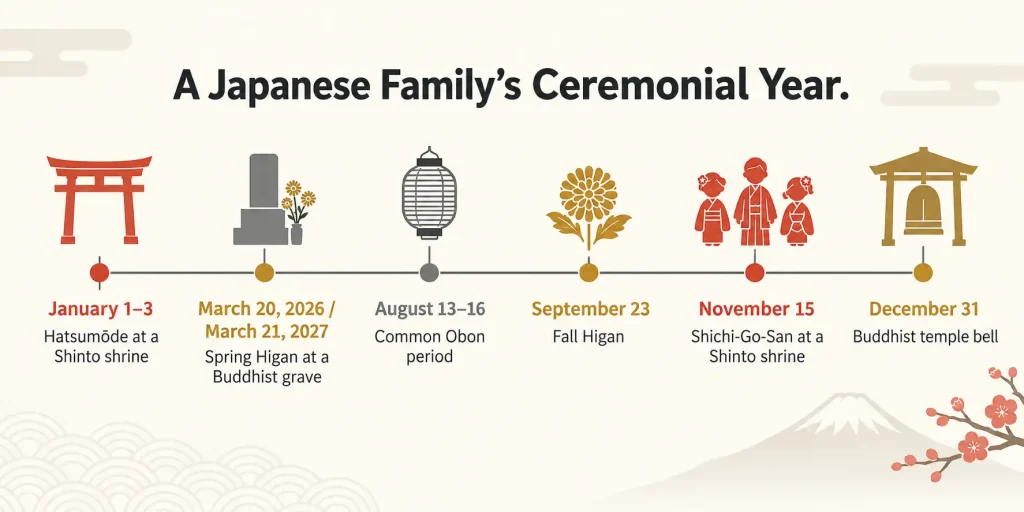
The annual cycle opens with 初詣, hatsumōde, literally “first visit,” usually made to a shrine or temple during the first days of January. Families pray for health, work, school success and safety, return old protective objects and obtain new ones.
Although Buddhist temples also receive New Year visitors, the most recognizable version is a Shinto shrine crowded with families standing before the worship hall. If you visit, you will see purification water, offering boxes, fortunes and counters distributing charms.
The standard shrine sequence is simple: offer a coin, bow twice, clap twice, make your prayer and bow once more. Two Bows, Two Claps, One Bow: The Sequence explains the procedure without turning it into a test visitors can fail.
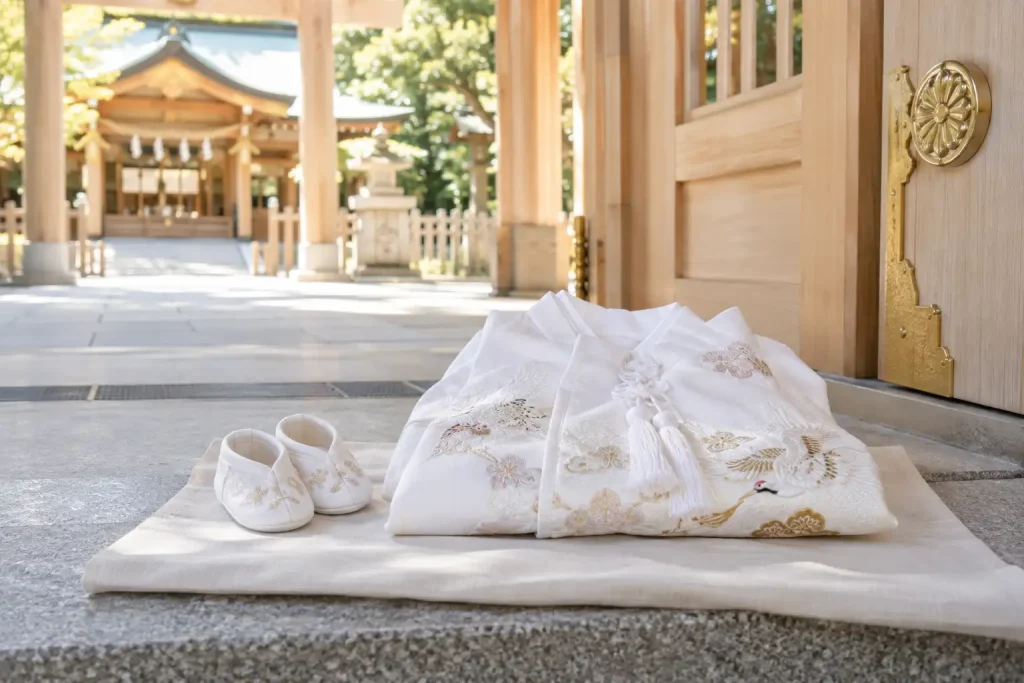
A baby’s first formal shrine appearance follows the same life-affirming side of the division. 初宮詣, hatsumiyamairi, “first shrine visit,” introduces the child to the local protective kami and asks for healthy growth. The exact timing varies between families, shrines and regions, so it should not be reduced to a universally enforced deadline.
Shinto is called first when the family is welcoming, beginning, blessing or protecting.
March and April: why do families visit graves around the equinox?
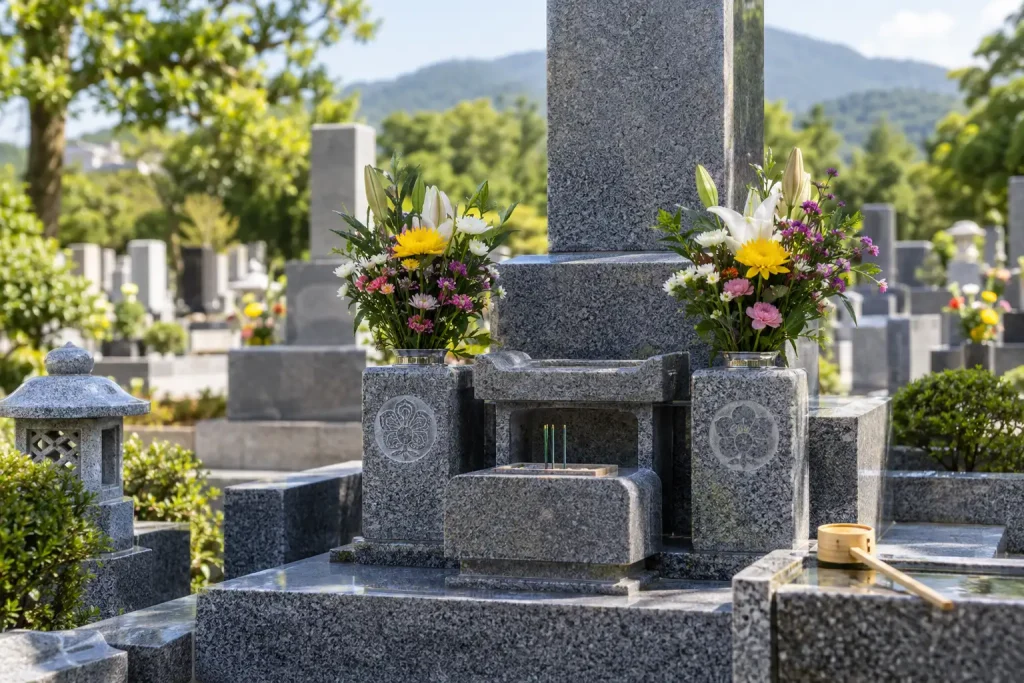
春彼岸, haru higan, “spring equinox shore,” is a Buddhist period centered on the spring equinox. Families may clean graves, leave flowers and incense, and remember relatives who have died.
彼岸, higan, literally means “the other shore,” referring to the Buddhist shore beyond attachment and suffering. In everyday family life, however, the visible activity is practical: a cemetery visit, grave cleaning and an offering.
Spring Higan lasts for a week centered on the equinox. The equinox date changes because it is determined astronomically rather than assigned a permanent calendar date.
The spring equinox falls on March 20 in 2026 and March 21 in 2027. That shift matters if you hope to observe a temple event, but it rarely creates the kind of nationwide travel pressure associated with New Year or Obon.
May and June: does a chapel wedding mean the couple is Christian?
Usually, no. A Christian-style wedding in Japan may be selected because the couple wants a white dress, an aisle, rings, music and a ceremony designed around the pair rather than their extended households.
Some ceremonies take place in actual churches, and some couples are Christian. Many others use purpose-built hotel or wedding-venue chapels and do not treat the ceremony as conversion, baptism or church membership.
That makes “married Christian” a useful shorthand but an inaccurate religious diagnosis. The chapel supplies an aesthetic and ceremonial format; it does not automatically acquire responsibility for the family’s ancestors, funerals or household memorials.
A Shinto wedding remains available, particularly at major shrines and specialist venues. It uses 神前式, shinzen-shiki, “ceremony before the kami,” and visibly centers the two families as well as the couple.
| Life event | Institution commonly used | What the ceremony does | What it does not prove |
|---|---|---|---|
| First shrine visit | Shinto shrine | Welcomes and protects a baby | Exclusive Shinto identity |
| Childhood blessing | Shinto shrine | Marks healthy growth | Formal membership |
| Wedding | Chapel, shrine or secular venue | Publicly joins the couple | Conversion to the venue’s religion |
| Funeral | Buddhist temple and clergy | Conducts rites for the deceased | That every relative holds Buddhist doctrine |
| Memorial services | Buddhist temple or household altar | Maintains the bond with ancestors | Rejection of Shinto practices |
| New Year visit | Shrine or temple | Requests well-being for the year | Exclusive affiliation |
This division is why asking “Which religion is this family?” often produces an incomplete answer. The more revealing question is “Which institution handles this event?”
July and August: why does Buddhism take over during Obon?
お盆, Obon, is the annual period when deceased ancestors are understood to return to the household. In much of Japan it is observed around August 13–16, although some regions use July or follow different local schedules.
Families return to hometowns, visit graves, prepare household offerings and take part in 盆踊り, bon odori, “Bon dancing.” Lanterns and farewell fires guide ancestral spirits home and then send them away.
This is where Buddhist ancestor worship in Japan becomes visible outside a funeral. Death is not treated as a single ceremony completed at the crematorium; it creates an ongoing schedule of remembrance.
For a visitor, community dances can be welcoming and public, while household and cemetery observances are private. Do not photograph mourners closely or treat grave offerings as festival props. The broader hierarchy of rules that visitors actually need is covered in Japanese Etiquette for Visitors: What Actually Matters.
Obon is worth seeing, but it is difficult travel timing. Domestic transport and accommodations become heavily contested as people return to family homes.
September to November: why do shrines and graves both become busy?
The fall calendar repeats the spring pattern. 秋彼岸, aki higan, “autumn equinox shore,” brings another Buddhist period of grave visits and remembrance.
The autumn equinox falls on September 23 in both 2026 and 2027. The surrounding Higan period is calculated around that central date.
Then the emphasis returns to children. 七五三, Shichi-Go-San, literally “seven-five-three,” is associated with November 15 and brings formally dressed children to Shinto shrines for prayers for healthy growth.
What you notice is less a mass ceremony than a steady procession of individual families. Children wear kimono or formal Western clothing, photographers work near the grounds, and families receive long 千歳飴, chitose ame, “thousand-year candy,” symbolizing longevity.
This is a good reminder that Shinto’s role is not abstract “nature worship.” In ordinary family practice, shrines are strongly connected with beginnings, protection, development and fortunate transitions.
December: why does the year end at a temple and restart at a shrine?
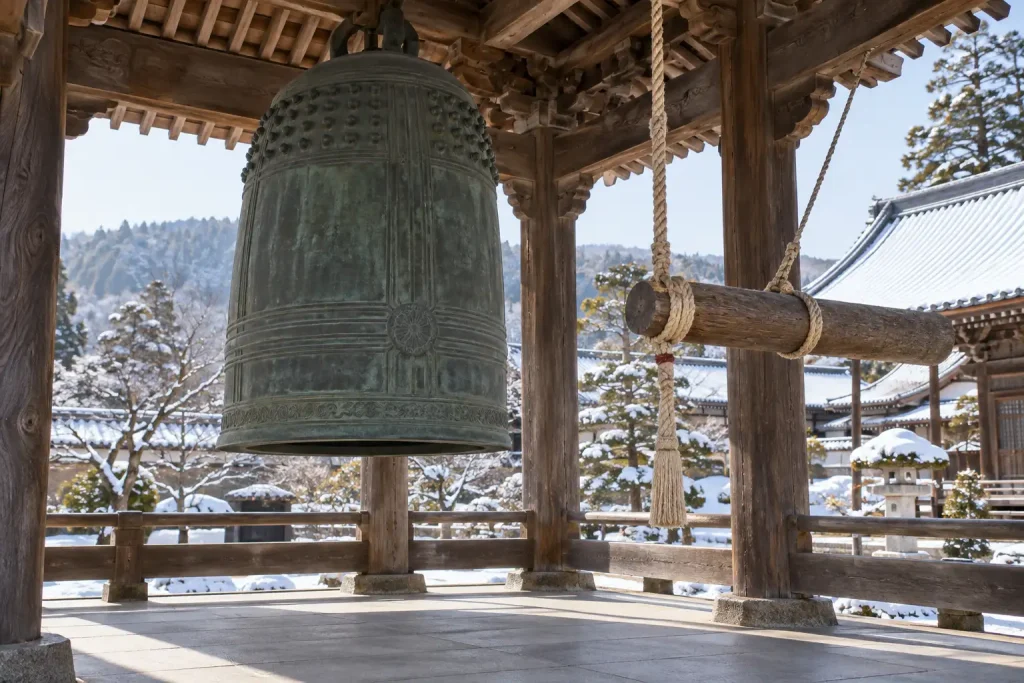
Late on December 31, Buddhist temples perform 除夜の鐘, joya no kane, “New Year’s Eve bell.” Temple bells are traditionally struck 108 times in connection with the Buddhist idea of human attachments or defilements.
Within hours, many of the same people make hatsumōde at a Shinto shrine. Nobody needs to resolve the apparent contradiction before boarding the train.
The two events do different work. The temple closes the old year by confronting human attachment; the shrine opens the new one by requesting protection and good fortune.
This midnight handoff is the annual version of the full life cycle:
- Shinto welcomes and protects new life.
- A shrine or commercial chapel may formalize marriage.
- Buddhism handles death and continuing memorial obligations.
- Shinto begins the family’s next year again.
The family is not changing religions overnight. It is changing ceremonial departments.
What happened in 1868, and why does it still matter?
Before the modern period, shrines and temples were often institutionally and physically entangled through 神仏習合, shinbutsu shūgō, “combination of kami and buddhas.” Buddhist figures could be understood as manifestations or deeper identities of local kami, and shrine-temple complexes served the same communities.
In March 1868, the new Meiji government issued orders collectively known as 神仏分離, shinbutsu bunri, “separation of kami and buddhas.” Religious titles, images, clergy and institutions that had overlapped were ordered apart.
“Shinto and Buddhism, kami and buddhas, shrines and temples were to be clearly distinguished.” — historical summary of the 1868 separation policy
The policy was not originally worded as a general command to destroy Buddhism. In practice, it helped trigger 廃仏毀釈, haibutsu kishaku, “abolish Buddhism and destroy Shakyamuni,” during which Buddhist buildings, images and objects were removed or destroyed in many places.
The important correction is that 1868 did not invent every modern family role from nothing. Buddhist funerals already had deep roots, while Christian-style commercial weddings became prominent much later. What 1868 did was harden an institutional boundary between shrine and temple that had previously been much less clean.
The result is the apparent paradox: official institutions are separate, but families continue to use both. Born Shinto, buried Buddhist describes a division of ceremonial labor, not a doctrinal law.
If you encounter dates from this period written in Japanese era notation, the era converter — every year from 1868–2050 and all five eras is the appropriate tool rather than another conversion table.
Which religious dates move in 2026 and 2027?
Some family ceremonies have no annual date. Birth rites follow the child, weddings follow venue availability, and funerals occur when required. The annual memorial calendar is different.
| Observance | 2026 | 2027 | How the date is set |
|---|---|---|---|
| Hatsumōde | Mainly January 1–3 | Mainly January 1–3 | First visit of the new year; no compulsory single day |
| Spring Higan | Centered on March 20 | Centered on March 21 | Week around the astronomical spring equinox |
| Obon in many regions | Commonly August 13–16 | Commonly August 13–16 | Regional convention; July observance exists |
| Fall Higan | Centered on September 23 | Centered on September 23 | Week around the astronomical fall equinox |
| Shichi-Go-San | November 15 | November 15 | Traditional fixed date; families often choose a nearby convenient day |
| Joya no kane | December 31 | December 31 | New Year’s Eve temple observance |
The spring and fall equinoxes are the genuinely movable entries here. Japan’s National Astronomical Observatory calculates them, and the official holiday dates are announced through the national calendar process.
Obon is variable in a different way. It does not move through astronomical calculation; regions follow different conventions. Confirm the local temple or destination schedule rather than assuming that every Obon event occurs on the same August evening.
When does nothing happen?
Most of the year. Families are not constantly moving between ceremonies, and an ordinary Tuesday provides little visible evidence of the religious life cycle.
May and June are not a nationwide “wedding season” with fixed public rites a traveler can reliably watch. A hotel chapel event is private, while shrine weddings depend on bookings and individual venues.
Outside Higan, Obon, New Year and November shrine visits, temple and shrine grounds may be quiet. That is normal rather than a missing part of the story.
The quiet also matters inside the home. A family may maintain a 仏壇, butsudan, “Buddhist altar,” remember ancestors privately and still visit a shrine when a child faces an entrance exam. There may be no public event to observe.
Which periods are worth planning a trip around?
Early January shows the Shinto opening of the year most clearly, but expect crowds and business closures. November offers the easiest glimpse of family shrine practice through Shichi-Go-San, especially at major local shrines.
Obon gives the clearest view of Buddhist ancestor remembrance and community dance, but it is the period to avoid if your priority is easy intercity travel. Transport competition can outweigh the cultural benefit.
The equinox weeks are quieter and better suited to observing temple and cemetery routines without a nationwide travel surge. For the larger annual calendar beyond family rites, Japanese Festivals by Season: A Year-Round Guide covers the events worth building an itinerary around.
Before planning a shrine visit, learn to identify the institution itself. Jinja vs Otera: The Five-Second Test explains the visual difference between a shrine and a temple.
FAQ
Are Japanese people Shinto or Buddhist?
Many people participate in both sets of practices without choosing an exclusive label. Survey answers, institutional registration and actual ceremonial behavior can therefore describe different things.
Calling everyone “both” is still too simple. Some families are committed to a specific Buddhist school, some belong to Christian churches, some avoid religion, and others participate only when family custom requires it.
Are all Japanese funerals Buddhist?
No. Buddhist funerals are prominent, but Shinto, Christian, secular and other funeral formats exist.
Do not infer an individual’s belief from the ceremony alone. Funeral decisions may reflect family affiliation, an inherited grave, local relationships and practical arrangements.
Is a hotel chapel a real church?
Usually it is a wedding facility rather than an independent congregation with ordinary weekly church life. The ceremony can look Christian while functioning as a commercial wedding service.
Some venues use ordained clergy, while others use celebrants. If that distinction matters to the couple, it must be confirmed directly with the venue.
Can visitors watch Shinto weddings?
Sometimes you can see the procession or part of the ceremony in an open shrine area, but the wedding remains a private family event. Keep your distance and follow any photography restrictions.
Public childhood observances and annual festivals are easier to encounter respectfully. Do not position yourself between a family and the worship hall for a photograph.
Why are funerals associated with Buddhism?
Buddhist institutions developed durable systems for funeral rites, posthumous names, graves and memorial services. That made temples central to the continuing relationship between households and their dead.
The association is institutional as well as philosophical. It should not be reduced to the claim that Shinto simply “dislikes death.”