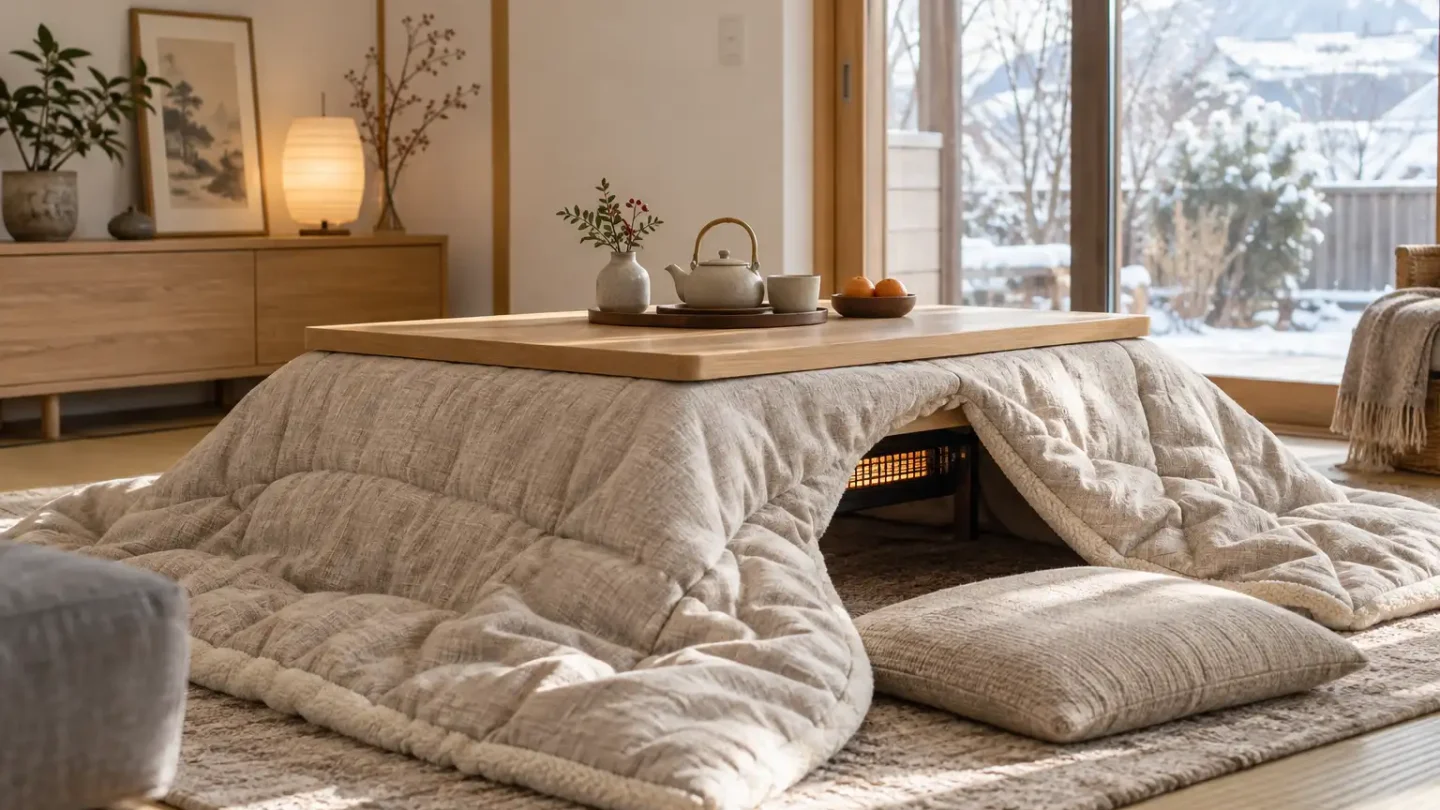
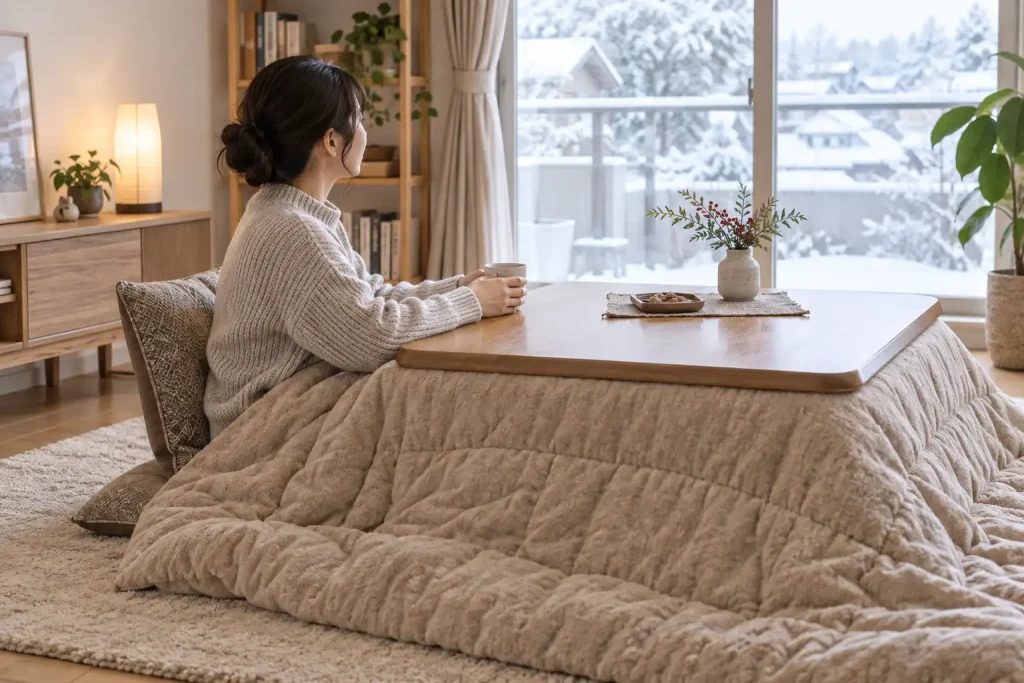
You slide your legs beneath the quilt, and heat closes around them almost immediately. The room may still feel cold around your shoulders, but nobody rushes to turn the whole space into a warm box. If you are asking what is a kotatsu, the physical answer is simple: a low table, a heater fixed beneath it and a thick covering that holds warm air around the people seated there. The more useful answer is that it is a form of local heating designed around the body rather than the entire room. Once you sit down, the host expects you to share that small heated zone for tea, food, television or conversation.
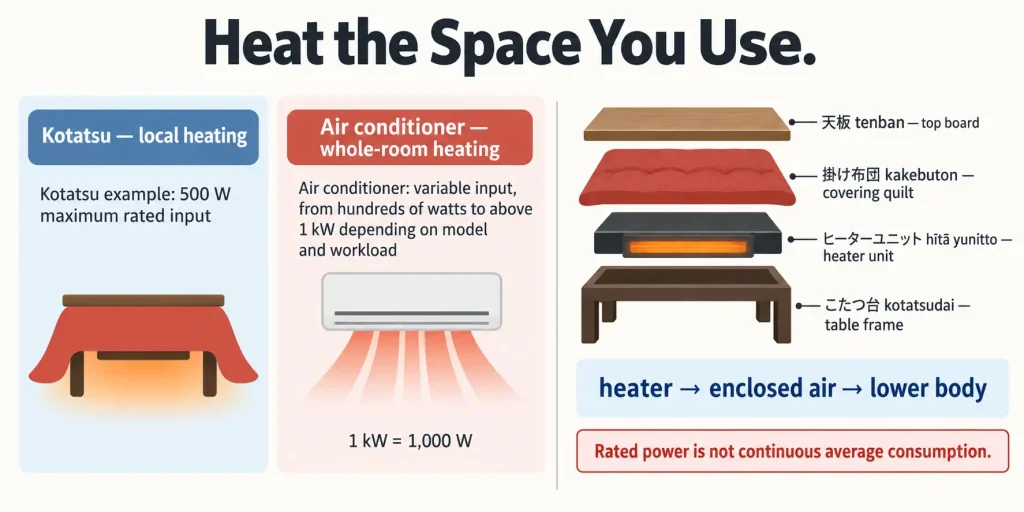
A current Koizumi kotatsu sold for a tabletop measuring approximately 41 by 30 inches has a rated heater consumption of 500 watts. That is hundreds of watts, but the popular claim that a home air conditioner always “draws kilowatts” needs correction. Modern heat-pump air conditioners vary their input: a small unit may operate at hundreds of watts after the room stabilizes, although its upper heating input can pass 1 kilowatt under demanding conditions. The fair comparison is therefore not “500 watts versus several kilowatts every minute.” It is a heater warming a compact space under a quilt versus a system maintaining the temperature of an entire room.
What is a kotatsu made from?
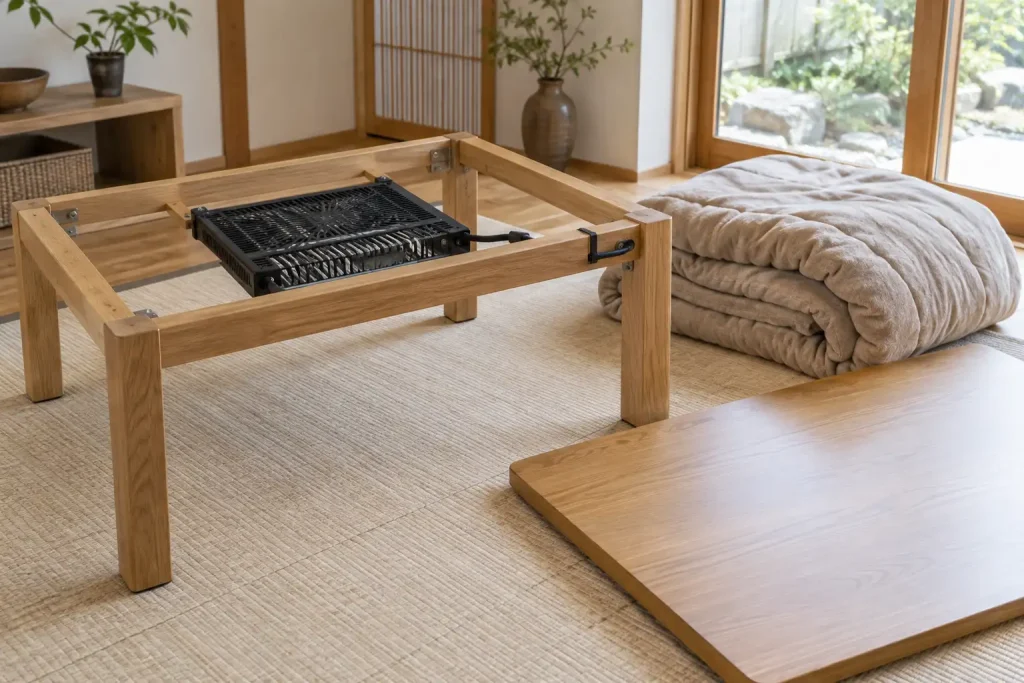
The modern 電気こたつ, denki kotatsu, literally “electric kotatsu,” has four working layers. At the bottom is the table frame, usually low enough for floor seating. An electric heating unit is mounted beneath the tabletop rather than standing separately on the floor. A 掛け布団, kakebuton, literally “covering quilt,” is spread over the frame, and a removable tabletop is placed above it so cups, dishes and laptops have a firm surface. The quilt slows the escape of warmed air, which is the main reason a modest heater can make your legs feel comfortable while the wider room remains cool.
The heater does not continuously consume its full rated power in every situation. Its thermostat cycles or modulates heat according to the selected setting and the temperature under the quilt. The 500-watt figure on a specification sheet is therefore useful for comparing equipment capacity, but it is not an automatic measure of hourly consumption throughout an evening. Quilt thickness, gaps around your body, room temperature and thermostat position all affect actual electricity use. This makes confident “cost per night” claims unreliable unless the calculation states the model, setting, electricity tariff and measured operating time.
| Component | Japanese term | Romaji | What it does |
|---|---|---|---|
| Low table frame | こたつ台 | kotatsudai | Holds the heater, quilt and top board |
| Electric heater | ヒーターユニット | hītā yunitto | Produces heat beneath the table |
| Covering quilt | 掛け布団 | kakebuton | Traps warm air around the seated users |
| Top board | 天板 | tenban | Creates a stable surface above the quilt |
| Controller | 温度調節つまみ | ondo chōsetsu tsumami | Adjusts the heater setting |
The table is only one part of how a small Japanese home is organized. Reading 1LDK, Jo and the Move-In Bill explains the apartment labels, room counts and charges that shape the space in which such furniture is used. A kotatsu can become the center of a compact living-dining room because the same surface supports meals, work and leisure. It does not require a dedicated fireplace or a large piece of American-style living-room furniture. Its efficiency comes partly from doing several jobs in one small footprint.
The first minute under the quilt
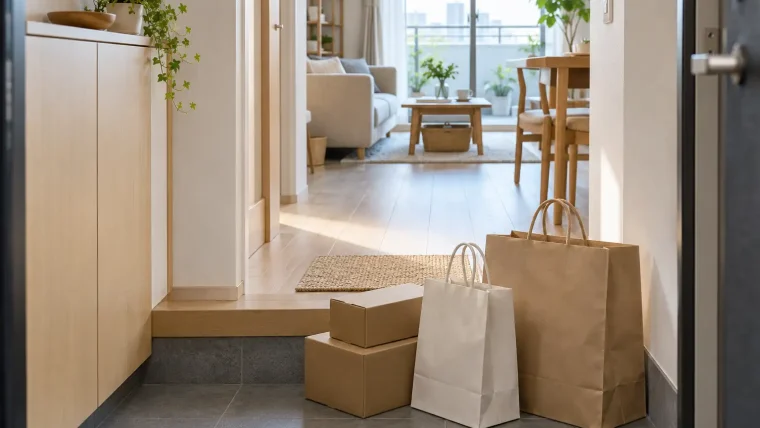
You normally encounter the kotatsu after entering the home and removing your shoes. The change in floor level at the 玄関, genkan, literally “entrance threshold,” marks the boundary between the outdoor footwear area and the clean interior; Why the Floor Steps Up Inside the Door explains that sequence in detail. Once you reach the living room, your host may gesture toward the table rather than formally explain the appliance. You sit on a floor cushion or low chair, lift the edge of the quilt and place your legs inside. You do not climb under it, lie across the table or place wet outerwear against the heater.
The exchange is usually brief:
どうぞ、こたつに入って。
Dōzo, kotatsu ni haitte.
Literal: “Please, enter the kotatsu.”
In practice: “Sit here and put your legs under the quilt.”
Your reply can be equally simple:
あったかいですね。
Attakai desu ne.
Literal: “It is warm, isn’t it?”
In practice: “This feels wonderfully warm.”
The verb 入る, hairu, “to enter,” may sound strange when the object is a table. You are not expected to crawl fully beneath it. In ordinary usage, こたつに入る means placing your lower body under the quilt and settling into the shared heated space. The phrase treats the warmth beneath the table as a small zone you enter. That is also why several people can be described as being “in” the same kotatsu.
What your host expects you to do
Your host is not asking you to admire a special cultural exhibit. They are offering the warm place in the room and expecting you to sit naturally without turning the arrangement into a performance. Move your legs carefully because another person may be sitting directly across from you. Keep your feet in your own portion of the space, especially when you cannot see where everyone else’s legs are. If food is on the tabletop, stabilize the quilt before shifting position so you do not disturb cups or dishes.
The local calculation is practical: once everyone is seated, the Japanese heated table concentrates warmth where it is felt most. The host may still use an air conditioner or another heater, particularly in a cold region or a poorly insulated building. A kotatsu is not evidence that Japanese households never heat rooms. It often supplements room heating, reduces the urge to raise the thermostat or provides comfort in the part of the home that is currently occupied. The exact combination depends on the building, climate, household and equipment.
| What happens | What you do | What the host means |
|---|---|---|
| The host points to the table | Sit at the offered side | This is the warm place prepared for you |
| The quilt edge is lifted | Place your legs beneath it | Share the enclosed heat without rearranging the table |
| Tea or food arrives | Keep the top stable | The kotatsu is also the serving surface |
| Someone changes position | Move your feet slightly | Make space inside the shared area |
| The host mentions the temperature | Answer plainly | They may be checking whether the setting is comfortable |
You do not need a long script for this encounter. If you want more situational language, the site’s phrasebook with 337 phrases for everyday situations provides broader vocabulary without turning a small domestic exchange into a memorization exercise. At the kotatsu itself, one observation and one request are normally sufficient. Complicated honorific language would sound less natural than a direct comment about comfort. The physical arrangement already explains most of what is expected.
Why heating the body made sense
A familiar explanation says that Japanese housing was “built for summer,” favoring airflow in a humid climate over winter heat retention. That idea describes important features of traditional timber houses, including movable partitions, ventilated spaces and rooms that were not sealed like contemporary insulated construction. However, it should not be turned into the claim that every Japanese home has no insulation. Building standards, materials and heating performance have changed, while older housing remains part of the current stock. The useful distinction is between historically common lightweight, draft-prone construction and newer homes designed to meet progressively stronger energy-efficiency requirements.
In a room that loses heat quickly, warming all the air can be costly and uncomfortable. The kotatsu heater changes the task: instead of maintaining the whole room at one temperature, it heats a few cubic feet beneath an insulating quilt. Your upper body may still need a sweater, cardigan or blanket. The floor beyond the table can remain distinctly cold. This is not whole-home comfort in the American central-heating sense; it is a deliberately uneven heat strategy.
The kotatsu’s basic logic can be summarized without exaggerating the appliance comparison:
- A current medium-size electric kotatsu can have a maximum rated input of 500 watts.
- The heater warms an enclosed pocket rather than the entire room.
- A room air conditioner moves heat efficiently but must compensate for losses through walls, windows, gaps and ventilation.
- Air-conditioner consumption varies with model, outdoor conditions, target temperature and workload.
- Using both appliances may improve comfort while allowing a lower room-temperature setting, but it does not guarantee a particular saving.
This is where the popular slogan “heat the person, not the room” is useful. It describes the heated volume, not a promise printed on every electricity bill. A heat pump may deliver more heat energy than the electrical energy it consumes, while a resistive kotatsu heater turns electricity directly into heat. The kotatsu’s advantage is spatial: it heats much less space. Its actual financial advantage depends on how the household would otherwise heat the room.
The moment your feet meet someone else’s
The social failure is small but immediate: you stretch out, touch another person’s legs and keep pushing because you assume the space under the quilt is empty. Since the blanket blocks your view, the other person cannot tell whether the contact was accidental until you react. Pull your feet back and apologize briefly. Do not lift the entire quilt to inspect where everyone is sitting, especially while food is on the table. A short sentence repairs the moment.
すみません、足が当たりました。
Sumimasen, ashi ga atarimashita.
Literal: “Excuse me, my foot made contact.”
In practice: “Sorry, I bumped your leg.”
Another problem begins when you become too warm but say nothing. The host may think the setting is comfortable because you have remained under the quilt. You can ask for the controller or request a lower setting without making the host feel that the arrangement itself is wrong. The ordinary phrase is direct and useful:
少し弱くしてもいいですか。
Sukoshi yowaku shite mo ii desu ka.
Literal: “May I make it a little weaker?”
In practice: “Could we turn the heat down a little?”
Do not drape additional clothing over the heater or push cushions deep inside to create more padding. Use the appliance according to its manual, keep the controller and power cord unobstructed, and switch it off when it is no longer supervised. The quilt is part of the designed system, but random fabric packed around the heating unit is not. A damaged cord, an incompatible replacement heater or accumulated dust near a hot component requires attention rather than improvisation. Comfort does not cancel electrical and fire safety.
Why this is not an American heated table
The closest American comparison is not an ordinary dining table with a space heater placed beneath it. That arrangement lacks the purpose-built mounting, clearance, controller and quilt system of a kotatsu. Nor is a kotatsu simply an electric blanket laid across furniture. The heater belongs to the frame, while the quilt creates a controlled pocket and the top board restores a usable surface. Reproducing only the appearance can introduce unstable furniture, blocked heaters and damaged fabric.
American homes are more commonly organized around whole-room or whole-house heating, with chairs and sofas lifting the body away from the floor. A kotatsu assumes low seating and a room layout in which people gather around one shared surface. Room size may also be discussed in 畳 or 帖, jō, “tatami-mat units,” rather than only square feet; How Many Mats Is the Room You Are Renting explains why that measurement is not perfectly uniform. The cultural difference is therefore not merely the presence of a heater. It includes posture, furniture height, shared space and acceptance that one warm zone can coexist with a cold room.
| Kotatsu encounter in Japan | Common US home-heating expectation |
|---|---|
| You sit close to the floor | You usually sit on a raised chair or sofa |
| Several people share one enclosed warm zone | Heat is distributed through a room or the whole home |
| The tabletop supports meals and daily activities | Dining, work and lounging often use separate furniture |
| Your lower body is much warmer than the surrounding room | A relatively even indoor temperature is expected |
| The quilt is a functional part of the heating system | Blankets normally warm an individual rather than enclose a table heater |
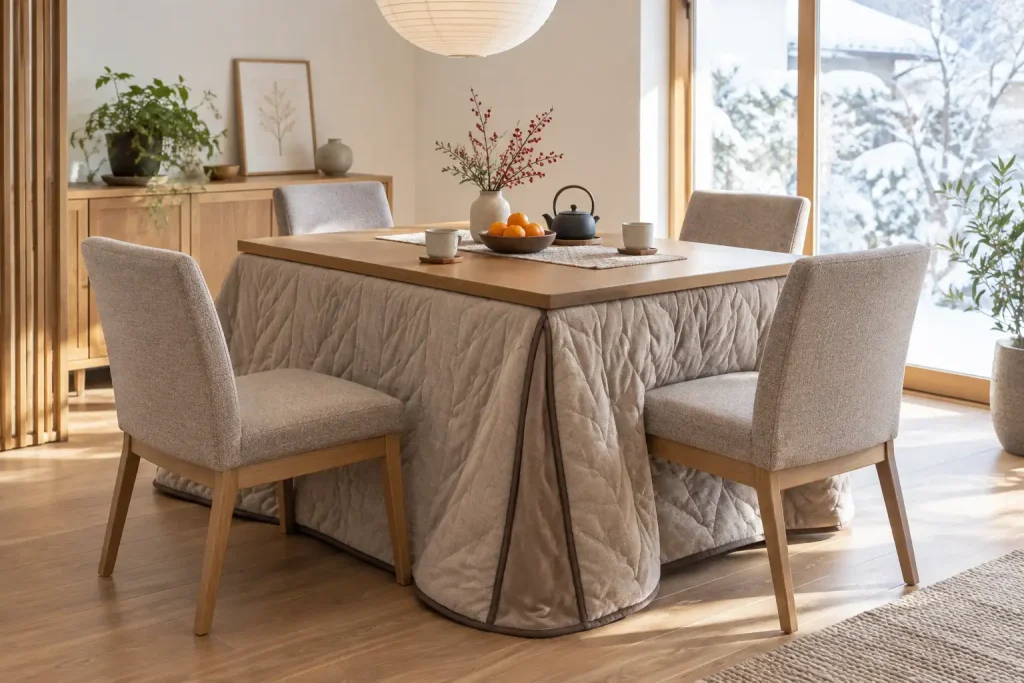
The difference should not be romanticized as Japanese restraint versus American excess. Many people use a kotatsu because it is comfortable, familiar and convenient, not because they are performing an environmental philosophy. Some dislike floor seating, find it hard on their knees or prefer an air-conditioned room. Modern raised and dining-height models exist precisely because the traditional posture does not suit everyone. The object survives by adapting to ordinary bodies and homes.
The comfort has a physical limit
A kotatsu can make you reluctant to stand because the temperature contrast begins as soon as you remove your legs. That familiar reluctance is social humor, not evidence that the appliance is designed for sleeping. Remaining folded into one position for hours can leave your back, hips or knees uncomfortable. Falling asleep beneath the table may also lead to excessive warmth or dehydration, while the surrounding room remains cold. Use the kotatsu as a place to sit, eat or relax, not as a substitute for a properly prepared bed.
You should also remember that warm legs do not mean the entire home is warm enough. Kitchens, bathrooms, hallways and changing areas may be much colder than the space beneath the quilt. This unevenness matters most to older people and anyone sensitive to sudden temperature changes. A kotatsu solves a local comfort problem; it does not repair poor insulation or eliminate every winter risk. That limitation is part of understanding kotatsu heating, not an argument against using one.
What the wattage really tells you
The wattage on the label identifies the appliance’s rated electrical input, not a guaranteed operating average or a full comparison with another heating system. The Koizumi KTR-33255 and its compatible KHH-51240 heater are rated at 500 watts. The heater has a controller, so its actual draw over time depends on operation and thermostat cycling. An air conditioner’s specification normally provides rated, minimum and maximum consumption because its compressor changes speed. Selecting one number from each label without matching room conditions produces a neat but misleading comparison.
The construction explains more than the headline number. The quilt restricts the heated volume, your body sits directly within it, and the table keeps daily activity centered on that warm pocket. A room air conditioner must move and distribute heat through a much larger volume, but a modern heat pump can be highly efficient at doing so. That is why the research supports “localized heating can require less energy than heating the room,” but not “every kotatsu always uses less electricity than every air conditioner.” The household’s behavior completes the comparison.
The two phrases that carry the visit
When someone invites you to sit, どうぞ、こたつに入って, dōzo, kotatsu ni haitte, means to place your legs under the quilt and join the shared warm space. When the heat becomes too strong, 少し弱くしてもいいですか, sukoshi yowaku shite mo ii desu ka, asks to lower it without drama. Between those two phrases, you already know the essential etiquette: enter carefully, share the hidden legroom and speak before discomfort becomes a problem. The table is not mysterious, ceremonial or automatically economical. It is a compact piece of heating equipment whose construction makes everyday social warmth possible in a room that may remain cool.
Short FAQ
Can you sleep under a kotatsu?
A kotatsu is intended for seated warmth, not overnight sleep. Its manual should determine permitted use, clearances and operating precautions. If you become sleepy, switch it off and move to a proper bed rather than treating the heated table as bedding. Long periods in one posture can also become uncomfortable. The cozy setting does not remove the need for ordinary heater safety.
Does every Japanese home have one?
No. Households choose among air conditioners, floor heating, portable heaters, electric blankets and kotatsu tables according to their building and routines. Floor seating is inconvenient for some people, and storing the quilt outside winter also requires space. A kotatsu is recognizable and widespread, but it is not compulsory household equipment. Regional climate and housing quality also affect whether it is useful.
Is a kotatsu cheaper than an air conditioner?
It can cost less when it replaces or reduces whole-room heating because it warms a far smaller space. The result is not automatic, however. The answer depends on the two appliance models, thermostat settings, outdoor temperature, insulation, electricity tariff and hours of operation. A 500-watt rating is a maximum equipment figure, not proof of continuous consumption. Compare measured electricity use rather than relying only on headline wattage.