You are standing at a funeral reception desk with a black-and-white envelope in your hands, and the attendant is waiting. A Japanese funeral is about to move through a tightly managed sequence in which almost every transition is announced or demonstrated.
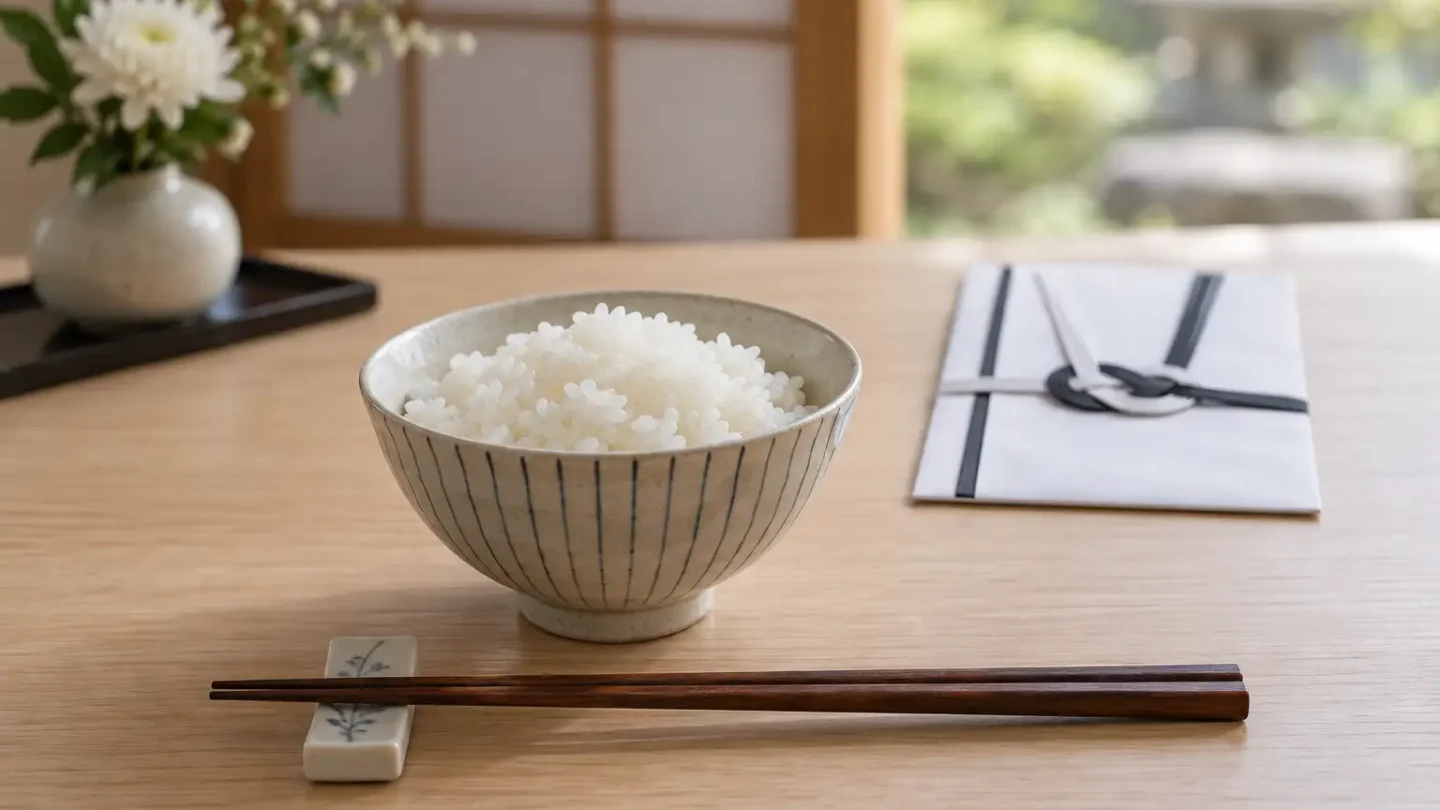
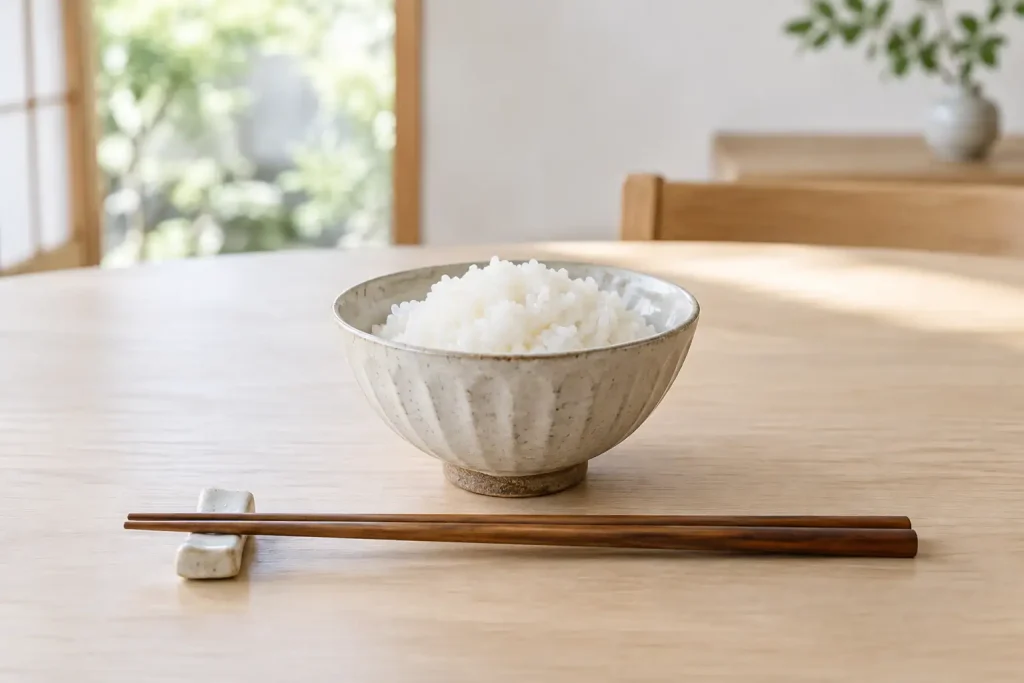
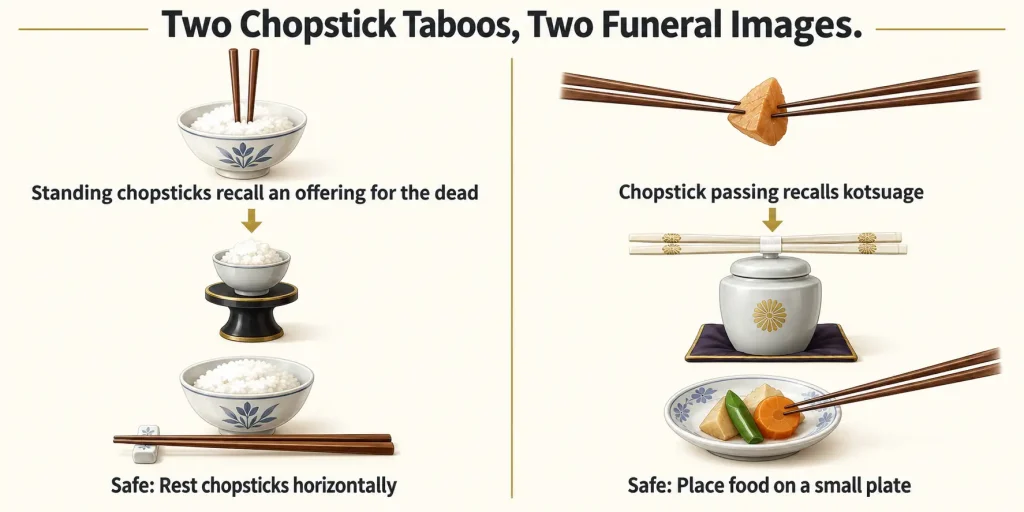
The two food taboos most visitors remember come from different parts of Japanese funeral customs. Chopsticks standing upright in rice resemble a rice offering associated with the dead, while passing food directly from chopsticks to chopsticks resembles the handling of bones after cremation.
That second ritual is 骨上げ, kotsuage, literally “raising the bones,” also called 収骨, shūkotsu, “collecting the bones.” The specific chopstick action may be called 箸渡し, hashiwatashi, “chopstick passing.”
This is the reason, not a vague superstition. At an ordinary meal, set food on a plate before another person picks it up.
What happens during Japanese funeral customs?
The sequence below describes a common Buddhist-format funeral. Practices vary by Buddhist school, region, funeral operator and the family’s wishes, so the people running the ceremony remain the authoritative guide on the day.
For the larger division between shrines, temples and household practice, How Shinto and Buddhism Actually Show Up covers the system without repeating the protocol here.
- Confirm which ceremony you are attending
Japanese funerals may include 通夜, tsuya, “the vigil,” followed by 葬儀・告別式, sōgi and kokubetsushiki, “funeral and farewell ceremony.” An invitation or message should indicate the venue and time.
The vigil is commonly the occasion attended by acquaintances, coworkers and people who cannot join the main funeral. Cremation and bone collection are generally limited to family and people specifically included by the bereaved household.
Do not assume that attendance at one event grants access to every later stage. If the message is unclear, the funeral hall or the person coordinating guests can confirm what applies.
- Prepare the condolence envelope
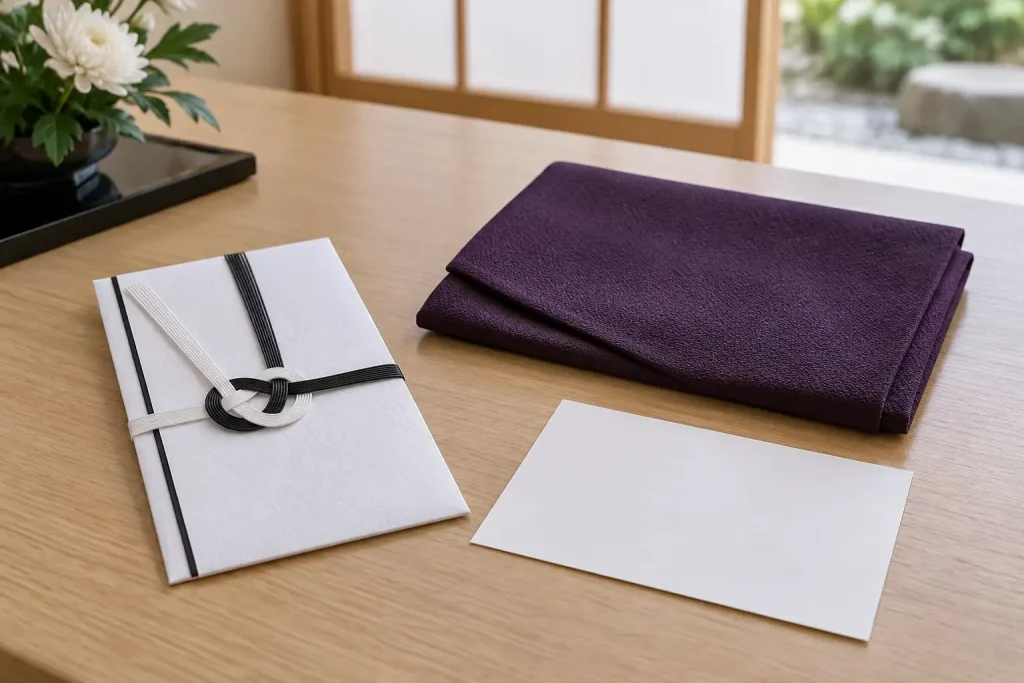
香典, kōden, literally “incense offering,” is condolence money placed in a formal envelope. The outer inscription, cord colors and envelope design depend on the funeral’s religion, Buddhist school and regional practice.
A plain black-and-white condolence envelope is widely seen at Buddhist funerals, but it is not universal. Lotus imagery is specifically Buddhist and is unsuitable for a Shinto or Christian ceremony.
The name is normally written on the front, while the inner envelope records the sender’s address and amount. Rather than guessing the inscription, check the funeral notice, ask the venue or use an envelope labeled for the known ceremony.
- Report to the reception desk
At the reception, write your name in the guest register if asked. Remove the kōden envelope from its 袱紗, fukusa, “wrapping cloth,” and present it with both hands so the writing faces the recipient.
A short condolence is sufficient. This is not the point for a long account of how you knew the deceased, especially while other guests are waiting.
The reception attendant may give you a return gift or claim ticket. Keep anything handed to you; funeral halls often run the practical side of the event with the precision of a conference desk.
- Enter, sit and follow the room
Funeral staff direct guests to seats, often with relatives closest to the front. Your position is normally decided by your relationship to the deceased rather than by arrival time.
Dark formal clothing is conventional. Bright accessories, conspicuous jewelry and strong perfume attract more attention than an imperfect bow.
Phones should be silent and put away. Photography is not something to improvise at a funeral; follow explicit family or venue instructions.
- Offer incense when directed
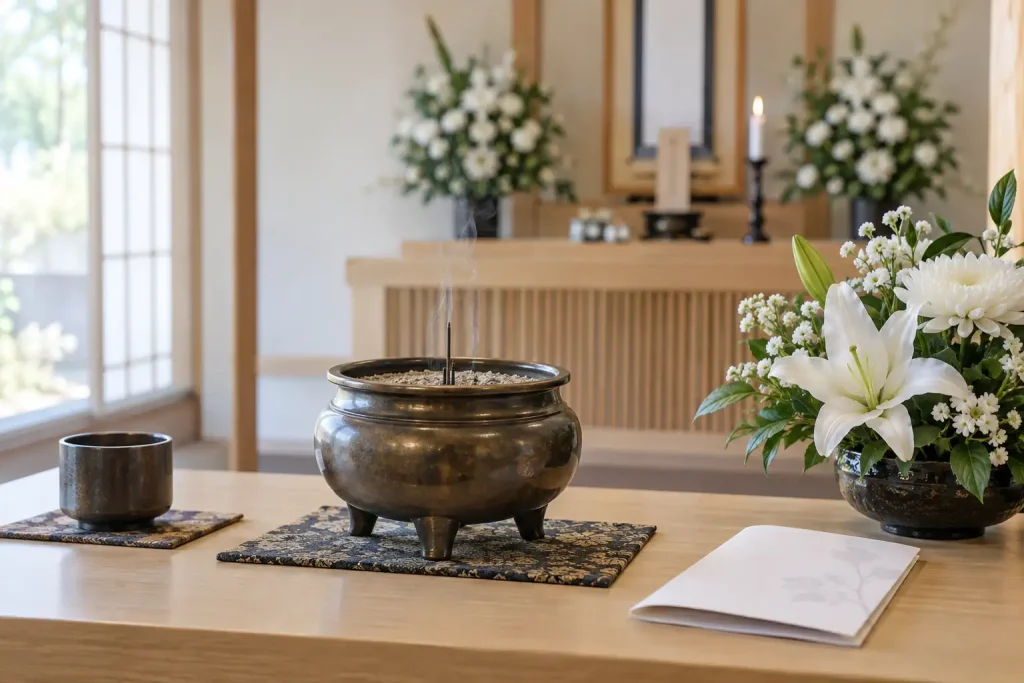
At a Buddhist ceremony, guests may be invited to perform 焼香, shōkō, “incense offering.” The number of times incense is taken, raised or placed differs by Buddhist school.
Watch the person ahead of you and follow the officiant or staff. If you are uncertain, a simple, restrained movement is less disruptive than stopping to reconstruct a detailed ritual from memory.
A shrine procedure does not transfer here. Two Bows, Two Claps, One Bow: The Sequence describes Shinto worship, but clapping is not part of a Buddhist funeral incense offering.
- Remain seated through the farewell
The service can include chanting, incense, a posthumous Buddhist name and farewell remarks. The structure depends on the temple, family and type of funeral.
Near the end, mourners may place flowers into the coffin before it is closed. Staff explain who should approach and in what order.
This is a managed ritual rather than a test of initiative. Do what you are invited to do, and do not step forward merely because a pause feels awkward.
- Travel to the crematorium only if included
After the ceremony, the coffin is taken to a crematorium. Close relatives and invited participants accompany it, while other guests leave after the farewell.
Japan’s strong association between funerals and Buddhism is part of a broader division of religious work. Shrines tend to handle beginnings and protection, while Buddhist institutions commonly handle death and memorial services.
If you are unsure whether a site is a shrine or a temple in another context, Jinja vs Otera: The Five-Second Test explains the visible differences.
- Follow staff during kotsuage
After cremation, family members return to the remains and place bones into an urn. Staff identify bones, explain the order and demonstrate what participants should do.
Depending on regional practice, two people may lift the same bone together with long chopsticks, or a bone may pass from one person’s chopsticks to another’s before reaching the urn. This is the funeral-only action echoed by the food taboo.
Do not try to anticipate the sequence. Crematorium staff control the procedure, and the method is not identical across Japan.
The action explains why passing food between chopsticks produces such an immediate reaction at the table. It visually recreates an intimate moment reserved for handling cremated remains.
- Leave the purification salt question to the ceremony
Small packets of お清め塩, okiyome-jio, “purification salt,” may be provided with a return gift. In the custom that uses it, salt is applied before reentering the home to mark a boundary between death and ordinary life.
This is a custom, not a national rule. It is associated with concepts of purification and differs by religion, Buddhist school, household and funeral operator.
Jōdo Shinshū institutions explicitly reject the practice because they do not treat death or the deceased as pollution requiring purification.
“In Shinshū, purification salt is not used, so it is unnecessary.” — Shinshū Ōtani-ha, Shinshū Kaikan
If no salt is provided, that absence may be deliberate. Do not request it as though the venue forgot an essential item.
How much money is put in a kōden envelope?
There is no legally required kōden amount. Published figures describe social custom, and actual amounts vary with relationship, region, age, workplace arrangements and whether a group is contributing together.
A survey published by the All Japan Association of Ceremonial Mutual Aid Societies found that the most frequent response could differ substantially from the mathematical average. That gap matters: a high average does not mean every guest is expected to match it.
The table reports customary ranges published by funeral-sector organizations, not recommendations. Dollar figures are rough conversions using ¥155 per US dollar, close to the September 16, 2026 market rate, and must be recalculated before publication because exchange rates change.
| Relationship to the deceased | Reported customary range | Approximate US equivalent |
|---|---|---|
| Neighbor or community acquaintance | ¥3,000–¥5,000 | About $19–$32 |
| Friend or acquaintance | ¥5,000–¥10,000 | About $32–$65 |
| Workplace connection | ¥5,000–¥30,000 | About $32–$194 |
| Relative | ¥30,000–¥100,000 | About $194–$645 |
The range is deliberately wide. Workplace collections, local associations and close family relationships can operate under their own conventions.
Some etiquette guides avoid amounts containing four or nine because their Japanese readings can evoke “death” and “suffering.” That is a convention rather than a financial or legal rule.
Envelope inscriptions also vary. 御霊前, goreizen, “before the spirit,” is common in some contexts, while 御仏前, gobutsuzen, “before the Buddha,” may appear in others. Jōdo Shinshū treatment differs, and Shinto and Christian funerals use other wording.
The practical authority is the funeral organizer or venue. This protocol was checked on September 16, 2026, but customs and operator instructions can change.
Why are upright chopsticks and chopstick passing different taboos?
The two actions are often bundled together online, but they refer to separate funeral images.
| Table action | Funeral association | Neutral alternative |
|---|---|---|
| Standing chopsticks upright in rice | Rice offering connected with the deceased | Lay chopsticks on the rest |
| Passing food chopstick to chopstick | Bone handling during kotsuage | Place food on a plate |
| Using unmatched chopsticks | Can recall the deliberately unusual tools used in bone collection | Use a normal matching pair |
| Pointing or waving with chopsticks | General table manners, not a funeral-specific image | Put them down before gesturing |
立て箸, tatebashi, “standing chopsticks,” resembles a bowl of rice prepared in connection with death rites. 箸渡し at the dining table recreates the movement associated with cremated bones.
The uncomfortable part is that direct chopstick passing is not merely an old superstition about luck. For people who have participated in kotsuage, the visual connection can be immediate and physical.
This is why the taboo belongs among the few Japanese etiquette rules that genuinely matter. Japanese Etiquette for Visitors: What Actually Matters separates these boundary rules from harmless errors of form.
Where do foreign visitors usually stall?
The first problem is the reception desk. Guests may hold the envelope in the wrong direction, struggle with the fukusa or begin an extended speech while a line forms.
The second is the incense offering. Visitors try to remember a supposedly universal number of movements, although Buddhist schools follow different forms. Watching the preceding guest and responding to staff is more reliable than applying instructions from an unrelated temple.
The third is knowing when to leave. Not every guest continues to the crematorium or participates in kotsuage. The invitation and the family’s instructions determine the boundary.
The fourth is purification salt. Visitors sometimes assume that every funeral must provide it, but Jōdo Shinshū services may intentionally omit it.
| Moment of hesitation | What caused the uncertainty | What happens instead |
|---|---|---|
| Reception | Unfamiliar envelope handling | Staff accepts and records the offering |
| Incense | Different sectarian procedures | Follow the officiant or the guest ahead |
| Departure | Unclear invitation scope | Ask the funeral hall quietly |
| Kotsuage | Regional differences | Crematorium staff demonstrates |
| Purification salt | Conflicting religious practices | Follow the ceremony’s actual practice |
What changes by region, religion and formality?
A Buddhist funeral is not a single national script. Chanting, incense movements, posthumous names, memorial schedules and envelope wording can differ by school.
骨壺, kotsutsubo, “bone urn,” practices also vary regionally. Some areas collect more of the remains than others, and kotsuage methods are not identical in every crematorium.
Shinto funerals, Christian funerals and secular farewells use different language and objects. A Buddhist lotus-printed envelope, for example, does not become neutral merely because it was sold in the funeral aisle.
The scale of the event matters too. A private family funeral may have no public reception desk and may specifically decline condolence money or flowers. A company-associated funeral can have a larger, more formal reception operation.
Dates on grave markers, memorial records or older documents may use Japanese era notation. Rather than adding a conversion chart, use the era converter — every year from 1868–2050 and all five eras when you genuinely need to read one.
What does nobody mind?
Nobody expects a foreign guest to know the deceased’s Buddhist school from the shape of the incense burner. Nobody is measuring the depth of your bow, and nobody needs an elegant Japanese condolence speech.
People do notice disruption: a ringing phone, unauthorized photography, loud conversation, blocking an aisle or treating bone collection as a cultural demonstration.
A small delay while you watch the person ahead is harmless. Quietly asking a staff member is also normal.
At a Japanese funeral, restraint is more useful than fluency.
For seasonal public memorial observances rather than private funerals, Japanese Festivals by Season: A Year-Round Guide explains Obon and the equinox periods when families visit graves.
What is the shortest version of the protocol?
- Confirm the ceremony.
- Prepare the envelope.
- Register and follow.
- Offer incense quietly.
- Leave when directed.
- Never pass chopstick to chopstick.
FAQ
Why are chopsticks placed upright in rice for the dead?
A bowl of rice with chopsticks standing vertically is associated with offerings made in the context of death. Recreating that arrangement at an ordinary meal brings funeral imagery onto the dining table.
This is separate from kotsuage. The bone ritual explains chopstick-to-chopstick passing, not the upright position itself.
Does every Japanese funeral include kotsuage?
Cremation is commonly followed by collection of the remains, but participation and procedure differ. Close relatives and specifically included mourners are the people most likely to attend.
The crematorium staff determines the local sequence. A visitor should not assume participation without an invitation.
Can a foreigner give kōden?
Foreign nationality does not determine whether condolence money is accepted. The family’s stated arrangements and the visitor’s relationship to the deceased are more relevant.
Some funerals explicitly decline money, flowers or both. The funeral notice or venue can confirm what applies.
Should the money be new?
Funeral etiquette sources often describe visibly brand-new notes as potentially suggesting that the death was anticipated. Some people therefore use ordinary clean notes or place a light fold in new ones.
This remains a convention, not a law. Venue instructions and established workplace practices take priority over generalized etiquette lists.
Is purification salt mandatory?
No. It is a variable custom rather than a compulsory stage of every funeral.
Jōdo Shinshū institutions commonly reject it because death is not treated as a pollution that must be removed. Other families or venues may provide a packet.
Can visitors attend the cremation?
Only if included by the family. Attendance at the vigil or main service does not automatically extend to the crematorium.
If the invitation is ambiguous, the appropriate contact is the funeral organizer or venue rather than the bereaved family during the ceremony.