
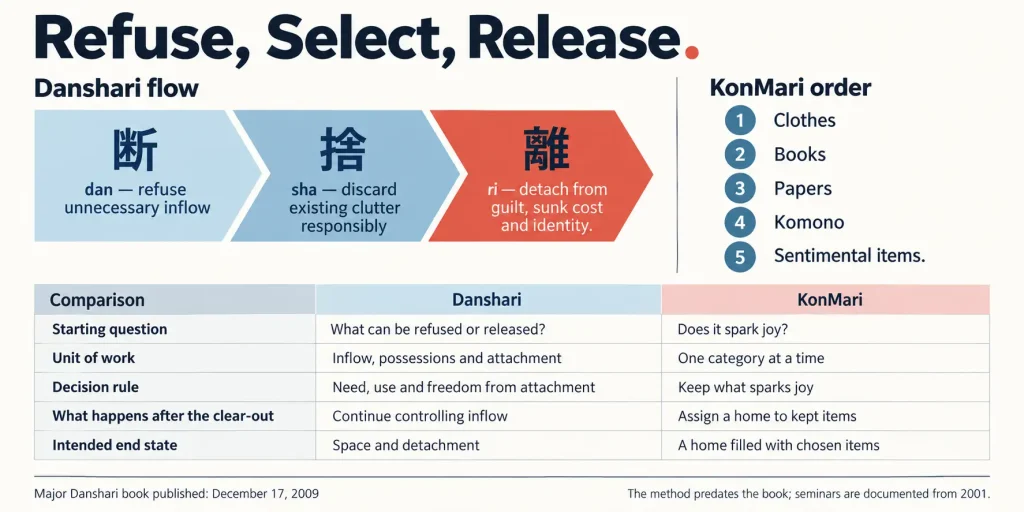
Danshari and the KonMari Method are repeatedly treated as interchangeable forms of Japanese minimalism, and they are not. If you ask what is danshari, the short answer is a method built around three actions: refusing unnecessary things before they enter your home, discarding possessions that have accumulated and loosening your attachment to objects. Yamashita Hideko adapted the name from the yoga practice concepts 断行・捨行・離行, dangyō, shagyo, rigyō. Her first major book presenting the method, Shin Katazuke-jutsu Danshari, was published in Japan on December 17, 2009. KonMari, by contrast, begins with the belongings already inside and asks you to handle them by category, keeping what produces the response translated as “sparking joy.”
The distinction becomes clearer when both systems are compared on the same axes. Five are enough: origin, starting question, unit of work, decision rule and intended end state. These axes matter because they affect what you physically do, not merely how the methods are marketed. Publication sales, celebrity, television exposure and international popularity are not useful for choosing how to clear a closet. The practical question is whether you need to interrupt the flow of new possessions, evaluate an existing accumulation or do both.
| Axis | Danshari | KonMari |
|---|---|---|
| Origin | Yamashita Hideko’s adaptation of 断行・捨行・離行 into a household practice | Marie Kondo’s structured tidying method |
| Starting question | Why is this object entering or remaining in your life? | Which possessions produce a positive personal response? |
| Unit of work | The relationship among you, an object and your present space | A complete category gathered from across the home |
| Decision rule | Present usefulness, suitability and attachment | Keep what sparks joy; release the rest with gratitude |
| Intended end state | An appropriate flow and amount of possessions, with less attachment | A completed category-based tidying process and a home containing chosen objects |
Neither method is simply the Japanese word for “throw everything away.” Neither requires a bare apartment, an empty bookshelf or a fixed number of shirts. Both can produce a visibly simpler home, but appearance is a result rather than a reliable definition. The difference lies in the route taken to get there. That route has consequences when shopping, receiving gifts, handling family property and deciding what should remain.
Why the comparison starts with the home itself
Japanese apartments are often discussed as if small rooms automatically produce a national talent for minimalism. That explanation is too neat. Limited storage can make excess visible more quickly, but it can also create crowded closets, rented storage and furniture chosen primarily to hide things. Reading 1LDK, Jo and the Move-In Bill explains the labels and costs that shape an apartment before any decluttering method is applied. A method does not create square footage, change a lease or make disposal rules disappear.
Room size also varies according to building, region and the measuring convention behind 畳 or 帖, jō, “tatami-mat units.” How Many Mats Is the Room You Are Renting deals with that measurement rather than pretending that every “six-mat room” has an identical area. Danshari can make a compact room more usable, but it cannot correct an unsuitable floor plan. KonMari can reveal how many clothes you own, but it cannot add a closet. The physical home remains a constraint under either system.
The five comparison axes were chosen for that reason. They show where each method begins, what it asks you to notice and what behavior continues after the initial clear-out. They also prevent the comparison from collapsing into stereotypes about “Japanese simplicity.” You do not need a Japanese home to use either system. You need a clear understanding of the decision each system asks you to make.

What is danshari as a working method?
The first axis is origin. Yamashita says she encountered the yoga philosophy of 断行, dangyō, 捨行, shagyō, and 離行, rigyō, during her student years and later translated those ideas into an everyday practice of dealing with household clutter. Her official biography calls the result a method of self-inquiry carried out through tidying. The publisher Magazine House released Shin Katazuke-jutsu Danshari on December 17, 2009. That date marks the book’s publication, not necessarily the first moment Yamashita used the word, because her publisher’s later biography says she had conducted Danshari seminars from 2001.
The second axis is its starting question. The Danshari method does not begin only with “Should I throw this away?” It asks how the object came into your space, whether it serves your present life and why it remains. The person and the current relationship with the object matter more than the object’s theoretical usefulness. A machine that works perfectly can still be unnecessary to you. A worn bowl can remain appropriate because you use it every day.
The third axis is the unit of work. Danshari observes the flow of material into, through and out of the home. That makes the front door conceptually important: free samples, bargain purchases, duplicate gifts and “just in case” supplies become clutter before they reach a shelf. In a Japanese home, the 玄関, genkan, “entrance area,” is already a physical boundary between outdoors and indoors. Why the Floor Steps Up Inside the Door explains the architectural boundary; Danshari adds a decision boundary for possessions.
The fourth axis is the decision rule, expressed through the three characters:
- 断, dan, “refuse” or “cut off”: stop unnecessary possessions from entering.
- 捨, sha, “discard”: remove clutter already occupying the home.
- 離, ri, “detach” or “separate”: loosen the attachment that allows possessions to control your choices.
These are related actions, not merely three bags labeled for sorting. 断 reduces future inflow, 捨 addresses the present accumulation, and 離 changes the relationship that can recreate the accumulation. If you only discard, the shelves may fill again because the purchasing and accepting habits remain untouched. If you only refuse new things, old clutter continues to occupy the home. The method expects the three parts to reinforce one another.
The fifth axis is the intended end state. Danshari does not require ownership to reach zero. The aim is an appropriate quantity and a workable relationship between you, your things and the space available now. That can mean keeping specialized cookware, books or hobby equipment if those objects actively belong to your life. It can also mean releasing expensive objects that survive only because admitting a bad purchase feels uncomfortable.
“The object may still be usable, but that does not prove it is useful to you now.”
That sentence is a practical paraphrase of the method, not a quotation from Yamashita. It identifies the part many decluttering guides avoid: market value and physical condition do not settle the decision. Money already spent cannot be recovered merely by storing the purchase indefinitely. If you can sell or donate it responsibly, do so. If you cannot, continued storage is still a cost in space and attention.
How KonMari approaches the same room
The first axis is origin. The KonMari Method is Marie Kondo’s structured approach to completing a tidying process rather than continually organizing one small location after another. Its official site describes a fixed category order: clothes, books, papers, 小物, komono, “miscellaneous items,” and sentimental possessions. The order moves from categories generally considered easier to evaluate toward those with stronger emotional weight. It is not a room-by-room cleaning schedule.
The second axis is the starting question. You gather the relevant objects and decide which ones you want to keep. The best-known prompt is whether an object “sparks joy,” an English rendering associated with ときめく, tokimeku, “to feel a flutter or positive response.” The method does not ask you to keep everything that produces momentary excitement regardless of function. Official KonMari guidance also recognizes necessary practical items and the value they provide. The decision is meant to clarify what belongs in the life you are choosing.
The third axis is the category. If you begin with clothes, you gather clothes from around the home rather than finishing one drawer and moving to the next. This reveals duplication and total quantity. The official sequence is:
- Clothes
- Books
- Papers
- Komono or miscellaneous items
- Sentimental items
The fourth axis is the decision rule. You handle possessions individually, keep what speaks positively to you and release the rest with gratitude. Official guidance says to finish discarding before concentrating on permanent storage. This prevents elaborate storage systems from becoming a way to avoid making decisions. Thanking an object is a ritual of acknowledgment within the method, not evidence that the object is considered literally alive.
The fifth axis is the intended end state. KonMari is presented as a distinct tidying event that reaches completion rather than a daily campaign against random clutter. Once you have selected what remains, every item receives a place. The household can then maintain the result by returning objects to their designated locations. This is why KonMari vs Danshari is not simply joy versus severity: one organizes a complete selection process, while the other gives equal importance to controlling inflow and examining attachment.

The same object under two different questions
Imagine a boxed kitchen appliance bought for a recipe you never made. It is clean, functional and expensive enough to trigger guilt. Under Danshari, you examine the relationship: why did it enter, does it serve your life now, and is guilt the only reason it remains? You also consider the future 断 step—refusing another specialized appliance bought for an imagined version of your routine. The decision extends beyond this box to the intake pattern that created it.
Under KonMari, the appliance belongs within the relevant miscellaneous subcategory. You gather comparable kitchen equipment, handle the item and decide whether it belongs in the home you want. It may spark enthusiasm because you genuinely intend to use it, or it may reveal only obligation. If it does not belong, you acknowledge its service—perhaps it taught you what you do not cook—and release it. The method then assigns a defined place to the appliances you keep.
| Practical situation | Danshari question | KonMari question |
|---|---|---|
| Unused sale purchase | What habit allowed this unnecessary object to enter? | Does keeping this object support the life I want? |
| Duplicate gift | Do I need to accept and retain every well-meant object? | Which item in this category do I positively choose? |
| Inherited dishes | Am I attached to the person, the object or the duty to store it? | Which pieces create a meaningful response when handled? |
| Everyday tool | Is it appropriate and active in my present life? | Does its function or presence contribute positively? |
| Full closet after a clear-out | Has uncontrolled inflow resumed? | Did I complete the clothing category and assign every item a place? |
The resulting decision may be identical. Both methods might lead you to keep the appliance, sell it or donate it. The difference is the information you carry forward. Danshari directs attention to acquisition and attachment, while KonMari trains a comparative selection response across a complete category. That distinction matters when clutter returns.
Where the methods genuinely overlap
Both systems ask you to stop treating storage as the whole answer. Adding containers can improve access, but it does not determine whether the contents belong in your home. Both methods require active decisions rather than moving unwanted objects into a different room. Both also place the current person ahead of an abstract rule about what a respectable household ought to own. You are not required to preserve an object merely because it was expensive, conventional or difficult to discard.
They also overlap in rejecting careless disposal as the intellectual center of the process. Danshari concerns the relationship with objects, not competitive throwing away. KonMari’s official guidance says discarding is important but not the purpose of the method; the focus is choosing what to keep. In practice, both can slow you down enough to notice wasteful buying. Neither makes the environmental consequences of discarded possessions vanish.
The language differs, but the everyday actions can look similar:
- Gather objects that need decisions.
- Notice duplication and deferred choices.
- Keep possessions that fit present life.
- Release items responsibly where possible.
- Give remaining items enough space to be used.
- Avoid recreating the same accumulation.
If your only problem is one overcrowded drawer before a move, the philosophical difference may not matter. Use whichever question helps you decide accurately. A mixed approach is not a violation: you can complete a KonMari category and then use 断 to limit what enters afterward. The methods are branded frameworks, not incompatible legal systems.

The missed difference is what happens after the clear-out
The practical difference most people miss is Danshari’s attention to inflow. A large weekend clean-out feels productive because bags leave the home, but that is only 捨. If online orders, promotional samples, duplicate gifts and fantasy-self purchases continue arriving at the same rate, the cleared space becomes temporary. Danshari puts 断 before 捨 for a reason: preventing an unnecessary object from entering is easier than storing, sorting and disposing of it later. 離 then addresses the fear or identity that made possession feel necessary.
KonMari can also influence future purchases, but its formal procedure is strongest when possessions have already accumulated and need to be evaluated. Category work exposes what you own and develops sensitivity to what you want to keep. Danshari makes the threshold itself a recurring question. This is why a person with a shopping or acceptance problem may benefit from Danshari even after completing a successful KonMari event. The first method directly names the next incoming object as part of the problem.
Use a short pause before acquiring something:
- Where will it live?
- What existing object does it replace?
- Will you use it in your current routine rather than an imagined routine?
- Would you still accept it if it were free but could not be returned?
- Are you taking responsibility for its eventual disposal?
These questions expose the hidden labor attached to ownership. Every object must be carried, cleaned, stored, found and eventually passed on or discarded. A free promotional item is not free if it occupies scarce storage and becomes a future disposal task. Refusing it politely can be the most efficient decluttering action available. If you need everyday Japanese for declining offers or asking about disposal, the site’s phrasebook with 337 phrases for everyday situations provides situational language without turning this article into a phrase list.
Neither method solves the disposal system
Decluttering advice often ends at the decision to “let go,” but the object still has to go somewhere. Japan’s household waste rules are municipal, not one universal national schedule. Large furniture and appliances may require appointments, designated stickers, retailer collection or another specific route depending on the item and municipality. Donations and secondhand stores can reject stained, outdated or low-demand goods. Selling takes photographs, messages, packaging and time.
This is the uncomfortable cost behind Japanese decluttering. A decision is not completed when an item moves into a hallway bag. If the bag remains for months, it has only changed shape. Before beginning a large session, identify realistic exit routes for ordinary trash, recyclables, donations, resale items and large waste. Do not promise that every possession can be given a meaningful second life.
The same caution applies to other people’s property. Neither method grants permission to discard a partner’s, child’s, roommate’s or parent’s possessions without consent. You can control what you acquire and decide about what belongs to you. A shared home requires shared rules, and inherited property may involve legal or family questions beyond tidying. Detachment is not a license to make irreversible decisions for someone else.
Which method fits the problem you actually have?
Choose Danshari when clutter keeps returning after repeated clean-outs. Its strongest question is not “How do I organize this?” but “Why does this keep entering, and why do I feel unable to release it?” It is also useful when your difficulty centers on sunk cost, imagined future use or the belief that accepting an object is the same as accepting another person’s affection. Work through refuse, discard and detach as connected behaviors. Do not reduce the method to filling trash bags.
Choose KonMari when possessions are scattered across rooms and you cannot see the total quantity. The category order gives the project a clear structure, while the object-by-object response helps you select rather than merely reduce. Start with clothes and leave sentimental possessions until your decision-making is more practiced. Finish deciding before investing in storage. This works especially well when the home needs one comprehensive reset.
Use both when you are moving into a smaller apartment. KonMari can help you evaluate complete categories before packing. Danshari can then govern what crosses the new threshold and what you buy to “solve” the new space. The combination is particularly practical because moving often triggers unnecessary purchases of organizers before the actual storage problem is understood. Measure the home, select what belongs and delay new containers until you know what remains.
Short FAQ
Is Danshari the same as minimalism?
No. Minimalism is a broad idea that often emphasizes owning fewer things. Danshari focuses on the relationship among you, possessions and space, including the flow of new objects into the home. The result may look minimalist, but a low item count is not the only goal. An appropriate quantity can differ from person to person.
Did Yamashita Hideko create Danshari in 2009?
Her landmark book was published on December 17, 2009, but the method predates that publication. A Magazine House biography says she had conducted Danshari seminars since 2001. It is therefore safer to call 2009 the year the major book introduced the method to a broad reading public. It is not a verified date for the first use of the word.
Does KonMari mean keeping only beautiful objects?
No. Official KonMari guidance includes practical objects whose function contributes to your life. “Spark joy” is a decision prompt, not a demand that every screwdriver or tax document produce excitement. Some possessions remain because they are necessary and useful. The category process helps you recognize that value consciously.
Can you combine Danshari and KonMari?
Yes. You can use KonMari to assess everything already in the home by category and Danshari to control future inflow. The methods ask different questions but do not require contradictory outcomes. Combining them is particularly useful after a move or major household change. The important part is to know which question you are asking.