The confusion between these two is not really a confusion about fish. It comes from an assumption built into the English use of the word sushi — that it means raw fish. It does not, and never has.
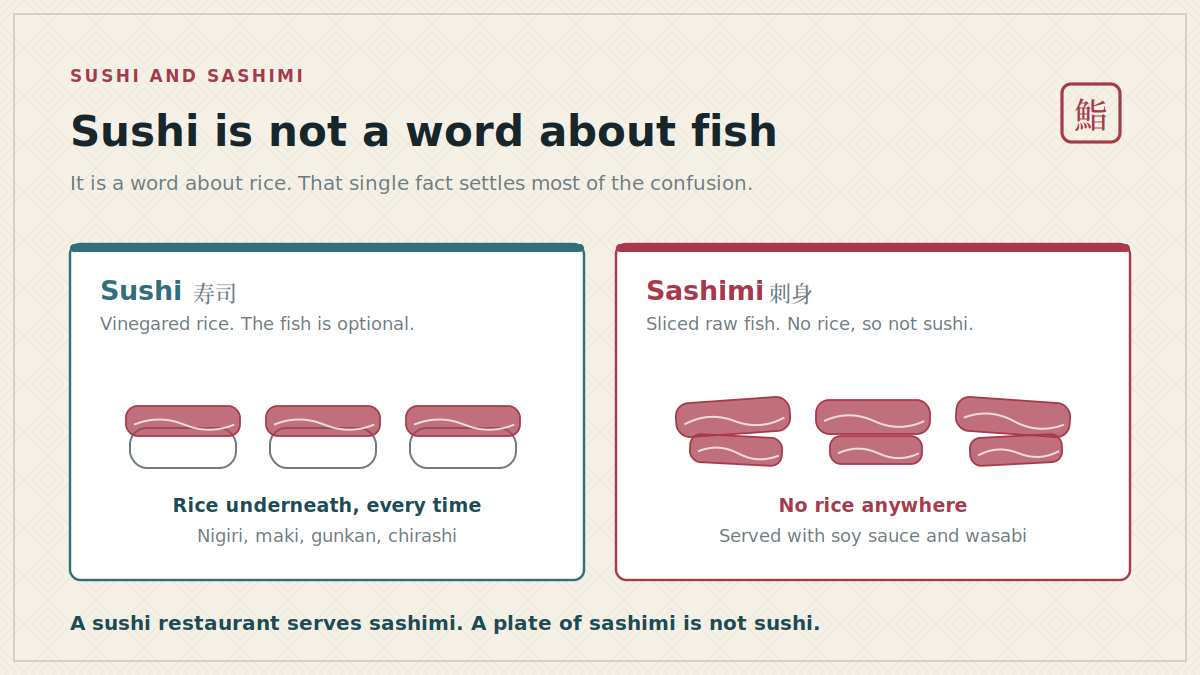
Sushi is a word about rice.
The definition
寿司 sushi means vinegared rice — rice seasoned with vinegar, sugar and salt, called shari or sumeshi. Anything built on that rice is sushi. The topping is optional and frequently is not fish at all.
刺身 sashimi means sliced raw fish or meat, served without rice. It is not a kind of sushi. It is a separate dish that happens to be sold in the same restaurants.
Two consequences that surprise people. A cucumber roll is sushi. A plate of raw tuna is not. And inari — rice in a sweet fried tofu pouch, with nothing raw anywhere near it — is unambiguously sushi.
| Term | Has rice? | Raw fish? | Is it sushi? |
|---|---|---|---|
| Nigiri | Yes | Usually | Yes |
| Maki roll | Yes | Sometimes | Yes |
| Inari | Yes | No | Yes |
| Cucumber roll | Yes | No | Yes |
| Sashimi | No | Yes | No |
| Kaisen-don | Yes, but plain | Yes | No — the rice is unseasoned |
That last row is the clean test. A seafood rice bowl has fish and rice and still is not sushi, because the rice has not been vinegared.
The six forms
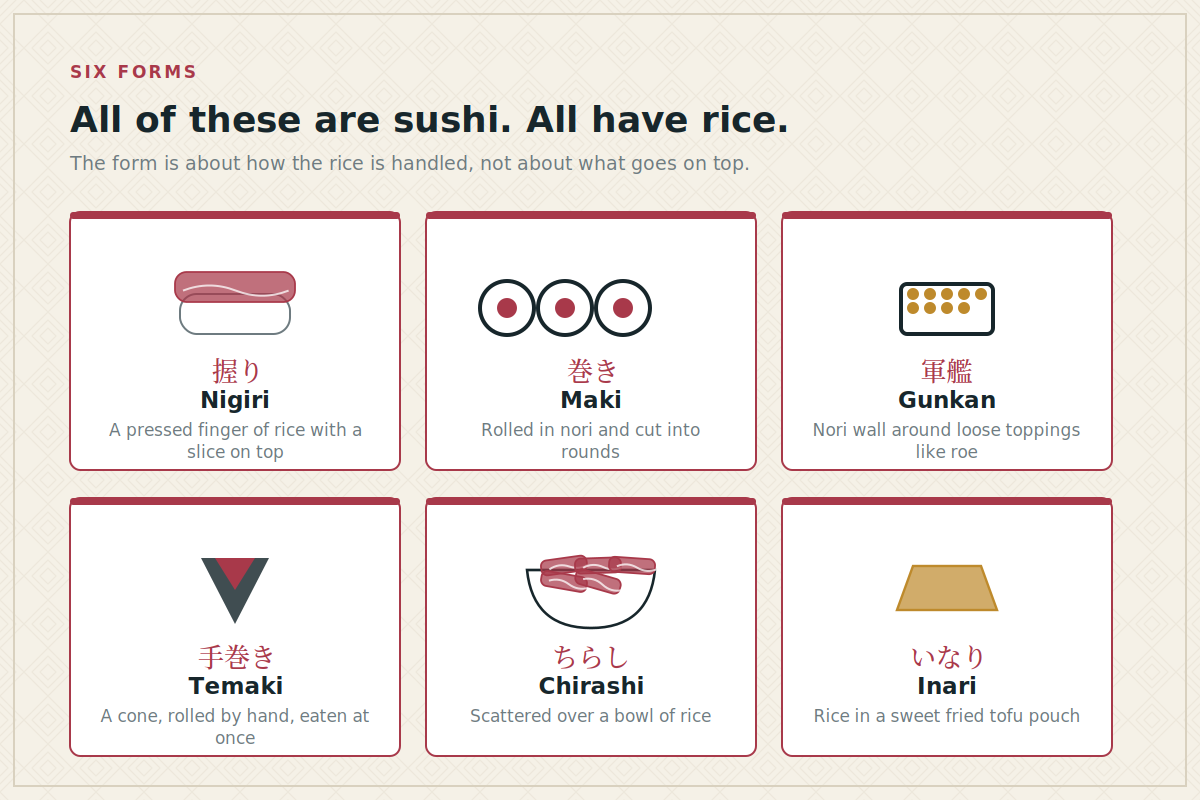
握り nigiri — a hand-pressed finger of rice with a slice laid over it. The default at a sushi counter.
巻き maki — rolled in nori and cut into rounds. Thin ones are hosomaki, thick ones futomaki.
軍艦 gunkan — “battleship.” A band of nori wrapped around the rice to make a wall, for loose toppings like salmon roe or sea urchin that would otherwise fall off.
手巻き temaki — a cone rolled by hand and eaten immediately, before the nori goes soft.
ちらし chirashi — “scattered.” Toppings arranged over a bowl of sushi rice, which is what many Japanese people eat at home.
いなり inari — rice in a pouch of sweetened fried tofu. Cheap, vegetarian, sold at every station.
Where the American forms come from
The inside-out roll with rice on the outside — uramaki — is largely an American development, and the California roll is generally traced to a chef in Los Angeles working around two problems at once: customers who did not want visible seaweed, and a shortage of good tuna.
This is not a criticism. It is a normal thing for a cuisine to do when it emigrates. But it explains why the sushi counter in Tokyo looks nothing like the sushi counter in Chicago, and why asking for a spider roll in Ginza will get you a blank look.
At the counter
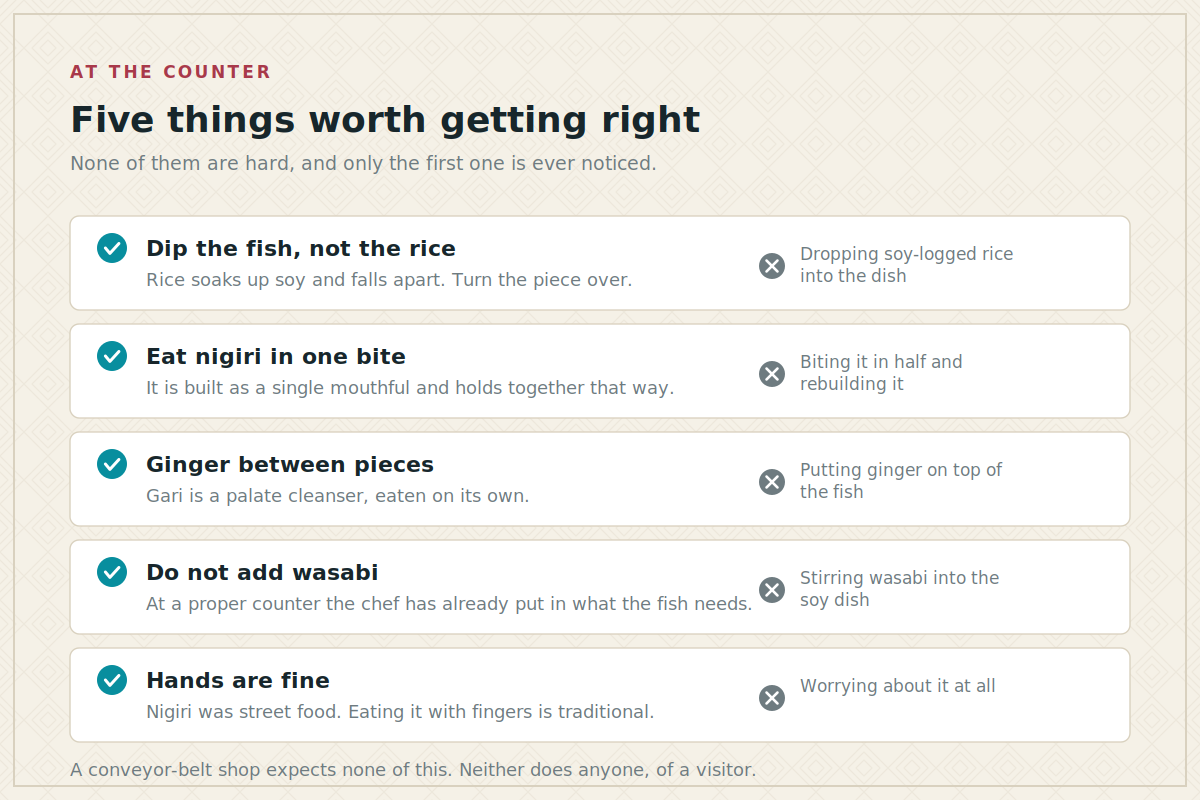
Dip the fish, not the rice. Turn the piece over and touch the fish to the soy. Rice is porous, soaks up far too much, and then disintegrates into the dish. This is the one a sushi chef will notice.
Eat nigiri in one bite. It is constructed as a single mouthful and does not survive being halved.
Ginger is a palate cleanser, eaten on its own between pieces. Not a topping.
Do not add wasabi. At a proper counter the chef has already placed what that particular fish needs between the rice and the topping. Adding more, or stirring it into the soy dish, undoes a decision someone made deliberately.
Fingers are fine. Nigiri began as street food and eating it with your hands is traditional, not a lapse.
All of this applies at a proper sushi restaurant. At a conveyor-belt shop, which is where most sushi in Japan is actually eaten, nobody expects any of it.
Conveyor belt sushi, which you should absolutely do
回転寿司 kaitenzushi is not the budget compromise it sounds like. It is where Japanese families eat, the fish at the better chains is good, and it removes every ordering problem at once.
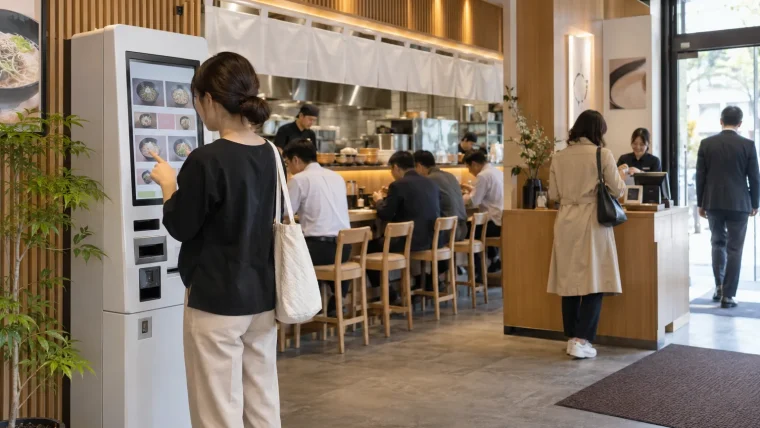
How it works: plates circulate on a belt and you take what you want, or you order on a touchscreen and your plate arrives on a separate express lane. Plate colour or pattern indicates price — the chart is on the wall. At the end, staff count your stack.
Green tea powder is at the table with a hot water tap. Two to three hundred yen a plate at the cheaper chains, five to eight hundred at the better ones, and a full meal for two rarely passes ¥4,000.
Sushi is not fish on rice. It is rice, with something on it. Once that lands, inari and cucumber rolls stop being anomalies.The whole distinction
A short history that explains the shape
Sushi began as a preservation method, not a delicacy. Fish was packed in fermenting rice, which produced lactic acid and kept the fish edible for months. The rice was thrown away.
Over centuries the fermentation shortened, then vinegar replaced it, and by the early nineteenth century in Edo — now Tokyo — someone had the idea of pressing a slice of fresh fish onto a finger of vinegared rice and selling it from a stall. That is nigiri, and it was fast food, eaten standing up, in one bite.
Two things in the modern form come straight from that origin. The rice is still the point, because the rice was the original technology. And nigiri is still a single mouthful, because it was designed to be eaten at a stall in a hurry.
What to order, and in what order
At a counter, a conventional progression runs light to rich: white fish, then silver-skinned, then tuna, then richer things like eel and sea urchin, finishing with tamago, the sweet omelette.
Worth trying, in rough order of how unfamiliar they are:
- Maguro — tuna. The standard. Chūtoro and ōtoro are the fattier belly cuts, and the price climbs steeply.
- Hamachi — yellowtail. Rich, easy, a good early one.
- Ika and hotate — squid and scallop. Both sweeter and softer than people expect.
- Ikura — salmon roe, on a gunkan. Bursts.
- Anago — sea eel, simmered and brushed with sauce. Warm, not raw.
- Uni — sea urchin. The one people either love immediately or do not. Worth finding out which.
Salmon, incidentally, is a recent arrival. It was not traditionally eaten raw in Japan at all, and became a sushi staple only after a Norwegian trade campaign in the 1980s and 90s. It is now among the most ordered items in the country, which is a good reminder that “traditional” is a moving target.
The practical summary
If you remember one thing: the rice is the dish. At a good counter the temperature and seasoning of the rice is what the chef is judged on, and the fish is the easier half.
Everything else — which form, which fish, counter or conveyor belt — is preference. And the etiquette that surrounds it is thinner than the internet suggests, which is also true of Japanese etiquette generally; the rules that actually matter are set out in our etiquette guide.
For the rest of the menu, and the six characters that decode most of it, start with our beginner’s guide to Japanese food.