
What Happens in Japan, Month by Month: A Japanese Holidays Calendar
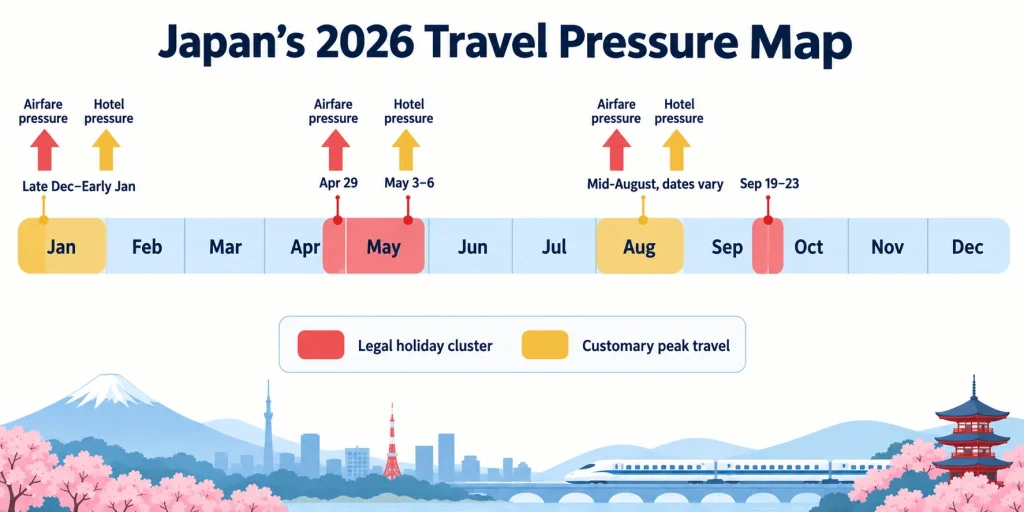
Japan’s year is controlled by two calendars at once: a legal calendar creates days off, while a social calendar creates the crowds. That is the mechanism behind this Japanese holidays calendar, and it explains why a random-looking Tuesday can close an office while a famous observance in August closes no public institution by law. In 2026, there are sixteen named national holidays in Japan, but the holiday law produces eighteen days off because it adds one substitute holiday and one day between two holidays. Golden Week is therefore a legal cluster; New Year and Obon are broader travel seasons built partly on custom, school schedules, and employer leave. If you book all three as though they were ordinary weeks, the mistake usually appears first in the airfare, the room inventory, or the reserved-seat screen.
How the Japanese holidays calendar creates days off
The National Holiday Act does more than print names on dates. It declares every national holiday a day off, moves the day off forward when a national holiday falls on Sunday, and turns a non-holiday caught between two national holidays into another day off. In 2026, Constitution Memorial Day falls on Sunday, May 3, so the substitute day arrives on Wednesday, May 6, after the holidays already occupying Monday and Tuesday. Respect for the Aged Day falls on Monday, September 21, and Autumnal Equinox Day falls on Wednesday, September 23, so Tuesday, September 22, becomes a holiday between them. The outsider’s mistake is counting only the sixteen named holidays and missing the two extra closures that the law manufactures.
Japan still does not “close” uniformly on any of these dates. Government offices, schools, banks, and many offices follow the calendar closely, but convenience stores, hotels, restaurants, attractions, and railways often stay open because demand is highest when everyone else is free. JNTO describes New Year, Golden Week, and Obon as the three major holiday seasons when domestic travel peaks and businesses may close or shorten hours. That wording matters: may close is not the same as a nationwide shutdown. The usable question is not “Is Japan open?” but “Which part of Japan am I expecting to use?”
The holiday law determines the day off; employers, families, and transport demand determine what the traveler actually experiences.
January through March: a reset, then isolated breaks
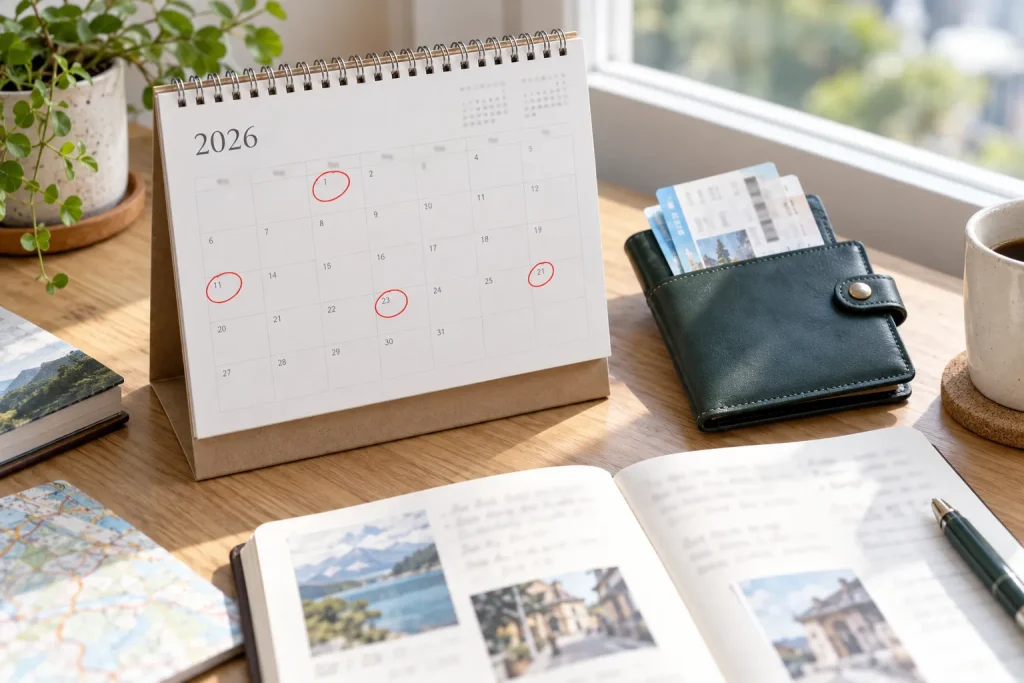
January begins with 元日, Ganjitsu, literally “New Year’s Day,” on January 1. The legal holiday is one date, but JNTO says many businesses close for several days from late December into early January, when domestic travel and shrine visits surge. Airfare and hotel pressure rises on popular routes, although transport, major hotels, and convenience retail continue operating. Coming-of-Age Day follows on January 12; February brings holidays on February 11 and 23, while the spring equinox holiday falls on March 20. Check each attraction’s official calendar, and use Japanese etiquette for visitors for the few shrine, home, bath, and restaurant rules that genuinely matter.
| Month | National holiday or statutory day off in 2026 | Date |
|---|---|---|
| January | New Year’s Day; Coming-of-Age Day | January 1; January 12 |
| February | National Foundation Day; Emperor’s Birthday | February 11; February 23 |
| March | Vernal Equinox Day | March 20 |
| April | Showa Day | April 29 |
| May | Constitution Memorial Day; Greenery Day; Children’s Day; substitute holiday | May 3; May 4; May 5; May 6 |
| June | None | — |
| July | Marine Day | July 20 |
| August | Mountain Day | August 11 |
| September | Respect for the Aged Day; statutory day between holidays; Autumnal Equinox Day | September 21; September 22; September 23 |
| October | Sports Day | October 12 |
| November | Culture Day; Labor Thanksgiving Day | November 3; November 23 |
| December | None | — |
Golden Week is a cluster, not a single holiday
Showa Day on April 29 opens the sequence, but the dense part of Golden Week travel runs from May 3 through May 6 in 2026. April 30 and May 1 remain ordinary weekdays, so “Golden Week” is not a statutory week in which every date is free. JNTO warns of crowds and fully booked transport, while airfare and room prices face upward pressure as cheaper inventory disappears. No honest national markup exists because route, city, terms, and booking date change the result. Book transport and lodging first, and remember that a rail pass cannot create a seat on a sold-out departure.
June through August: quiet June, then the Obon wave
June has no national holiday; Marine Day falls on July 20, and Mountain Day on August 11. Neither is Obon, because Obon in Japan is a customary mid-August season rather than a public holiday; its name is お盆, Obon, literally the “Bon observance.” JNTO still classifies it among the three major travel seasons, and concentrated hometown travel can raise Japan travel costs on peak domestic flows. Dates, closures, and direction of demand vary, so check the employer, venue, and route instead of assuming a uniform week. For processions, dances, and seasonal events, Japanese festivals by season covers the festival experience without duplicating this closure calendar.
September creates a second legal chain
September 2026 contains the less famous trap: holidays on Monday, September 21, and Wednesday, September 23, force Tuesday, September 22, to become a day off under the Act. With the preceding weekend, that creates a five-day run for standard Monday-to-Friday schedules. The label Silver Week has no legal force, and the alignment does not return every year. Treat September 19–23 as a period to check transport and lodging rather than as another Golden Week. If a booking page shows 令和8年, Reiwa hachi-nen, “Reiwa year eight,” the Japanese era converter covers every year from 1868 through 2050 across the five modern eras.
October through December: days off without a shutdown
Sports Day falls on October 12, Culture Day on November 3, and Labor Thanksgiving Day on November 23. None belongs to JNTO’s three major Japan travel seasons, while December has no national holiday despite its consequential year-end closures. This is where a Japan festival calendar fails: local events can fill rooms, and independent businesses can close without a red date on the calendar. The seasonal festival guide covers the events themselves, while Japanese gift-giving customs distinguishes a travel souvenir from a host gift. Use those guides instead of treating every cultural observance as a closure notice.
What the calendar does to an itinerary
Separating the legal and social calendars reveals four consequences. An “open” country can still be hard to cross when trains run but useful seats are gone. A statutory closure can empty an office district while crowding a heritage city. Price pressure follows demand rather than the legal label, which puts non-statutory Obon beside Golden Week. Direction matters too, because hometown-bound and city-bound flows need not peak together.
Use this booking order when your dates touch one of the pressure periods:
- Fix the intercity legs you cannot replace, then check the operator’s reservation window and holiday notices.
- Secure lodging with cancellation terms you understand; do not assume a room will become cheaper merely because you wait.
- Verify each must-see venue on its own official calendar, including last admission and year-end closure notices.
- Leave local meals and flexible sights until later, but identify at least one dependable option near your hotel for New Year nights.
You should also separate closures from inconveniences. The following items deserve advance checks because they can fail independently:
- the final train or bus after an evening event;
- reserved seats on a long-distance train;
- restaurant holiday notices and reservation-only service;
- museum maintenance days attached to a holiday;
- luggage forwarding deadlines during peak demand.
| Travel period | 2026 planning window | Legal status | Airfare pressure | Hotel pressure | What actually changes |
|---|---|---|---|---|---|
| New Year | Late December through early January | January 1 is national; surrounding days vary by business | Up on high-demand routes | Up in popular destinations; closures reduce some inventory | Many independent businesses close; shrines are extremely busy; transport continues |
| Golden Week | April 29 and May 3–6 | Built from national and statutory holidays | Up | Up | Domestic transport and major destinations can sell out while attractions remain open |
| Obon | Mid-August; exact leave dates vary | Not a national holiday | Up on peak domestic flows | Up where family and leisure demand concentrates | Employer leave and hometown travel create crowds; business closures are inconsistent |
Where the simple rule fails
The rule breaks by region and industry. Some communities observe Bon in July, while a public office and the convenience store across the street may follow opposite holiday logic. Major local events can create price pressure outside every national peak. “The country stops” is therefore a warning, not a description: New Year brings the broadest closures, Golden Week the strongest legal cluster, and Obon a non-statutory family-travel wave. Follow verified venue and operator calendars, because trains continue running and hotels do not apply one national markup.
FAQ
How many national holidays does Japan have in 2026?
Japan has sixteen named national holidays in 2026. The calendar adds May 6 as a substitute holiday and September 22 as a day between holidays. That produces eighteen official days off. Weekends remain separate. Different calendars may therefore show sixteen names or eighteen days without either being wrong.
Is Obon a national holiday in Japan?
No. Obon is a customary family and memorial season, not a national holiday. Employers may grant leave and businesses may close around mid-August. Transport and tourist operators often remain busy. Check the exact dates used by the company, venue, and region.
Does everything close during Golden Week?
No. Offices often close, while transport, hotels, retail, restaurants, and attractions may operate for holiday demand. The main risks are congestion and reduced availability. Independent businesses choose their own days off. Treat “open” as separate from “easy to access.”
When should you avoid traveling in Japan?
Avoid New Year, Golden Week, and Obon if low prices and spontaneity matter most. If those periods are the purpose of the trip, book earlier instead of canceling automatically. September 19–23 also needs care in 2026. Local festivals can add pressure elsewhere. The rule of thumb is simple: when residents gain consecutive days off, reserve movement and sleep before entertainment.