You are standing just inside a Japanese front door, and the floor rises in front of you. Someone is about to expect you to remove your shoes, but the more useful question is what is a genkan and why the house itself tells you where to stop.
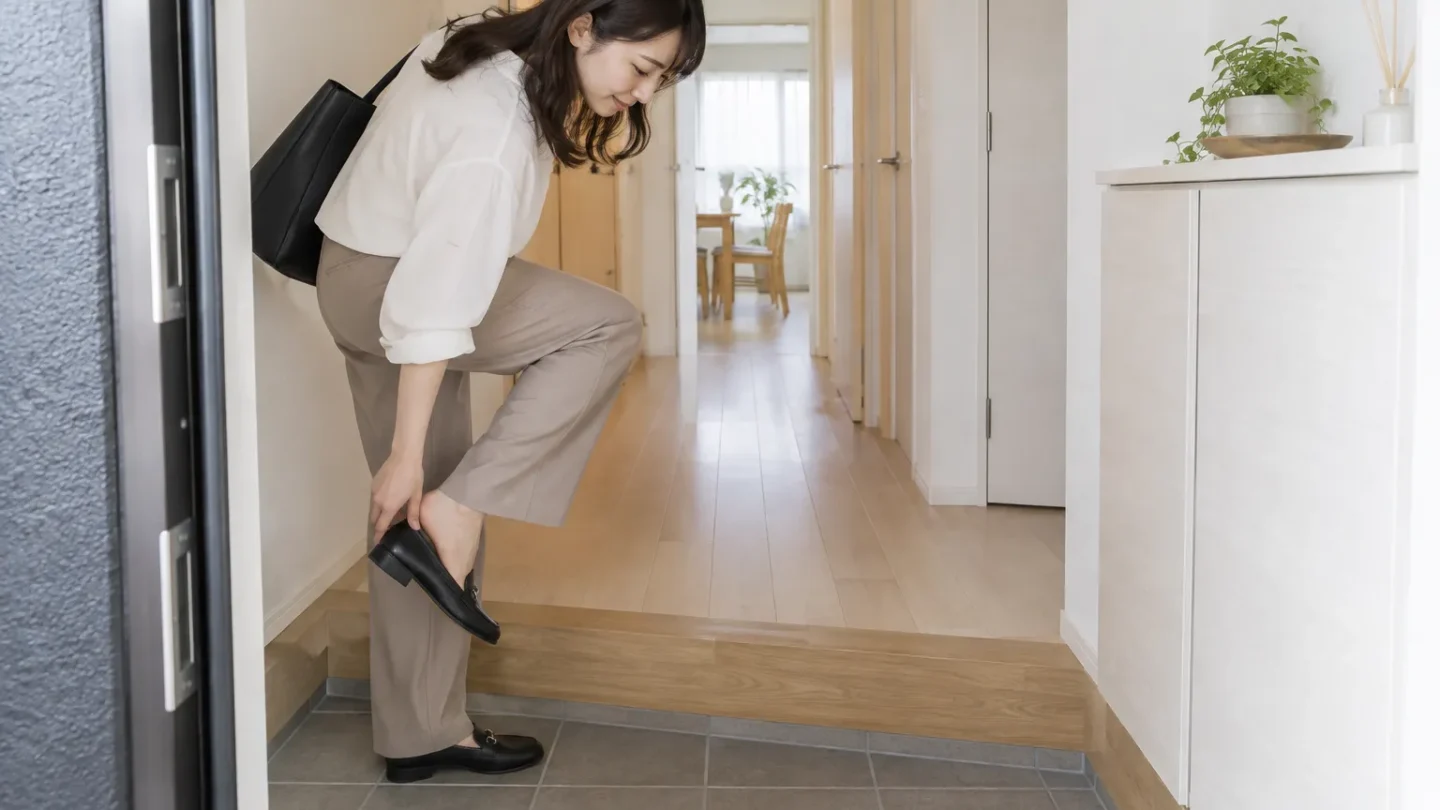
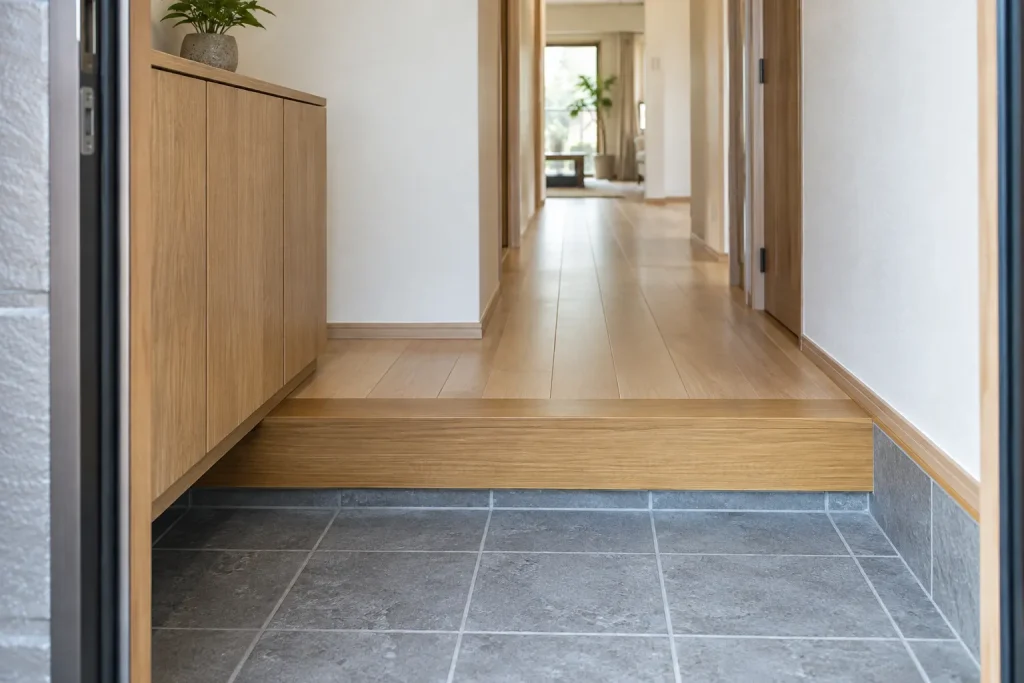
玄関, genkan, “entrance,” is the transition space between outdoors and the inhabited interior. Its lower floor receives outdoor footwear, while the raised floor beyond it belongs to the home. The step is not decoration added to support a rule: the architecture creates the rule.
What exactly are you standing on?
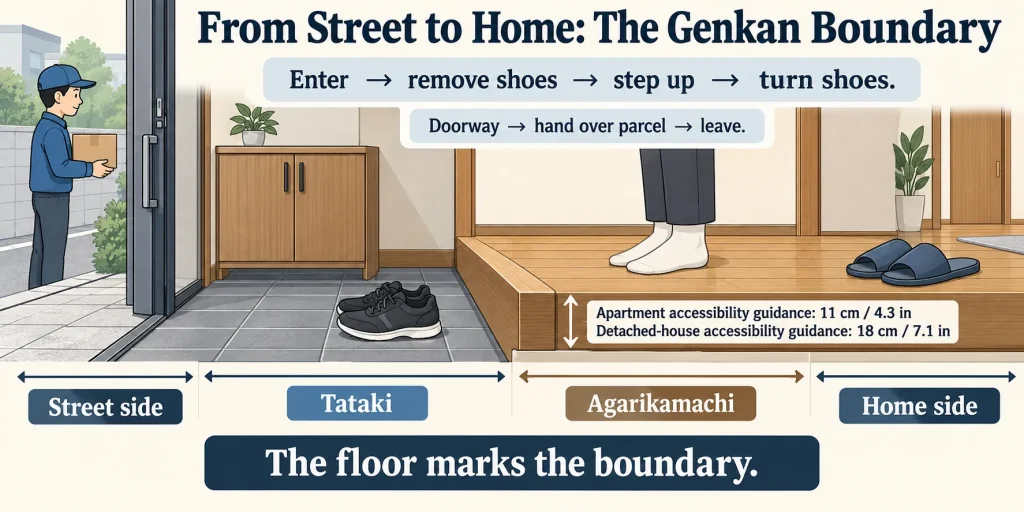
The lower part of the entry is commonly called 三和土/たたき, tataki, traditionally referring to a beaten-earth surface and now often used for the tiled or concrete entry floor. It sits on the outside side of the home’s internal boundary even though it is behind the front door.
The horizontal edge between that lower surface and the raised interior is the 上がり框/あがりかまち, agarikamachi, literally the “rising frame.” It may be a distinct wooden sill, a finished edge, or simply the visible face of the raised floor. This is the line you do not cross while wearing outdoor shoes.
The arrangement makes the distinction visible without signs. Dirt, rainwater, umbrellas, parcels, and shoes can remain below, while socks, slippers, and indoor flooring stay above. The design is therefore best understood as Japanese entryway architecture, not as a test of whether a visitor has memorized the correct manners.
“The step helps prevent sand and mud from shoe soles from being carried into the interior.”
That practical function is how Japanese building-material manufacturer DAIKEN describes the raised threshold. The same boundary also organizes movement: pause below, remove shoes, and enter above.
| Part | Japanese term | Position | Practical role |
|---|---|---|---|
| Entry area | 玄関, genkan | Inside the exterior door | Receives residents, visitors, shoes and deliveries |
| Lower floor | 三和土/たたき, tataki | Below the interior floor | Holds outdoor footwear and street dirt |
| Raised sill | 上がり框, agarikamachi | At the change in floor level | Marks the crossing into the living area |
| Shoe storage | 下駄箱, getabako | Usually beside the lower floor | Stores footwear |
| Interior hall | 廊下, rōka | Beyond the sill | Connects the entrance with the home |
The exact height and materials vary. Japan’s Ministry of Land, Infrastructure, Transport and Tourism has published accessibility guidance recommending that an entrance step be no higher than 11 centimeters, or about 4.3 inches, in an apartment building and 18 centimeters, or about 7.1 inches, in a detached house. Those figures are accessibility recommendations checked in September 2026, not measurements you can expect in every building.
How do you enter a Japanese home?
The sequence is easier when you follow the floor instead of watching everyone else’s feet. Each movement has a physical place, and the next movement begins only after the previous one is complete.
- Stop on the lower floor. Enter far enough to close the exterior door, but keep both shoes on the tataki. What you see is a small landing below the wooden or finished interior floor. You have entered the building, but you have not yet entered the clean living zone.
- Face into the home. Stand with your toes pointing toward the raised floor. Do not turn around first and try to back out of your shoes. Facing inward gives you a stable position and lets you step forward rather than perform an awkward pivot over the sill.
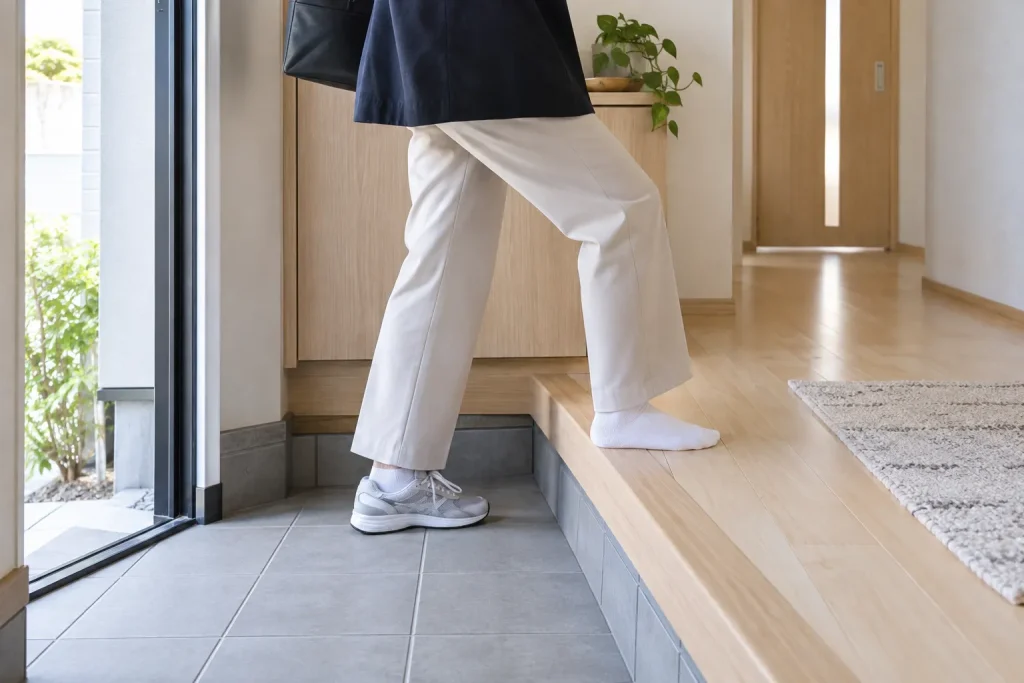
- Remove the first shoe. Slip one foot out while keeping the socked foot from touching the lower surface. Place that socked foot directly on the raised floor. The lower area is treated as the place for outdoor footwear, so using it as a temporary sock floor defeats the spatial division.
- Remove the second shoe. Shift your weight onto the foot already inside and take off the other shoe. Bring the second socked foot onto the raised level. You are now entirely on the interior side of the threshold.
- Turn the shoes around from above. Kneel or bend from the raised floor and rotate the shoes so their toes point toward the door. This leaves them ready to put on when you depart. Do not step back into the lower area in socks merely to arrange them perfectly.
- Move the shoes out of the path. Place them together near the side of the genkan or where the host indicates. In a small apartment, leaving shoes in the middle can block the only route through the doorway. A host may place them in a shoe cabinet if space is tight.
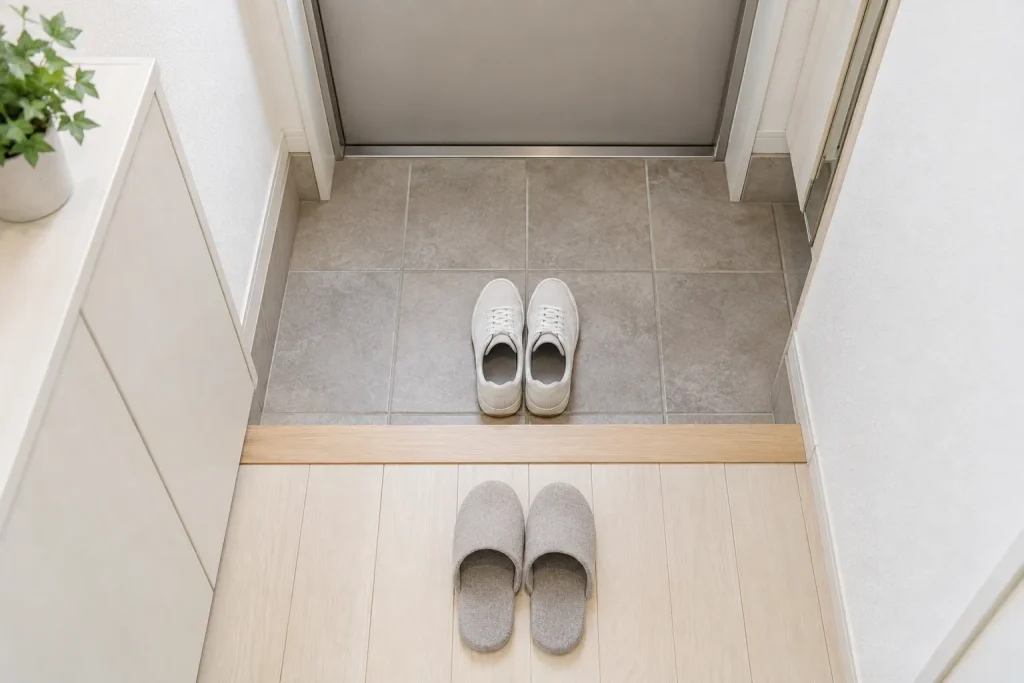
- Use slippers if they are offered. Indoor slippers normally wait on the raised side, not on the tataki. Put them on only after both feet have crossed the sill. Some homes use slippers throughout the hall, while others do not use them at all.
- Continue when the host moves inward. Once your footwear is settled, follow the host into the apartment. The entry sequence is finished; you do not need to keep apologizing or discussing your shoes.
This physical sequence also helps make sense of apartment plans. Reading 1LDK, Jo and the Move-In Bill explains how the genkan, halls, rooms, and combined living areas appear in Japanese rental listings.
Why do delivery workers stop at the genkan?
A delivery does not normally require the courier to enter the clean interior zone. The resident can open the door, speak, sign when required, and receive the parcel while the courier remains outside or at the lower entry level.
This is why the genkan works as more than a shoe-changing station. It is a small interface where a private home can conduct a brief exchange with the public world. The door provides security and weather protection; the lower floor provides a place for the exchange; the agarikamachi shows where household space begins.
In an apartment with a narrow entry, a courier may remain in the common hallway and pass the parcel across the doorway. In a detached house, the person may step into a larger covered genkan when invited, especially during rain. Neither arrangement requires crossing onto the raised interior floor.
The boundary is practical rather than theatrical. A resident can deal with a courier, utility worker, neighbor, or canvasser without inviting that person into the home. The floor itself supports a conversation that is neither fully outside nor socially inside.
| Visitor or exchange | Usual stopping area | Shoes removed? | What happens next |
|---|---|---|---|
| Courier handing over a parcel | Outside the door or lower genkan | Usually no | Parcel and any required confirmation are exchanged |
| Neighbor delivering an item | Doorway or lower genkan | Usually no | Brief conversation without entering the living area |
| Invited guest | Lower genkan first | Yes | Guest crosses onto the raised floor |
| Repair worker | Lower genkan before instructions | Depends on the work | Resident or company procedure determines access |
| Household resident | Lower genkan | Yes | Shoes are stored or left facing the exit |
This pattern is common, but it is not a universal legal rule about delivery work. Contactless drop-off, parcel lockers, building security, weather, package size, and individual company procedures can change where the handover occurs.
Where do visitors usually get stuck?
The first hesitation comes immediately after the door closes. Visitors see that they are technically indoors and assume the entire space is clean. The lower floor is inside the building envelope, but functionally it still belongs with outdoor footwear.
The second mistake is stepping onto the raised floor in shoes to create more room. In a tiny entrance, the correct movement can feel impossible because the door, shoes, luggage, and host occupy the same small area. Pause on the lower level and let the host move anything that blocks the crossing.
A third common problem is placing a socked foot on the tataki after removing one shoe. Instead, transfer that foot directly to the higher floor. If balance is difficult, use a wall, handle, bench, or the edge of the sill when one is available rather than rushing.
The final stall happens when visitors try to turn their shoes while still wearing them. This produces a cramped backward shuffle and can place outdoor soles on the raised edge. Step up first; arrange the footwear from the interior side afterward.
The sequence can be reduced to four problem points:
- Do not treat the lower floor as ordinary indoor flooring.
- Do not cross the sill in outdoor shoes.
- Do not place socks on the lower surface.
- Do not block the center with shoes or luggage.
Does every genkan work the same way?
No. The core distinction between the shoe area and the interior remains recognizable, but the movement changes with the building, weather, available space, and level of formality.
A modern studio apartment may have a shallow drop and barely enough room for one person. An older detached house can have a deeper entry, a broad wooden sill, and a step that is more noticeable. Accessible housing may reduce the change in level or replace it with a nearly flush transition while using materials and layout to preserve the boundary.
Rain adds umbrellas, wet coats, and water to the sequence. Umbrellas usually remain in a stand or designated area near the entrance instead of being carried through the home. In snowy regions, boots and melting snow make the separation even more visibly practical.
Slippers also vary. A family may offer them to guests, leave them lined up near the raised edge, or use none. At some traditional accommodations, schools, clinics, temples, restaurants, and workplaces, you may encounter a similar footwear change, but the designated boundary will not always look like a residential genkan.
Formality affects attention, not the basic geometry. At a formal visit, shoes may be arranged carefully and moved to the side. In a close friend’s cramped apartment, the same action may be quick and unremarkable.
What does nobody actually mind?
People usually do not mind if you pause for a moment to understand the layout. A brief hesitation is less troublesome than stepping across the boundary in outdoor shoes.
Nobody expects a visitor to rotate a pair of shoes with ceremonial precision. Pointing them toward the exit and moving them out of the way is enough. If the host immediately rearranges them, that often reflects limited space or household habit rather than a silent rebuke.
You also do not need special socks purchased for Japan. Clean, intact socks are sensible because they may be visible, but the genkan is not an inspection station. The practical concern is where the soles of your shoes and your socked feet touch.
Declining unstable slippers can also be reasonable, particularly if mobility is an issue. The raised sill is a genuine accessibility obstacle, which is why Japanese housing guidance addresses its height and visibility. Tell the host plainly rather than attempting a movement that feels unsafe.
A simple すみません, sumimasen, “excuse me” or “sorry,” is sufficient if you step in the wrong place and correct yourself. The phrasebook with 337 everyday phrases provides useful expressions for arrivals, visits, and deliveries without requiring you to memorize a scripted doorway performance.
The things that attract attention are practical:
- Outdoor shoes crossing onto clean flooring
- Socks touching the lower entry surface
- Wet umbrellas carried into the rooms
- Shoes or luggage blocking the doorway
- Ignoring a clearly marked footwear change
Small differences in angle, speed, or slipper use generally do not matter. Japanese shoe etiquette is much easier when understood as cooperation with the room.
Mini-FAQ
Should shoes point toward the door?
Yes, shoes are commonly turned so they are ready for departure. Step onto the raised floor first, then turn them from above instead of moving around the lower floor in socks.
Can I leave my shoes where I removed them?
Move them to the side if the entrance is narrow. Your host may indicate another position or place them in the shoe cabinet.
Does a courier enter the genkan?
The handover may happen outside the door, across the doorway, or on the lower entry floor. A courier does not normally need to cross the raised boundary into the living area, but building layouts and delivery procedures differ.
The shortest version is: enter below, shoes off, step up, turn shoes, move inside.