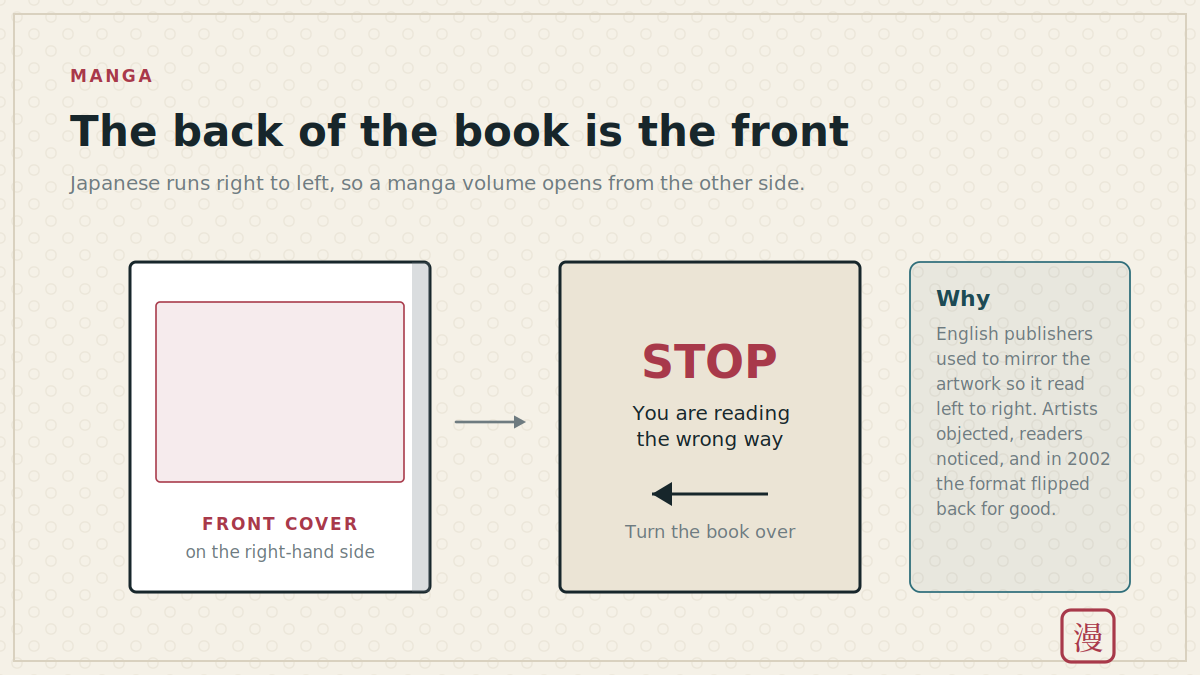
Open an English-language manga volume the way you would open a novel and you will land on a page that tells you to stop. It is not a joke and it is not a gimmick — you are holding the book backwards, and the page exists because enough people did it that publishers started printing a warning.
Right to left, at every scale
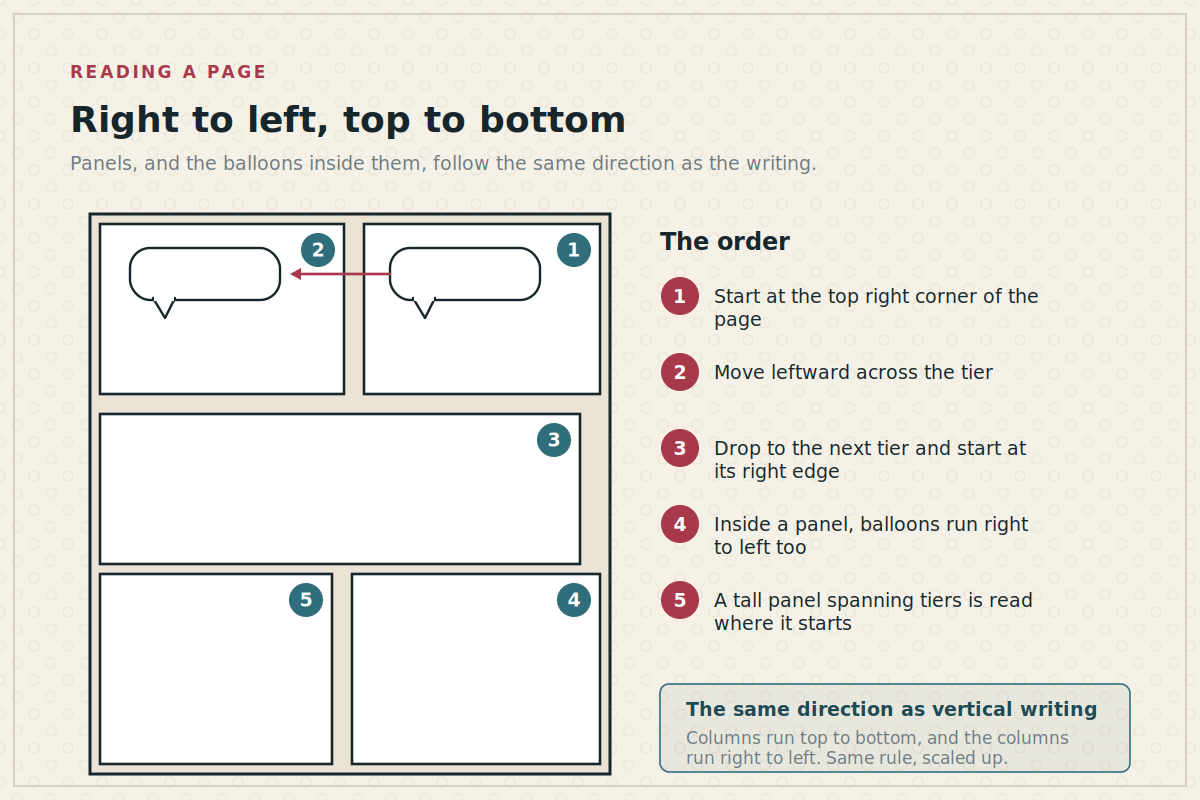
Traditional Japanese writing runs in vertical columns, top to bottom, with the columns progressing right to left. Manga applies that same direction to everything above the level of the character.
- Start at the top right corner of the page.
- Move leftward across the tier of panels.
- Drop to the next tier and start again at its right edge.
- Inside a panel, speech balloons also run right to left.
- A tall panel spanning two tiers is read at the point where it starts.
The balloon rule is the one that trips people who have got the panel order right. If two characters are talking in the same panel, the right-hand balloon spoke first — which means a conversation can appear to run backwards until your eye adjusts.
It takes most readers about half a volume. After that it is invisible, and going back to a Western comic feels briefly wrong.
Why English publishers stopped flipping it
For years, English manga was mirrored. The artwork was flipped horizontally so it read left to right, which made everyone right-handed, reversed every sword, and put the writing on every sign backwards.
Tokyopop broke that in 2002 with a line marketed as “100% Authentic Manga.” The commercial reasoning was not primarily about respect for the art. Not flipping was cheaper, the books were printed on lighter paper in the Japanese tankōbon format, and the price came down from sixteen or twenty dollars to about ten.
The other half of the strategy was distribution: rather than comic shops, they went to Borders and Barnes & Noble, where a ten-dollar paperback in a book-sized format made sense on a shelf. Viz followed within months at an even lower price.
Artists had been objecting to flipping for years — mirrored artwork wrecks directional storytelling, from a sword stroke to a baseball pitch — but it was the bookstore economics that settled it. Unflipped has been the standard ever since.
The words for the things
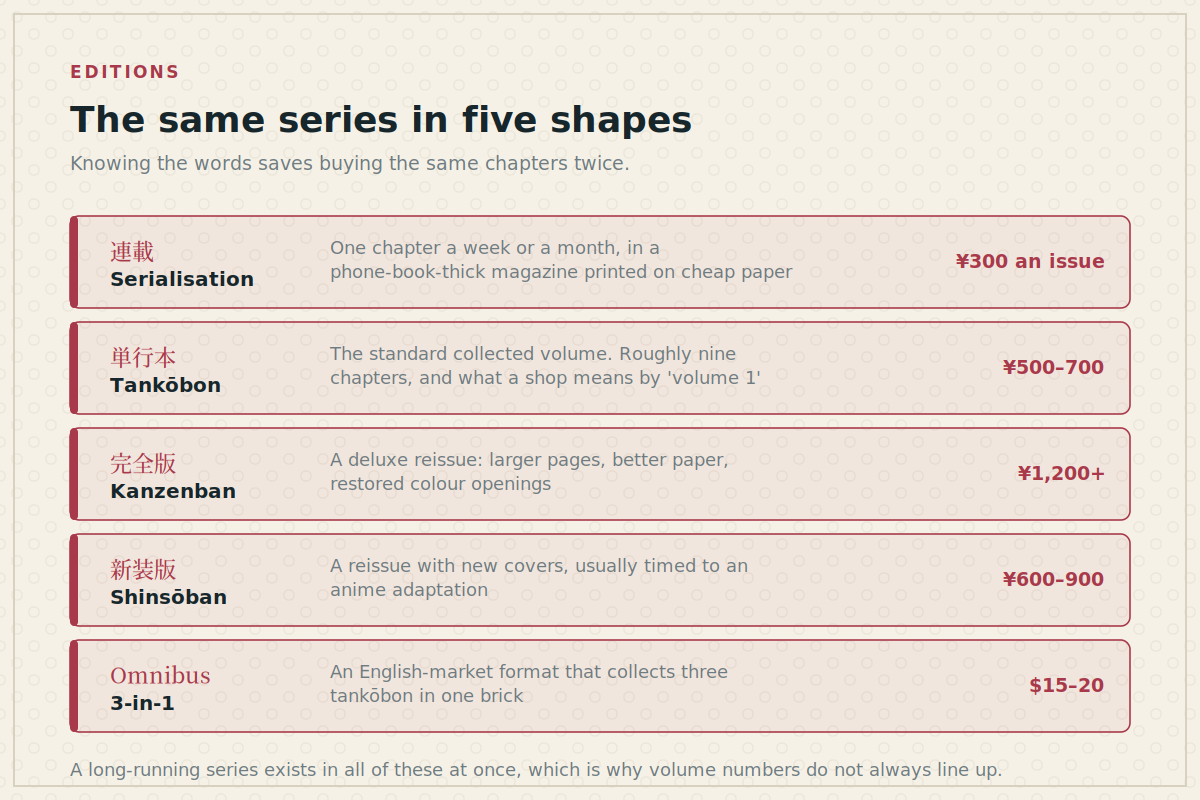
A long-running series exists in several formats at once, and the volume numbers do not line up between them.
連載 serialisation. One chapter at a time in a weekly or monthly magazine — thick, cheap, printed on coloured newsprint, and designed to be read on a train and left behind.
単行本 tankōbon. The standard collected volume, roughly nine chapters. This is what a shop means by “volume 1.”
完全版 kanzenban. A deluxe reissue: bigger pages, better paper, restored colour openings that the tankōbon printed in black and white.
新装版 shinsōban. A reissue with new covers, usually timed to an anime adaptation.
Omnibus editions, sold as 3-in-1 or similar, are an English-market invention that collects three tankōbon into one brick — good value, hard to hold.
Where to start, and the other kind of reading order
The phrase also means something else: in what order should you consume a franchise that exists as a manga, an anime, several films and a spin-off.
Three general rules that hold up more often than not.
- The manga is usually the author’s version. An anime adaptation is made by a different studio, often while the manga is still running, and has to fill time.
- Anime that catch up to an ongoing manga either invent material or stop. The invented material is called filler, and it is generally skippable — episode lists marking it are easy to find.
- Adaptations that started later are usually more faithful, because the source was finished when they began. A remake of an older series is frequently the closer version.
The pragmatic answer for most people: watch the anime first, because it is easier, then read the manga from roughly where the anime diverged. You lose some surprise and gain the version the author actually drew.
The anime is an adaptation with a broadcast schedule. The manga is what the author drew. Neither is automatically better, but only one of them had to fill twenty-four minutes a week.Why the two versions differ
Sound effects, and why they are still in Japanese
One of the more visible translation decisions on the page.
Japanese has an unusually large inventory of mimetic words — 擬音語 for sounds and 擬態語 for states — and manga uses them as artwork, drawn into the panel rather than lettered into a balloon.
Publishers choose between three approaches: redraw them in English, which damages the art; leave them and print a small gloss beside them; or leave them entirely and expect the reader to cope. Most modern releases do the second.
The single best example of why this is hard: しーん shīn is the sound effect for silence. Japanese has a written sound for nothing happening, and English simply does not.
Vertical text, and what it means for the page
The text inside a manga speech balloon runs vertically, in columns from right to left, which is why balloons in manga tend to be tall and narrow rather than wide and round.
That shape is not a style choice. It is the container fitting the writing, and it is one of the reasons a translated page can look subtly off — English text is horizontal and has to be fitted into a balloon designed for columns, which is why letterers either reshape the balloons or set the English in unusually narrow blocks.
Where else vertical writing turns up in Japan, and how the direction works, is covered in our article on vertical Japanese writing.
A short glossary
| Term | Japanese | What it means |
|---|---|---|
| Mangaka | 漫画家 | The manga author, who usually writes and draws |
| Shōnen | 少年 | Aimed at boys. A demographic, not a genre |
| Shōjo | 少女 | Aimed at girls, same caveat |
| Seinen | 青年 | Adult men |
| Josei | 女性 | Adult women |
| Doujinshi | 同人誌 | Self-published work, including fan work |
| Oneshot | 読切 | A standalone chapter, often a pilot |
The demographic labels are worth understanding, because English readers routinely take them as genre descriptions. Shōnen tells you which magazine a series ran in, not that it is for children — plenty of shōnen series are considerably darker than plenty of seinen ones.
Reading it in Japanese
Manga is a reasonable place to start reading Japanese, for one specific reason: series aimed at younger readers print furigana above every kanji, so you can read anything as long as you know kana.
Look for the word 総ルビ on a volume, which means furigana throughout. Most shōnen and shōjo titles qualify; seinen titles usually do not.
The writing systems themselves, and why a language ended up needing three at once, are explained in how Japanese writing works. And what the printed page can carry that a subtitle cannot — translation notes, furigana glosses, jokes built on kanji — is part of what gets lost between formats, alongside the honorifics in our article on how characters address each other.