You’ve got your name in katakana and you want to put it on something — a wish strip at a summer festival, a place card, a piece of calligraphy, the Japanese side of a business card. All of those run vertically, and vertical is not the same text turned sideways.
Several characters change orientation. Punctuation moves. The reading order of columns runs the opposite way from what you’d guess. This guide covers what actually changes, and how to lay your own name out correctly by hand.
Two systems, both current
Japanese has written vertically for most of its history and horizontally for about a century and a half. Both are alive in 2026, and which one you use is a matter of context rather than formality.
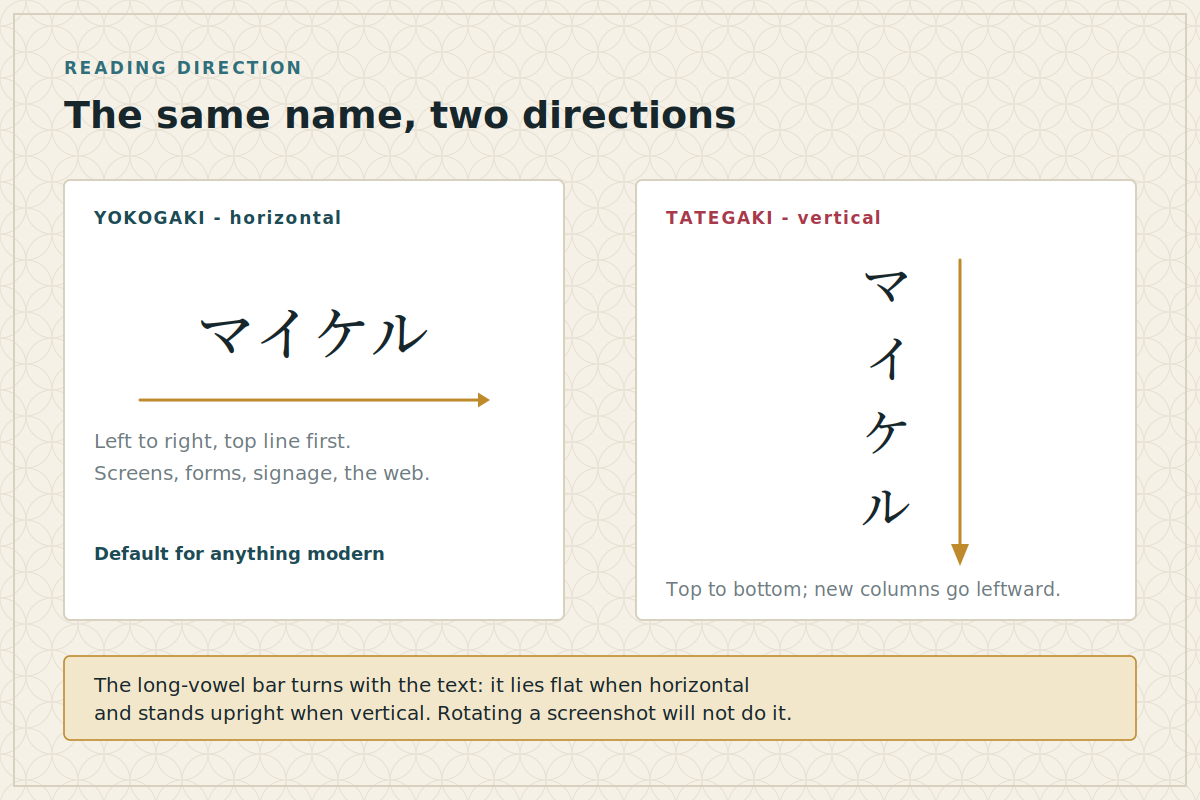
Horizontal — yokogaki, 横書き — is the default for anything digital, anything with numbers or Latin script mixed in, forms, signage, and the web. It reads left to right, lines stacking downward, exactly as English does.
Vertical — tategaki, 縦書き — is the default for literature, newspapers, calligraphy, formal correspondence, and most printed books. Characters run top to bottom, and when a column is full the next one starts to the left. That last detail catches people out: a vertical Japanese book opens from what an English reader would call the back.
What changes when you turn the page
This is the part that separates a correct layout from a rotated screenshot.
The long-vowel bar stands up
The chōonpu ー, the mark that holds a vowel for an extra beat, is a horizontal stroke in horizontal text and a vertical stroke in vertical text. It always runs along the direction of writing. So Michael, マイケル, has no bar and looks the same either way — but Taylor, テイラー, ends in a stroke that lies flat horizontally and stands upright vertically.
This single mark is the most common giveaway. If you see vertical Japanese with a flat dash floating in the middle of a column, someone rotated an image instead of setting the text.
Small characters shift corner
The small ッ, ャ, ュ, ョ and the small vowels sit low-left in a horizontal line. In vertical text they move to the upper-right of their cell. Charlotte, シャーロット, contains two of them, so it changes in two places going vertical — plus the bar, which makes three.
The middle dot stays put
The interpunct ・ that separates a given name from a surname keeps its central position and simply becomes a break in the column. マイケル・スミス written vertically is one continuous column with a small dot between the two parts, not two columns.
Numbers usually switch to kanji
Arabic numerals in vertical text either rotate as a group or get replaced by kanji numerals: 二〇二六 rather than 2026. For a name this rarely matters, but it’s why a vertical date on a formal card looks unfamiliar.
Where you’ll actually meet it
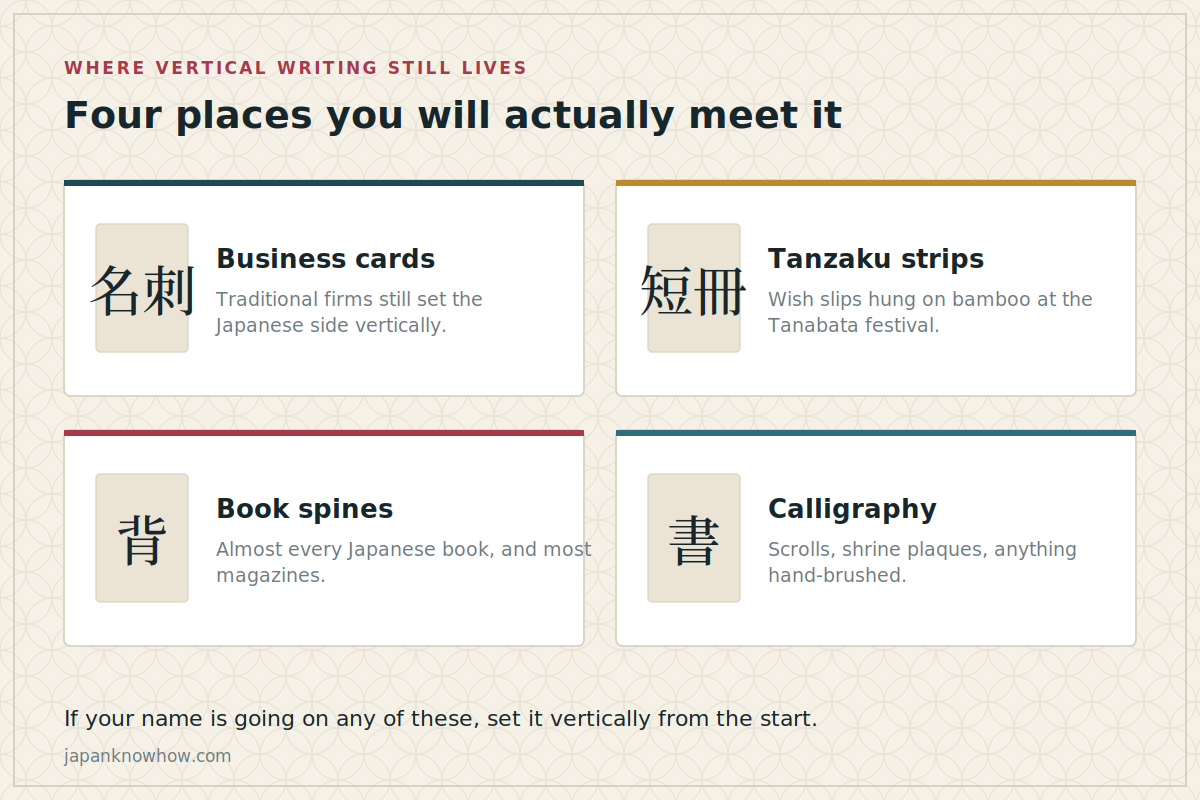
The list is shorter than it used to be, but each item on it is one you’re likely to run into:
- Business cards. Traditional companies still set the Japanese face vertically. The Latin face stays horizontal, which is why a Japanese meishi often reads in two directions on two sides.
- Tanzaku. The paper strips hung on bamboo at Tanabata in July carry a wish written vertically, usually in a single column. If you write one as a visitor, this is the format.
- Book spines and covers. Almost universal, and the reason a shelf of Japanese books reads bottom-to-top to a Western eye.
- Calligraphy and shrine plaques. Anything hand-brushed, including the wooden ema plaques you hang at a shrine.
- Formal letters and envelopes, and vertical menus in older restaurants.
Laying out your own name by hand
If you’re writing a tanzaku or an ema, here’s the practical sequence.
| Step | What to do | Common mistake |
|---|---|---|
| 1 | Count your characters, including the bar and any small kana | Forgetting the bar takes a full cell of its own |
| 2 | Divide the strip height by that count to get even cells | Starting large and running out of room |
| 3 | Start at the top, centred in the column | Drifting left or right as you go down |
| 4 | Turn the bar upright; move small kana to upper-right | Copying the horizontal form exactly |
| 5 | If you need a second column, start it to the left | Continuing to the right, as in English |
One more thing worth knowing: every character occupies the same square cell, whatever its shape. Japanese type is monospaced by design, so ル and 縦 take exactly the same width. Even cells are most of what makes handwriting look competent, which is why practice paper is printed as a grid.
Rotating a screenshot will not do it. The characters change, not just the direction.The rule that catches almost everyone
Getting it out of a computer
If you need vertical text digitally rather than by hand, three routes work in 2026:
- CSS. writing-mode: vertical-rl is supported in every current browser and handles the character substitutions properly. This is what our name pages use for the vertical sample.
- Word processors. Japanese-language versions of the major office suites have a vertical text direction option; English-language versions often don’t expose it.
- Design software. Adobe applications have a vertical type tool, but it only behaves correctly with a genuine Japanese font — a Latin font with a few kana bolted on will not substitute the punctuation.
What doesn’t work: rotating a text box, adding line breaks between every character, or exporting a horizontal image and turning it 90 degrees. All three produce something a Japanese reader can decode and immediately identify as wrong.
Before you commit
Vertical layouts tend to show up at exactly the moments that are hard to undo — a brushed piece, an engraved gift, a card you’re handing to someone. So get the katakana settled first: our guide to writing your name in Japanese covers the spelling, and it’s worth checking whether yours is one of the names whose established spelling differs from the rules, because a beautiful vertical rendering of the wrong spelling is still the wrong spelling.
And if the piece is permanent, the advice on our tools page applies here too: have a native speaker look at the final layout, not just the text. Orientation errors are invisible to the person who made them and obvious to everyone else.