Every guide to Japan mentions that convenience store food is “surprisingly good,” which undersells it and misses the point. It is not surprisingly good for a petrol-station shop. It is good, full stop, and it is what a large share of the country eats for breakfast and lunch.
There is a specific reason for that, and it is worth understanding before you order.
Why it is good
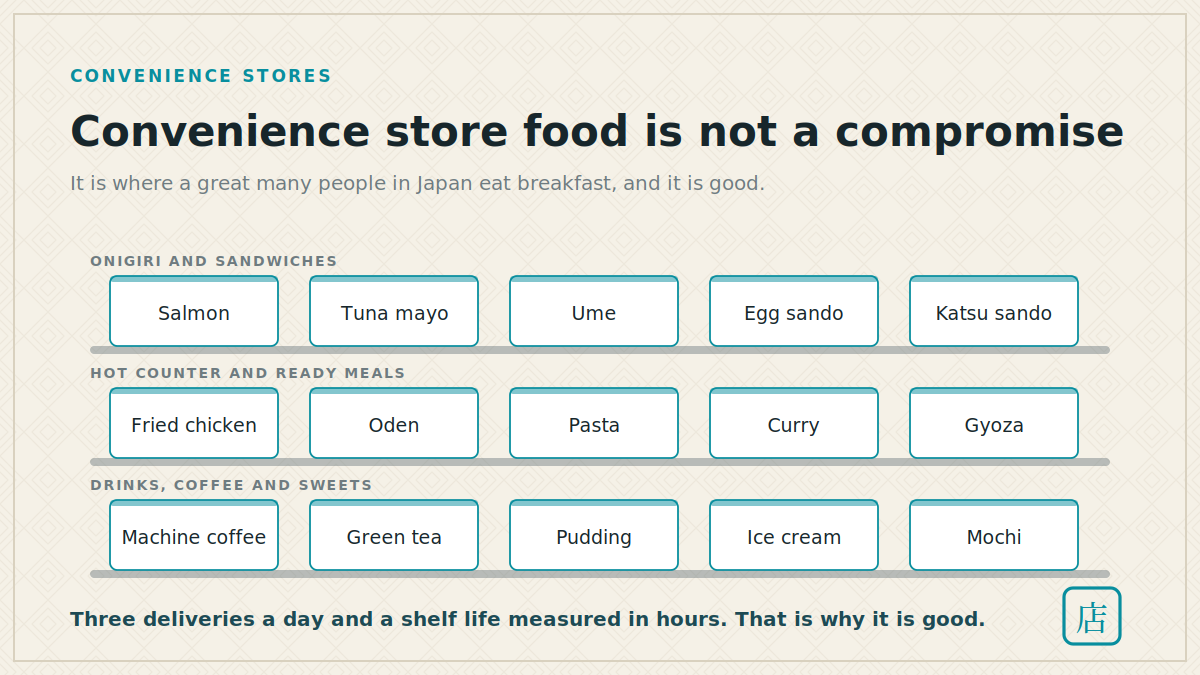
A Japanese konbini takes fresh deliveries around three times a day, and the food is made to a shelf life measured in hours rather than days. Anything unsold at the end of its window is pulled.
That changes what is possible. A sandwich that has to last five days needs preservatives and a formulation built around stability. A sandwich that will be discarded tonight can be made like a sandwich.
Add to that three chains with roughly equal share competing directly — 7-Eleven, FamilyMart and Lawson — across more than fifty thousand stores, on private-label products they develop themselves. The competition happens at the level of the egg sandwich, and it shows.
What to buy
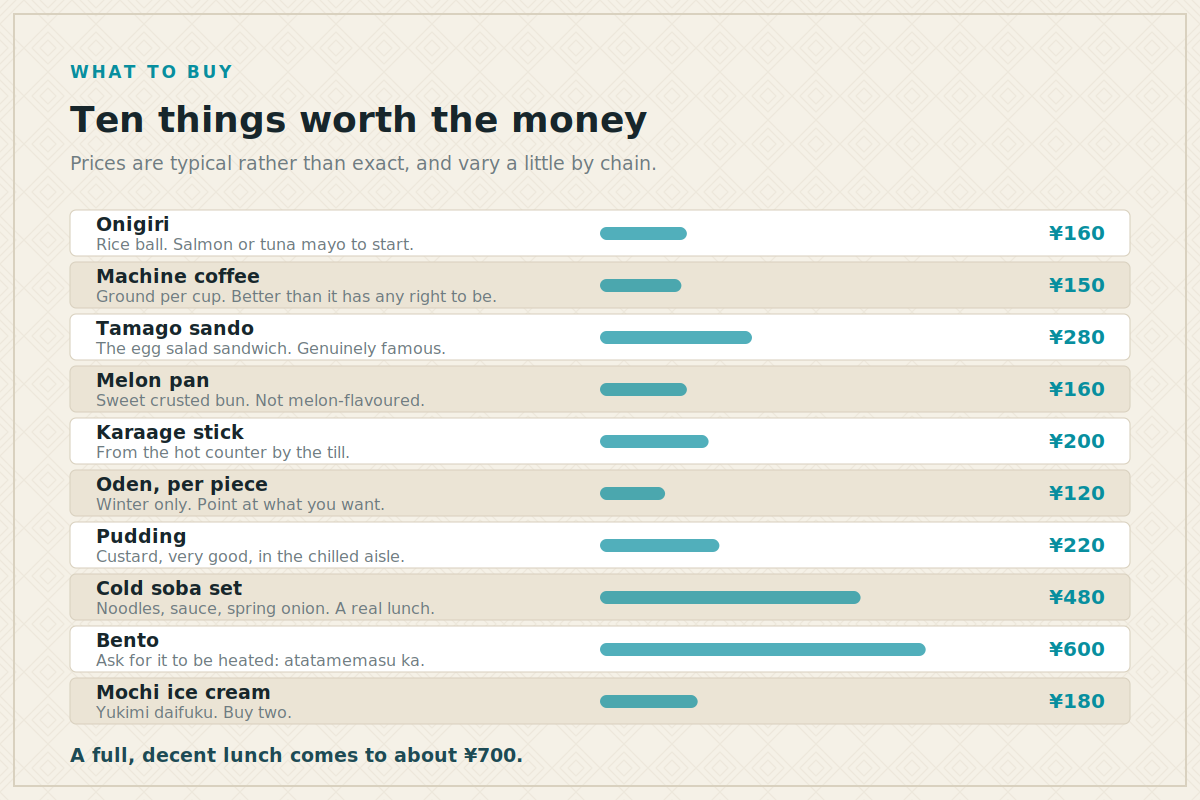
Onigiri — the rice ball, and the thing to start with. Salmon (sake) and tuna mayonnaise (tuna mayo) are the safe openers; pickled plum (ume) is sharp and salty and an acquired taste. About ¥160.
The egg salad sandwich — tamago sando, and specifically the 7-Eleven one, which has a small international reputation it has earned. Soft crustless white bread, egg mayonnaise, nothing else.
Machine coffee — ground per cup, roughly ¥150, and better than most café coffee at three times the price. Buy the cup at the till, then use the machine yourself.
Beyond those:
- Fried chicken from the hot counter — FamilyMart’s Famichiki and Lawson’s Karaage-kun are the famous ones.
- Oden in winter — a vat of dashi by the till with fishcakes, daikon and eggs simmering. Point at what you want.
- Bento — say yes when asked “atatamemasu ka,” which means “shall I heat it?”
- Cold soba or udon sets — genuinely a proper lunch for under ¥500.
- Pudding and mochi ice cream — the desserts are a whole category. Yukimi Daifuku is ice cream wrapped in mochi and it is very good.
The onigiri wrapper
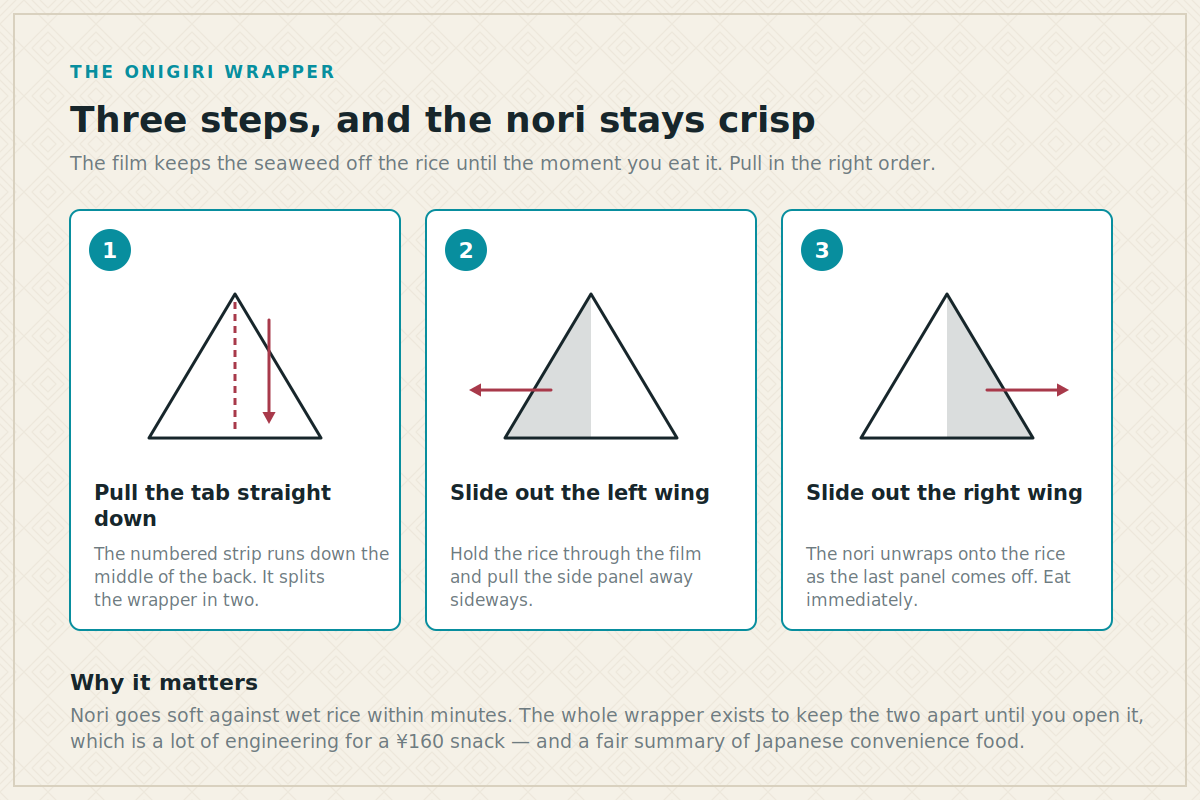
This defeats a lot of visitors, and the failure mode is tearing the whole thing apart and eating a rice ball with shreds of plastic in it.
The design solves a real problem: nori goes limp against wet rice within minutes, so the sheet is held in a separate film layer until the moment you open it.
- Pull the numbered tab straight down. It runs down the middle of the back and splits the wrapper into two halves.
- Slide the left panel out sideways, holding the rice through the film.
- Slide the right panel out. The nori wraps itself onto the rice as the last layer leaves.
Then eat it fairly quickly, because the clock has started.
The store does more than sell food
This is the part that genuinely helps a traveller, and almost nothing written for visitors covers it.
| What | Why it matters to you |
|---|---|
| ATMs | 7-Eleven’s take foreign cards, 24 hours, in English. The most reliable cash in Japan |
| Toilets | Free, clean, and everywhere. Ask at the counter if the door is marked |
| Printing and scanning | Print a boarding pass or a booking confirmation from your phone |
| Parcel drop-off | Send a suitcase to your next hotel with takkyubin |
| Ticket machines | Concerts, museums, theme parks, buses |
| Free wifi | Reliable, and useful when an eSIM misbehaves |
The luggage forwarding is the sleeper. A suitcase from a Tokyo konbini to a Kyoto hotel costs about ¥2,000 and arrives the next day, which turns a miserable train transfer into a pleasant one.
Telling the three chains apart
They are more distinct than they look, and Japanese people have firm opinions.
7-Eleven is generally considered strongest on food, particularly the sandwiches, the onigiri and the coffee, and its ATMs are the ones that reliably accept foreign cards.
Lawson runs a premium bakery line and the Karaage-kun fried chicken, and its Natural Lawson branches lean healthier.
FamilyMart has Famichiki, a cult item, and generally the best hot counter.
All three are within a few minutes’ walk of wherever you are standing in a Japanese city, so the practical answer is to use whichever you can see.
A sandwich that will be thrown away tonight can be made like a sandwich. That is the entire explanation, and it is not really about Japan being magical.Why konbini food works
How to actually buy things
Four notes, all trivial and all things visitors get stuck on.
“Atatamemasu ka?” means “shall I heat this up?” Say hai for yes, and if you have no idea what was asked, hai is almost always the right answer at a konbini counter.
The bag question. Since bags became chargeable you will be asked whether you want one. Fukuro wa irimasen means no thanks.
Chopsticks and spoons come with anything that needs them, unasked.
Payment. Cards, IC cards and QR codes all work everywhere. Put money on the little tray rather than into the cashier’s hand.
Where you can eat it
Some stores have a small counter with stools. Otherwise, eating standing outside the shop is normal, and hotel rooms are the other obvious answer.
What is mildly frowned on is eating while walking down a busy street. It is not a hanging offence and the rule has softened, but the local habit is to stand still, eat, and then move — which is also why there are bins inside the shop and almost none outside it. The wider question of which Japanese etiquette rules carry weight is in our etiquette guide.
Seasonal things worth watching for
The konbini calendar is real, and it is one of the more charming things about living in Japan.
- Spring — sakura everything. Pink mochi, sakura latte, cherry blossom KitKat.
- Summer — cold noodle sets, shaved ice, salt-and-lychee drinks for the heat.
- Autumn — chestnut and sweet potato, in every possible form.
- Winter — oden by the till, nikuman steamed buns, and hot drinks in the warmer cabinet.
Christmas produces a specifically Japanese phenomenon: konbini and chains selling reserved fried chicken and small cakes, which is how a great many Japanese households mark 25 December.
If you cannot eat something
Packaged food is actually the easier case in Japan, because the labelling law applies to it — eight allergens must be declared on the pack, and the ingredient list is complete.
The catch is that it is in Japanese. A translation app’s camera mode handles it, and the characters worth recognising by sight are set out in our article on allergies and vegetarian eating. Restaurant food, where nothing has to be declared, is the harder half.
For the rest of what to eat in Japan and how to read a menu, start with our beginner’s guide to Japanese food.