Ask what kind of ramen someone likes and you will get an answer like “tonkotsu” or “shoyu,” as if those were points on one scale. They are not on the same scale at all. One is a soup and the other is a seasoning, and they combine freely.
That is why “tonkotsu shoyu” is a real and common thing rather than a contradiction, and why the usual beginner’s explanation of ramen falls apart the moment you look at an actual menu.
Four variables, not one
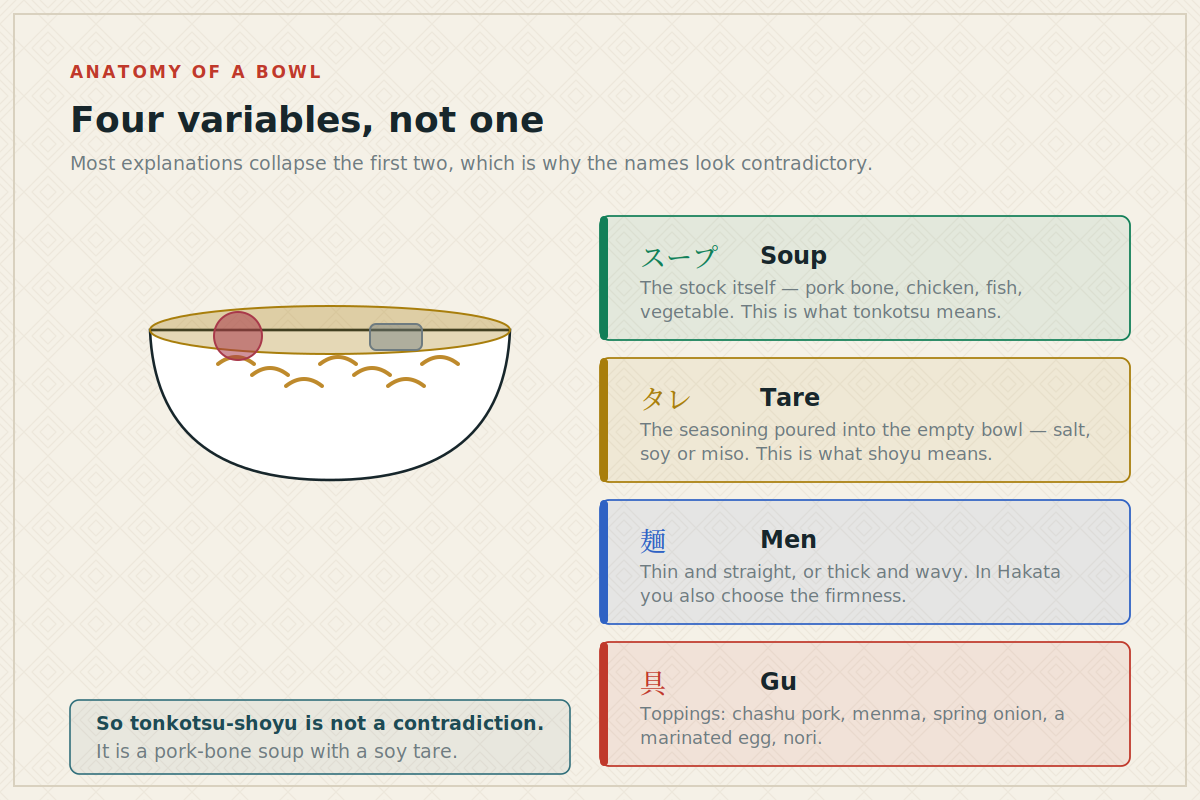
A bowl of ramen is assembled from four components, and each is chosen independently.
スープ sūpu, the soup. The stock itself — pork bone, chicken, dried fish, kelp, vegetables, or a blend. This is what tonkotsu refers to: a stock boiled hard from pork bones until the collagen emulsifies and it turns opaque white.
タレ tare, the seasoning. A concentrated liquid ladled into the empty bowl before the soup goes in. This is what shio, shoyu and miso refer to — salt, soy sauce, fermented bean paste. The tare is where most of the salt and most of the character comes from, and it is the part shops keep secret.
麺 men, the noodles. Thin and straight, thick and wavy, flat and rippled. Made with alkaline water, which is what gives ramen noodles their colour, bite and faint smell.
具 gu, the toppings. Chashu pork, menma bamboo shoots, spring onion, a marinated soft-boiled egg, sheets of nori.
Once the first two are separated, the naming stops being confusing. A Hakata bowl is tonkotsu soup with a salt tare. A Yokohama iekei bowl is tonkotsu soup with a soy tare. Both are “tonkotsu”; they taste substantially different.
Eight regional styles
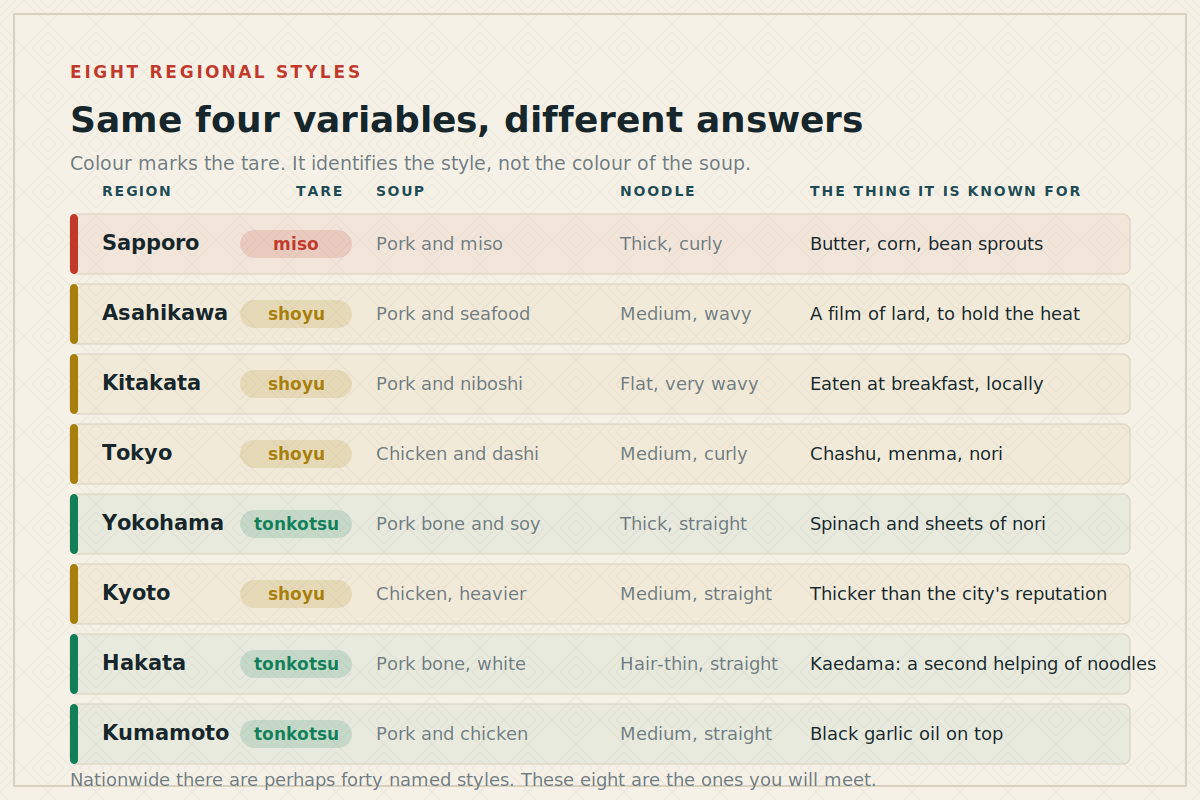
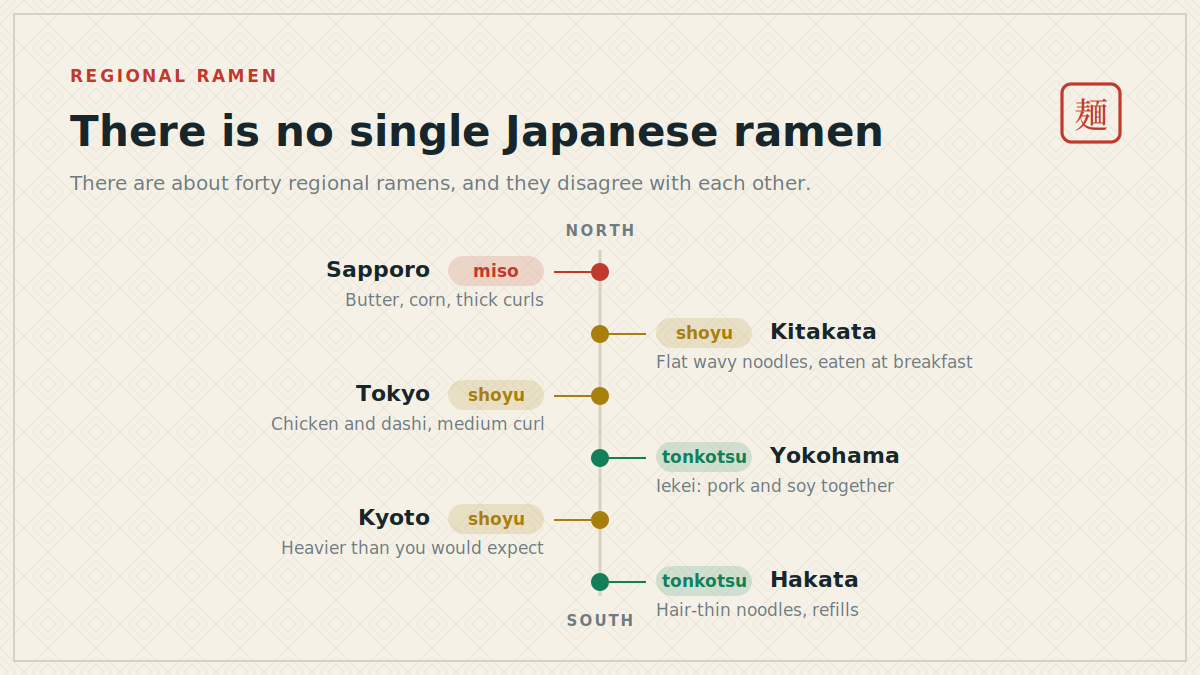
Sapporo — miso. Invented in the 1950s, rich and heavy for a cold climate, with thick curly noodles, sweetcorn, bean sprouts and often a slab of butter melting on top. Hokkaido’s contribution to the canon and the reason miso ramen exists at all.
Asahikawa — shoyu, with a layer of lard floating on the surface. That is not a mistake; it is insulation, and in a city that reaches minus twenty it keeps the bowl hot to the last mouthful.
Kitakata — a small town in Fukushima with an extraordinary density of ramen shops and flat, very wavy noodles. Locals eat it at breakfast, a habit with its own name, asa-rā.
Tokyo — the classic: chicken and dashi stock, soy tare, medium curly noodles, chashu and menma and nori. This is the bowl most people picture.
Yokohama — iekei, a hybrid invented in 1974: tonkotsu soup with a soy tare, thick straight noodles, spinach and a stack of nori sheets. You are meant to dunk the nori and wrap it round rice.
Kyoto — heavier and richer than the city’s refined reputation suggests, which is a small joke Kyoto enjoys.
Hakata — Fukuoka’s tonkotsu, milky white, with hair-thin straight noodles that cook in seconds. Two institutions come with it, below.
Kumamoto — tonkotsu with mayu, a black oil of burnt garlic drizzled on top.
The two Hakata institutions
替え玉 kaedama — a second helping of noodles. Because Hakata noodles are so thin they go soft fast, they are served in small portions and you order more mid-bowl, dropped straight into your remaining soup. Say “kaedama kudasai” while there is still broth left. It costs ¥100 to ¥200.
Noodle firmness is a question you will be asked. The scale runs from soft to almost raw:
| Japanese | Reading | What it means |
|---|---|---|
| やわ | yawa | Soft |
| 普通 | futsū | Normal — the safe answer |
| かため | katame | Firm |
| バリカタ | barikata | Very firm |
| ハリガネ | harigane | “Wire.” Barely cooked |
Order futsū the first time. If you plan to have a kaedama, order katame, because the noodles keep softening in the bowl.
Forms that are not regional
Tsukemen — the noodles and the soup arrive separately, and you dip. The soup is concentrated and much saltier, because it is not being eaten as soup. At the end you can ask for sūpu-wari, hot stock to dilute what is left so you can drink it.
Abura soba or mazesoba — no soup at all. Noodles, tare and oil in the bottom of the bowl, mixed hard before eating.
Tantanmen — the Japanese descendant of Sichuan dan dan noodles, with sesame and chilli, usually milder than the original.
Tonkotsu is a soup. Shoyu is a seasoning. Once you stop treating them as rival answers to the same question, every ramen menu in Japan becomes legible.The distinction that unlocks it
How to eat it
Six practical notes.
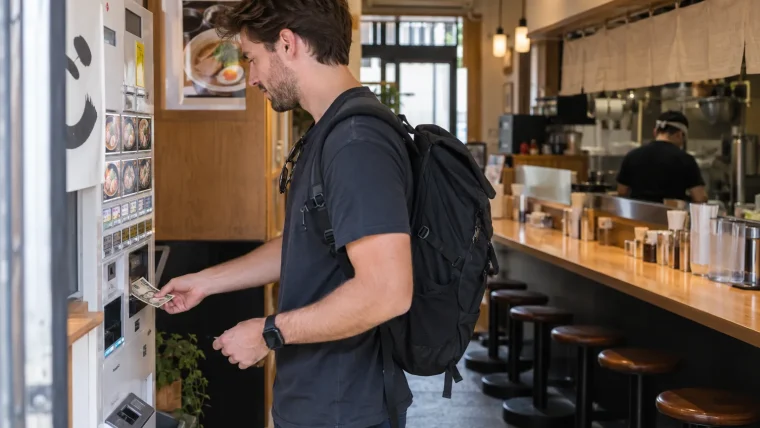
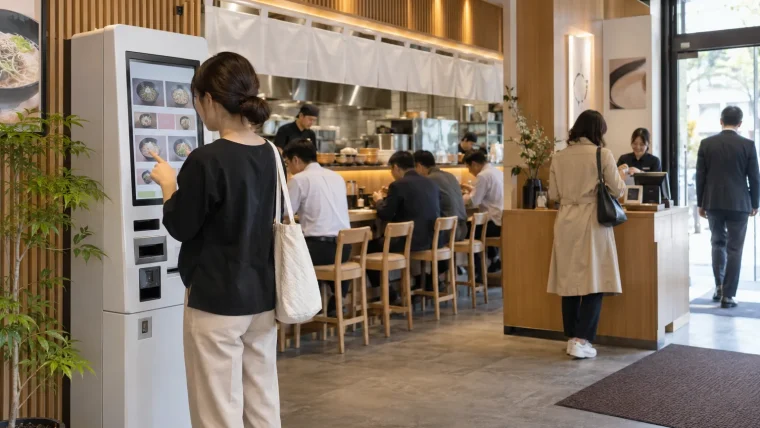
- Buy a ticket first. Most ramen shops have a vending machine by the door. Top-left is usually the house standard.
- Eat quickly. Noodles keep cooking in hot broth and the texture degrades within minutes. This is why nobody lingers.
- Slurping is functional, not just permitted — it cools the noodles and draws broth with them.
- Use the renge, the flat-bottomed spoon, for the soup. Alternate.
- You do not have to finish the broth. It is extremely salty and finishing it is a compliment, not an obligation.
- Do not linger afterwards. Counter seats are the shop’s entire capacity. Eat, pay, go.
Finding a good one
The signals are unglamorous and reliable. A queue of people on their own, at lunchtime, made up of workers rather than tourists. A shop that sells one thing. A vending machine with few buttons. Steam on the windows.
Tabelog is what locals use, and its scale is compressed — anything above 3.5 is genuinely very good, and above 3.8 is exceptional. Applying American review-site instincts to those numbers will make you dismiss the best shop on the street.
Ignore the ranking lists in English. They point everyone at the same four shops in Tokyo, where you will queue for ninety minutes for a bowl that is no better than the one in the arcade near your hotel.
A note on the price
A bowl runs ¥900 to ¥1,300, and shops have been raising prices reluctantly for years against rising wheat, pork and energy costs. There is a well-documented psychological barrier around the ¥1,000 mark that many owners have been unwilling to cross, sometimes to the point of going out of business rather than raising the price.
Which is worth knowing when you look at a bowl that took twelve hours of stock-making and costs less than a sandwich at the airport.
The rest of the menu vocabulary — and the six characters that decode most Japanese dishes — is in our beginner’s guide to Japanese food. And if you cannot eat pork or fish, note that almost every bowl above contains one or both, including several that do not sound like it; our article on eating with restrictions covers what to do.