The decision is not simply whether to buy a goshuin book. You must choose between bringing a dedicated book, buying one at your first religious site or accepting separate prewritten sheets, and getting that decision wrong can leave you carrying the wrong notebook, arriving after the desk closes or asking for a religious item before you have worshipped. The right option depends mainly on three factors: how many shrines and temples you intend to visit, whether you want calligraphy written directly onto bound paper and how tightly your schedule is planned. Cost matters, but the difference is usually smaller than the time lost by building a route around closed or crowded reception desks.
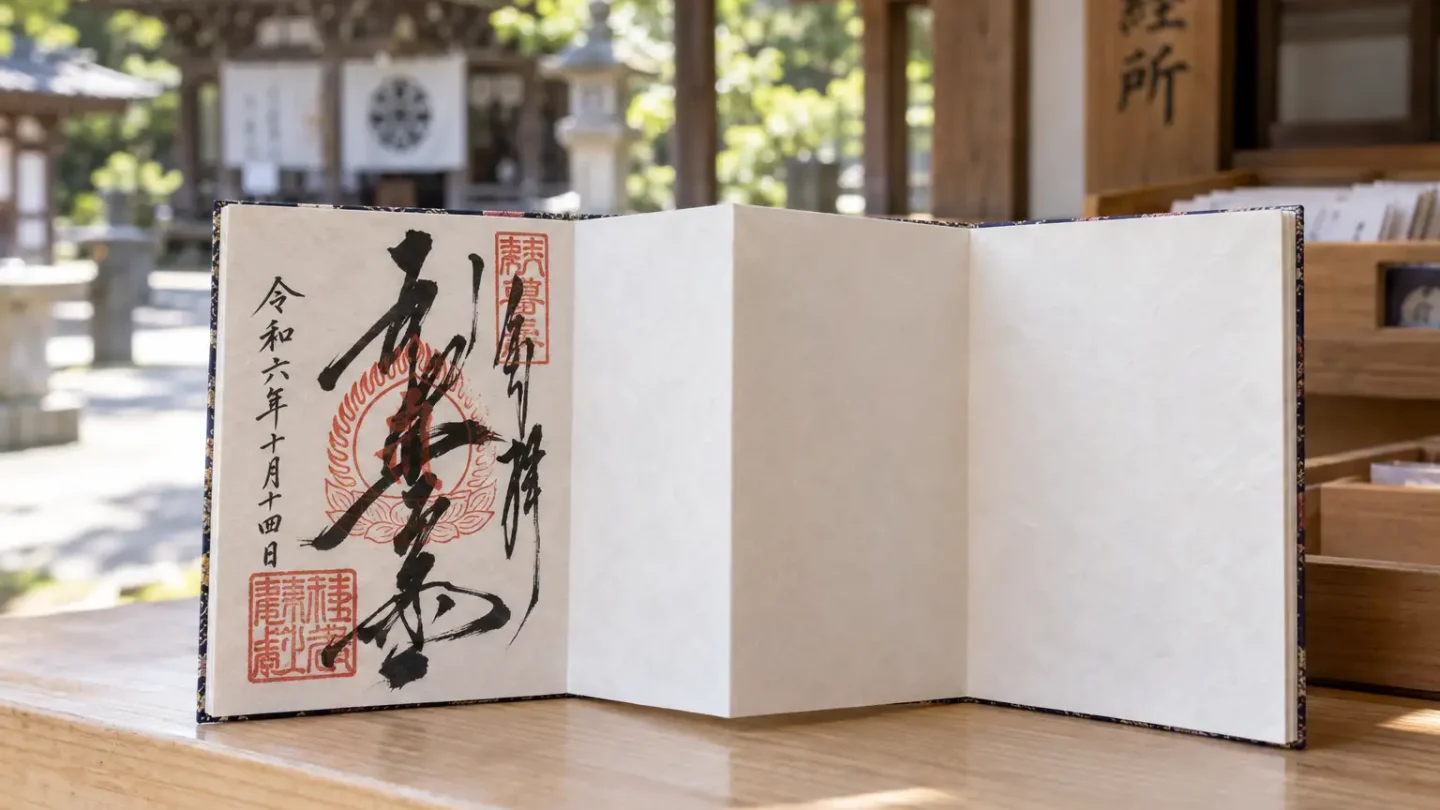
A 御朱印, goshuin, literally “honorable vermilion seal,” is not an ordinary tourist stamp. Jinja Honchō, the Association of Shinto Shrines, describes it as evidence of a shrine visit and traces its background to written receipts issued when copied sutras were presented to religious institutions. A modern entry commonly combines one or more red seals with black calligraphy naming the shrine, temple, deity, sacred figure or hall, plus the date. Some places write directly into your book, while others provide 書き置き, kakioki, “written in advance,” on a separate sheet. The receiving institution—not a travel blog—decides the format, hours, offering and conditions.
Bring a dedicated book when the visits matter more than the cover
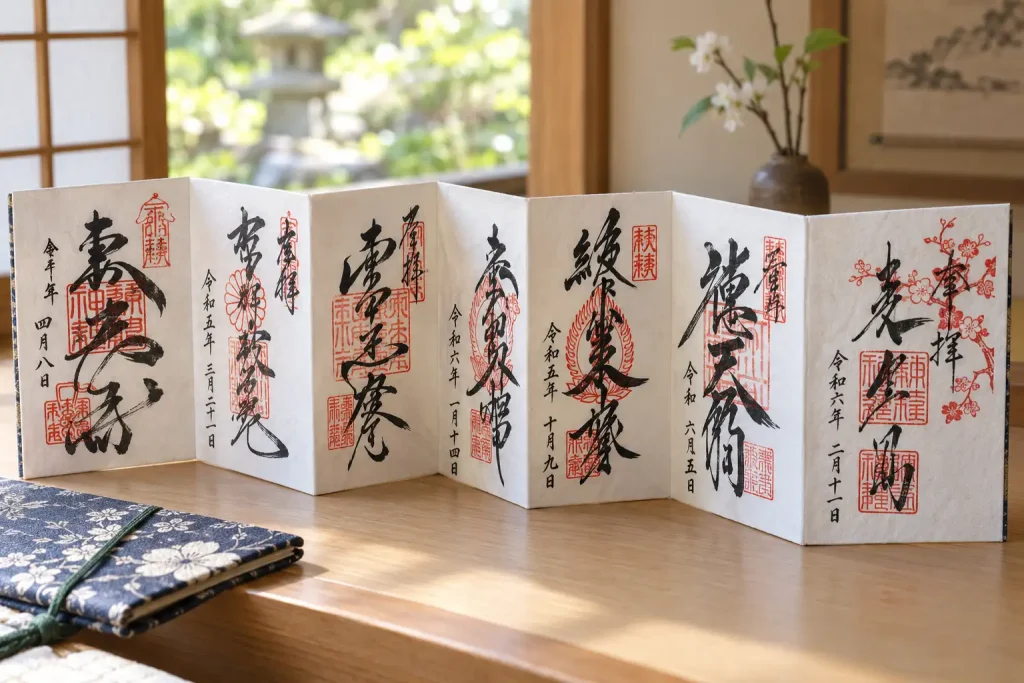
Buying a blank book before your trip gives you control over its size, binding and first page. It suits a traveler who already knows that several religious sites are part of the itinerary and does not want to spend the first morning comparing designs. A proper 御朱印帳, goshuinchō, “goshuin notebook,” normally opens in accordion folds so calligraphy can be written across a flat surface. Bring it in clean condition and reserve it for goshuin rather than railway stamps, museum impressions, stickers or travel journaling.
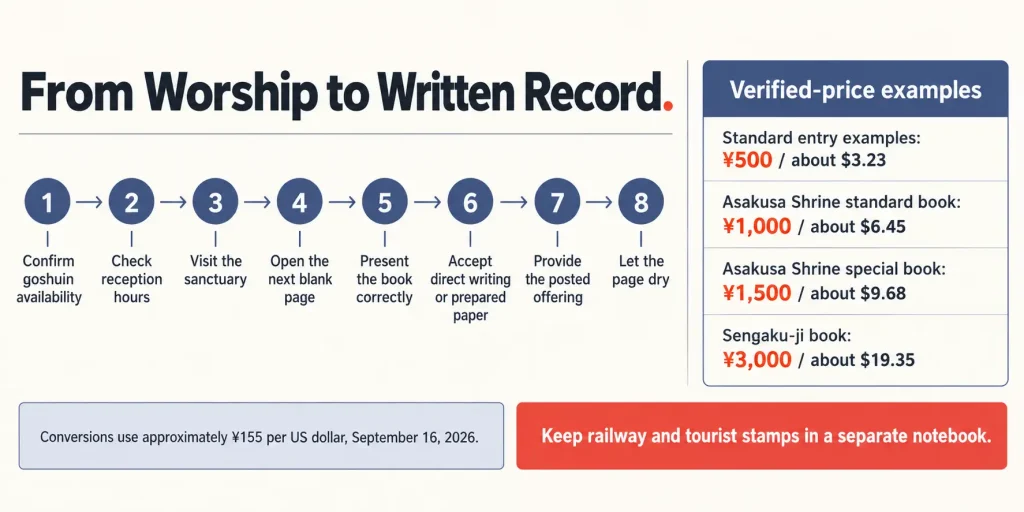
The cost consists of the book purchased in advance plus the offering requested at each site. The brief’s ¥300–500 range should no longer be treated as a universal current price. Official 2026-accessible pages show ¥500 as the standard offering at Chion-in, Hōryū-ji and Kanda Myōjin, while special or elaborate versions elsewhere may cost more. At the September 16, 2026, market rate of approximately ¥155 per US dollar, ¥500 is about $3.23. Exchange rates move, so dollar figures are approximate and should be refreshed near publication.
What this option gets you is an uninterrupted chronological record from the first visit. It also avoids pressure to purchase whichever cover happens to be available at a crowded desk. However, bringing a book does not guarantee direct calligraphy. Kanda Myōjin’s official offering page, for example, states that its goshuin is supplied on prepared paper rather than written into the visitor’s book. A prewritten sheet is still the institution’s authorized goshuin.
This option fits:
- A traveler planning several shrine or temple visits.
- Someone who wants one consistent book from the beginning.
- A visitor who is comfortable checking each institution’s current procedure.
- Someone willing to accept prewritten sheets when direct writing is unavailable.
The religious context comes before the collecting system. How Shinto and Buddhism Actually Show Up explains why shrines and temples can both issue goshuin while remaining different institutions. If you are unsure which kind of place you have entered, Jinja vs Otera: The Five-Second Test identifies the visible distinctions. Knowing the difference prevents you from using shrine worship gestures automatically at a Buddhist temple.
Buy your first book at a shrine or temple
Purchasing the book at your first stop gives the collection a clear starting place. This suits a first-time visitor who wants a cover associated with a particular shrine or temple and prefers staff guidance over choosing online. The book is separate from the goshuin offering unless the institution explicitly states otherwise. Some places will not sell the book by itself because it is intended to receive an entry as part of the visit.
Official prices show why “a goshuin costs ¥500” does not describe the full starting expense. Asakusa Shrine lists standard books at ¥1,000, approximately $6.45 at the cited exchange rate, and special books at ¥1,500, approximately $9.68. It states that books are not distributed without a goshuin being entered. Sengaku-ji lists its own book at ¥3,000, approximately $19.35, and connects the goshuin process with copying and presenting a short Buddhist text. These are examples, not national price limits.
| On-site choice | Verified price | Approximate USD | What the amount covers |
|---|---|---|---|
| Asakusa Shrine standard book | ¥1,000 | $6.45 | The book; an entry is required with it |
| Asakusa Shrine special book | ¥1,500 | $9.68 | Special book design; an entry is required |
| Sengaku-ji book | ¥3,000 | $19.35 | Temple’s own goshuincho |
| Chion-in standard goshuin | ¥500 | $3.23 | One direct-written or prepared entry |
| Kanda Myōjin prepared goshuin | ¥500 | $3.23 | One prewritten sheet |
| Hōryū-ji listed goshuin | ¥500 | $3.23 | One listed goshuin during stated availability |
The advantage is provenance: the book itself records where the practice began for you. The disadvantage is uncertainty. Designs can sell out, distribution rules can change and the desk may not open when the grounds do. Meiji Jingū says its goshuin reception begins at 9:00 a.m. and continues until the day’s closing time, even though visitors may be able to enter the wider grounds earlier. Tōdai-ji likewise publishes different hours for buildings and goshuin desks, with some goshuin ending before the relevant hall closes.
If you choose this route, verify four items on the official website:
- Whether that institution currently issues goshuin.
- Whether it sells books and whether a goshuin is included or separate.
- Whether the entry is direct or prewritten.
- The current reception hours, including seasonal or event changes.
Do not arrive expecting a book because you saw one in an old social-media post. Covers change more often than the underlying practice. A limited design is not worth skipping the sanctuary or pushing ahead of other worshippers. If the book has sold out, accept the result and continue your visit.
Choose prepared sheets when time and handling matter
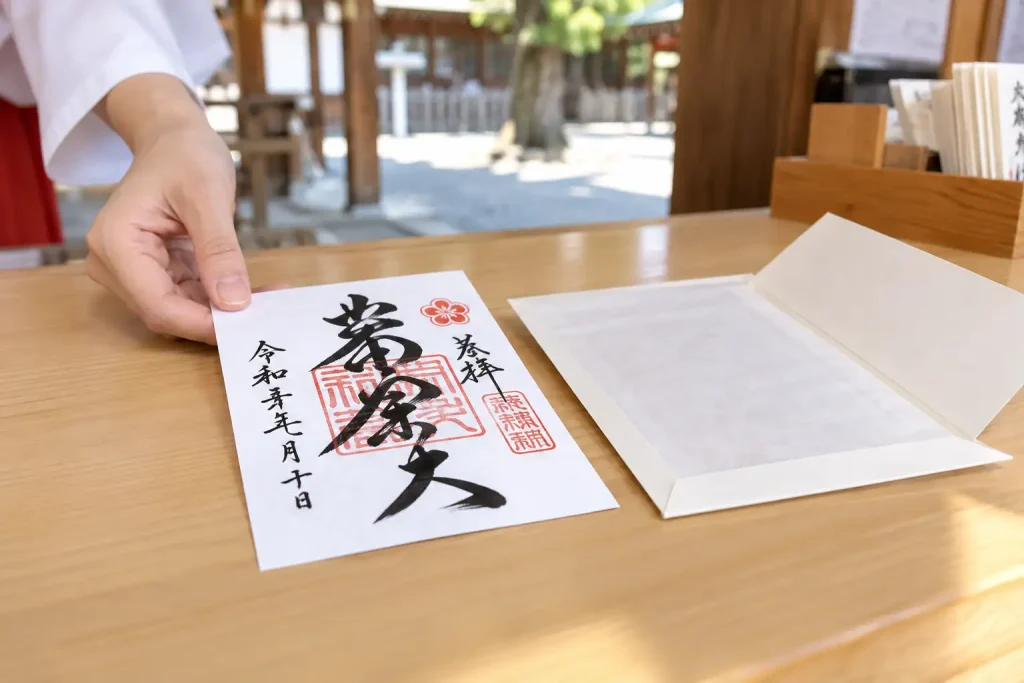
A prepared sheet is not a fake substitute. 書き置き may contain seals and calligraphy completed in advance, sometimes with the date added at distribution. You later mount it on a blank page in your book. This format allows a shrine or temple to serve visitors during busy periods, protects staff time and makes it possible to offer detailed or seasonal designs that are difficult to produce on demand.
This option suits a traveler who is staying in one city, visiting during a crowded event or unwilling to leave a valuable book at a reception desk. It also works when you have no book yet. Keep the sheet flat in a protective folder until it can be mounted properly. Do not fold it to fit a pocket, cut off the margins or cover the calligraphy with adhesive.
The cost is set by the institution. Kanda Myōjin currently lists its prepared goshuin at ¥500, about $3.23 at the cited rate, and explicitly says handwritten entries are unavailable. That single example corrects two common assumptions: a goshuin does not have to be produced in front of you, and carrying a book does not entitle you to direct writing. The authorized sheet is the available form.
| Deciding factor | Bring a book | Buy on site | Accept prepared sheets |
|---|---|---|---|
| Number of planned visits | Best for several visits | Best when one site should begin the collection | Works for one or many |
| Cover preference | Choose before traveling | Choose a design tied to the first site | No book required immediately |
| Direct calligraphy | Possible, never guaranteed | Possible, never guaranteed | Not expected |
| Schedule flexibility | Still requires desk-hour checks | Highest risk if books sell out or desk is closed | Often efficient during busy periods |
| Starting cost | Book price plus each entry | Site’s book plus entry | Usually only the sheet offering |
| Best fit | Planned collecting route | Meaningful first location | Short visit, crowds or uncertain availability |
The factor that flips the answer: how many real visits you have
The first threshold is not a magic page count. It is whether you have more than one or two genuine shrine or temple visits planned. If you are visiting only one temple during a food-and-neighborhood trip, buying a dedicated book solely to fill a single page may not be useful. Accept a prepared sheet if offered, or decide that the visit itself is enough. If religious sites form a recurring part of the trip, a dedicated book becomes practical because it protects and organizes the entries.
The second factor is whether direct writing is essential to you. If it is, you must research each location separately and accept that the answer may still change on the day. Staffing, crowds, ceremonies and special events can shift distribution from direct writing to prepared sheets. If you will feel disappointed by any prewritten entry, do not build a tight route around goshuin. The institution owes you neither custom calligraphy nor a particular design.
The third factor is time. Goshuin reception does not necessarily follow the site’s opening hours. A large complex may have several halls, separate desks and different cutoffs. At Tōdai-ji, published times vary by location, and one hall lists goshuin only until 4:00 p.m. Arriving shortly before closing can leave no reasonable time to worship first and then reach the correct desk. If your itinerary cannot tolerate that uncertainty, collect fewer entries.
The visit comes before the entry
A goshuin stamp is commonly described in English as a temple or shrine stamp, but that phrase hides its purpose. The Miyagi Prefecture Shrine Office says it is proof of worship, not a stamp rally, and instructs visitors to worship before requesting it. Asakusa Shrine likewise asks every recipient to visit the sanctuary either before or after receiving the entry. Sengaku-ji’s official procedure begins with worship and then adds a short sutra-copying and presentation process before the goshuin is completed.
At a Shinto shrine, use the institution’s stated worship procedure. Two Bows, Two Claps, One Bow: The Sequence explains the common pattern and its limits. At a Buddhist temple, do not clap simply because you performed that sequence at the previous stop. Bow or join your hands quietly according to the temple’s instructions. The entry records a visit to that religious place; it does not flatten Shinto and Buddhism into one collectible system.
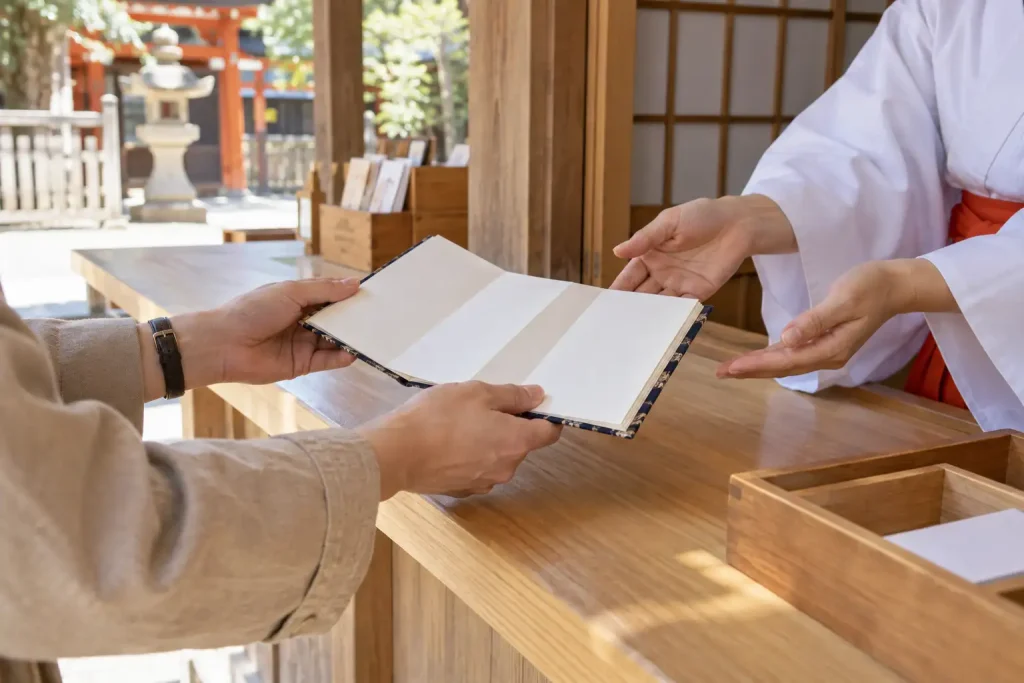
Present the book ready for writing:
- Open it to the next blank page.
- Confirm that the page is upright.
- Remove loose paper, receipts and bookmarks.
- Ask rather than demand a particular version.
- Have the stated offering ready in yen.
- Step aside and remain quiet while staff work.
- Accept direct writing or a prepared sheet according to the day’s procedure.
You may see the word 初穂料, hatsuhoryō, literally “first-fruits offering,” at a shrine, or 納経料, nōkyōryō, “sutra-presentation offering,” at a temple. In practical terms, the posted amount tells you what to provide. Treating it as an offering does not mean you may choose an arbitrary lower amount when a figure is displayed. It also does not mean a special edition must be available because you are ready to pay.
Three itineraries with the arithmetic shown
Consider a first-time visitor spending nine days across Tokyo, Kyoto and Nara. Four religious sites are genuine priorities, not quick detours for pages. Using Asakusa Shrine’s ¥1,000 standard book as the example and four ¥500 entries, the planned total is ¥3,000: ¥1,000 + (4 × ¥500) = ¥3,000, or approximately $19.35 at ¥155 per dollar. The answer is to buy the book at the first meaningful stop, but check every desk’s hours and accept prepared sheets where direct writing is not offered.
Now consider someone spending an entire trip in one city with two temple visits. Buying Sengaku-ji’s ¥3,000 book and adding two hypothetical ¥500 entries would produce a ¥4,000 total, about $25.81, but the second entry’s actual price and compatibility must be checked at its issuing institution. If the visitor mainly wants a record of those two visits, prepared sheets or a less expensive book may be more proportionate. The decision flips because the number of planned entries is low and the on-site book is comparatively expensive.
The third traveler is attending a major festival and has only one afternoon. Crowds and altered reception procedures are more important than cover design. The answer is to worship, accept the format currently offered and avoid queuing for multiple decorative versions. Japanese Festivals by Season: A Year-Round Guide explains how annual events affect visits without repeating goshuin procedure here. If the desk closes before you arrive, the correct result is no entry that day.
| Traveler | Calculation | Best choice |
|---|---|---|
| Nine-day, three-city first visit | ¥1,000 book + 4 × ¥500 = ¥3,000, about $19.35 | Buy at the first meaningful site |
| One-city visitor with two religious stops | Book cost + 2 verified local offerings | Compare on-site book price with prepared sheets |
| Festival visitor with one afternoon | Current entry amount only, if reception remains open | Accept the day’s available format |
| Traveler interested mainly in architecture | No goshuin cost required | Visit without starting a collection |
These examples are planning models, not national price promises. The ¥500 entry figures come from named official sources, while the hypothetical routes determine the multiplication. Admission fees are separate where a temple charges for entry to a hall or precinct. Transportation is also separate. Check the official pages again before relying on the totals.
Why the default choices waste money and time
The first mistake is buying a decorative notebook that is not intended for goshuin. Ordinary paper may bleed, bindings may not open flat and staff may decline to write in a book containing unrelated commercial stamps. Use a dedicated goshuincho. If you also collect railway and attraction stamps, carry a separate notebook. This is the simplest way to prevent an awkward discussion at the desk.
The second mistake is optimizing the route for entries rather than visits. A schedule that allows seven minutes per temple may produce more pages, but it leaves no time to understand where you are. The Miyagi shrine authority explicitly warns against making the goshuin the purpose and treating the practice as a stamp rally. Japanese Etiquette for Visitors: What Actually Matters covers the broader principle: pay attention to the place and the people using it instead of performing a memorized checklist.
The third mistake is assuming the ¥300–500 figure remains universal. Named official sources now commonly show ¥500 for a standard entry, while special formats, books and related procedures can cost more. A traveler carrying only exact ¥300 portions may simply be working from an outdated guide. Bring coins and ¥1,000 notes, then follow the amount displayed. Do not negotiate.
The fourth mistake is assuming that every religious institution issues goshuin. Some do not, and some Buddhist traditions may offer another kind of record or no collectible entry at all. A closed desk is not an invitation to knock on residential doors. A ceremony takes priority over your travel schedule. A refusal should be accepted once, without demanding an explanation.
The date is part of the record
A goshuin usually includes the date, often written with a Japanese era year. That is not decorative filler; it places the visit in time. If you later need to read a Reiwa date, the site’s era converter covering every year from 1868 through 2050 and all five eras can convert it without duplicating the tool here. Do not ask staff to replace the Japanese date with an American-style numeric date merely for convenience. The writing follows the institution’s format.
The date also makes online resale particularly hollow. Asakusa Shrine warns that resale through internet auctions has become a problem and asks recipients to care for the book as evidence of worship. Purchasing someone else’s entry does not create your own visit. It gives you calligraphy and paper detached from the act the institution says the item records. If your goal is visual art, purchase an authorized print or publication instead.
Check the desk, not just the gate
Grounds opening, hall admission and goshuin reception may operate on different schedules. Meiji Jingū currently lists goshuin reception from 9:00 a.m. until closing, with the location subject to change. Tōdai-ji publishes separate times for different halls and notes earlier goshuin cutoffs at some locations. Seasonal daylight, ceremonies and crowd control may alter normal arrangements. Check the official site close to the visit and confirm signs when you arrive.
A practical route should include slack:
- Arrive early enough to worship without rushing.
- Locate the main sanctuary before looking for the reception desk.
- Check whether the desk takes your book or supplies a sheet.
- Allow time for a queue and handwritten work.
- Return before the stated collection deadline if a claim ticket is issued.
- Protect the page until the ink and seal paste are dry.
If timing is tight, reduce the number of stops. Missing one entry costs less than racing across a city, paying transport fares and reaching several closed desks. The book should document visits you made properly, not dictate the entire trip.
FAQ
Is a goshuin just a souvenir stamp?
No. Religious authorities describe it as evidence of worship or a visit. It can contain red seals, calligraphy and the date, but its significance is not the same as a free attraction stamp. Worship first and follow the issuing institution’s rules. Keep tourist stamps in another notebook.
How much does a goshuin cost in 2026?
There is no national price. Several official pages checked in September 2026 list ¥500, approximately $3.23 at the cited exchange rate, for a standard entry. Books and special formats cost more, while other institutions may set different amounts. Check the current official page or posted sign.
Must staff write directly in the book?
No. Some sites issue prepared sheets only, temporarily or permanently. Kanda Myōjin’s official page says its current goshuin is provided on prepared paper and is not handwritten on demand. Accept the authorized format offered. You can mount the sheet in your book later.
Can the same book contain shrine and temple goshuin?
Many visitors use one book for both, but an individual institution controls what it will accept. If you want to avoid uncertainty, use separate books for shrines and temples. Never mix ordinary tourist stamps into either one. Ask politely if a local instruction is unclear.
Should you request the goshuin before or after worship?
The general rule is to worship first. Asakusa Shrine asks recipients to worship either before or after receiving the entry, which accommodates local crowd management. Follow the specific institution’s signs. Do not collect the entry and leave without visiting the sanctuary.
Can you receive a goshuin by mail?
Some institutions make limited official provisions, while many refuse postal requests because the item records a visit. Never assume mail service is available. Use only the institution’s official channel if it explicitly offers one. Do not buy resold entries from auctions.
What if the goshuin desk is closed?
Accept that you will not receive an entry that day. Do not knock on private quarters, interrupt ceremonies or ask unrelated staff to reopen the desk. You may revisit during the published hours. The religious visit still has value without a page in the book.