The words you will actually meet are 元号, gengō, when an era name is discussed; 改元, kaigen, when the name changes; and 元年, gannen, on a document from the first year. During selection, reports shift to 候補名, kōhomei, for candidates, 原案, gen’an, for the proposals placed before decision-makers, and 出典, shutten, for the textual source behind each pair of kanji. These japanese era name rules are not a contest for the most poetic expression. They are a practical filter for a name that must survive handwriting, official forms, computer systems, public associations, and decades of daily use. The five alternatives disclosed after the 2019 decision show those filters at work, although the government did not publish a scorecard explaining precisely why each one lost.
Japanese era name rules begin with six tests
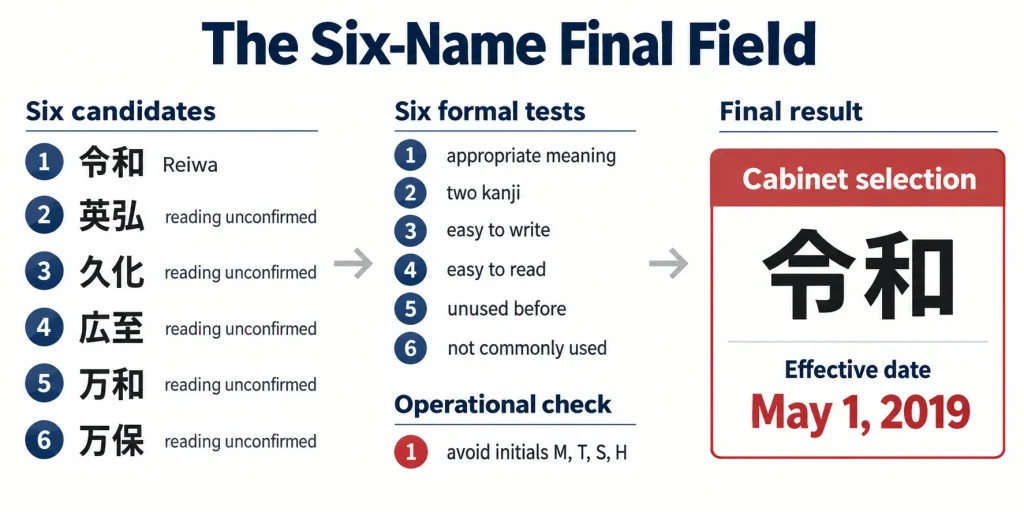
The modern procedure comes from 元号選定手続, gengō sentei tetsuzuki, literally “era-name selection procedure.” It says that a candidate should express an ideal appropriate for the public, consist of two kanji, be easy to write, be easy to read, never have been used as an era name or an emperor’s posthumous name, and not be in common use. That last condition reaches beyond earlier eras: officials check familiar names of people, places, companies, and products. The procedure does not say that a candidate must sound ancient, mysterious, or uniquely Japanese. Choosing Two Kanji for the Next Thirty Years follows the complete path from invited scholars to the Cabinet decision.
The six criteria are often compressed into a loose claim that an era name must “sound auspicious.” That misses most of the work. A graceful literary source cannot rescue characters that are difficult to read, awkward to write, already attached to a prominent organization, or liable to be confused with an existing name. Conversely, the procedure does not demand that every Japanese reader independently derive the government’s intended interpretation from the characters. The test concerns suitability as a national designation, not the production of a miniature dictionary definition.
| Test | What officials examine | Practical failure |
|---|---|---|
| Appropriate meaning | Whether the proposed idea suits a public ideal | A negative, divisive, or undignified association |
| Two kanji | Whether the written name contains exactly two Chinese characters | A longer expression, kana, or a mixed-script name |
| Easy to write | Whether ordinary users can reproduce the characters | Rare or excessively intricate forms |
| Easy to read | Whether the proposed reading is manageable and stable | An obscure reading that invites repeated mistakes |
| Never used before | Whether it duplicates an era or imperial posthumous name | Confusion with an established historical designation |
| Not commonly used | Whether it already identifies a prominent person, place, business, or product | A supposedly new era arriving with an existing public identity |
“Easy to write” and “easy to read” are separate tests: recognizing a character on television is not the same as entering it correctly on a form.
元号 and 年号: the name attached to a year
元号, gengō, literally “origin designation,” is the standard government term for an official era name such as 令和, Reiwa. You meet it in laws, Cabinet documents, government announcements, and formal explanations of the calendar. The common mistake is to translate it as the emperor’s personal reign name. It labels the era and its years; it is not the reigning emperor’s personal name. In everyday explanation, how Japanese eras are named begins with understanding that distinction.
年号, nengō, literally “year designation,” is a widely used alternative for the same system. You are likely to meet it in historical writing, dictionaries, textbooks, and conversations about dated records. The mistake is assuming that 年号 means the number following an era name, such as the “8” in Reiwa 8. It normally refers to the named era framework, not merely to the numeral. Both 元号 and 年号 may be translated as “era name,” although official modern documents favor 元号.
改元, kaigen, literally “changing the era designation,” is the act of replacing one era name with another. You meet it at the legal transition, not whenever a calendar year turns in January. The common mistake is treating it as a synonym for an emperor’s accession. Under the modern system the events are connected, but they remain conceptually different: an accession concerns the throne, while 改元 concerns the calendar designation. In 2019, the new name was announced before it took effect, making that distinction unusually visible.
元年, gannen, literally “origin year,” identifies the first year of an era. You meet it on coins, certificates, forms, calendars, and official records instead of a construction such as 令和1年. The mistake is reading 元 as an abbreviation for the numeral one. It marks the inaugural year and is read gan, not ichi. For the dates and boundaries rather than the naming process, Japanese Era Years: Meiji to Reiwa, Explained shows how a Western date maps to the correct era.
From a scholar’s suggestion to a Cabinet proposal
考案者, kōansha, literally “person who devises [something],” is the scholar asked to formulate possible names and document their meanings and sources. You encounter the word when news reports speculate about who composed a successful proposal. The common mistake is translating it as “inventor,” which suggests ownership of the name. A proposer supplies a researched candidate but does not approve it and does not possess it. The government also protected proposers’ identities because public attribution could encourage lobbying or turn the selection into a personality contest.
候補名, kōhomei, literally “candidate name,” refers to a possible name while the list is still being assembled and checked. You meet it early in the process, before officials narrow the material into a final set. The mistake is using 候補名 and 原案 as perfectly interchangeable terms. Every proposal begins as a candidate, but 原案 carries the narrower sense of an original proposal formally presented for consideration. That difference matters when a newspaper reports rumors about candidates while the Cabinet is examining only a small confidential set.
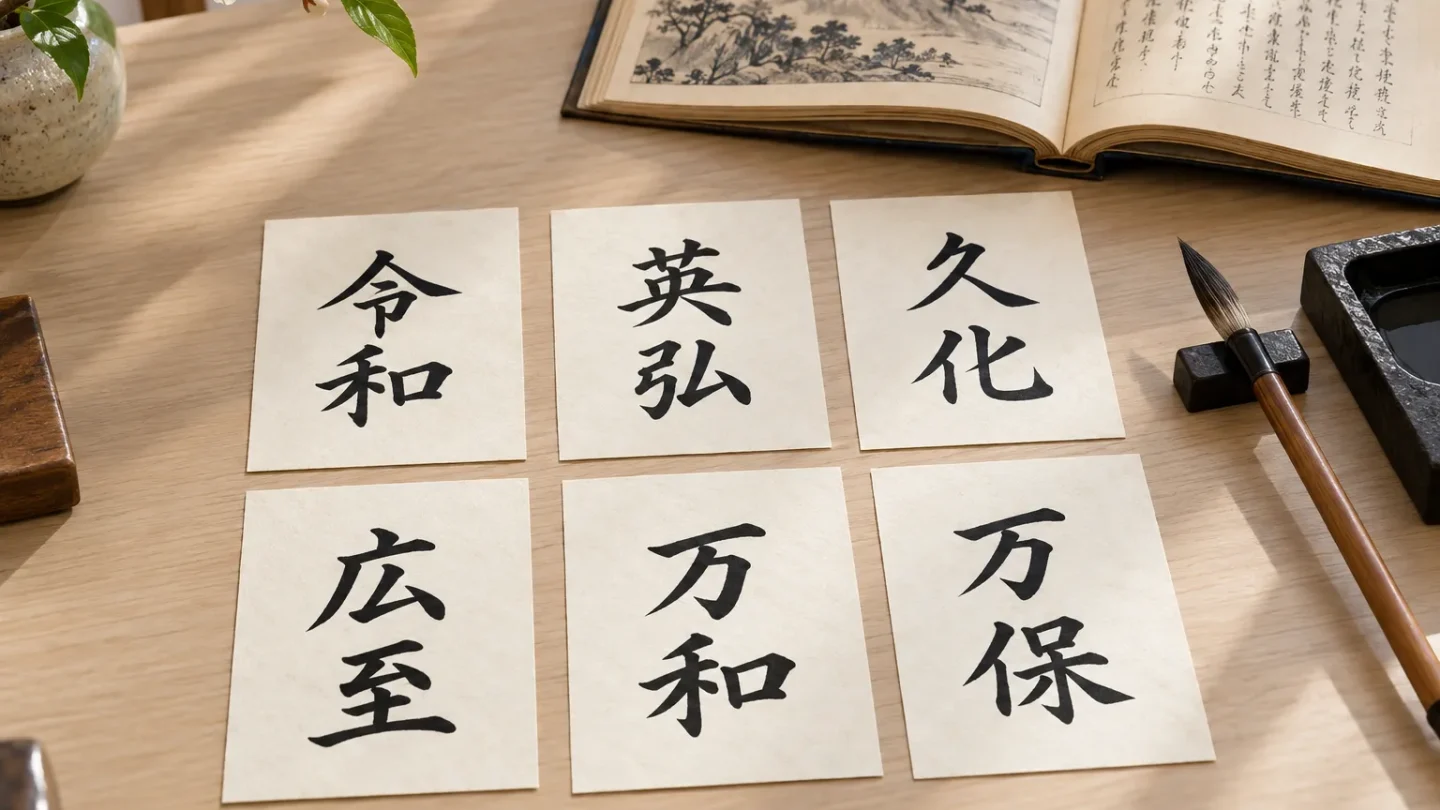
原案, gen’an, literally “original proposal,” is the term used for a name placed before the consultation and decision process. English reports often call the 2019 set a “shortlist,” which is useful but not literal. The Japanese word does not mean that a public competition produced finalists or that members ranked them like award nominees. It means a prepared proposal on which designated officials and advisers can offer opinions. In 2019, six 原案 reached that stage: Reiwa and five alternatives.
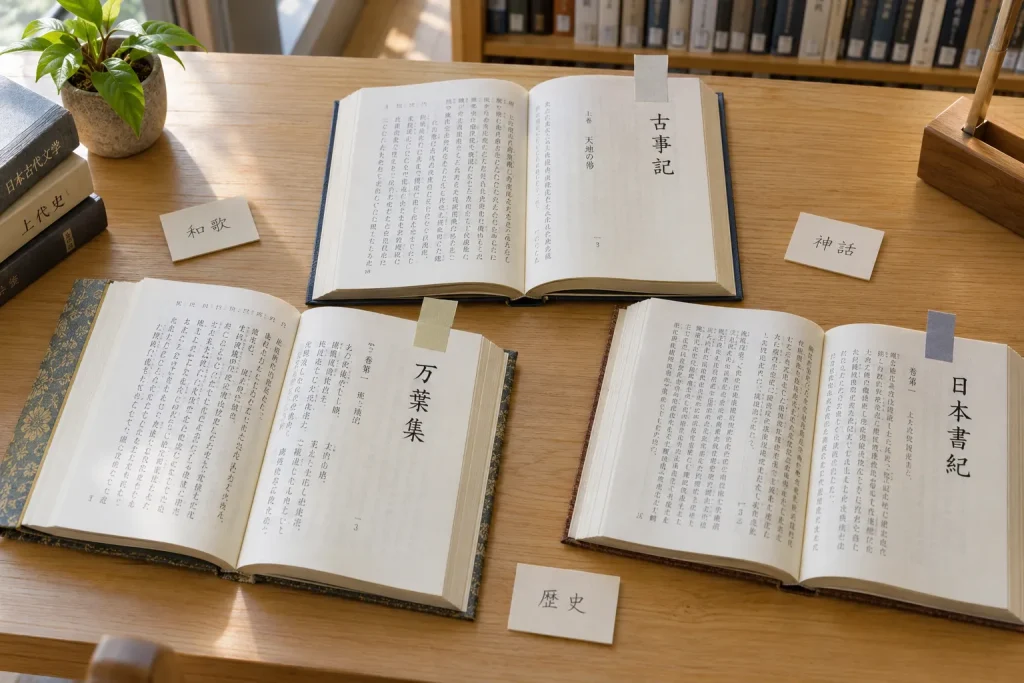
出典, shutten, literally “source from which [something] comes,” is the passage or classical work offered to support a candidate. You meet it beside extracts from the Man’yōshū, the Kojiki, the Nihon Shoki, or Chinese classics. The common mistake is treating the source as a direct dictionary definition of the new compound. Scholars select characters from a contextual passage and explain the idea they intend the pair to convey. The First Era Name Not Taken From China examines Reiwa’s Japanese textual source without pretending that Chinese literary influence disappears from the passage.
The six proposals considered in 2019
The disclosed 原案 were 令和, 英弘, 久化, 広至, 万和, and 万保. Contemporary reporting supplied likely readings for the rejected forms, but the government did not officially publish their readings or intended English meanings. That is an important limit: labels such as Eikō, Kyūka, Kōshi, Banna, and Banpō are useful media reconstructions, not a released official glossary. Literal glosses below therefore describe the visible characters rather than claiming to reproduce each proposer’s complete explanation. This is the central uncomfortable fact behind the Reiwa rejected names: the public received the shortlist, but not the evaluation sheets.
| Proposal | Reported reading | Character-level literal | Reported source category | What can safely be said |
|---|---|---|---|---|
| 令和 | Reiwa | auspicious/order + harmony | Man’yōshū | Selected and officially explained as “beautiful harmony” |
| 英弘 | often Eikō | excellence + broad/expansive | Japanese classic | Reading and intended interpretation were not officially released |
| 久化 | often Kyūka | lasting + transformation | Chinese classic | Reading and intended interpretation were not officially released |
| 広至 | often Kōshi or Kōji | broad + reaching/arrival | Japanese and Chinese classical sources | Multiple plausible readings appeared in secondary reports |
| 万和 | often Banna or Banwa | ten thousand/all + harmony | Chinese classic | Reading was not officially confirmed |
| 万保 | often Banpō or Banhō | ten thousand/all + protection | Chinese classic | Reading was not officially confirmed |
令和, Reiwa, combines 令 and 和. In the selected Man’yōshū context, the government presented the name as expressing a culture born and nurtured when people bring their hearts together beautifully. The Ministry of Foreign Affairs subsequently used “beautiful harmony” for overseas explanation. The mistake is translating the two characters mechanically as “command and peace” while ignoring the cited passage and official interpretation. A full account of the public unveiling appears in 1 April 2019, and the Board Held Up.
英弘 is commonly rendered Eikō in coverage, with 英 suggesting excellence or distinction and 弘 conveying breadth or expansion. It appears to satisfy the visible two-character and writing tests, but that does not reveal its internal assessment. The same applies to 久化, usually reported as Kyūka, whose characters can suggest enduring transformation. Neither should be assigned a polished English slogan without the proposer’s unreleased explanation. A character gloss is evidence; an elegant compound translation would be editorial invention.
広至 was reported with more than one possible reading, including Kōshi and Kōji. Its characters suggest breadth and reaching or arrival, while reports connected it with both Japanese and Chinese textual material. This ambiguity demonstrates why “easy to read” is not merely cosmetic. It does not prove that reading ambiguity caused the proposal to lose, because no official elimination record was published. It does show why the disclosed kanji alone are insufficient to reconstruct the full decision.
万和 and 万保 were generally reported as Banna or Banwa, and Banpō or Banhō, respectively. 万 can carry the idea of ten thousand and, by extension, abundance or entirety; 和 suggests harmony, while 保 suggests protection or preservation. Both look semantically suitable at character level, yet their official readings and intended interpretations remain undisclosed. They may have passed the formal checks and simply attracted less support than Reiwa. Calling them “rejected for failing the rules” would therefore go beyond the evidence.
イニシャル: an extra check, not one of the six
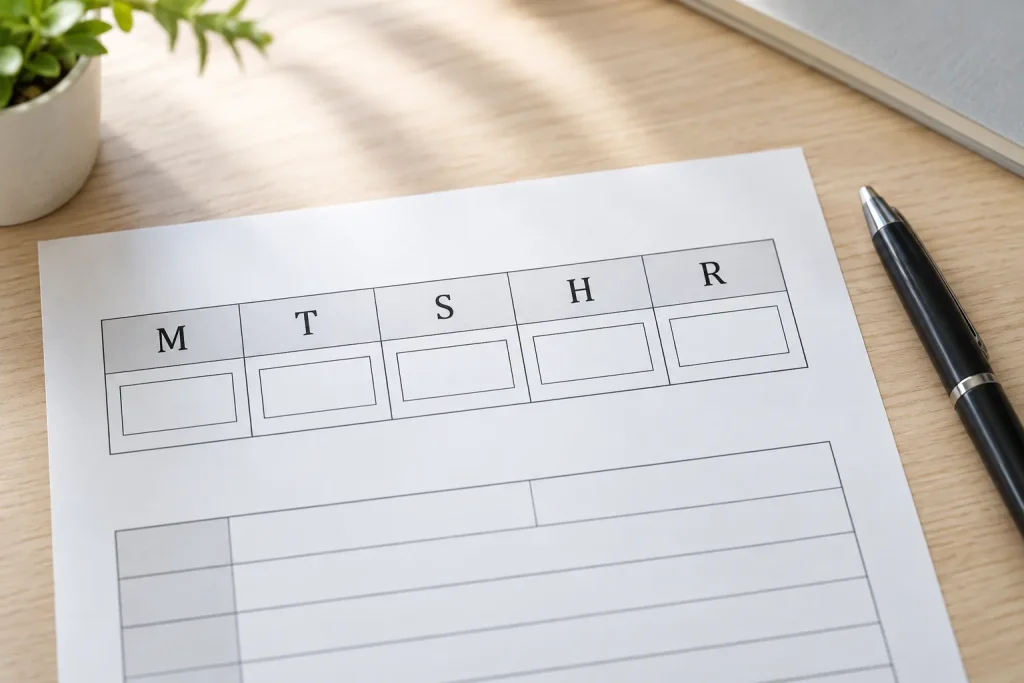
イニシャル, inisharu, is the English-derived word “initial,” but in Japanese it commonly means the first Roman letter used as an abbreviation, not a handwritten set of personal initials. You meet it in discussion of M, T, S, H, and R as compact labels for Meiji, Taishō, Shōwa, Heisei, and Reiwa. The mistake is presenting the initial check as one of the six published criteria. It was an additional practical screen used in preparing the 2019 proposals. Candidates beginning with M, T, S, or H in romanization were avoided so that the new abbreviation would not collide with the previous modern eras.
The chosen R created a distinct sequence: M, T, S, H, R. This matters on date fields where an era may be reduced to one letter followed by a year number. It also explains why a candidate can satisfy the formal language tests yet remain operationally inconvenient. The initials rule is evidence that naming now has a software and paperwork dimension as well as a literary one. The Japanese calendar must function in database fields, administrative forms, and ordinary handwriting at the same time.
有識者懇談会 is consultation, not a public jury
有識者懇談会, yūshikisha kondankai, literally “meeting for discussion among knowledgeable persons,” was the advisory gathering shown the proposals before the decision. You meet the expression in the official schedule and in reporting about the invited specialists. “Expert panel” is a workable English label, but it can mislead if it suggests a jury with the power to select the winner. Participants expressed views; they did not conduct a public ballot that legally bound the government. The Cabinet retained responsibility for the final choice.
閣議, kakugi, literally “Cabinet conference,” is the formal Cabinet meeting at which the government reaches its decision. You meet it after the consultation stages and the hearing of views from the presiding officers of the legislature. The mistake is picturing the Cabinet as a room or storage unit because of the English word “cabinet.” Here it means the collective executive body and its formal deliberation. Reiwa was determined through a Cabinet decision, rather than by the emperor personally selecting a preferred literary phrase.
政令, seirei, literally “government ordinance,” is the legal instrument establishing the new era name under the Era Name Act. You meet it when the choice moves from confidential deliberation into enforceable public administration. The common mistake is treating the televised calligraphy board as the act that legally creates the era. The board announces the decision, but the ordinance gives it legal form. That distinction separates an iconic press image from the machinery of government.
公布, kōfu, literally “public promulgation,” is the formal publication of a law or ordinance. You meet it after the Cabinet has settled the name and the legal text is issued. The mistake is translating it simply as “announcement,” because an announcement can be informational while promulgation has a defined legal role. In the 2019 sequence, the name was publicly revealed before the Reiwa era began. The future effective date allowed institutions to prepare their records and systems.
A glossary for the complete selection sequence
The terms below are grouped by the moment when you meet them rather than by kana order. This Japanese era glossary is designed for recognizing official documents and news reports, not for memorizing every administrative expression. Literal translations are deliberately narrow because they show how the written components work. Context supplies the natural English equivalent. Where an English label such as “shortlist” or “expert panel” is used, it remains an explanatory convenience rather than a word-for-word translation.
| Term | Reading | Literal meaning | Where you meet it |
|---|---|---|---|
| 元号 | gengō | origin designation | Official discussion of the era name |
| 年号 | nengō | year designation | History, dictionaries, and general explanation |
| 改元 | kaigen | change of era designation | The transition to a new era |
| 元年 | gannen | origin year | The first year printed on records |
| 考案者 | kōansha | devising person | Reports about the scholars proposing names |
| 候補名 | kōhomei | candidate name | The early pool of possibilities |
| 原案 | gen’an | original proposal | The proposals formally presented |
| 出典 | shutten | source of origin | The classical passage supporting a candidate |
| イニシャル | inisharu | initial letter | Roman-letter abbreviation checks |
| 有識者懇談会 | yūshikisha kondankai | knowledgeable persons’ discussion meeting | Consultation before the decision |
| 閣議 | kakugi | Cabinet conference | The executive decision |
| 政令 | seirei | government ordinance | The legal establishment of the name |
| 公布 | kōfu | promulgation | Formal publication of the ordinance |
What the shortlist proves—and what it does not
A worked example makes the limits clear. Suppose a scholar proposes 広至 and supplies a reading, a classical passage, and an explanation centered on something broad reaching its proper destination. Officials can check that it uses two kanji, inspect whether the reading and writing are manageable, search previous era and posthumous names, and investigate existing public uses. They can also test its Roman initial against earlier era abbreviations. What an outside reader cannot do is infer from the surviving characters which check received reservations or whether the proposal passed every check and lost only at the final comparison.
The six names therefore reveal selection, not elimination. Reiwa did not necessarily “pass” while all five others “failed”; every final proposal may already have survived extensive screening. The consultation and Cabinet stages were designed to compare viable options, not to expose defective ones for public inspection. No published government score sheet assigns a failed criterion to 英弘, 久化, 広至, 万和, or 万保. Any article that confidently gives five separate reasons for rejection is supplying information the released record does not contain.
The three terms worth memorizing
Memorize 元号, gengō, because it names the system; 改元, kaigen, because it names the change; and 元年, gannen, because it appears wherever the first year is written. Keep 候補名, 原案, 出典, 閣議, and 政令 at recognition level unless you regularly read Japanese government reporting. The remaining administrative vocabulary becomes clear from the sequence once those three anchors are in place. If your actual problem is converting a date rather than following the selection process, the era converter covers every year from 1868 through 2050 across all five modern eras. The companion Showa, Heisei and Reiwa Year Tables provide lookup tables without duplicating the naming rules here.