1 April 2019, and the Board Held Up: Reiwa Announcement 2019
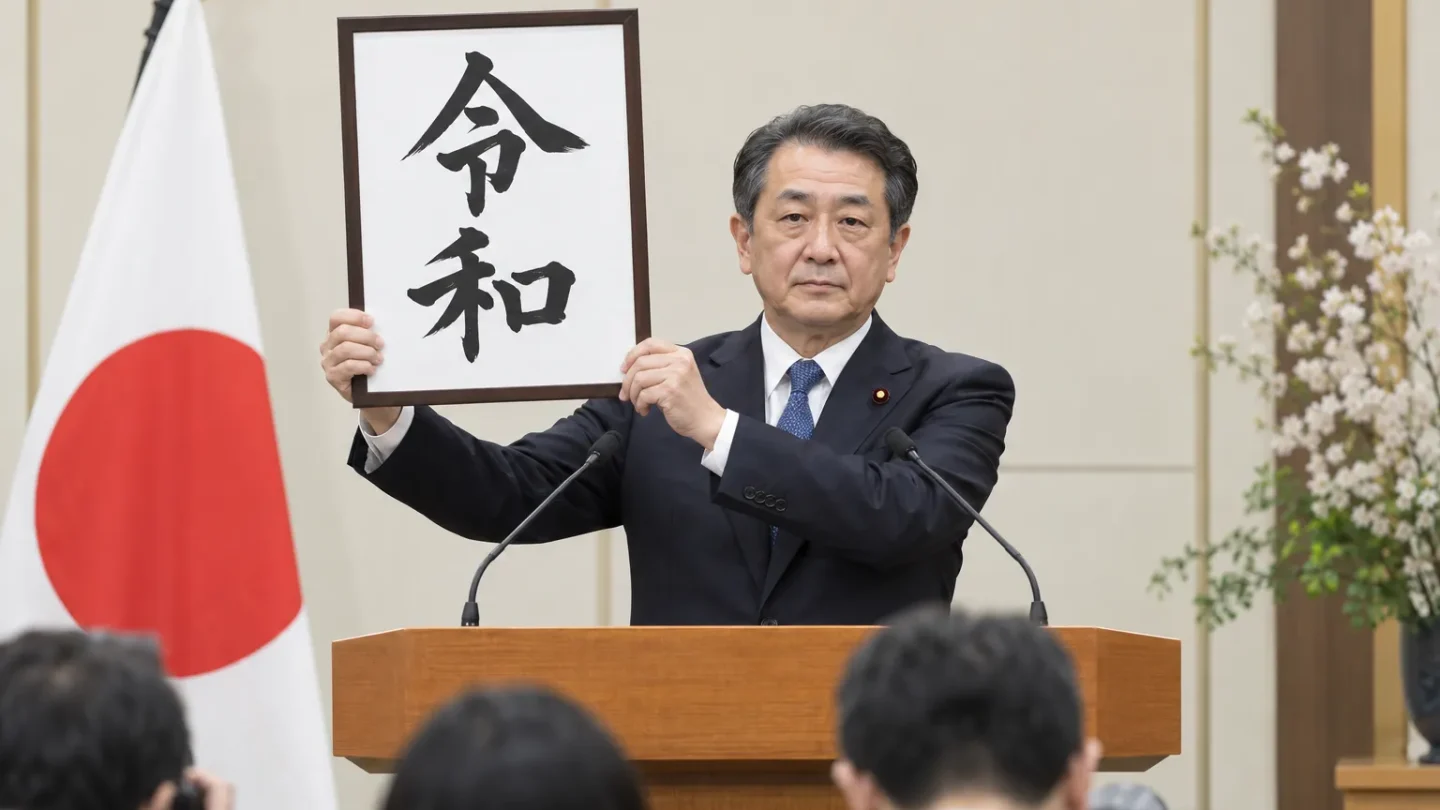
You are watching a lectern in the Prime Minister’s Office. The scheduled start has passed. Then Chief Cabinet Secretary Yoshihide Suga enters, reads the Cabinet decision and raises a white board bearing two black characters: 令和. The reiwa announcement 2019 has happened at 11:41 a.m. Tokyo time—but the new era has not begun. That distinction explains both the delay and the secrecy.
The Reiwa Announcement 2019, Minute by Minute
The announcement was the public end of a controlled government process, not a naming ceremony open to improvisation. If you want the selection rules behind it, Choosing Two Kanji for the Next Thirty Years covers the legal framework and candidate criteria. Here, the useful question is narrower: what happened that morning, and why did the name remain hidden until the board appeared?
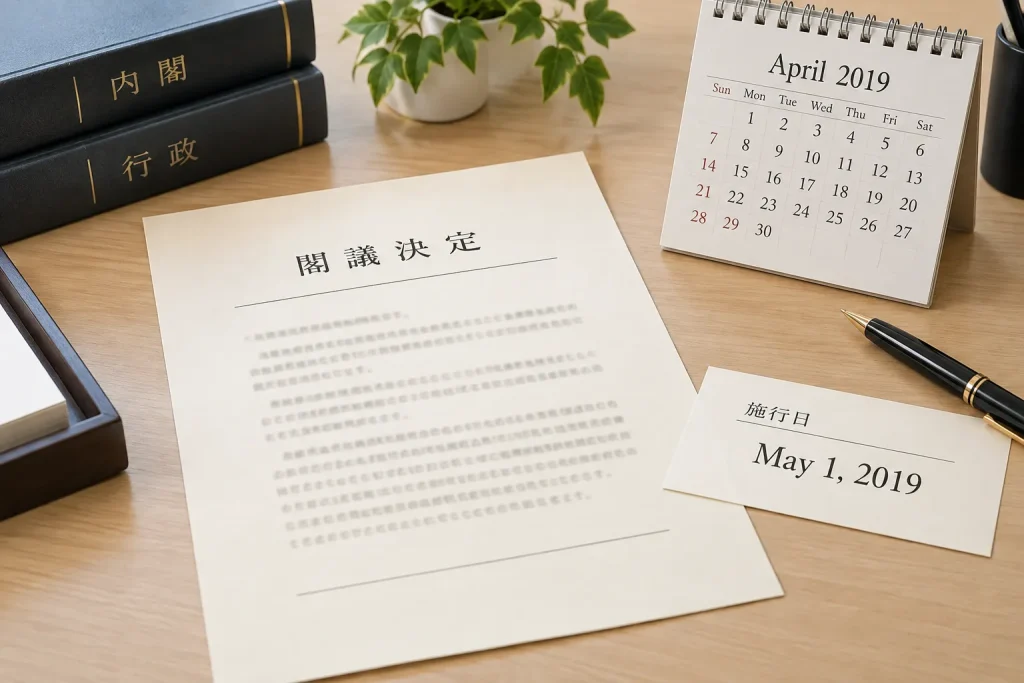
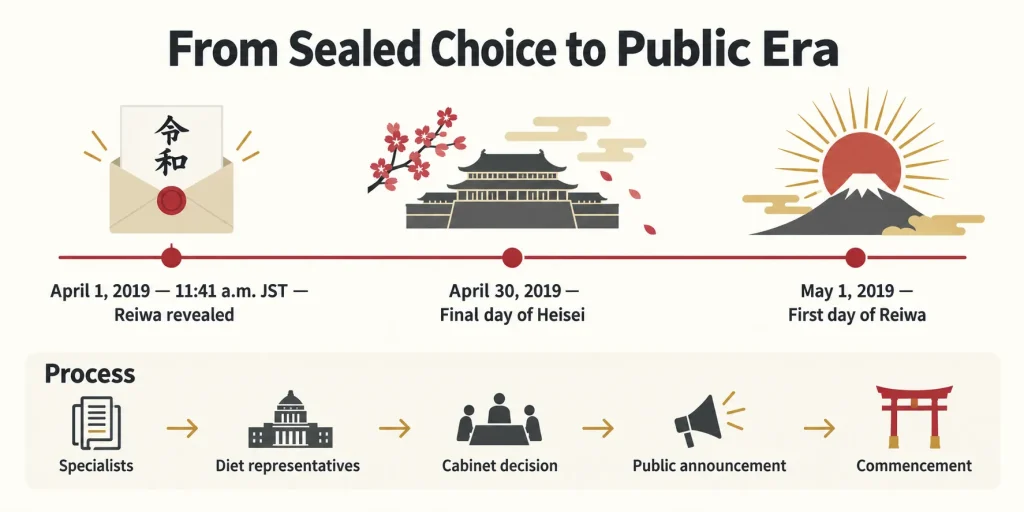
- Separate announcement day from era day. On April 1, the Cabinet announced the name. 令和, Reiwa, officially rendered by the government as “beautiful harmony,” took effect on May 1. Until April ended, official dates remained Heisei dates.
- Begin with the confidential proposals. Specialists had submitted possible names in advance. The government did not publish a running shortlist. That morning, the candidates moved through consultation under tight controls.
- Consult outside the Cabinet. A specialist panel considered the candidates, followed by representatives of both houses of the Diet. Their views informed the decision; they did not enact the name.
- Let the Cabinet decide. It approved the order changing the era and the notification naming it. Reiwa was now the chosen Japanese era name. The press still did not have it.
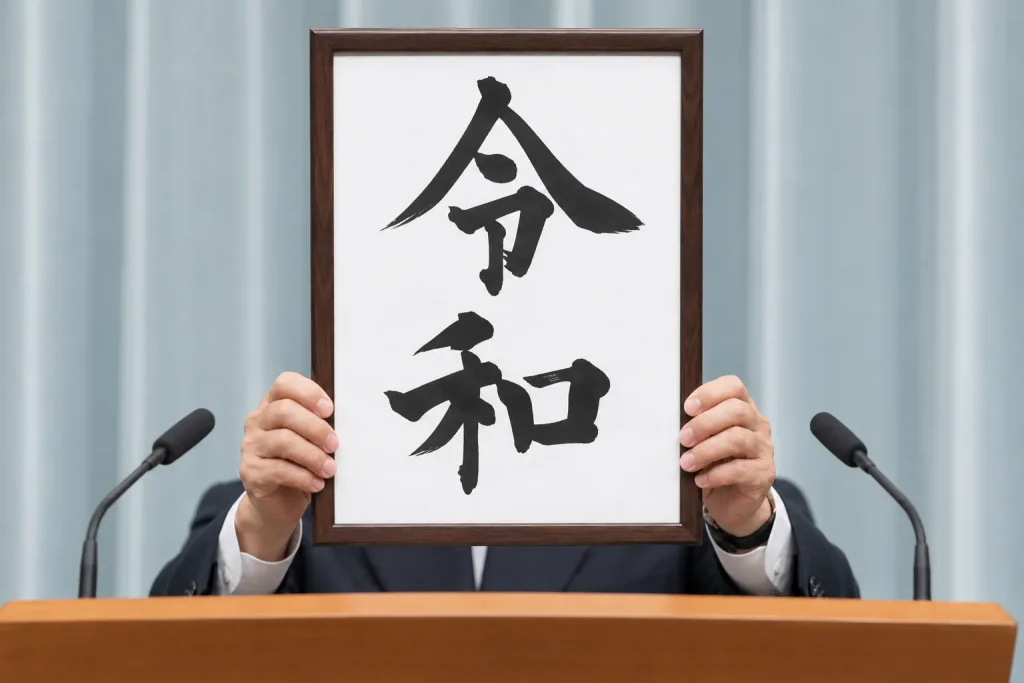
- Write the public board. This was not the legal instrument. Bold brush calligraphy made the name readable on television and reproducible in print.
- Wait through the overrun. The preceding steps ran long. At 11:41 a.m., Suga reached the lectern. The delay is not evidence of a last-second quarrel.
- Read first, reveal second. Suga stated the Cabinet decision, then held the board toward the cameras. He was announcing a choice already made.
- Explain the name separately. Prime Minister Shinzo Abe later described its source in the Man’yōshū. Suga disclosed the characters; Abe supplied the government’s interpretation.
“The new era name is Reiwa.”
That sentence was the hinge. The room did not choose the name when it heard it. The country learned a Cabinet decision that had just been secured behind closed doors.
What the Board Did—and Did Not Do
The board dominates the image, so it is easy to mistake display for enactment.
| Object or act | What it did | What happened next |
|---|---|---|
| Cabinet order | Changed the era under the Era Name Act | Promulgation and an effective date followed |
| Cabinet notification | Fixed the reading and written name | Officials could prepare forms and systems |
| Calligraphy board | Made 令和 immediately visible | Television and newspapers carried the image |
| Prime minister’s statement | Explained the selection and literary source | Public discussion shifted to meaning |
For the wider mechanics, Choosing Two Kanji for the Next Thirty Years explains how proposals are screened. The uncomfortable fact is simpler: the photogenic board was communication, not law.
Why the Name Stayed Sealed
Secrecy protected the decision before it existed. If a candidate escaped early, headlines, lobbying and commercial use could make that option look politically favored—or unusable—before the Cabinet acted. A leak could also turn consultation into theater by revealing an apparent winner in advance.
The timing created a tradeoff. Software vendors, printers and public offices needed notice because Japanese dates appear in databases, forms and certificates. A longer gap after selection would invite leaks. The government announced before accession but kept candidates confidential through decision morning.
That was unusual only because the transition itself was unusual. Earlier modern era changes followed an emperor’s death, leaving no planned month of preparation. Emperor Akihito’s scheduled abdication allowed systems to be updated before Reiwa began.
The secrecy was therefore practical, not mysterious. It guarded an unfinished governmental choice while the announced transition date gave institutions time to prepare.
The Gesture Borrowed from Heisei
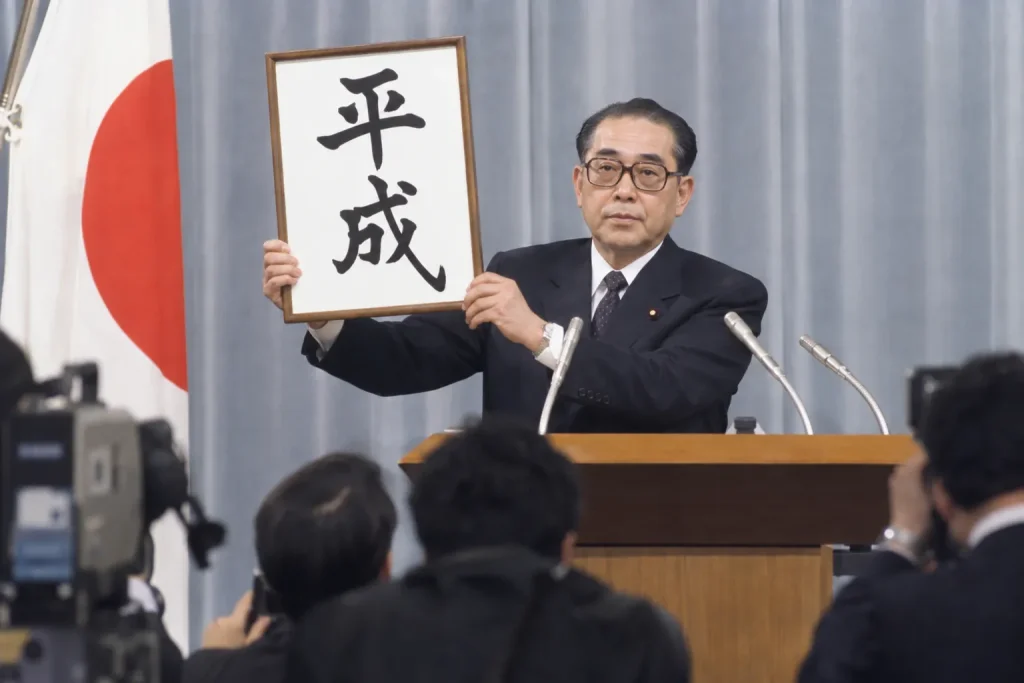
Suga’s pose was instantly legible because Keizo Obuchi had done the same job for 平成, Heisei, “achieving peace,” when he was chief cabinet secretary. On January 7, 1989, Obuchi displayed the Heisei board after the death of Emperor Hirohito. Heisei began the following day.
| Feature | Heisei | Reiwa |
|---|---|---|
| Public announcer | Chief Cabinet Secretary Keizo Obuchi | Chief Cabinet Secretary Yoshihide Suga |
| Announcement | January 7, 1989 | April 1, 2019 |
| Era began | January 8, 1989 | May 1, 2019 |
| Transition trigger | Emperor’s death | Planned abdication and accession |
| Shared visual grammar | Official holds up a two-kanji calligraphy board | Official holds up a two-kanji calligraphy board |
The Heisei announcement had made an official, a lectern and a handwritten placard into a recognizable public ritual. Repeating that form made a bureaucratic decision immediately understandable.
Where Readers Usually Lose the Sequence
Four mix-ups produce most of the confusion:
- Announcement is not commencement. Reiwa was known in April but did not govern dates until May.
- The board is not the decree. It displayed the result of Cabinet action.
- Consultation is not a referendum. Specialists and Diet representatives gave views; the Cabinet decided.
- A literary source is not a literal translation. The government explained Reiwa as “beautiful harmony,” while individual kanji have broader dictionary histories.
If your real task is reading a date rather than reconstructing the announcement, Japanese Era Years: Meiji to Reiwa, Explained covers the notation. For a specific conversion, the Japanese era converter covers every year from 1868 through 2050 across the five modern eras.
What Changed—and What Did Not
The gengō system—元号, gengō, “era name”—did not suddenly begin in 2019. What changed was the planning window. Because the accession date was known, the government could disclose the next name before the current era ended.
That means the sequence varies by transition:
- After a death, decision, announcement and commencement may be compressed.
- With a scheduled transition, announcement can precede commencement.
- On a historical document, the exact day matters in a year shared by two eras.
The Showa, Heisei and Reiwa Year Tables handle quick year matching; they are more useful than memorizing this press-room chronology when you are filling out a form.
What Nobody in the Room Needed From You
Nobody expected viewers to translate both characters on sight. Nobody required you to know the Man’yōshū passage, recognize the calligrapher’s hand or treat the delay as coded political drama. The practical information was plain: the name was Reiwa, its written form was 令和, and it would apply from May 1.
Likewise, nobody minds if you use the Gregorian year in ordinary English discussion. The two systems coexist. Use the era year where a Japanese form requests it; use the format requested by the institution handling the document.
The same applies to Reiwa meaning. “Beautiful harmony” records the government’s intended English explanation. It does not erase every other historical sense of 令, and you do not need to force a two-word English gloss into every context.
The Reveal in One View
FAQ
Was Reiwa already in force when Suga raised the board?
No. The government announced the name on April 1; the era began on May 1. Japanese documents dated during April remained in Heisei.
Why was the announcement late?
The consultations and Cabinet process took longer than the public schedule allowed. Published records support a procedural overrun; they do not support treating the delay as proof of a crisis.
Did Suga choose the name?
No. As chief cabinet secretary, he announced the Cabinet’s decision. Specialists and Diet representatives had been consulted earlier that morning.
Was the 1989 board identical?
No. It bore different characters and belonged to a different kind of transition. The repeated element was the presentation: the chief cabinet secretary held a large calligraphy board toward the cameras.