Choosing Two Kanji for the Next Thirty Years: How Japanese Era Names Are Chosen
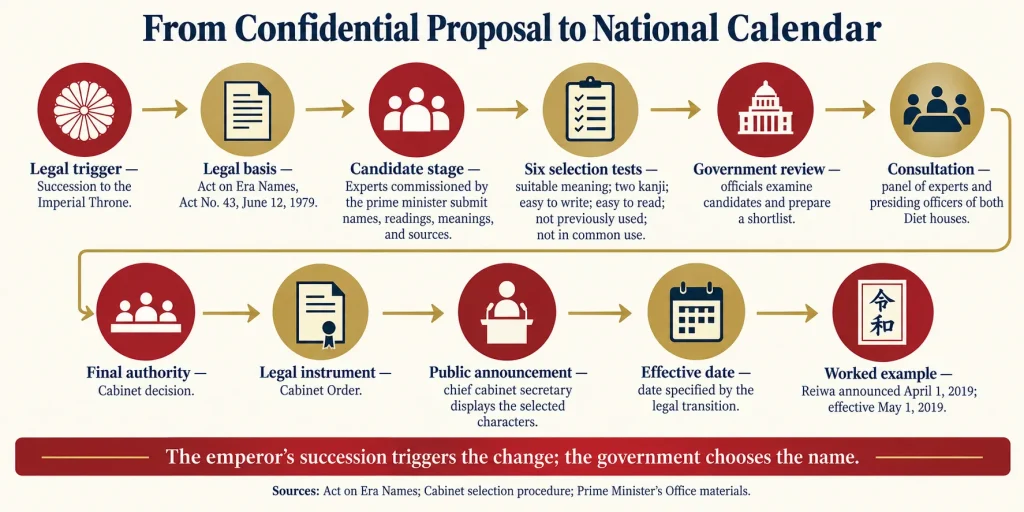
Japan’s emperor does not choose the name of the era associated with his reign; the national government selects it and establishes it by Cabinet Order. That is the central fact behind how Japanese era names are chosen, and it changes the meaning of the entire ceremony. Scholars develop confidential candidates, officials test them against established criteria, outside experts give opinions, and the Cabinet makes the decision. The emperor’s succession triggers the change, but it does not transfer the naming power to the emperor. The calligraphy displayed at the public announcement represents a government decision, not a monarch’s private choice.
The legal foundation is remarkably short. 元号法, Gengō-hō, “Act on Era Names,” enacted in 1979, says that an era name is prescribed by Cabinet Order and may be changed only upon succession to the Imperial Throne. It does not list approved kanji, prescribe a literary source, or say that a scholar must propose the winning expression. Those details come from the government’s selection procedure, first reported to the Cabinet later in 1979 and used as the framework for Heisei and Reiwa. Law and protocol therefore do different jobs: the statute establishes authority and timing, while the procedure explains how a candidate reaches the Cabinet.
The process is designed to produce a short expression capable of surviving handwriting, printing, speech, databases, calendars, and official documents. A successful candidate must carry an appropriate meaning, consist of two kanji, be easy to read and write, and avoid duplication with earlier era names or imperial posthumous names. It should not be an expression already common in everyday use. These are administrative selection criteria, not mystical properties attributed to the characters. A candidate can sound elegant and still fail because it is difficult, ambiguous, already established elsewhere, or impractical for nationwide use.
The law gives the decision to the Cabinet
The Act on Era Names was promulgated as Act No. 43 on June 12, 1979. Its first provision states that era names are prescribed by 政令, seirei, “Cabinet Order.” Its second provision states that an era name is changed only when succession to the Imperial Throne occurs. The supplementary provisions treated Shōwa as though it had been determined under the new law. Nothing in the statute authorizes the emperor to select his own era name.
That arrangement follows Japan’s postwar constitutional structure. The emperor performs acts in matters of state with the advice and approval of the Cabinet, while government bears political responsibility. A Cabinet Order establishing a new era may be formally promulgated through the constitutional machinery involving the emperor, but promulgation is not authorship or personal selection. Confusing these two roles produces the most persistent error in explanations of the system. The government decides; the emperor does not choose a label for himself.
The distinction became unusually visible during the transition from Heisei to Reiwa. The government announced 令和, Reiwa, officially explained in connection with “beautiful harmony,” on April 1, 2019. The new era began on May 1, 2019, when the imperial succession took effect. Because the change was prepared in advance, government offices, businesses, and software providers received a limited period in which to update their systems. The announcement was ceremonial, but its legal force came from the Cabinet Order.
| Legal or procedural layer | What it controls | What it does not establish |
|---|---|---|
| Constitution of Japan | The emperor’s state acts and the Cabinet’s responsibility | A list of acceptable era names |
| Act on Era Names | Cabinet Order as the legal instrument; succession as the trigger | Detailed linguistic selection criteria |
| Government selection procedure | Candidate preparation, examination, consultation, and Cabinet deliberation | A legally binding result before the Cabinet acts |
| Cabinet Order | The official name and effective date | A personal choice by the emperor |
Scholars create candidates, not a public contest
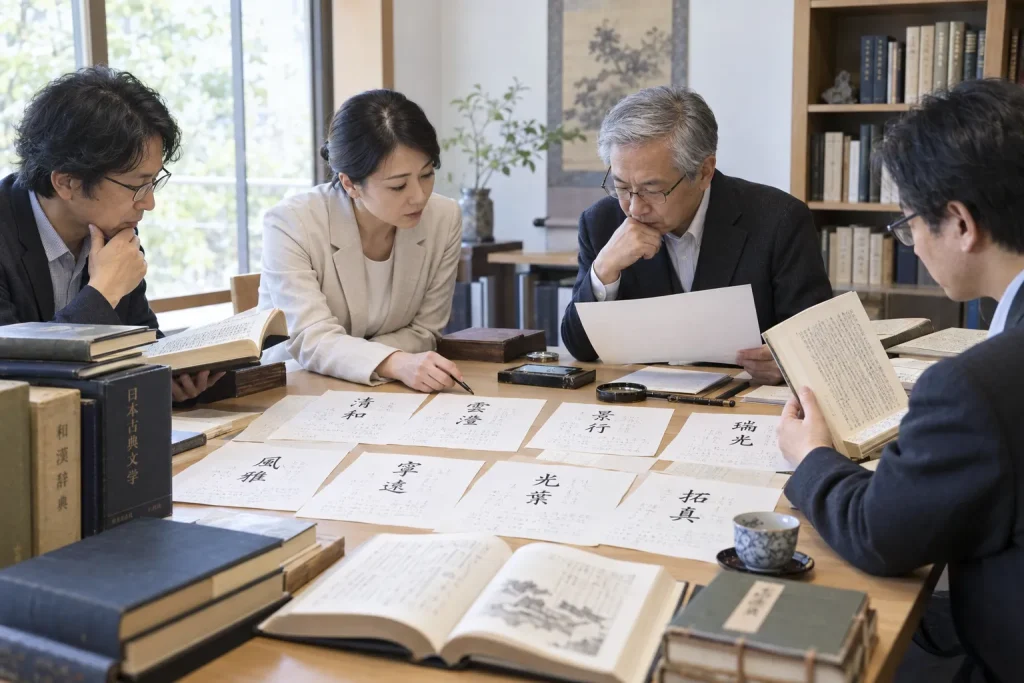
The prime minister commissions people with recognized expertise to devise possible names. The specialists may work in fields such as classical literature, Japanese studies, Chinese literature, or related scholarship. Their task is not to vote on a favorite slogan. They submit candidates with readings, meanings, and textual sources so that the government can evaluate each proposal. The identities of contributors and the competing names are normally protected during the selection process to reduce lobbying and speculation.
This confidentiality has a practical purpose. If candidate lists circulated early, companies could register trademarks, domain names, product names, or social-media accounts around expressions that might later become nationally significant. Public campaigning could also turn a linguistic and administrative screening process into a popularity contest. The selected name must work for the entire state, not merely win an online poll. Secrecy is therefore part of risk control, even though it inevitably limits public scrutiny before the decision.
The specialists do not make the final choice. Their proposals enter a government-controlled evaluation process, where officials narrow the list and test candidates against the established conditions. A scholar can provide the expression that ultimately wins without possessing legal authority to name the era. The outsider’s error is to imagine a council of classicists declaring the result. Scholars supply the raw candidates; constitutional government converts one candidate into law.
Six tests stand between a phrase and the calendar
The selection procedure identifies six widely cited conditions for an appropriate era name. The expression should have a suitable meaning for the ideals of the nation. It should consist of two kanji, be easy to write, and be easy to read. It should not duplicate an era name or an emperor’s posthumous name used previously. It should also not be an expression in common use.
These conditions do more than filter out bad poetry. Two characters keep the name compact enough for dates, forms, seals, calendars, databases, newspapers, and everyday handwriting. Readability matters because the name must be spoken immediately by people who did not participate in its creation. Writability matters because citizens and public employees may have to reproduce it without specialized calligraphic knowledge. Novelty protects the new era from being confused with an earlier official period or an ordinary commercial expression.
| Selection test | Administrative purpose | A plausible reason for rejection |
|---|---|---|
| Appropriate meaning | Gives the national designation a defensible public interpretation | Negative, divisive, or unsuitable associations |
| Two kanji | Keeps dates and official notation compact | A candidate containing more or fewer characters |
| Easy to write | Allows routine use on paper and in public systems | Rare or excessively complex characters |
| Easy to read | Supports consistent nationwide pronunciation | Several likely readings or an obscure pronunciation |
| Not previously used | Prevents confusion with earlier eras and posthumous imperial names | Duplication of a historical designation |
| Not in common use | Preserves a distinct national identifier | An established company, place, slogan, or ordinary phrase |
The uncomfortable part is that these tests are not a mathematical formula. “Appropriate,” “easy,” and “common” require judgment, and reasonable readers may disagree. A candidate does not earn the position merely by passing a database search. Officials must consider sound, visual balance, associations, practical use, and the proposed literary explanation together. The protocol narrows discretion; it does not eliminate it.
The government tests more than literary beauty
The two characters must function as a nationwide data label from the moment the new era begins. Officials therefore consider whether a candidate resembles other well-known expressions, produces an awkward abbreviation, or creates avoidable confusion in print and speech. They also investigate historical uses rather than checking only the short list of modern eras. A beautiful quotation can be unsuitable if its extracted characters have already accumulated a strong unrelated meaning. The source matters, but so does the life the expression has acquired outside that source.
Modern technology adds another layer. The kanji need to be supported across public records, computers, printers, databases, and mobile devices. Reiwa used standard characters already present in Japanese systems, but software still needed a new era entry, abbreviated representation, conversion logic, and effective date. The code point for the single-character Reiwa compatibility symbol was assigned separately through the international character-standard process. Choosing ordinary writable kanji does not mean the digital transition happens automatically.
The initial letter also matters operationally because Japanese forms and software sometimes abbreviate modern era names. Meiji, Taishō, Shōwa, Heisei, and Reiwa are commonly represented by M, T, S, H, and R. The 2019 government procedure reportedly considered the risk of an abbreviation colliding with recent eras. This concern is administrative rather than a requirement written into the two-sentence law. It illustrates how a modern candidate can satisfy the traditional-looking criteria and still create a practical problem.

Consultation comes before the Cabinet decision
Once the government has a short list, it seeks opinions from designated experts. During the Reiwa selection, a panel representing fields beyond classical literature was asked to discuss the candidates. The government also consulted the presiding officers of both houses of the National Diet. These consultations broaden the information available to the Cabinet, but they are not a national referendum and do not transfer the decision to Parliament. The Cabinet remains the authority named by the Act on Era Names.
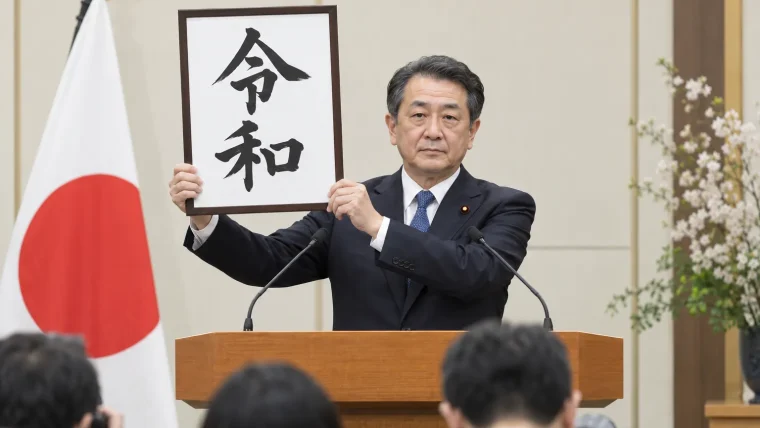
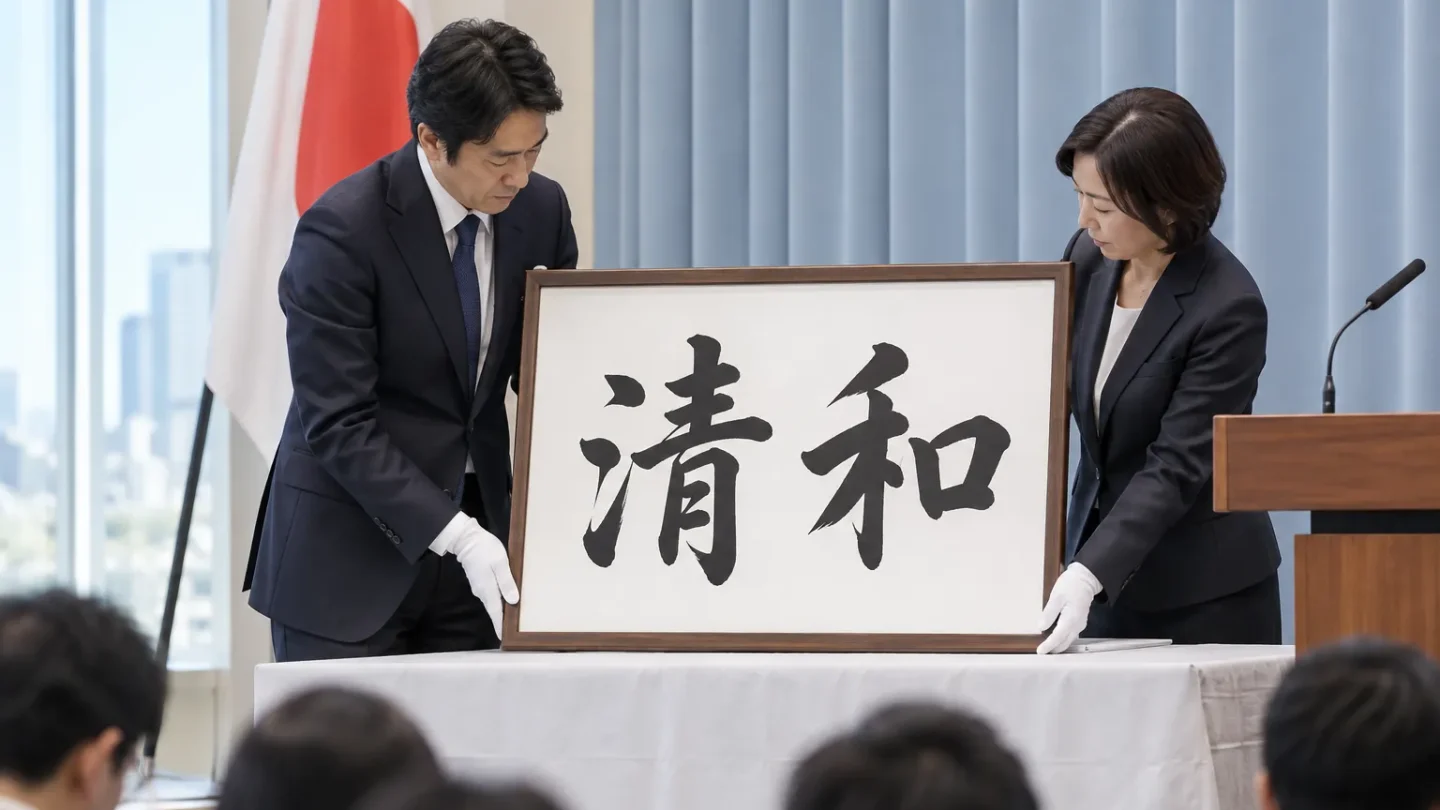
Cabinet ministers then deliberate and select the new name. A Cabinet Order provides the legal vehicle, after which the chief cabinet secretary announces the characters publicly. In 2019, Chief Cabinet Secretary Yoshihide Suga displayed the calligraphy for 令和. Prime Minister Shinzo Abe subsequently explained the government’s interpretation and the literary passage behind it. The familiar televised board was the last public-facing step in a process that had been conducted largely in confidence.
That sequence explains why the announcement appears instantaneous even though the work behind it is not. The public sees two kanji, a reading, and an explanation arriving together. Before that moment, scholars have prepared proposals, officials have conducted checks, experts have given views, parliamentary leaders have been consulted, and ministers have reached agreement. The calligraphed board does not create the name by itself. It communicates a decision already made through government procedure.
Reiwa shows how a candidate is defended
令和, Reiwa, was taken from the preface to a group of plum-blossom poems in the 万葉集, Man’yōshū, “Collection of Ten Thousand Leaves.” The cited passage includes the characters 令 and 和 in a description of an auspicious early-spring month, mild air, and gentle wind. Government explanations presented the name as expressing a culture in which people bring their hearts together and create beauty. The official English rendering emphasized “beautiful harmony,” rather than mechanically translating each character in isolation. That difference matters because an era name operates as a selected expression with a stated source, not as a two-item vocabulary exercise.
Reiwa was notable because the government identified its source in a Japanese classical anthology. Earlier modern era names had been explained through passages in Chinese classics. This does not mean Japanese literature had suddenly become legally mandatory. The 1979 law contains no rule requiring a Japanese or Chinese source, and the published criteria do not reserve future choices for one literary tradition. Reiwa demonstrates what the government chose in 2019, not what every future Cabinet must choose.
You should also be cautious with the claim that the characters possess one indisputable literal translation. 令 can carry meanings connected with an order or command in other compounds, while 和 can refer to harmony, peace, or Japan. Context determines how characters function inside a phrase. Extracting the harshest dictionary gloss and treating it as the hidden “real meaning” ignores the source passage and the government’s stated interpretation. The language is historically layered, but it is not mystical.

The winner immediately becomes infrastructure
An era name is not merely a ceremonial motto. It becomes part of dates used in government notices, licenses, certificates, tax materials, medical records, employment documents, bank systems, insurance forms, calendars, and business software. Organizations must connect the new first year to the corresponding Gregorian dates and preserve older records under earlier eras. A system that assumes the current era will continue indefinitely can fail even when its arithmetic is otherwise correct. The name therefore enters national infrastructure at the same moment it enters public language.
Reiwa exposed the cost of late certainty. The name was announced in April 2019 and took effect in May 2019, leaving institutions a short implementation window. Advance preparation was possible because the succession date was known, but the characters themselves remained confidential until the announcement. Developers could create placeholders and test flexible date logic, yet final labels, fonts, abbreviations, and printed stock had to wait. Secrecy protected the selection while shifting part of the operational burden onto organizations using the calendar.
For readers dealing with documents, the useful distinction is between choosing an era name and converting an era date. Japanese Era Years: Meiji to Reiwa, Explained covers how the modern system counts years after a name has been established. Showa, Heisei and Reiwa Year Tables provides direct year correspondences instead of repeating the tables here. The site’s Japanese era converter handles every year from 1868 through 2050 across all five modern eras. Those tools answer a calculation question; the present article explains the authority and protocol that create the label being calculated.
A transition can divide one Gregorian year
An era begins when the legally specified change takes effect, not automatically on January 1. That means a Gregorian year containing a succession can belong to two eras. The transition from Shōwa to Heisei occurred in January 1989, while the transition from Heisei to Reiwa occurred in May 2019. A year-only conversion can therefore be ambiguous when the exact month and day are missing. The date must be compared with the legal transition point.
This has consequences for archival searches and official paperwork. A document dated early in a transition year may belong to the outgoing era, while a document dated later in the same year belongs to the incoming one. Simply subtracting a fixed number from the Gregorian year can produce the wrong answer near the boundary. The Four Japanese Years That Belong to Two Eras maps those boundary cases in detail. How to Read a Date on a Japanese Document explains the visual order of era, year, month, and day on actual paperwork.
The first year of an era is also commonly written 元年, gannen, “origin year,” instead of using an ordinary numeral. This is a notation convention rather than a second era-selection rule. Software and printed forms must nevertheless recognize it because it appears in official and public contexts. A database that accepts only a numerical first year can mishandle a valid human-readable date. Naming the era and implementing the era are separate problems.
What the protocol makes possible—and impossible
The first consequence is that the emperor cannot quietly alter the system through personal preference. Succession supplies the legal condition for change, but the Cabinet supplies the name through a Cabinet Order. This separates the continuity of the imperial institution from political responsibility for the administrative designation. It also means criticism of the selected wording is directed at a government decision. The name may be associated with an emperor’s reign, but it is not his authored slogan.
The second consequence is that literary scholarship functions as input rather than authority. Scholars can identify passages, meanings, historical precedents, and linguistic risks. They cannot make their favored candidate legally operative. A Cabinet may accept one proposal, reject all proposed expressions, or request additional work within the procedure. Expertise shapes the choice without replacing executive responsibility.
The third consequence is that secrecy and technical readiness pull in opposite directions. Confidentiality discourages commercial capture and premature campaigning. Software developers, printers, form designers, and local governments, however, benefit from knowing the characters as early as possible. The Reiwa transition showed how organizations can prepare their systems for an unknown placeholder while waiting for the actual name. No protocol can maximize both complete secrecy and unlimited implementation time.
The fourth consequence is that the selected name acquires meanings the committee cannot fully control. Government can state its literary source and intended interpretation, but newspapers, businesses, artists, critics, and ordinary speakers will use the expression in new contexts. Products and institutions will adopt it, and the characters will accumulate associations from events occurring during the era. Selection fixes the official label, not its entire cultural future. Thirty years of usage can do more to shape a word than the announcement speech that introduced it.
Where the modern rules stop applying
The 1979 law governs the contemporary system, not every era name in Japanese history. Earlier governments changed eras for reasons other than imperial succession, including political events, disasters, auspicious signs, and calendrical beliefs. One emperor could therefore reign through multiple named eras. Applying the modern “one reign, one era” expectation backward will distort historical dates. The protocol described here explains Heisei, Reiwa, and the next modern transition—not the full premodern record.
Unofficial or alternative era names found in local, religious, or historical documents are another apparent counterexample. Their existence does not mean a regional community can establish a competing legal era under the current Act on Era Names. Historians may study those labels as evidence of local practice, political resistance, textual transmission, or chronological convention. They are not Cabinet Orders. Modern national forms remain governed by the officially established era.
The two-kanji condition is also procedural rather than a command written into the statute itself. A future government would be expected to follow the established selection framework, but the Act’s text says only who prescribes the name and when it may change. This distinction is more than legal trivia. Saying “Japanese law requires exactly two kanji” overstates what the statute contains. The more accurate statement is that the government’s formal selection criteria call for two kanji.
FAQ about Japanese era names
Does the emperor choose the era name?
No. Under the Act on Era Names, the name is prescribed by Cabinet Order. Scholars prepare candidates, officials examine them, experts and parliamentary leaders may be consulted, and the Cabinet makes the decision. The emperor’s succession is the event that permits the change. Formal promulgation should not be confused with personal selection.
Is an era name legally required to contain two kanji?
The two-kanji condition comes from the government’s established selection procedure. The text of the 1979 Act does not itself list a character count. It states that the Cabinet prescribes the era name by Cabinet Order and that a change occurs only with imperial succession. Calling two kanji a selection requirement is accurate. Calling it an explicit clause of the statute is not.
Why was Reiwa considered unusual?
Its official literary source was identified in the Man’yōshū, a Japanese classical anthology. Earlier modern names had been linked to Chinese classical texts. Reiwa therefore marked a change in source tradition, not a change in the law. The next government is not legally bound to select its candidate from the Man’yōshū or another Japanese work. The source will depend on the candidates and the Cabinet’s decision.
Can the public submit or vote on era-name candidates?
The established procedure is not a public naming contest. The prime minister commissions knowledgeable specialists, and their proposals are handled confidentially. Public suggestions have no automatic status within the official process. The government may observe public reaction to language and associations, but the Cabinet retains legal responsibility. A social-media poll cannot establish an era.
Why does Japan still use era years alongside Western years?
Era dates remain embedded in government, institutional, cultural, and everyday documentation. Gregorian dates are also widely used, so both systems coexist. The appropriate format depends on the document and organization. When converting a transition-year date, you need the month and day as well as the year. Use the receiving organization’s instructions rather than assuming that either system is universally required.
When will the next Japanese era begin?
The Act on Era Names allows a change only when there is a succession to the Imperial Throne. This article cannot verify or predict when that will occur. The timing and implementation procedure will depend on the legal circumstances and official government announcements. Any specific future date circulating without an authoritative notice should be treated as speculation. The rule to carry away is: succession triggers the change, scholars supply candidates, and the Cabinet chooses the name.