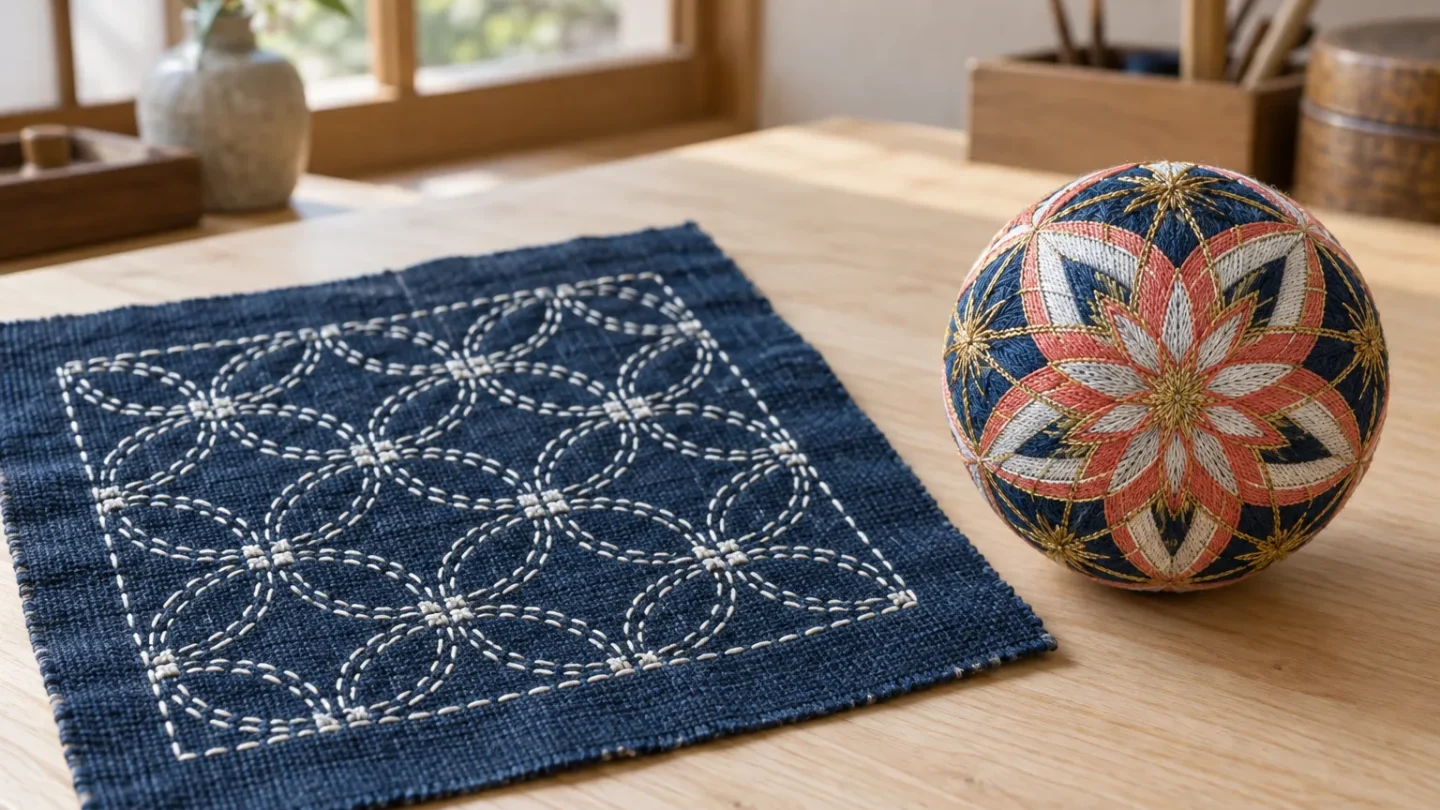
You will meet sashiko and boro on museum labels, kogin-zashi and hishizashi beside northern garments, and temari and jiwari when a maker marks a ball. This sashiko stitching explained guide restores their working context. The crafts share repeated geometry, but not one proven family tree: northern stitching follows woven cloth; temari marks a sphere.
Before the Pattern: Cloth, Cold, and Repair
The regional story begins with material limits. Aomori Prefecture states that cotton was not cultivated in its cold climate and cotton cloth was hard for low-income farming households to obtain. Bast cloth remained common; cotton thread added warmth and strength. That setting produced local systems, not one universal “Japanese stitch.” For what official craft labels do—and do not—guarantee, see The Law, the Mark, and the Price Difference.
刺し子, sashiko: “little stabs”
You meet 刺し子, sashiko, literally “little stabs,” as a broad label for reinforcing or joining cloth with repeated running stitches. The mistake is treating it as one white-on-blue pattern. Japanese sashiko is a family of practices, not a motif sheet.
“Sashiko” tells you that stitching matters. It does not yet tell you which region, counting rule, material, or purpose you are looking at.
麻, asa: “bast fiber”
You meet 麻, asa, on ground-cloth labels. English captions often say “hemp,” but historical asa can cover bast fibers including hemp and ramie. The mistake is reading every “hemp” label as a precise fiber identification; check the object record when it matters.
木綿, momen: “cotton”
You meet 木綿, momen, in accounts of thread worked into an asa garment. “Cotton was scarce” does not mean none reached the north. Cloth spread late, was hard for poor households to obtain, and faced domain restrictions; valuable thread could be used in a bast-fiber base.
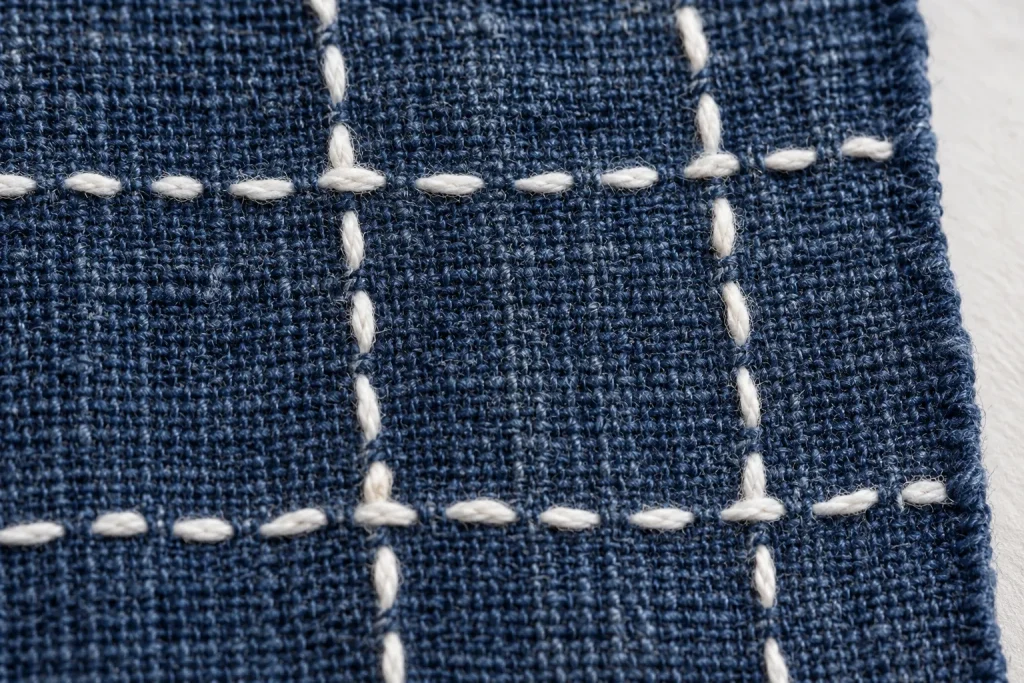
ぼろ, boro: “rags” or “tatters”
You meet ぼろ, boro, in collections and design shops. It names worn, repeatedly patched material, not an original decorative school. The mistake is calling deliberately distressed patchwork “boro.” Historical boro textiles record continued use and repair; their beauty does not erase the constraint behind it.
パッチワーク, pacchiwāku: “patchwork”
You meet パッチワーク, pacchiwāku, in modern books and stores. It suggests a designed composition assembled from pieces. That is not automatically boro, which describes condition and repair history. A new bag can borrow the look without acquiring the history.
キルト, kiruto: “quilt”
You meet キルト, kiruto, on supplies and classes. It points broadly to Western-style quilt making. Sashiko can join layers, but is not automatically a quilt: appearance alone does not establish construction.
For a cloth practice without cutting or permanent seams, How a Square of Cloth Carries a Bottle keeps folding separate from repair.
Sashiko Stitching Explained by Region
Calling kogin, hishizashi, and Shōnai “three schools” is too neat. Official language identifies Tsugaru and Nanbu as distinct transmitted techniques and Shōnai as another region. “Regional traditions” avoids implying institutions with one syllabus.
津軽こぎん刺し, Tsugaru kogin-zashi: “Tsugaru small-cloth stitching”
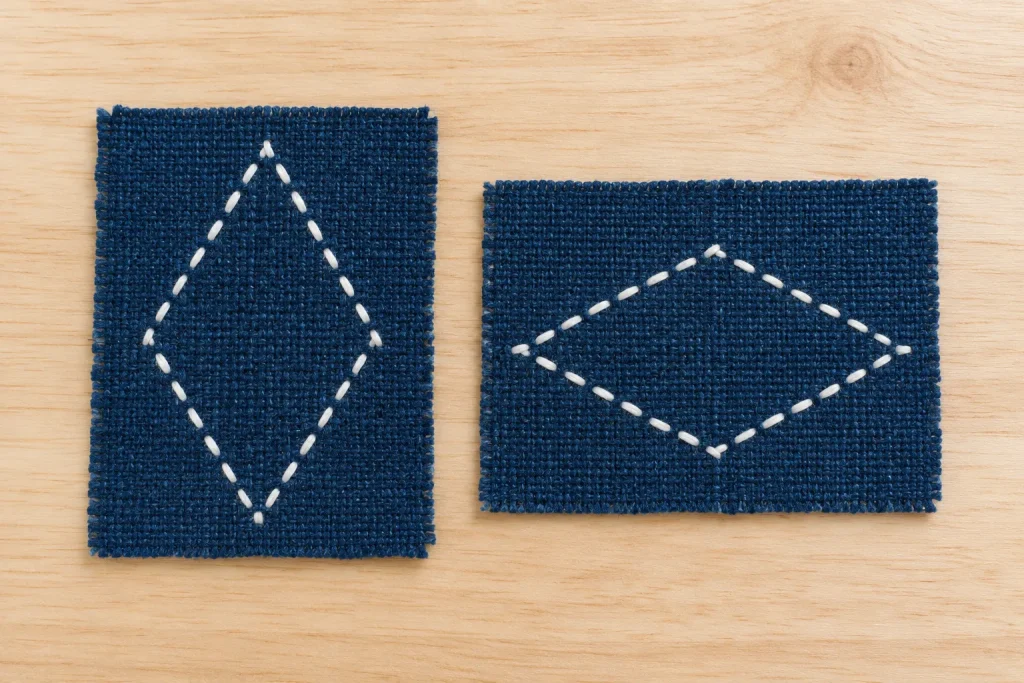
You meet 津軽こぎん刺し, Tsugaru kogin-zashi, beside garments from the former Tsugaru domain around Hirosaki. Odd numbers of vertical warp threads build upright diamonds called modoko. The mistake is calling every counted white stitch on indigo “kogin.”
南部菱刺し, Nanbu hishizashi: “Nanbu diamond stitching”
You meet 南部菱刺し, Nanbu hishizashi, around Hachinohe and the former Nanbu domain. Even warp-thread counts make its diamonds wider and more horizontal. The mistake is treating motif or color as the only difference.
庄内刺し子, Shōnai sashiko: “Shōnai reinforcement stitching”
You meet 庄内刺し子, Shōnai sashiko, in Yamagata work-clothing collections. Examples use running stitches and crossing lines to reinforce layered cloth. The mistake is forcing it into kogin and hishizashi’s counted-thread formula.
| Regional term | Ground and stitch logic | Typical visual effect | Mistake to avoid |
|---|---|---|---|
| Tsugaru kogin-zashi | Warp threads counted in odd units | Upright diamonds | Using “kogin” for all sashiko |
| Nanbu hishizashi | Warp threads counted in even units | Wider horizontal diamonds | Treating the distinction as color alone |
| Shōnai sashiko | Running stitches through layered cloth; straight lines may cross | Reinforced fields and geometric networks | Claiming it follows the same count system |
A printed “sashiko” kit may teach a running stitch but none of these regional grammars. If provenance affects the price, ask for the technique, maker, and place.
How the Flat Grid Works
布目, nunome: “cloth grain”
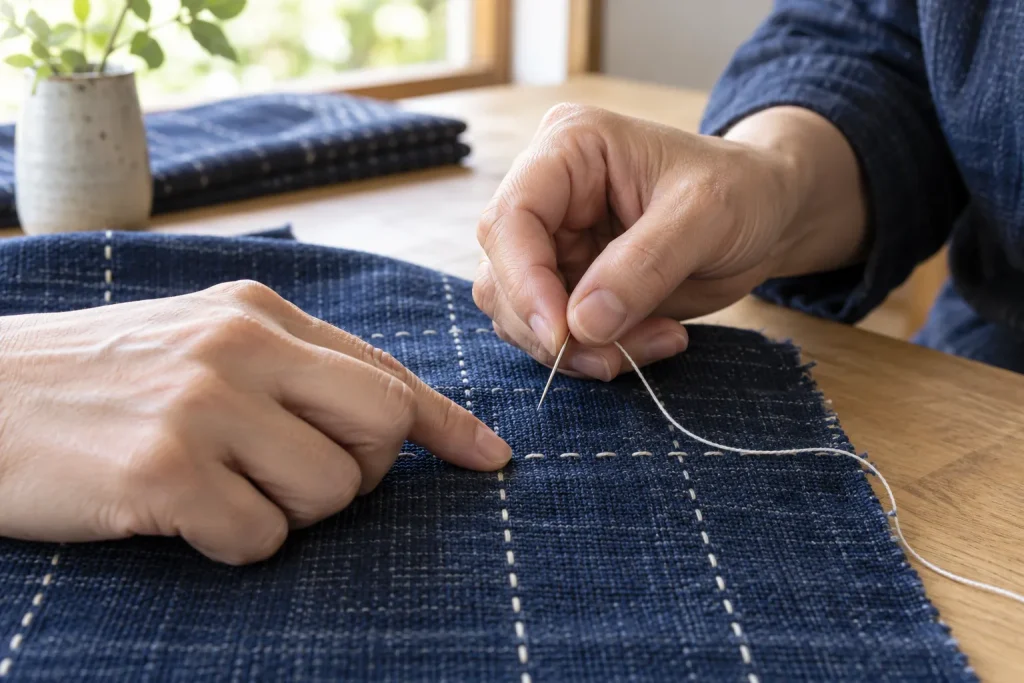
You meet 布目, nunome, when instructions say to follow the weave. Warp and weft are the measuring system. The mistake is drawing a freehand diamond and treating the cloth as blank canvas.
A worked comparison makes the rule visible:
- Identify vertical warp threads; do not measure with a ruler.
- For kogin, pick up odd groups for a vertical unit.
- For hishizashi, pick up even groups for a horizontal unit.
- Repeat the unit into a field.
The smallest decision is not an inch but a thread count. For another craft where repetition structures a flat surface, Folds That Ended Up in Space and Surgery covers origami without inventing a shared origin.
When the Grid Leaves the Cloth
手まり, temari: “hand ball”
You meet 手まり or 手毬, temari, literally “hand ball,” in toy and decorative-craft contexts. The mistake is assuming it was always a display ornament. Yamagata Prefecture says Tsuruoka goten-mari began as a toy; today its core may be a rice-hull pouch wrapped, marked, and embroidered.
Cloth arrives with warp and weft; a ball has no ready-made straight grid. Their resemblance lies in repetition and symmetry, not a documented transfer between crafts.
芯, shin: “core”
You meet 芯, shin, at the first stage: a core wrapped into an even sphere. The mistake is assuming scraps define all historical temari. The Tsuruoka account documents an older clamshell-and-sawdust core and a present rice-hull core. Temari ball making has local recipes.
地割り, jiwari: “ground division”
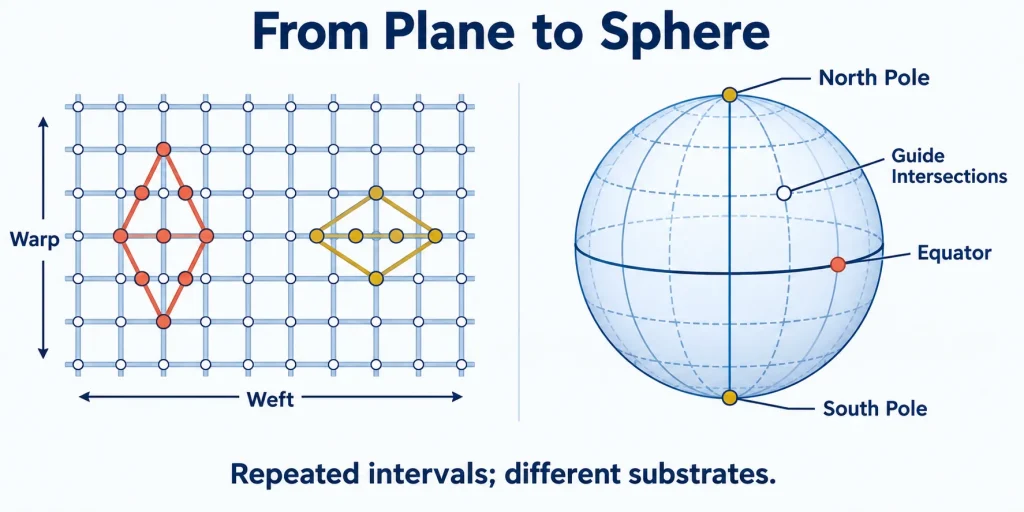
You meet 地割り, jiwari, after wrapping. Guide thread and pins divide the surface into poles, an equator, and repeated sections. The mistake is calling this the same as a woven grid; it is a coordinate system built on a curve.
One Geometry Claim, Tested
“The same geometric grid” works only at a high level: both crafts use repeatable units and controlled intervals. Their working grids differ.
| Question | Counted northern sashiko | Temari |
|---|---|---|
| Where does the grid come from? | Warp and weft already woven into cloth | Guide points and thread marked onto a sphere |
| What is counted? | Fabric threads and stitch intervals | Surface divisions and intersections |
| What happens at the edge? | A flat field reaches a seam or border | The pattern closes around the ball |
| What creates distortion? | Uneven cloth or stitch tension | An uneven core, misplaced division, or tension |
| What is historically demonstrated? | Regional reinforcement and insulation systems | A ball construction and decorative marking system |
Geometry does not prove genealogy. Similar diamonds can arise from symmetry. Evidence does not show that temari carried a sashiko grid from garment to ball, or that kimono scraps were the universal core.
For maker names, the name converter with 898 checked katakana names can help with readings; it cannot authenticate an object.
The Words Worth Keeping
Memorize three terms: sashiko for the broad family, boro for cloth marked by wear and repair, and jiwari for dividing a temari sphere. Keep the three regional names recognizable; the rest can remain lookup words until you begin making.
In practice:
- For “boro,” look for repair history, not surface distress.
- For “kogin,” look for counted warp threads and odd counts.
- For “traditional” temari, ask which local construction is documented.
- When objects share a diamond, compare grids before origins.
Glossary at the Point of Use
| Term | Reading | Literal meaning | Where you meet it |
|---|---|---|---|
| 刺し子 | sashiko | little stabs | Museum labels, kits, stitched workwear |
| 麻 | asa | bast fiber | Historical fabric descriptions |
| 木綿 | momen | cotton | Thread and cloth labels |
| ぼろ | boro | rags, tatters | Repaired garments and collections |
| パッチワーク | pacchiwāku | patchwork | Modern craft categories |
| キルト | kiruto | quilt | Supply stores and classes |
| 津軽こぎん刺し | Tsugaru kogin-zashi | Tsugaru small-cloth stitching | Hirosaki and western Aomori labels |
| 南部菱刺し | Nanbu hishizashi | Nanbu diamond stitching | Hachinohe and eastern Aomori labels |
| 庄内刺し子 | Shōnai sashiko | Shōnai reinforcement stitching | Yamagata work-clothing collections |
| 布目 | nunome | cloth grain | Counted-stitch instructions |
| 手まり/手毬 | temari | hand ball | Ball craft and toy displays |
| 芯 | shin | core | First stage of ball construction |
| 地割り | jiwari | ground division | Marking a temari sphere |