Roughly 1,300 years separate Japan’s earliest era naming from Reiwa, the first era name officially presented as being drawn from a Japanese classic. The immediate reiwa manyoshu origin is an eighth-century preface about a plum-blossom gathering, not a passage selected directly from a Chinese book. Yet the claim becomes less tidy when you place that preface beside Zhang Heng’s earlier Chinese Rhapsody on Returning to the Fields. Both texts describe an auspicious spring month through closely related Classical Chinese phrases. Reiwa broke with the documented source tradition, but it did not break with the Chinese literary language that had shaped Japanese court writing.
That awkward distinction is the point. The source document is Japanese, while the language and imagery in that document belong to a shared East Asian literary tradition. Calling Reiwa “not taken from China” is defensible only if “taken from” means the work formally cited by the Japanese government. It is misleading if it suggests that the selected sentence developed without Chinese models. Reiwa was politically and symbolically Japanese in its citation, but philologically more complicated.
How the 1,300-year claim is calculated
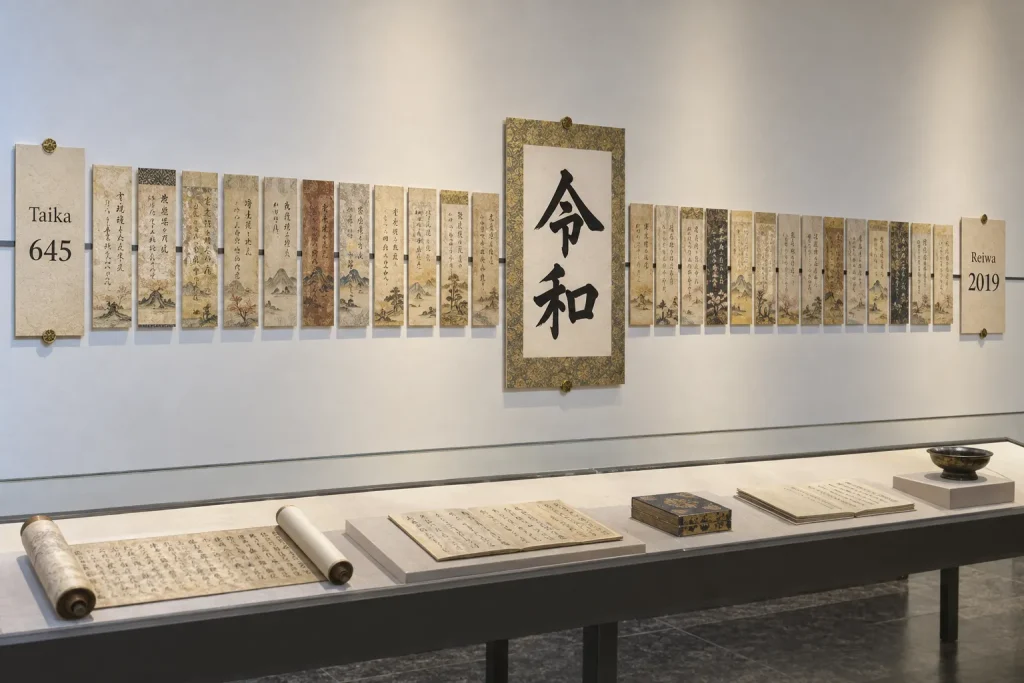
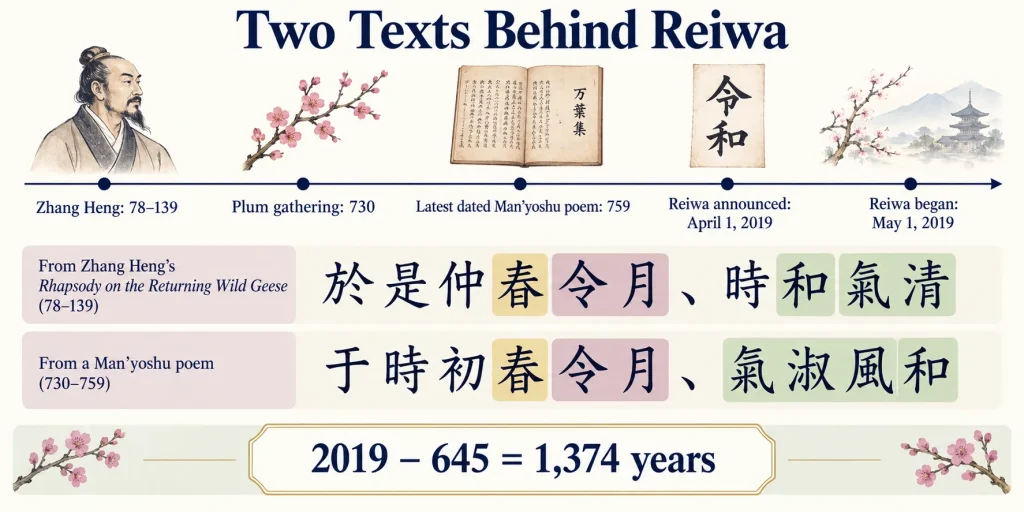
Japan’s era-name system begins conventionally with 大化, Taika, literally “great transformation,” in 645. The government announced 令和, Reiwa, officially explained in English as “beautiful harmony,” on April 1, 2019. Subtracting 645 from 2019 produces 1,374 years. That is why official statements and contemporary reporting generally used the rounded expression “about 1,300 years” rather than presenting 1,300 as an exact duration.
The same arithmetic can be written as a short chain:
- Taika begins the conventional era-name chronology in 645.
- Reiwa is announced in 2019.
- 2019 − 645 = 1,374 years.
- Rounded down to the nearest century, the interval is about 1,300 years.
- Reiwa takes effect on May 1, 2019, one month after its announcement.
The count does not mean Japan used era names without interruption throughout every part of that interval. Nor does it establish that the source of every early name can be reconstructed with equal certainty. It measures the distance between the conventional beginning of the system and the announcement of Reiwa. Choosing Two Kanji for the Next Thirty Years explains the modern selection process and the practical burden placed on two characters. Here, the narrower question is why the government treated the source text itself as historic.
| Counted component | Date or quantity | Calculation | Primary basis |
|---|---|---|---|
| Conventional first era, Taika | 645 | Starting year | Japanese historical chronology |
| Reiwa announcement | April 1, 2019 | Ending year | Cabinet announcement |
| Reiwa begins | May 1, 2019 | 30 days after announcement | Cabinet Order |
| Exact year difference | 1,374 years | 2019 − 645 | Calendar arithmetic |
| Public shorthand | About 1,300 years | 1,374 rounded by century | Government explanation and contemporary record |
The table is counted rather than costed because choosing an era name is not a consumer transaction with a published price. No primary source gives a fee for selecting Reiwa or a standard yen cost for adopting a new era name. Creating a dollar comparison would add a number with no documentary basis. The measurable total here is the chronological interval: 1,374 years, conventionally described as roughly 1,300.
The reiwa manyoshu origin begins at a plum party
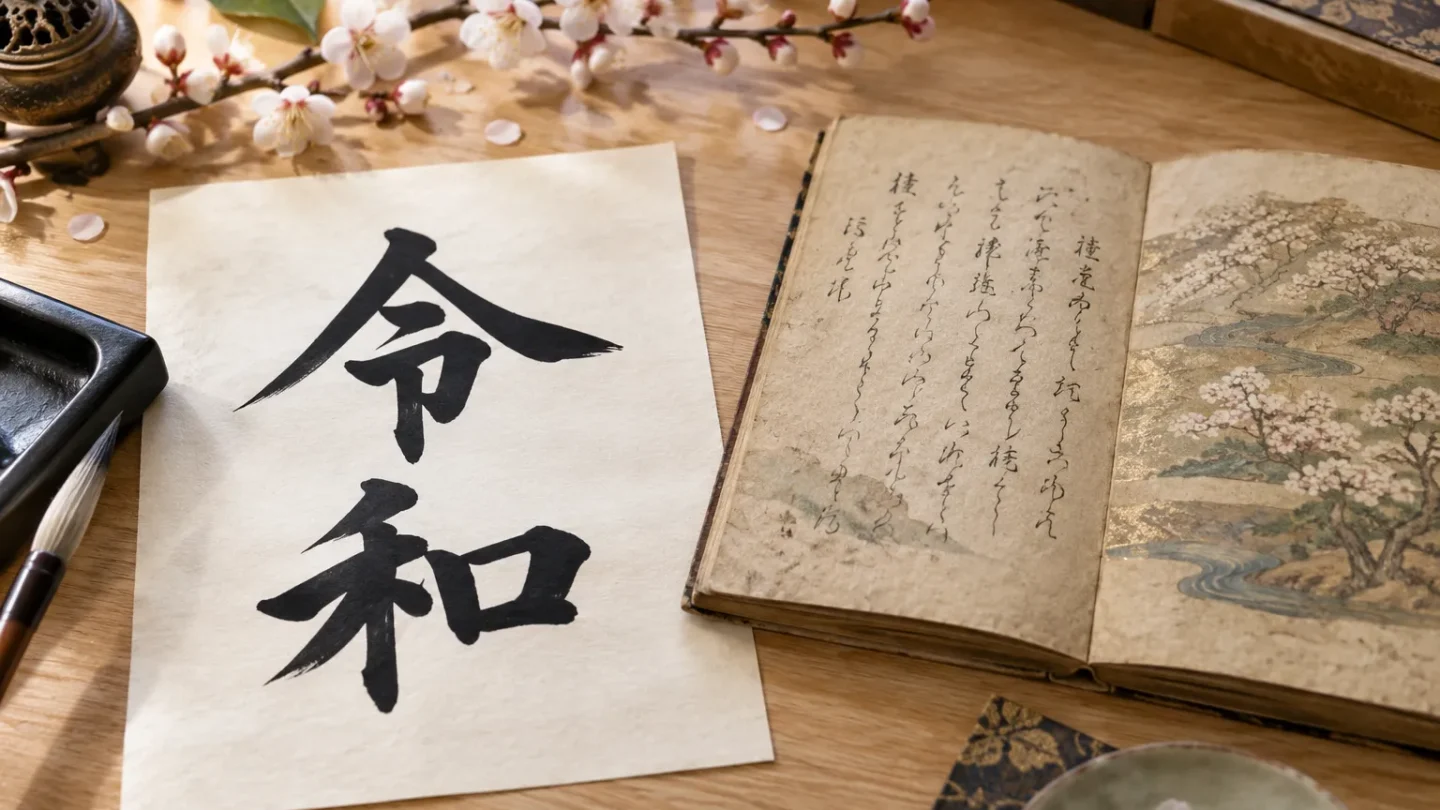
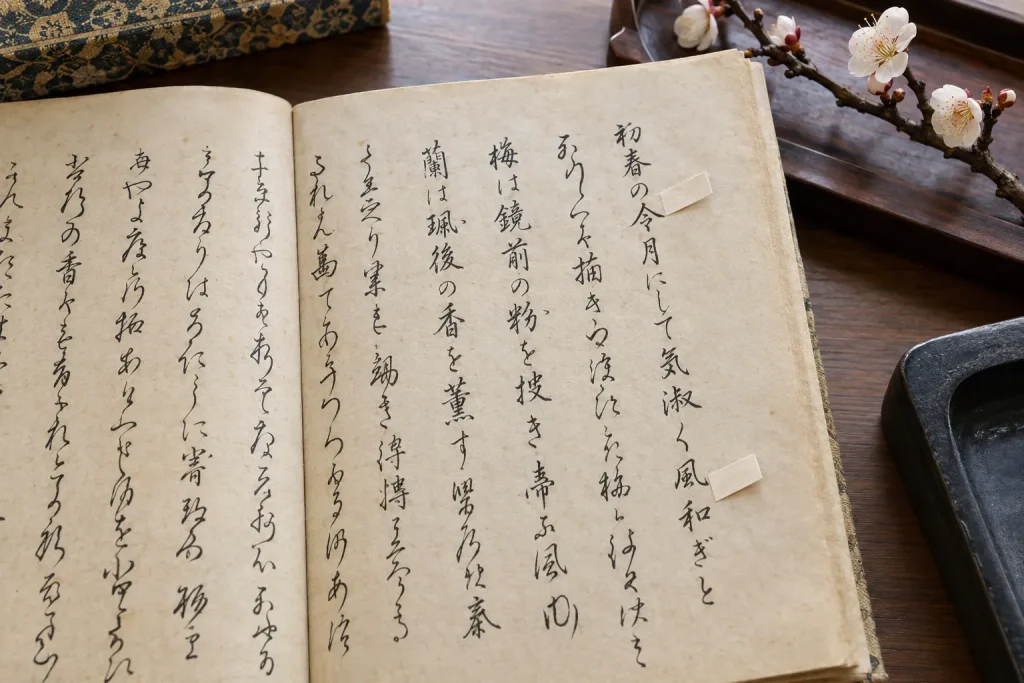
The source identified by the government is the preface to a group of plum poems in Book Five of 万葉集, Man’yōshū, literally “Collection of Ten Thousand Leaves.” The anthology’s latest securely dated poem belongs to 759, although the collection preserves substantially earlier material. The relevant preface describes a gathering held in 730 at the residence of Ōtomo no Tabito in Dazaifu. Guests composed poems while plum blossoms opened in early spring. Reiwa takes one character from 令月, reigetsu, “auspicious month,” and one from 風和, kaze yawaragu in Japanese reading, “the wind is gentle.”
The key sentence reads:
于時初春令月、氣淑風和
A restrained translation is: “It was an auspicious month in early spring; the air was fine and the wind was gentle.” The two selected characters are not adjacent in the original. 令 appears inside 令月, while 和 appears later in 風和. The Reiwa kanji were therefore extracted from two parts of one sentence and combined into a new era name. That procedure matters because translating the source sentence is not the same as assigning one fixed dictionary meaning to the new compound.
| Element | Position in the preface | Meaning in context | Contribution to 令和 |
|---|---|---|---|
| 令 | First character of 令月 | Auspicious, fine, favorable | First character |
| 月 | Second character of 令月 | Month | Not selected |
| 風 | First character of 風和 | Wind | Not selected |
| 和 | Second character of 風和 | Gentle, mild, harmonious | Second character |
| Combined era name | Two nonadjacent characters | Officially explained as “beautiful harmony” | 令和 |
The government’s English explanation was interpretive rather than a word-for-word translation. 令 can mean an order or command in other compounds, which produced immediate confusion outside Japan. In this literary context, however, 令月 is a conventional favorable or auspicious month. 和 describes gentleness and harmony rather than merely political peace. The Reiwa meaning depends on the selected passage and the government’s stated aspiration, not on choosing the most alarming entry in a modern bilingual dictionary.
Why the Japanese source mattered in 2019
Previous era names were understood to have been taken from Chinese classical works. Reiwa’s citation of the Man’yōshū therefore allowed the government to identify a Japanese literary work as the immediate source for the first time. Prime Minister Shinzo Abe emphasized that the anthology contained poems from emperors, nobles, warriors, and ordinary people. He presented it as a work expressing Japan’s cultural breadth rather than as an elite court text alone. His explanation connected the new name with the hope that culture would grow as people brought their hearts together.
The symbolism was deliberate. The government could have selected two acceptable characters and justified them through another Chinese classic, as earlier governments had done. Instead, it chose a passage from a work widely treated as foundational to Japanese poetry. 1 April 2019, and the Board Held Up covers the announcement itself, including Chief Cabinet Secretary Yoshihide Suga displaying the calligraphy. The source choice supplied the cultural message behind that televised moment.
Japanese source did not mean vernacular Japanese sentence. The plum-poem preface was written in 漢文, kanbun, literally “Chinese writing,” the Japanese practice of composing and reading Classical Chinese. Educated writers in Nara-period Japan worked inside a literary world built from Chinese characters, vocabulary, genres, and allusions. A Japanese anthology could therefore contain a Japanese event described through Chinese literary forms. That is exactly what makes the source both genuinely Japanese and visibly continental.
The earlier Chinese sentence behind the wording
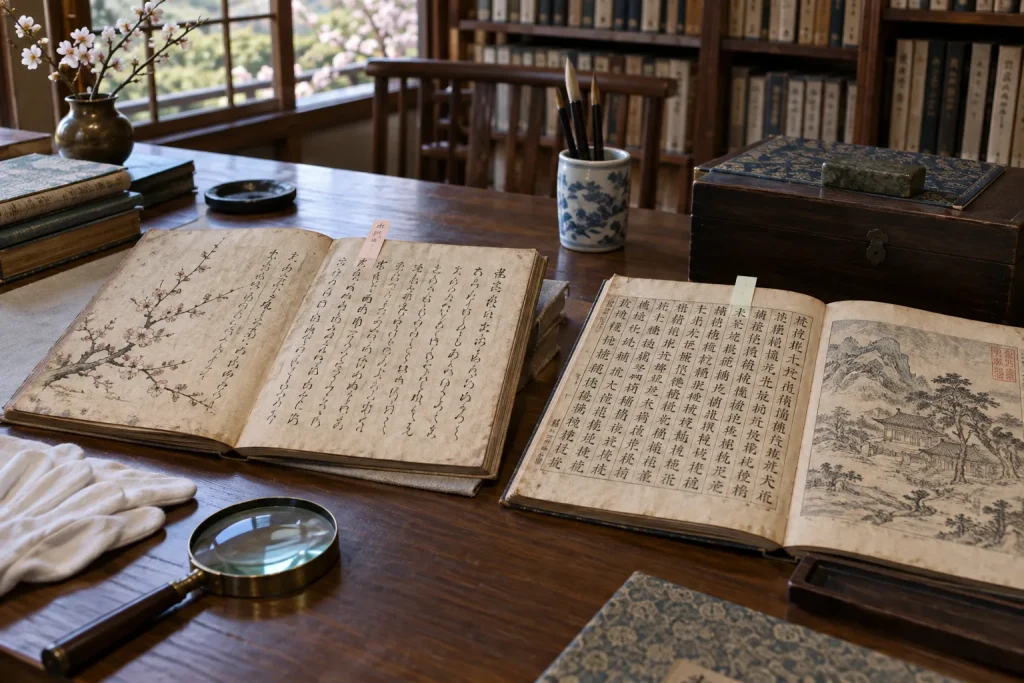
Zhang Heng lived from 78 to 139, more than five centuries before the 730 plum gathering described in the Man’yōshū. His 歸田賦, Gui tian fu, literally “Rhapsody on Returning to the Fields,” includes a spring passage whose phrasing resembles the Japanese preface. The comparison does not show that Reiwa was secretly lifted as a two-character compound from Zhang’s work. It shows that the Man’yōshū author wrote within an inherited Classical Chinese repertoire.
The two passages can be compared without forcing them into identity:
| Text | Relevant wording | Shared or parallel elements |
|---|---|---|
| Zhang Heng, Rhapsody on Returning to the Fields | 於是仲春令月、時和氣清 | Spring, 令月, favorable atmosphere, 和, clear air |
| Man’yōshū plum preface | 于時初春令月、氣淑風和 | Spring, 令月, fine air, 和, gentle wind |
| Direct overlap | 春令月 | Spring and an auspicious month |
| Structural parallel | Time + atmosphere + 和 + air/weather | Closely related seasonal formulation |
The resemblance is stronger than the accidental recurrence of two common characters. Both passages establish spring, call the month 令月, and follow it with balanced language about atmosphere and harmonious conditions. The order of individual words changes, and the descriptions are not identical. Scholars therefore describe the relationship as influence, adaptation, an echo, or a possible textual model rather than treating the sentences as exact copies. The Man’yoshu origin remains the immediate citation, while Zhang Heng supplies an earlier literary ancestor.
This distinction resolves the apparent contradiction. Reiwa was the first era name whose officially cited source was a Japanese classic. The Japanese passage itself was composed in Classical Chinese and appears to draw on an older Chinese expression. Both statements can be true at the same time. National ownership of a book and historical ancestry of its language answer different questions.
What “from a Japanese classic” does not prove
It does not prove that no similar pairing of 令 and 和 existed elsewhere. Chinese text databases contain the characters in many contexts, and Classical Chinese writers reused conventional descriptions of seasons, weather, and auspicious occasions. It also does not prove that the unnamed author of the plum preface had Zhang Heng’s manuscript physically open in 730. Textual similarity can establish a strong literary relationship without documenting the exact act of borrowing. A careful account should retain that limit.
It also does not make the Man’yōshū culturally sealed off from China. The anthology contains Japanese poems, Chinese poems, and prose passages written in Chinese. Its writing system reflects the adaptation of Chinese characters to represent Japanese language. Its authors belonged to a court culture in which Chinese literature was a core part of education. Presenting this mixture as contamination misses how written culture in early Japan actually worked.
The sharper claim is narrower: the cabinet cited a Japanese work instead of citing a Chinese classic directly. That choice altered the official genealogy of the Reiwa era name. It did not erase the international genealogy of the sentence from which the characters came. Reiwa’s novelty is bibliographic and political, not proof of literary isolation. The inconvenient Chinese echo makes the history more accurate, not less Japanese.
From two source characters to a working calendar
Reiwa became the legal era name on May 1, 2019, when Emperor Naruhito acceded to the throne. That made the calendar year 2019 a transition year: dates through April 30 belonged to Heisei 31, while dates from May 1 belonged to Reiwa 1. The source debate does not change how dates are converted. Readers who need the practical arithmetic can use the Japanese era converter, which covers every year from 1868 through 2050 across the five modern eras.
For years after the first Reiwa year, the conversion is straightforward:
- Take the Gregorian year.
- Subtract 2018.
- The result is the Reiwa year.
- For 2026, the calculation is 2026 − 2018 = Reiwa 8.
- Treat 2019 separately because the era began on May 1 rather than January 1.
The site already provides the conversion structure, so there is no reason to reproduce its 183 generated era-year pages here. Japanese Era Years: Meiji to Reiwa, Explained covers how the modern era calendar works and why the first year is written 元年, gannen, literally “original year.” Showa, Heisei and Reiwa Year Tables supplies lookup tables when you need a date rather than the literary history. Those resources address conversion; this article addresses the source claim behind the current name.
Why the comparison matters beyond etymology
The government’s choice was designed to communicate cultural confidence. Citing the Man’yōshū allowed officials to say that Japan had looked into its own classical canon for an era name. That message was especially effective because the anthology includes voices associated with several levels of society. Yet the wording chosen from it also demonstrates that “Japan’s own canon” had never developed in a vacuum. The archive itself preserves centuries of adaptation, borrowing, and transformation.
The best American comparison is not a translated slogan but a government phrase drawn from an early national document whose author was educated through older European models. The immediate source would still be American even if its vocabulary and rhetoric carried Greek, Roman, French, or British precedents. Source attribution and linguistic ancestry would remain separate layers. Reiwa asks you to hold those layers together. Reducing the story to either “entirely Japanese” or “really Chinese” discards half the evidence.
Era names are built to be brief, memorable, writable, and favorable. Two characters have to function on coins, forms, calendars, licenses, certificates, news graphics, and digital systems. They also acquire meanings that exceed the sentences from which they were selected. After May 1, 2019, 令和 became not only a literary combination but the name of a lived period. The older texts explain its construction; subsequent history determines what people associate with it.
Frequently asked questions
Was Reiwa really the first era name from a Japanese source?
Yes, in the specific sense used by the Japanese government: the officially cited source was a Japanese classic, the Man’yōshū. Earlier era names had been associated with Chinese classical sources. However, the selected Man’yōshū passage was written in Classical Chinese. Its phrasing also closely resembles an older passage by Zhang Heng.
Does that mean Reiwa actually came from China?
Not as a direct official citation. The cabinet identified the Man’yōshū plum preface as its source. Zhang Heng’s work is relevant because it appears to be a literary model or antecedent for that preface. Saying “the source is Japanese, but the source passage has Chinese ancestry” is more precise than choosing only one side.
What do the two characters mean?
令 can mean favorable or auspicious in the compound 令月 used by the preface. 和 refers to gentleness, harmony, or peaceful balance in the phrase 風和. The Japanese government explained the combined era name in English as “beautiful harmony.” That explanation communicates the intended sense rather than providing a mechanical translation of each character.
Were 令 and 和 next to each other in the Man’yoshu?
No. 令 appears in 令月, “auspicious month,” while 和 appears later in 風和, “the wind was gentle.” The name combines two nonadjacent characters from the same sentence. This was a deliberate extraction, not the adoption of an existing two-character expression printed there as 令和.
When did Reiwa begin?
Reiwa began on May 1, 2019, when Emperor Naruhito acceded to the throne. The name had been announced on April 1, 2019. Dates from January 1 through April 30, 2019, remain part of Heisei 31. The first Reiwa year covers the remainder of 2019.
What is the single figure to remember?
Remember 1,374 years: the arithmetic distance from Taika in 645 to Reiwa’s announcement in 2019. “Roughly 1,300 years” is the public shorthand, not an exact count. Recheck the historical-source characterization by September 21, 2027, or sooner if Japan’s official archival explanation is revised. The underlying classical passages are stable, but government pages, translations, and database addresses can change.