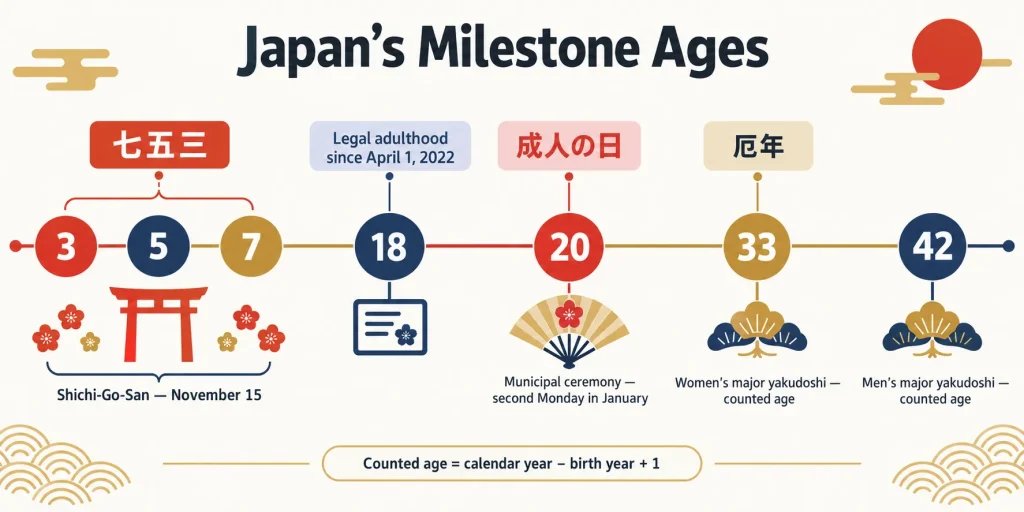
Three, five, seven, twenty, thirty-three and forty-two form Japan’s most recognizable calendar of age milestones. These Japanese age ceremonies do not belong to one system: children visit shrines in November, municipalities gather twenty-year-olds in January, and some adults observe traditionally calculated caution years.
That distinction matters. Japan’s legal age of adulthood became eighteen on April 1, 2022, but Yokohama and many other municipalities retained twenty as the age for their public gatherings. The years thirty-three and forty-two are different again: they are usually calculated by 数え年, kazoedoshi, literally “counted age,” under which you begin at one and add a year every New Year’s Day.
For the wider annual calendar around these occasions, What Happens in Japan, Month by Month separates statutory holidays from observances that do not close public offices.
The calendar of Japanese age ceremonies
The easiest way to understand the system is to put the ages in order rather than treating every event as a “coming-of-age ceremony.”
| Age or ages | Japanese name | Usual timing | What is marked | How age is normally handled |
|---|---|---|---|---|
| Three, five and seven | 七五三, Shichi-Go-San, “seven-five-three” | Around November 15 | A child’s growth and well-being | Traditional counted age or ordinary age, depending on family and shrine |
| Eighteen | 成年, seinen, “legal adulthood” | From the eighteenth birthday | Legal capacity under the Civil Code | Ordinary age |
| Twenty | 二十歳のつどい, hatachi no tsudoi, “gathering of twenty-year-olds” | Coming-of-Age Day in January | Municipal and community recognition | Birth-date eligibility set by each municipality |
| Thirty-three | 女の大厄, onna no taiyaku, “women’s major caution year” | Commonly observed near New Year | A traditional life-transition year | Counted age |
| Forty-two | 男の大厄, otoko no taiyaku, “men’s major caution year” | Commonly observed near New Year | A traditional life-transition year | Counted age |
The table describes common practice, not compulsory stages. Families can skip a shrine visit. Eighteen-year-olds do not receive a single national ceremony. Yakudoshi observance is a custom, not a legal or medical prediction.
Ages three, five and seven: the November shrine visit
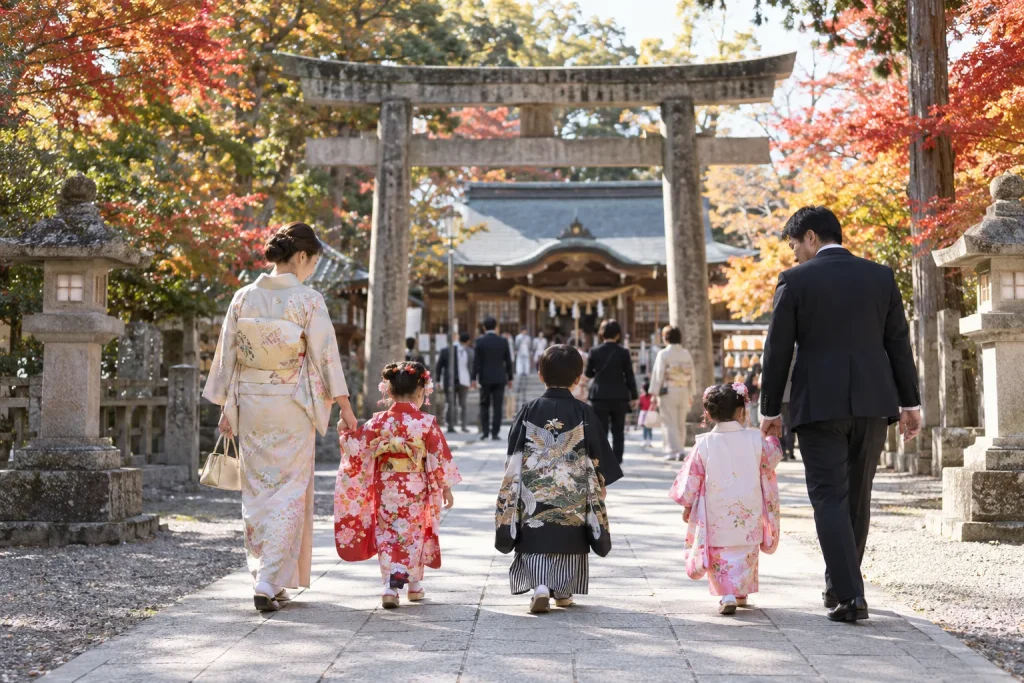
七五三, Shichi-Go-San, literally “seven-five-three,” centers on a visit to a Shinto shrine to give thanks for a child’s growth and ask for continued well-being. The traditional date is November 15, although families commonly use nearby weekends or other convenient dates during the fall.
The customary age pattern is not simply “every child attends three times.” The National Association of Shrines connects the observance to older rites:
- 髪置, kamioki, “letting the hair grow,” at three;
- 袴着, hakamagi, “putting on hakama,” at five;
- 帯解, obitoki, “changing from cords to an obi,” at seven.
The familiar modern pattern is often age three for girls and boys, age five especially for boys, and age seven especially for girls. Practice varies by family and region, however, and shrines generally explain their own arrangements.
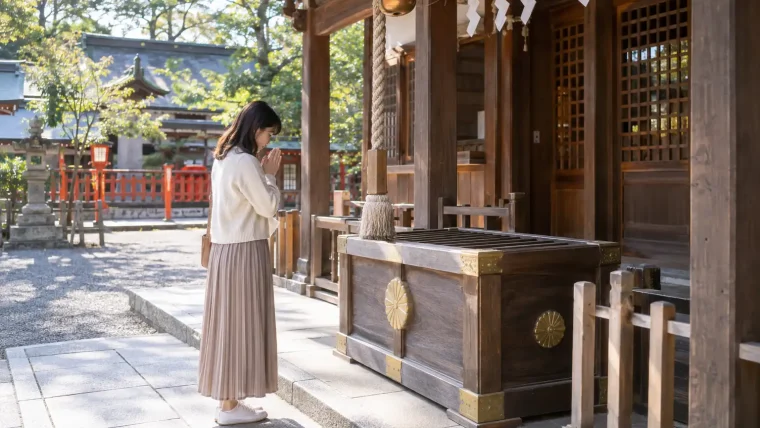
Visitors notice formal clothing before anything else. Children may wear kimono or Western formalwear, while parents and grandparents dress for photographs and the shrine visit. Some families request a formal prayer; others make an ordinary visit without entering a prayer hall.
The uncomfortable part is commercial rather than ceremonial. Photography, clothing rental, dressing and hair styling can cost far more than the shrine visit. None of those purchases defines the observance. A family using clothes it already owns and taking its own photographs is not performing a lesser version.
November 15 is the reference date, not an appointment that every family in Japan must keep.
If you plan to visit a well-known shrine in mid-November, expect formal family groups and photographers around the approach. Do not block the worship area for a photograph. Japanese Etiquette for Visitors: What Actually Matters covers the shrine behavior worth remembering without turning the visit into a list of invented prohibitions.
In 2026, November 15 falls on a Sunday. In 2027, it falls on a Monday. Those calendar positions can affect weekend crowds even though the observance itself is not a national holiday.
What a Shichi-Go-San photograph can actually cost
There is no honest nationwide “average cost.” A shrine may request a set offering for a formal prayer, while commercial studios price clothing, photographs and outings separately. Campaigns also expire.
The following arithmetic uses one identifiable 2026 Studio Alice promotion, not a claim about every family or studio. Its standard listed shooting fee was ¥5,500, discounted by half for an October campaign. Products remained separate.
Using the Federal Reserve’s September 3, 2026 reference rate of ¥155.47 per US dollar:
| Checked component | Yen | Approximate dollars | Source and validity |
|---|---|---|---|
| Listed shooting fee | ¥5,500 | $35.38 | Studio Alice, checked September 14, 2026 |
| October campaign discount | −¥2,750 | −$17.69 | One-half discount, October 1–12, 2026 |
| Photo products | Not included | Not calculated | Selected and charged separately |
| Total before products | ¥2,750 | $17.69 | Valid only under the named promotion |
The calculation is:
- ¥5,500 × 0.5 = ¥2,750.
- ¥2,750 ÷ 155.47 = approximately $17.69.
- Add the price of every print, album or digital product you select.
This is why Shichi-Go-San costs cannot be reduced to the photography fee shown in an advertisement. A low entry price may buy the session but not the finished photographs, shrine offering, outdoor kimono rental, dressing or transportation.
Age twenty: a civic ceremony after adulthood moved to eighteen
成人の日, Seijin no Hi, literally “Coming-of-Age Day,” is a national holiday on the second Monday of January. The Holiday Act describes its purpose as recognizing young people who have become adults and encouraging them as they begin independent lives.
That sounds as though the ceremony must follow the legal age of adulthood. It does not.
Japan’s amended Civil Code lowered adulthood from twenty to eighteen on April 1, 2022. Municipalities still decide whom their local gatherings recognize. Yokohama explicitly retained twenty-year-old participants and renamed its event 二十歳の市民を祝うつどい, hatachi no shimin o iwau tsudoi, “gathering to celebrate twenty-year-old citizens.”
Yokohama’s stated reason is practical: eighteen overlaps with entrance examinations and job hunting. Its 2027 event is scheduled for January 11 and covers residents born from April 2, 2006, through April 1, 2007.
This produces the central correction:
- You become a legal adult at eighteen.
- Seijin no Hi remains a national holiday.
- The public gathering you see may still be designed for people who are twenty.
- Invitations, registration and eligibility come from the municipality, not from a single nationwide ceremony office.
The holiday falls on January 12 in 2026 and January 11 in 2027 because both dates are the second Monday of January.
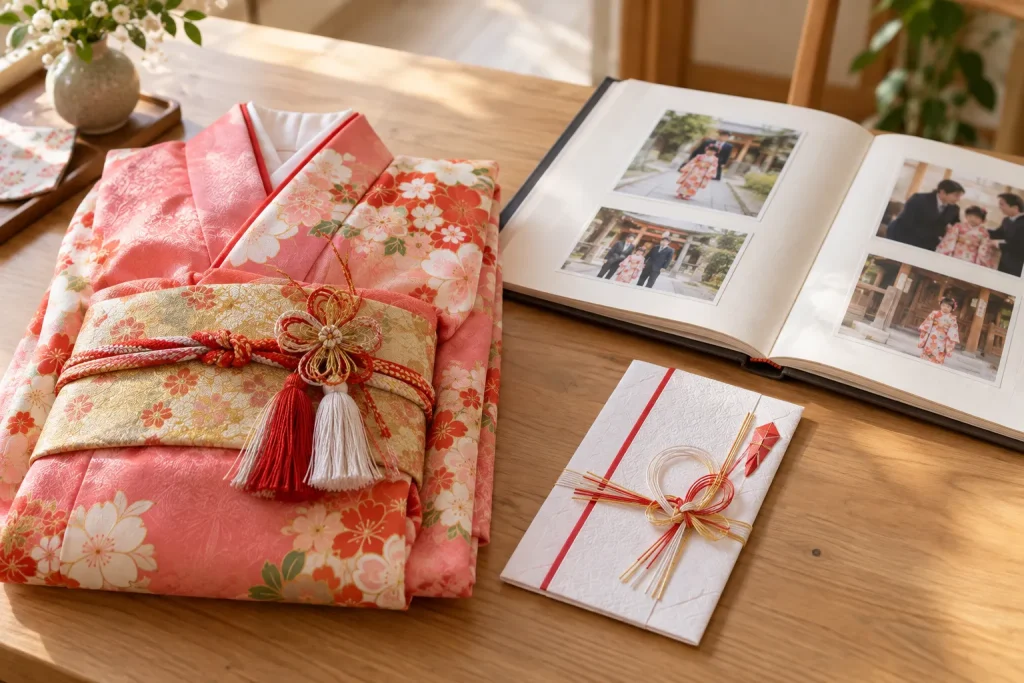
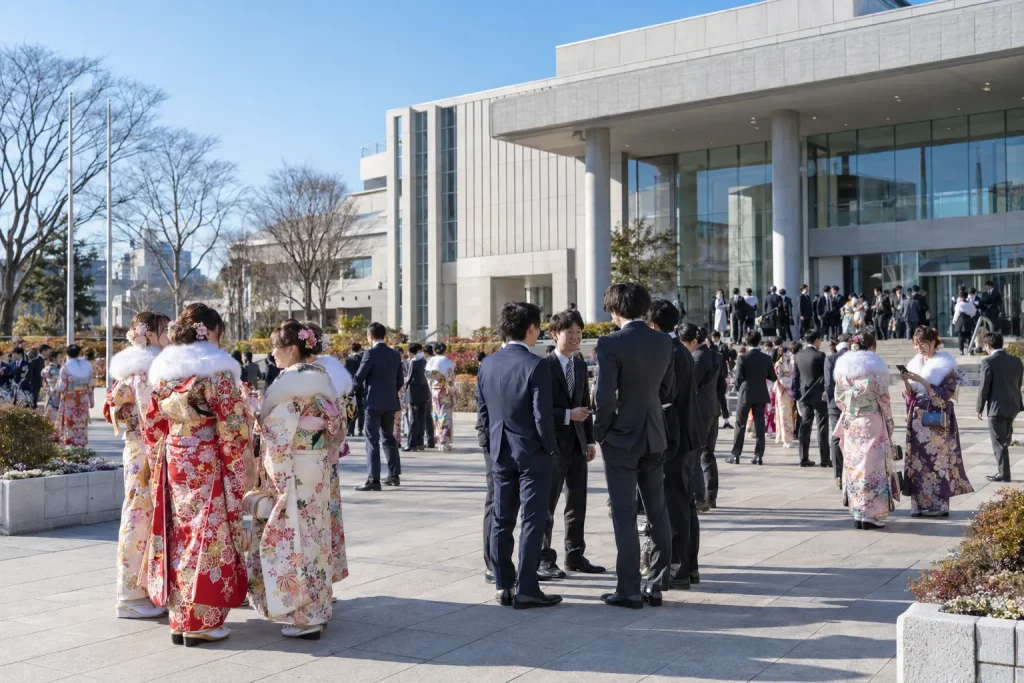
In many cities, participants wear suits or 振袖, furisode, literally “swinging sleeves,” the long-sleeved formal kimono associated with unmarried women. The clothing is visible; the legal distinction is not. A photograph of people in furisode does not prove that everyone pictured became an adult that morning.
For seasonal crowds and events beyond this one holiday, Japanese Festivals by Season: A Year-Round Guide explains what visitors experience rather than repeating the legal calendar.
What changes the total at twenty
The civic gathering and the commercial preparation around it are separate transactions. Your clothing bill can change through:
- owning, borrowing or renting formalwear;
- booking advance photography;
- adding professional dressing and hair styling;
- choosing new or previously worn kimono;
- traveling back to the municipality where you attended school;
- attending a private reunion after the official gathering.
A current Studio Alice listing gives a useful worked example of the scale involved: its Furiho rental plan was advertised at ¥99,800 before tax. With Japan’s ten-percent consumption tax, the arithmetic is:
| Component | Calculation | Amount |
|---|---|---|
| Advertised plan | Listed amount | ¥99,800 |
| Consumption tax | ¥99,800 × 10% | ¥9,980 |
| Total | ¥99,800 + ¥9,980 | ¥109,780 |
| Dollar reference | ¥109,780 ÷ 155.47 | About $706.13 |
That is a commercial clothing package, not a fee charged for becoming an adult. It should not be presented as a national average. The coming of age Japan photographs may look standardized, but household spending is not.
If an invitation uses a Japanese era year such as 令和9年, Reiwa kyūnen, “Reiwa year nine,” the era converter covering every year from 1868 through 2050 and all five eras will translate it without requiring you to rebuild the era table.
Ages thirty-three and forty-two use different arithmetic
厄年, yakudoshi, literally “calamity year,” refers to traditional caution years associated with periods of change. The National Association of Shrines lists the commonly recognized years as twenty-five, forty-two and sixty-one for men, and nineteen, thirty-three, thirty-seven and sometimes sixty-one for women.
Within those lists, forty-two for men and thirty-three for women are widely treated as 大厄, taiyaku, “major caution years.” These are the yakudoshi ages most likely to appear prominently on a shrine chart.
The wording “dangerous year” needs restraint. It describes a cultural belief and observance; it is not evidence that people of those ages face a measurable increase in accidents or illness. Shrines themselves also note regional differences.
The calculation usually uses kazoedoshi:
| Birthday status during 2026 | Ordinary age during part of 2026 | Counted age for 2026 |
|---|---|---|
| Born at any point in 1985 | Forty or forty-one | Forty-two |
| Born at any point in 1994 | Thirty-one or thirty-two | Thirty-three |
The general formula is:
Counted age in a calendar year = calendar year − birth year + 1.
Therefore:
- 2026 − 1985 + 1 = 42.
- 2026 − 1994 + 1 = 33.
This Japanese age counting method begins at one in the birth year and advances everyone at New Year, not on individual birthdays. The preceding year may be called 前厄, maeyaku, “pre-caution year,” and the following year 後厄, atoyaku, “post-caution year.”
Some people request 厄祓い, yakubarai, literally “calamity purification,” at a shrine. Others do nothing. There is no national deadline, and the National Association of Shrines says local customs differ.
Regional practice matters more than the neat chart
The three milestones do not have the same authority.
Shichi-Go-San is a family and shrine observance. Coming-of-Age Day is a statutory holiday, but the gathering is organized locally. Yakudoshi is a customary age framework whose listed years and observance can vary by region.
Before arranging anything, check in this order:
- The municipality’s official eligibility notice for the twenty-year gathering.
- The shrine’s current reservation rules and prayer offering.
- The studio or rental provider’s cancellation terms.
- Whether the family is using ordinary age or counted age for Shichi-Go-San.
- Whether the local shrine publishes a different yakudoshi chart.
If your trip overlaps mid-November, Where the Leaves Turn, and Exactly When helps distinguish foliage timing from the Shichi-Go-San calendar. The two can coincide at photogenic shrines, but neither determines the other.
The comparison worth remembering is simple: the United States usually lets birthdays do the organizational work. Japan’s milestones can instead follow a fixed November reference date, a Monday holiday in January or a New Year-based age calculation.
FAQ
Is Shichi-Go-San always held on November 15?
November 15 is the traditional date, but families commonly choose a nearby weekend or another convenient fall date. Shrine schedules and reservation arrangements vary.
Do both boys and girls celebrate at three, five and seven?
The familiar pattern associates age three with girls and boys, five especially with boys, and seven especially with girls. Modern family practice varies, so do not treat the pattern as an admission rule.
Is eighteen or twenty the age of adulthood in Japan?
Legal adulthood is eighteen under the Civil Code change effective April 1, 2022. Municipal coming-of-age gatherings may still recognize twenty-year-olds.
Can an eighteen-year-old attend a Coming-of-Age Day ceremony?
It depends on the municipality’s eligibility rules. Yokohama’s gathering remains for twenty-year-old residents. Check the official notice for the city involved.
Why are thirty-three and forty-two considered important?
They are commonly listed as the major yakudoshi years for women and men respectively. This is a cultural classification, not a scientific forecast of harm.
How do I calculate my yakudoshi age?
For the usual counted-age method, subtract your birth year from the current calendar year and add one. Local charts can differ, so confirm the result with the shrine you intend to visit.
Must you pay for these ceremonies?
No single national price exists. Formal prayers, clothing, photography and private celebrations are optional or locally priced. Municipal eligibility and shrine practices must be checked separately.
Next time you see a January photograph labeled “Japan’s adulthood ceremony,” look at one detail before accepting the caption: the participants are probably twenty, even though legal adulthood begins at eighteen. The single figure to remember is twenty. Recheck it against the relevant municipality’s notice before the January 11, 2027 holiday.