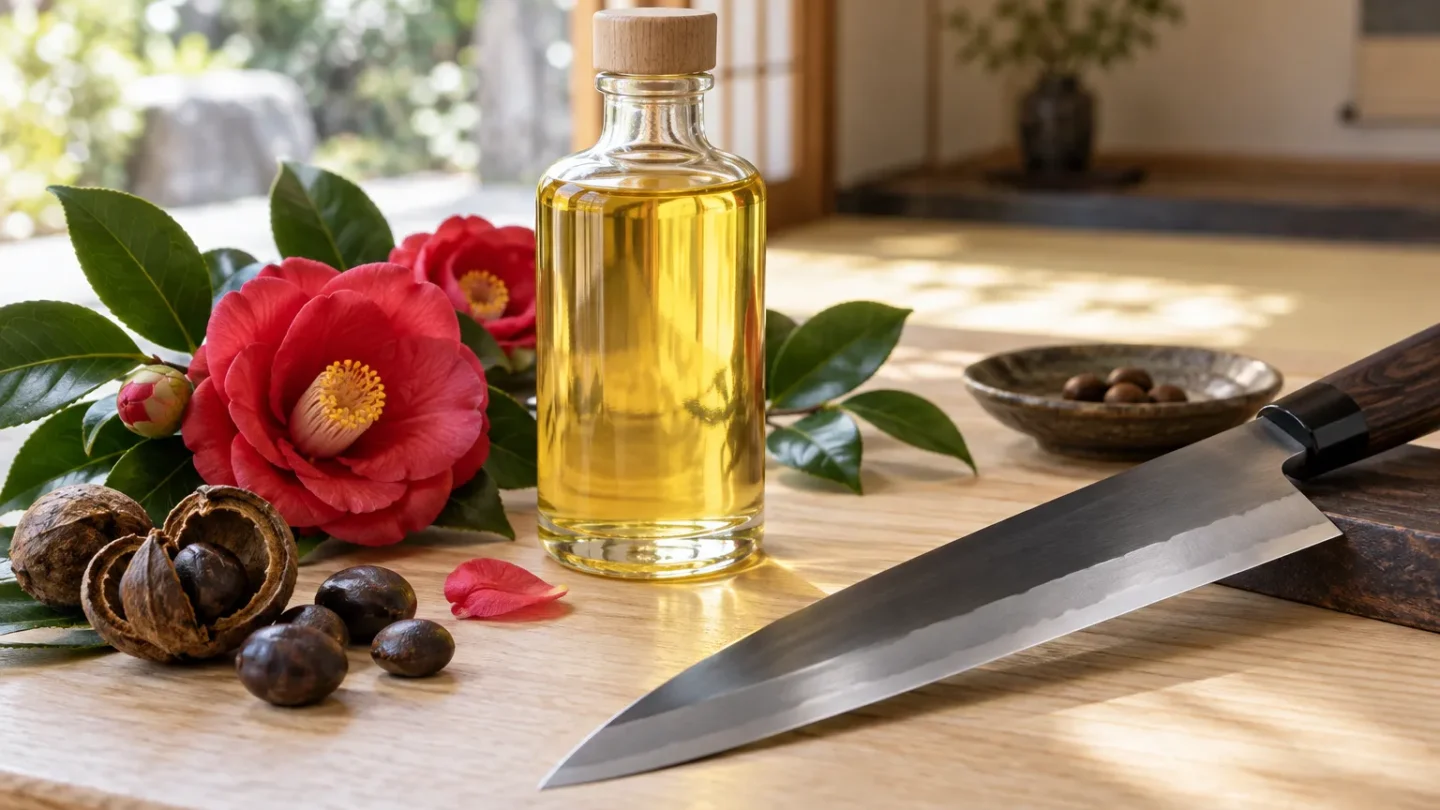
The most expensive mistake is putting the wrong oil on a valuable sword blade. A scented cosmetic blend may look like Japanese camellia oil, but additives, moisture, and residue can leave a sticky film on polished steel instead of protecting it. Restoration can cost far more than the bottle you thought would save the blade.
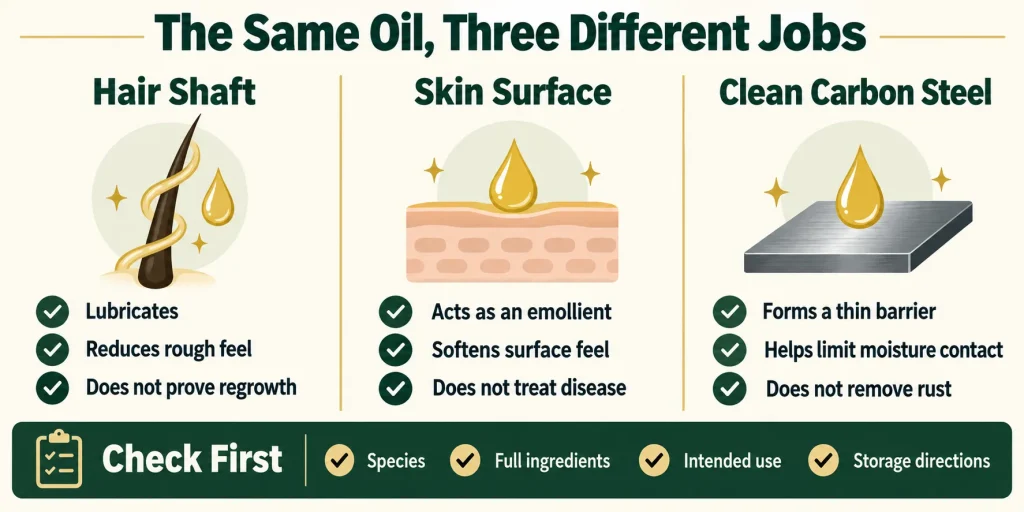
椿油, tsubaki-abura, literally “camellia oil,” is pressed from camellia seeds. It has long been associated with hair care in Japan, especially on Izu Ōshima, and plain grades are also sold for carbon-steel knives, scissors, woodworking tools, and sword-maintenance kits. The connection is less mysterious than it sounds: an oil film can reduce direct exposure to moisture, while the same oil can lubricate the surface of a hair fiber.
That does not make every bottle interchangeable, and it does not make tsubaki oil a treatment for hair loss.
Putting a beauty oil on an irreplaceable blade
A bottle labeled “tsubaki” can contain pure seed oil, fragrance, plant extracts, silicones, or other cosmetic ingredients. Using a hair product on a sword seems reasonable because traditional maintenance kits may also contain camellia oil. What matters, however, is the finished formula rather than the flower printed on the package.
A cosmetic blend may leave residue that attracts dust or makes the blade difficult to inspect. Applying it over fingerprints can also trap salts and moisture against the steel. Japanese swords with traditional polish should not be treated as ordinary kitchen knives, because careless wiping or abrasive cleaning can damage the surface.
Use this basic distinction:
| Product label or description | Intended surface | Main concern |
|---|---|---|
| Hair or body oil | Hair and intact skin | May contain fragrance or cosmetic additives |
| Knife or tool oil | Carbon-steel tools | May not be approved for cosmetic use |
| Sword-maintenance oil | Sword blade | Must match the conservator’s or dealer’s instructions |
| Cooking oil | Food preparation | Food suitability does not establish suitability for skin or antiques |
What to do instead: Use only a product explicitly intended for the blade or tool, and ask a qualified sword conservator before treating an antique or traditionally polished sword.
Assuming the word “camellia” identifies the plant
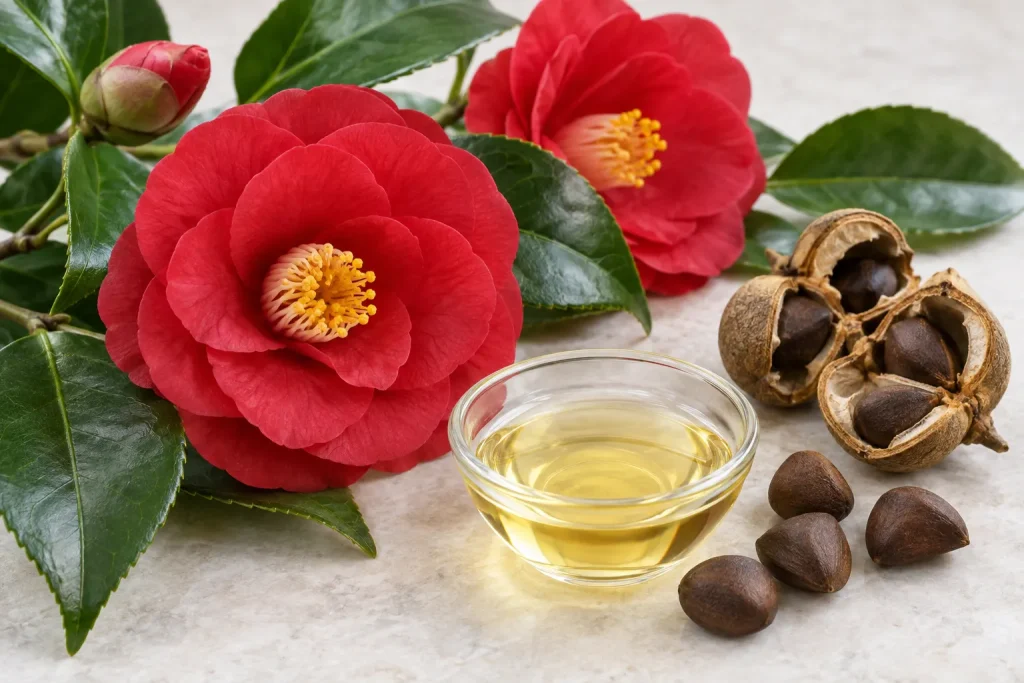
This is a half-informed mistake. You learn that tsubaki oil comes from camellia seeds, then buy the first “camellia oil” you find. The name alone does not tell you which Camellia species supplied the seed.
Japanese tsubaki oil is closely associated with Camellia japonica. Tea-seed oils may instead be pressed from Camellia oleifera or another Camellia species, while camelina oil comes from Camelina sativa, a completely different plant. Similar English names make substitutions surprisingly easy.
The fatty-acid profiles of camellia species can overlap, but origin, refining, odor, stability, and intended use may differ. A seller that provides only a poetic product name is giving you less useful information than one that lists the botanical species and complete ingredients.
What to do instead: Read the botanical name, ingredient list, extraction method, and intended use before buying.
Believing Ōshima is the only legitimate source
伊豆大島, Izu Ōshima, literally “the large island of Izu,” is a traditional center of tsubaki cultivation and oil production. Camellia trees suit the island’s environment, and the flower has become part of Ōshima’s public identity. This history is real, but “made on Ōshima” and “made from camellia” are not identical claims.
The mistake is treating geography as a complete quality test. Camellia oil is produced elsewhere in Japan and outside Japan, while products carrying Ōshima imagery may differ in seed origin, pressing, filtration, and formulation. Provenance matters culturally and commercially, but it does not replace a label.
This distinction reflects a broader pattern in What J-Beauty Actually Does Differently: product function and routine matter more than an exotic story. Japanese shoppers may value regional provenance, yet they still check what the product is made for.
“Traditional source” tells you where a practice developed. It does not tell you whether this particular bottle belongs on your face or your sword.
What to do instead: Treat Ōshima provenance as useful background, then verify the species, ingredients, and use instructions.
Reading “mostly oleic acid” as a medical claim
Most tsubaki oils are rich in oleic acid, a monounsaturated fatty acid also found in olive oil. Its exact share varies with the plant, growing conditions, harvest, and processing, so a single percentage should not be assigned to every bottle. Product-specific laboratory data are more reliable than a universal number copied from another Camellia species.
Oleic acid helps explain why the oil spreads easily and works as an emollient. On hair, it can lubricate the fiber and reduce the rough feel associated with dryness. On skin, an emollient fills spaces between surface cells and makes the area feel softer.
That description does not establish treatment of eczema, inflammation, infection, or any other condition. It also does not mean that a concentrated oleic-acid product will suit every skin barrier. If you have persistent irritation or a diagnosed skin condition, ask a dermatologist or pharmacist before adding an unfamiliar oil.
| Component | Chemical family | What it helps explain | What it does not prove |
|---|---|---|---|
| Oleic acid | Monounsaturated fatty acid | Spreadability and emollient feel | Hair regrowth or treatment of disease |
| Linoleic acid | Polyunsaturated fatty acid | Part of the oil’s lipid profile | A guaranteed result on sensitive skin |
| Palmitic acid | Saturated fatty acid | Texture and oxidative behavior | Suitability for every cosmetic use |
| Minor compounds | Varies by oil and processing | Color, odor, and stability differences | That all tsubaki oils are equivalent |
What to do instead: Read composition as an explanation of physical properties, not as proof of a medical outcome.
Expecting camellia oil Japanese hair care to regrow hair
This is the most consequential beauty mistake. People see shinier hair, less tangling, or reduced breakage and conclude that the oil has made new hair grow. The conclusion feels plausible because retained length can make hair look fuller over time.
There is no established clinical evidence base showing that topical tsubaki oil regrows lost hair. Cosmetic lubrication can improve appearance and reduce friction along the shaft, but the shaft is not the follicle. A product that makes existing hair look smoother is not automatically affecting the biological processes that produce new hair.
No responsible description should turn tradition into a treatment claim. Sudden shedding, widening parts, bald patches, scalp pain, or persistent itching can have causes that an oil will not identify. A dermatologist can assess the pattern and discuss evidence-based options appropriate to the cause.
Softer hair is a cosmetic result. New follicle-driven growth is a medical claim, and the evidence for tsubaki oil does not support it.
What to do instead: Use tsubaki oil, if tolerated, for conditioning the existing hair shaft—not as a substitute for evaluating hair loss.
Using more oil because you researched its composition
Knowing that the oil is rich in monounsaturated fat can lead to another half-informed error: assuming that a thicker layer delivers more benefit. On fine hair, excess oil can collapse volume and make clean strands look greasy. On the face, it can produce an uncomfortable film or complicate a routine that already contains rich products.
Oil is not water. Applying it to dry hair or skin may reduce moisture loss, but it does not supply hydration by itself. This is why a small amount spread over damp lengths often behaves differently from a heavy coating applied to a dry scalp.
The same “more is better” idea also fails on steel. A visibly thick layer collects dust, hides early surface changes, and creates more material to remove during the next inspection. Protection depends on clean coverage, not on leaving the blade dripping.
What to do instead: Begin with the smallest amount that forms an even film and follow the product or tool maker’s directions.

Treating plain oil as a cleansing oil
A plant oil can dissolve some oily makeup, so using tsubaki oil as a cleanser sounds economical and traditional. The missing detail is emulsification. Modern cleansing oils usually contain ingredients that allow the oily mixture to disperse when water is added.
Plain seed oil may loosen makeup but remain on the skin with dissolved pigment and sunscreen. Scrubbing harder to remove it can defeat the purpose of gentle cleansing. The difference between a seed oil and a formulated cleanser is explained in Oil First, Foam Second, and Why.
This matters particularly with water-resistant sunscreen. Japanese and American sunscreen products are governed and labeled differently, as covered in Different Filters, a Different Rulebook. The sunscreen’s removal directions, not the nationality of the oil, should guide cleansing.
A formulated cleanser will commonly tell you to:
- Apply it as directed.
- Add water so the product emulsifies.
- Rinse thoroughly.
- Follow with another cleanser only when the routine or product calls for it.
What to do instead: Use a product labeled as a cleansing oil when you need a rinseable first cleanser.
Sealing moisture and fingerprints under oil
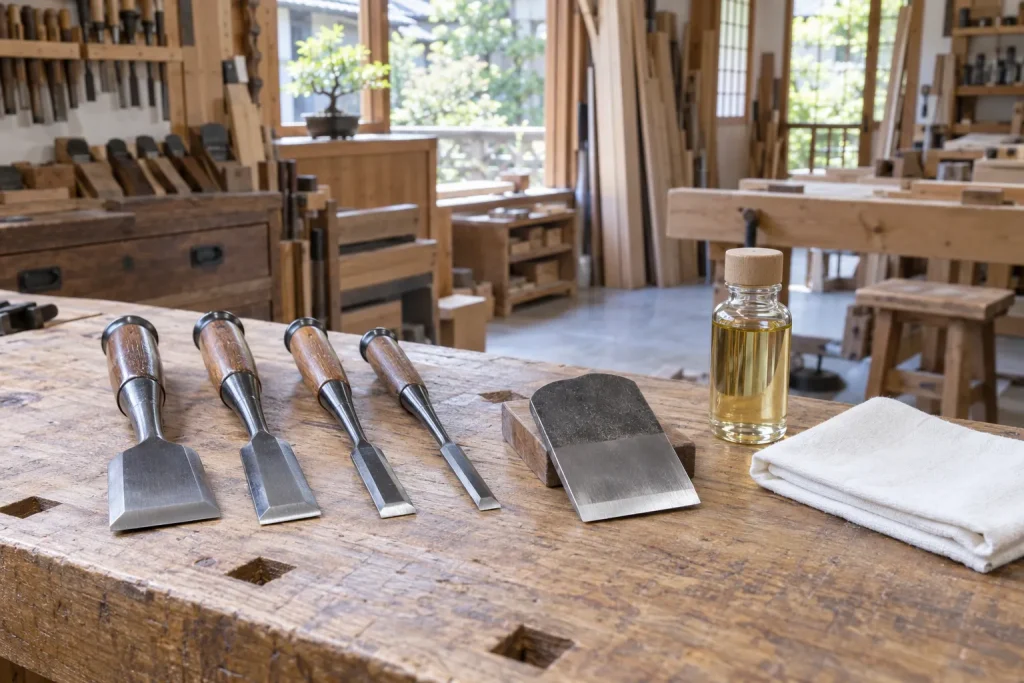
Oil does not reverse rust. If you cover damp, salty, or dirty steel, the surface may continue to corrode beneath a layer that appears protective. Sword blades and carbon-steel tools should be clean and fully dry before an appropriate oil is applied.
The same principle explains why handling matters. Fingerprints are not merely visual marks; skin moisture and salts can remain on steel after you put the object away. A collector who oils without first removing them has completed only the last part of the task.
The order is more important than the amount:
- Follow the maker’s instructions for removing the existing oil.
- Check the surface in good light.
- Remove fingerprints using an approved method.
- Make sure the metal is dry.
- Apply a very thin, continuous film.
- Store the object under the conditions recommended for it.
Do not improvise with abrasives, household polish, or rust remover on a valuable sword. If you see active corrosion, ask a specialist familiar with Japanese blades rather than trying to polish it out.
What to do instead: Clean, inspect, and dry the steel before applying the correct protective oil.
Keeping the bottle beside heat and sunlight
High oleic-acid content can make an oil more oxidation-resistant than some oils rich in polyunsaturated fats. It does not make the product immune to oxygen, light, heat, and contamination. “Stable” and “never goes rancid” are not synonyms.
There is no responsible universal answer to how quickly tsubaki oil goes rancid. Species, processing, antioxidants, packaging, headspace, and storage all affect shelf life. The printed date and storage instructions on the bottle are therefore more useful than a fixed number repeated online.
Warning signs can include:
- a sharp or stale odor that was not present when opened;
- a clear change in color;
- unexpected thickening or tackiness;
- contamination around the opening;
- skin irritation from a product previously tolerated.
Cloudiness or sediment is not automatically proof of spoilage, because minimally processed oils can change with temperature. If appearance has changed, check the manufacturer’s instructions instead of guessing. When a cosmetic oil smells rancid or causes a reaction, stop using it.
What to do instead: Keep the container tightly closed, away from direct light and heat, and follow the maker’s after-opening guidance.
Assuming “natural” means suitable for every person and surface
Pure plant oil can still cause irritation or an allergic response. A finished tsubaki product may also contain fragrance, preservatives, or botanical extracts that matter more to your skin than the camellia oil itself. The word “natural” does not identify those ingredients.
The same caution applies when shopping in Japan. If you cannot read the package, the phrasebook—337 phrases, including shopping helps you ask about price, stock, and product details without duplicating a separate language guide here. For a skin product, look for the full ingredient list; for a tool product, look for the intended metal and handling directions.
Do not use tool oil as a cosmetic, even if its base appears to be camellia. Do not use cosmetic oil on food-contact equipment unless the manufacturer confirms that application. And do not treat the absence of fragrance as proof that a formula contains nothing else.
What to do instead: Match the complete product—not merely its headline ingredient—to the person or object that will receive it.
The habit that prevents most mistakes
Read the back label before you believe the front label. The front may say tsubaki, Ōshima, beauty oil, traditional, or natural; the back tells you the plant, ingredients, purpose, storage conditions, and responsible company. That short check prevents most mix-ups between hair oil, facial oil, cleansing oil, cooking oil, and steel-care oil.
The tradition is straightforward: camellia seed oil has been used in Japanese grooming and practical maintenance, including protection of carbon steel. The evidence is narrower: its lipid profile explains lubrication and emollient behavior, while no sound evidence base supports hair-regrowth claims. Keeping those two sentences separate is the most useful way to understand the oil.
The Same Oil, Three Different Jobs
Composition panel:
- Oleic acid: largest fatty-acid fraction in typical camellia seed oils.
- Linoleic acid: smaller polyunsaturated fraction.
- Palmitic and stearic acids: smaller saturated fractions.
- Unit: percentage of total identified fatty acids.
- Required publication note: exact percentages vary by species, sample, origin, and processing.
- Do not print one universal percentage as the composition of every tsubaki product.
Process panel:
- Hair: apply sparingly to the existing hair shaft.
- Skin: check the complete ingredients and test a small area.
- Steel: clean, inspect, dry, and apply an approved thin film.
- Hair loss: seek assessment rather than replacing care with oil.
Short FAQ
Is tsubaki oil the same as tea tree oil?
No. Tsubaki oil is pressed from Camellia seeds, while tea tree oil is a concentrated essential oil from Melaleuca alternifolia. They have different compositions and uses and should not be treated as substitutes.
Can tsubaki oil make hair grow faster?
There is no established clinical evidence that it regrows hair or meaningfully accelerates follicle-driven growth. It may make existing strands look smoother and help reduce breakage caused by friction.
Can the same bottle be used on hair and a sword?
Only if the manufacturer explicitly identifies the product as suitable for both purposes and a sword specialist has not recommended otherwise. Cosmetic additives may be undesirable on steel, while tool products should not automatically be assumed safe for skin.