What J-Beauty Actually Does Differently
A Japanese skincare label is not allowed to promise you clearer skin unless the formula contains a government-approved ingredient at a government-approved dose — that single rule, more than any ritual or ingredient trend, is the real split behind every japanese vs korean skincare comparison you’ll read online.
Everything else in this piece follows from that one fact. Japan splits beauty products into two legal boxes, and only one of them is allowed to say what it does. Korea, meanwhile, built a faster lane for the same kind of claim. Neither system is stricter across the board — they’re stricter in different places, and that’s what actually decides what ends up on your bathroom shelf.
The Rule That Actually Separates Japanese vs Korean Skincare Claims
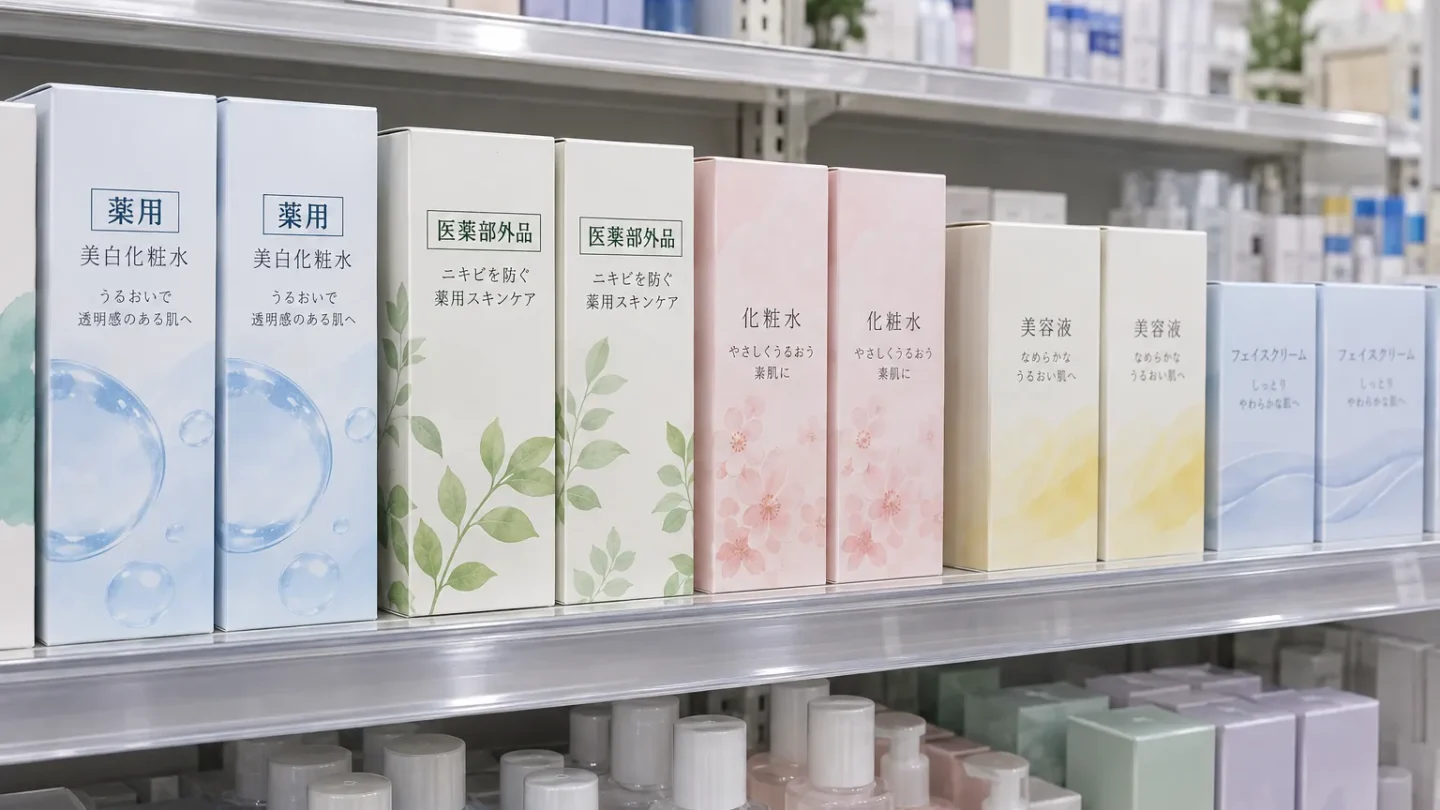
Start with the mechanism, not the marketing. Under Japan’s Pharmaceuticals and Medical Devices Act, a beauty product sold in Japan falls into one of two legal categories: an ordinary cosmetic (化粧品, keshōhin), or a quasi-drug (医薬部外品, iyakubugaihin — literally “medicine-outside-product”). A plain cosmetic can talk about cleansing, moisturizing, and appearance. It cannot say it prevents acne, fades spots, or reduces wrinkles. Only a quasi-drug can make those claims, and it can only make them because it contains a specific active ingredient, at a specific concentration, that Japan’s health ministry has separately reviewed and approved for that exact effect.
This is different from most Western “clean label” thinking, where a brand picks an ingredient because published research supports it and then writes the claim itself. In Japan, the ingredient and the claim are legally welded together by the Ministry of Health, Labour and Welfare (MHLW) before the product ever reaches a shelf. A brand cannot simply cite a study and say “brightening.” It has to use an ingredient already on the approved list, in the approved dose, for that specific wording.
South Korea runs a related but looser version of the same idea. Its Ministry of Food and Drug Safety (MFDS) also splits products into general cosmetics and functional cosmetics — the category that’s allowed to claim whitening, wrinkle improvement, UV protection, or anti-hair-loss effects. The difference is speed: if a Korean formula uses only ingredients the MFDS has already pre-approved for that function, the manufacturer can get to market through a short report-based procedure rather than a full efficacy review. That one difference in how fast an approved-ingredient claim can clear the door is where most of what people notice about J-beauty and K-beauty actually comes from.
医薬部外品 (Iyakubugaihin): The Category Between Drug and Cosmetic
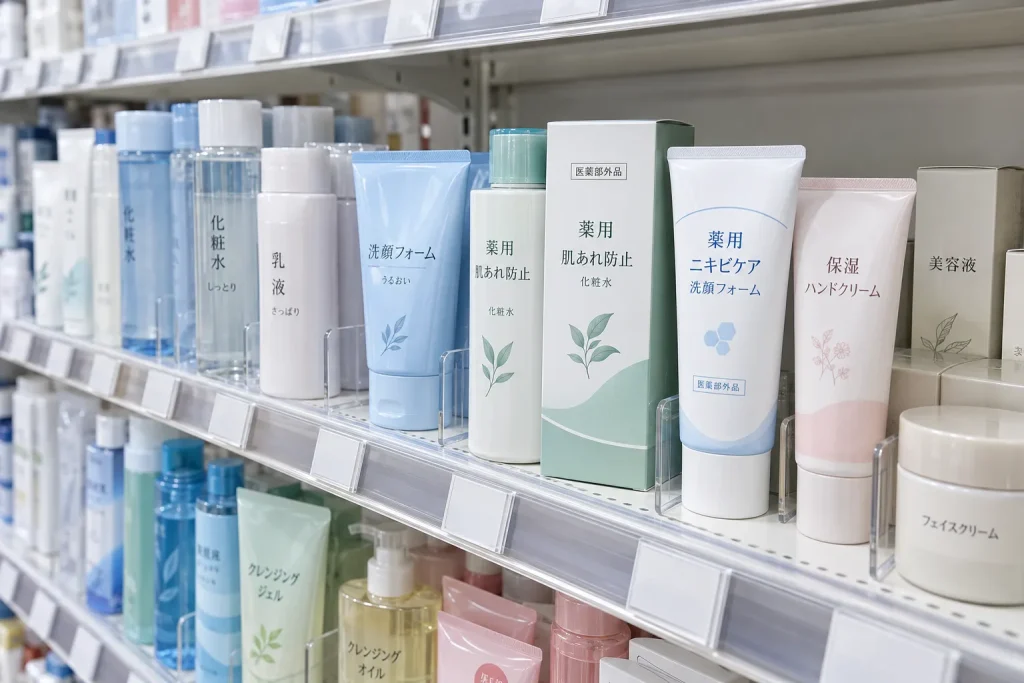
The part outsiders get wrong first is assuming “quasi-drug” means something diluted or unofficial. It doesn’t. A quasi-drug sits in a real, legally defined middle tier between full pharmaceuticals and cosmetics — mild enough to sell in a convenience store without a pharmacist present, but regulated enough that its label carries legal weight. You’ll recognize the products by the words 医薬部外品 or 薬用 (yakuyō, “medicated”) printed on the box. Toothpaste, hair-loss tonics, whitening serums, and anti-acne creams routinely fall into this box in Japan, while their US or European equivalents are often sold as ordinary cosmetics with softer wording.
The detail that trips people up: being a quasi-drug is not a quality signal, and a plain cosmetic isn’t automatically worse. Plenty of well-known Japanese skincare lines are sold entirely as cosmetics and never touch the quasi-drug system at all — a point worth holding onto, because it undercuts the assumption that everything “serious” in J-beauty runs through this approval process.
有効成分 (Yūkō Seibun): The List That Decides What You’re Allowed to Say
The second part of the mechanism is the approved-ingredient list itself — the 有効成分, yūkō seibun, or “active ingredient.” This is a government-maintained catalogue of substances cleared for specific quasi-drug effects: whitening, anti-acne, anti-wrinkle, hair growth, and several others, grouped by MHLW guidance into roughly eight recognized categories of medicated-cosmetic effect. Arbutin, for instance, was formally approved as a whitening active ingredient in Japan in 1989, based on clinical evidence against melasma; by recent academic counts, roughly twenty such lightening-specific active ingredients — including kojic acid, tranexamic acid, and niacinamide — sit on that approved list today.
The detail people miss here is that the list only grants permission for the exact wording tied to that ingredient’s approval. A brand can’t take an approved whitening ingredient and use it to justify an anti-aging claim, and it can’t use a promising but unapproved compound — however well-studied abroad — to make any medicated claim at all in Japan. The ingredient buys you one specific sentence, not a general reputation for effectiveness.
The Review Clock: PMDA, MHLW, and the Months a New Claim Takes
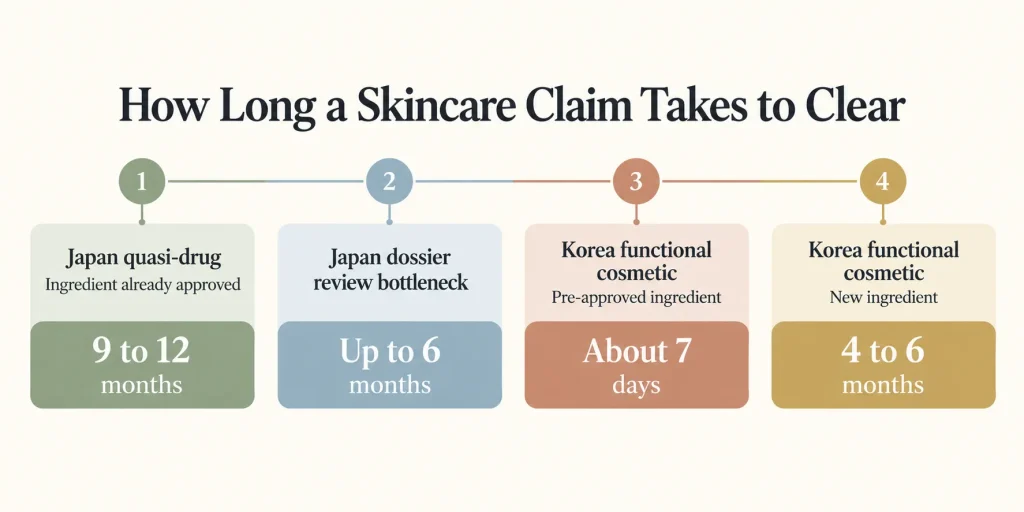
| Market | Route | Typical timeline |
|---|---|---|
| Japan | Quasi-drug approval, ingredient already on the approved list | About 9–12 months |
| Japan | Dossier review window flagged by industry as a launch bottleneck | Up to about 6 months |
| South Korea | Functional cosmetic, pre-approved ingredient (report route) | About 7 days |
| South Korea | Functional cosmetic, new or unapproved ingredient (full efficacy review) | About 4–6 months |
That seven-day figure for Korea isn’t a loophole — it only applies when a brand sticks to ingredients the MFDS has already cleared for that function. Step outside the approved list in Korea and the timeline lengthens to something closer to Japan’s. The real gap isn’t “regulated versus unregulated.” It’s how wide each country’s fast lane is for ingredients everyone already agrees are safe and effective.
What Follows From a Slower Approval Line
A Head Start for Faster-Moving Formulas
Because a new Japanese quasi-drug claim can take the better part of a year to clear, a Korean brand using the same class of active ingredient can often reach international shelves, and Japanese consumers, well before a comparable Japanese-branded product finishes review. This is the mechanism the Mordor Intelligence report pointed to directly: the review window itself becomes a competitive gap.
Marketing That Sells Texture Instead of Promises
When you can’t add a new efficacy claim quickly, you compete on something the approval system doesn’t touch: how a product feels on skin. This is part of why J-beauty’s reputation rests so heavily on sensory qualities — the specific slip of an essence, the weight of a cream, layering rituals — rather than before-and-after promises. It’s less a cultural preference for subtlety and more a product of what the law will actually let a brand advertise quickly.
A Rating System Japan Exported Almost by Accident
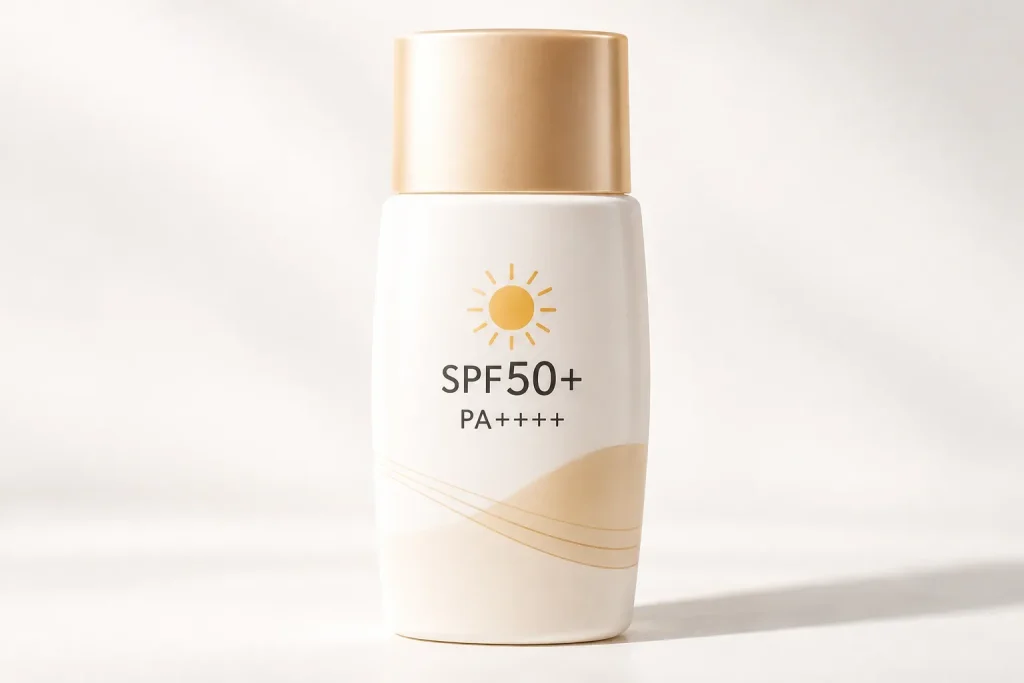
Japan’s caution around unverified claims produced one genuine global export: the PA rating scale for UVA protection. The Japan Cosmetic Industry Association introduced the three-level PA system in 1996, based on Japan’s own persistent-pigment-darkening (PPD) test method, and revised it to a four-level PA+ through PA++++ scale effective January 1, 2013. Korea adopted the same PA scale for its own sunscreens, and it’s now standard across most of Asia — a stricter labeling habit than the US system, which still relies on a pass/fail “Broad Spectrum” claim with no UVA strength indicated at all.
Japanese Shoppers Buying Korean Anyway
If Japan’s system were simply “better” for consumers, you’d expect Japanese shoppers to stay loyal to homegrown quasi-drug products. They haven’t. South Korea’s cosmetics exports to Japan reached about $1.09 billion in 2025, up 4.9 percent year-on-year, according to Korea’s Ministry of Food and Drug Safety — inside a Japanese domestic cosmetics market estimated at roughly $20.75 billion the same year. Regulatory rigor at home doesn’t automatically translate into consumer preference for domestically approved products.
Where the Rule Runs Out
The quasi-drug mechanism explains claims-based marketing. It does not explain everything people buy. Some of J-beauty’s most internationally recognized products, like SK-II’s Pitera line, are sold as plain cosmetics and marketed on an origin story — the discovery of a fermented sake-yeast extract — rather than on a quasi-drug efficacy claim at all. Heritage and legend sell products in Japan just as effectively as an approved ingredient does, and neither DHC nor Muji’s popular skincare lines depend on the quasi-drug system to move volume domestically or abroad.
| Category | Country | Specific-effect claim allowed? | Pre-market approval required? |
|---|---|---|---|
| Cosmetic (化粧品) | Japan | No | No |
| Quasi-drug (医薬部外品) | Japan | Yes, only for MHLW-approved actives | Yes |
| General cosmetic | South Korea | No | No |
| Functional cosmetic | South Korea | Yes, for approved-ingredient formulas or after review | Yes (about 7 days or 4–6 months, depending on ingredient) |
The Part a Misread Label Can Actually Cost You
None of this is medical advice, and nothing here should be read as a promise of results. If you’re buying a Japanese quasi-drug product expecting it to treat a real skin condition rather than a cosmetic concern, or you’re unsure whether an active ingredient is safe to use alongside a prescription treatment, that question belongs to a pharmacist or dermatologist, not a product label. In Japan, a local pharmacy can answer this directly — the phrasebook’s pharmacy and health section carries the exact phrase for asking where one is and for describing what you need. If you’re traveling and something goes wrong with a product reaction, your embassy’s website is the place to check current guidance, not a beauty forum.
Reading the Regulatory Split, Not Just the Packaging
The categories above were checked against MHLW, PMDA, and MFDS-adjacent sources current as of September 2026. Regulations in both countries are revised periodically — Japan’s quasi-drug standards were last substantially updated in 2021, and Korea’s functional-cosmetics framework is under active proposed revision for 2028 onward — so a rule confirmed here could shift by the time you’re reading this.
Frequently Asked Questions
Is Japanese skincare regulated more strictly than Korean skincare?
Not uniformly. Japan requires approval for any specific-effect claim through its quasi-drug system, while Korea allows a fast, report-based route for claims built on already-approved ingredients. Both countries require full review for genuinely new active ingredients.
What does 医薬部外品 mean on a Japanese product?
It marks the product as a quasi-drug — a category allowed to claim a specific effect, like whitening or anti-acne, because it contains a Ministry of Health, Labour and Welfare-approved active ingredient at an approved dose.
Why do new K-beauty products seem to launch so much faster?
When a Korean functional cosmetic uses only ingredients the MFDS has already approved for that function, it can clear a report-based procedure in about a week. A comparable Japanese quasi-drug claim typically takes closer to a year.
Does a Japanese cosmetic without “医薬部外品” on the label do nothing?
No — it simply isn’t legally allowed to make a specific-effect claim. Many well-known Japanese skincare products are sold as plain cosmetics and never enter the quasi-drug system at all.
Should a Japanese label be trusted more than a Korean one?
Trust the ingredient list either way. A slower approval process tells you a specific claim went through a longer review; it doesn’t tell you the unclaimed parts of the formula are better or worse than a faster-approved Korean equivalent.
If a Japanese label promises less than the Korean bottle next to it, that’s not modesty — read it as the law speaking, not the formula.