Oil First, Foam Second, and Why
You are standing at a sink with sunscreen on your face, an oil cleanser in one hand, and a foaming wash beside it. The bottles seem to imply that both are required. That expectation is the first thing to question. Double cleansing Japanese routines are built around two different cleaning jobs, but not every face presents both jobs every evening. Oil is useful when you need to loosen water-resistant sunscreen, foundation, or other oil-soluble material; the second cleanser removes remaining residue and ordinary surface soil. If the first product already leaves your skin clean, or if your skin is dry and bare, another wash may add friction without solving a real problem.
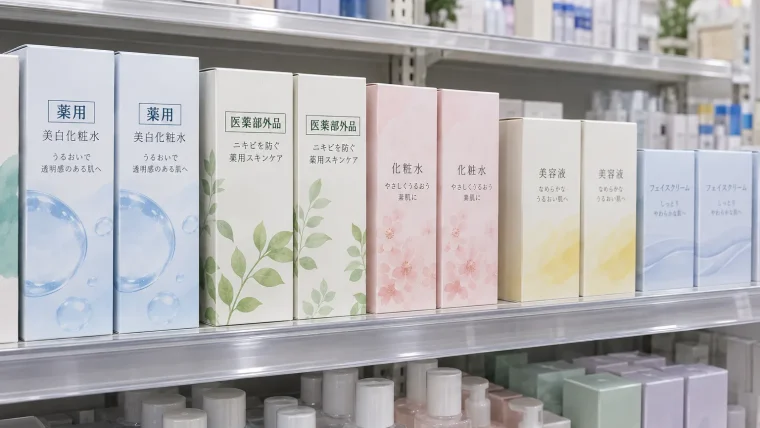
The Japanese expression is 二度洗顔, nido sengan, literally “two-times face washing.” In stores, the phrase ダブル洗顔, daburu sengan, “double face wash,” is also common. Some cleansing oils are labeled ダブル洗顔不要, daburu sengan fuyō, literally “double face washing unnecessary.” That label matters because Japanese products do not all assume the same sequence. For the larger logic behind lotions, emulsions, sunscreens, and cleansers, see What J-Beauty Actually Does Differently.
What double cleansing actually removes
The method makes sense when the materials on your face do not respond equally to water. Long-wear foundation, mascara, sebum, and water-resistant sunscreen contain oily or film-forming components. A cleansing oil, balm, or milk can mix with those materials and help lift them from the skin. Water and surfactants are then added so the mixture can be rinsed away.
A foaming or water-based cleanser has a different role. It can remove sweat, dust, loose residue, and material left after the first rinse. Calling one stage “deep” and the other “surface” cleansing is misleading because neither product literally selects a depth of skin. Both act mainly at the surface, and their practical difference comes from formulation.
A controlled study published online in 2019 and in print in 2020 compared water, a foaming cleanser, and a cleansing oil for removing water-resistant and non-water-resistant sunscreens. Cleansing oil performed better for water-resistant sunscreen, while both oil and foam removed the non-water-resistant product effectively. Participants also reported more dryness after using the foaming cleanser on water-resistant sunscreen. That supports a narrow conclusion: the remover should match the film. It does not prove that everyone should perform two complete washes every night.
| What is on the skin | First product that may fit the task | Is a second cleanser automatically needed? |
|---|---|---|
| Water-resistant sunscreen | Oil, balm, or compatible remover | No; check how the product rinses and how skin feels |
| Long-wear base makeup | Oil, balm, milk, or makeup remover | Sometimes, if residue remains |
| Light, non-resistant sunscreen | Gentle cleanser may be enough | Not necessarily |
| No makeup or sunscreen | Gentle cleanser, or water where appropriate | Usually no reason to add an oil stage |
| Very dry or irritated skin | Cleansing should be minimized and individualized | Extra washing may aggravate discomfort |
The sequence that gives each product a job
The following sequence describes how the method is commonly performed. It is a protocol, not a medical prescription. Follow the directions on the specific cleanser because some oils are designed to emulsify and rinse clean without a second product.
- Check what you are removing. Look for water-resistant sunscreen, long-wear foundation, mascara, or a substantial base layer. If your face is bare, there may be no oil-soluble film that justifies Japanese double cleansing.
- Read the package before wetting your hands. Many oils are intended for dry hands and a dry face, while other formulations tolerate wet hands. Japanese labels may explicitly say whether another face wash is unnecessary.
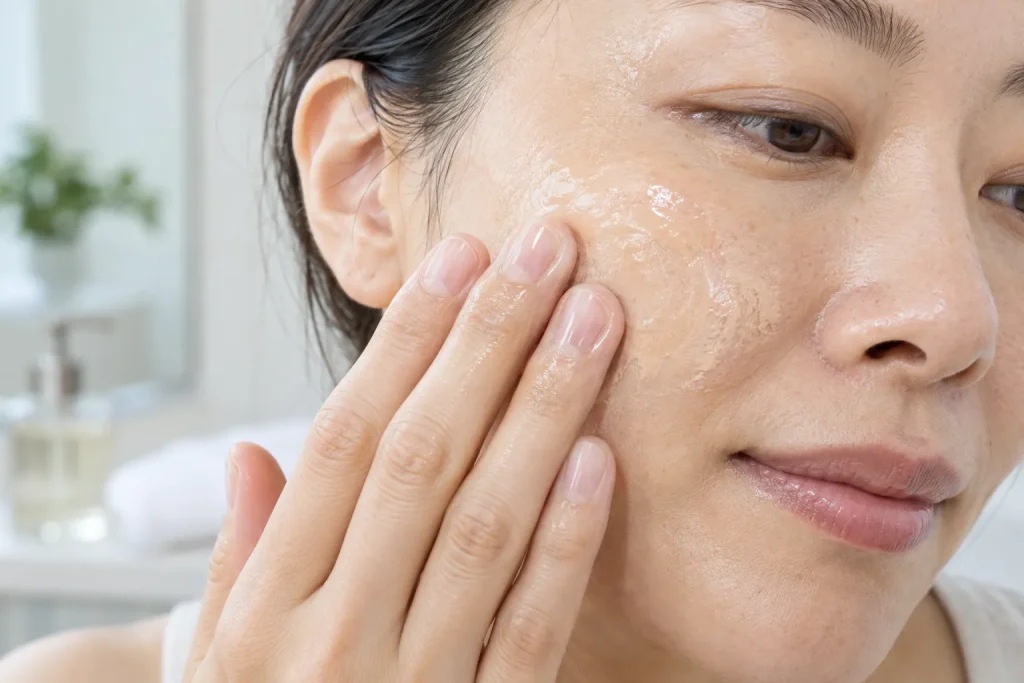
- Spread the first cleanser gently. Move the oil, balm, or milk over the areas carrying makeup and sunscreen. It should loosen the film and allow pigments to move without hard rubbing. Pressing longer and scrubbing harder are not measures of effectiveness.
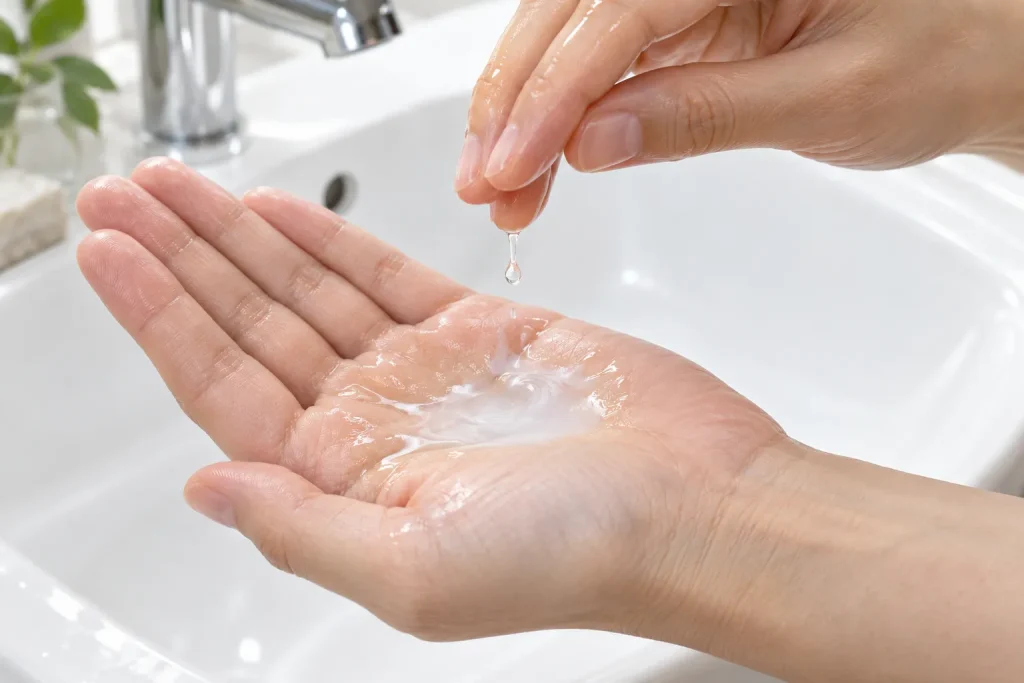
- Add water if the formula calls for emulsification. With many cleansing oils, a small amount of water turns the clear oil cloudy or milky. This visible change means the oil and water are dispersing together. It is not dirt being “drawn out” of pores.
- Rinse away the first cleanser. Continue until the loosened makeup and sunscreen are gone. A properly formulated oil may rinse with little perceptible residue. A balm or richer milk may leave a softer film, which is not automatically evidence that the face is dirty.
- Decide whether there is a second job. If makeup remains near the hairline, or the first product’s instructions call for another cleanser, use a small amount of a gentle water-based wash. If the skin is already clean and comfortable, stopping is a legitimate option.
- Clean briefly rather than chasing a squeak. A squeaky or tight finish is not proof of superior cleansing. The American Academy of Dermatology recommends a gentle cleanser for dry skin and warns against using enough to produce a thick lather.
- Rinse and pat rather than rub. Remove cleanser carefully around the nose, jaw, and hairline. Pat the face with a clean towel. Persistent burning, itching, cracking, or worsening irritation belongs with a dermatologist, not a more elaborate cleansing routine.
Where the routine commonly breaks down
The first stall happens before the oil reaches the face. A reader treats “oil” as if any kitchen or single-ingredient oil were equivalent to a formulated cleanser. It is not. A cleansing oil normally contains emulsifying ingredients that help the oil, loosened cosmetics, and water rinse away together; a plain oil may simply redistribute the film.
The second stall is adding water too early. If the directions specify dry application, wet hands can dilute the product before it has mixed with resistant makeup. The practical correction is simple: read the package, follow its order, and do not assume every bottle behaves like the last one.
The third stall is overworking the product. Massage becomes prolonged rubbing, especially around the nose and eyes, because the user expects visible debris to emerge. There is no need to turn cleansing into an extraction procedure. Persistent plugs, inflamed acne, dermatitis, or eye irritation should be assessed by a qualified clinician.
The fourth stall is treating the foam as compulsory. Oil cleansing followed by foam is appropriate only when both steps have something useful to remove. On dry skin, the second round may be the stage that creates tightness. AAD guidance favors gentle, fragrance-free products for dry or sensitive skin and advises using only enough cleanser to remove dirt and oil.
| What goes wrong | What you may notice | More accurate response |
|---|---|---|
| Plain oil replaces a rinse-off cleanser | Oily film or smeared makeup | Use a product formulated and labeled for cleansing |
| Water is added before dry-use oil | Resistant makeup moves poorly | Follow the package sequence |
| Massage becomes scrubbing | Redness, warmth, or tenderness | Stop rubbing and rinse gently |
| Foam is used automatically | Tightness after washing | Reconsider whether a second cleanse had a task |
| Very hot water is used | Dryness or discomfort | Use comfortably lukewarm water |

Why the habit became associated with Japan
The functional ancestry of Japanese skincare cleansing is easy to explain, but the exact birth date of the modern routine is not. Oil-based removers answered a practical problem: heavily pigmented or resistant facial products did not wash away reliably with water alone. Modern base makeup and durable sunscreen kept that problem relevant. Japanese beauty companies then sold cleansing oils, creams, and foams as distinct product categories.
What cannot be established from the checked primary material is a single Japanese inventor or a precise year when “double cleansing” became a national routine. Historical references to face powders, theatrical cosmetics, or traditional oils do not by themselves prove an unbroken line to today’s bathroom sequence. Claims that the routine directly descends from geisha practice are therefore stronger than the available evidence permits.
The uncomfortable commercial fact is that a two-product ritual sells two products. That does not make the chemistry false, but it does mean the sequence should not be treated as an obligation created by culture. Japanese packaging itself undermines that idea: products marked ダブル洗顔不要 explicitly tell the buyer that the second wash is unnecessary.
Tradition explains familiarity; formulation determines whether the next step has a purpose.
How climate, place, and the product change the sequence
In a humid summer, you may be removing a more persistent combination of sunscreen, sebum, sweat, and base makeup. That can make an oil first step practical, but humidity does not turn the second wash into a universal rule. The deciding factors remain what you applied and how completely the first cleanser rinses.
In a dry winter, heated indoor air and repeated washing can make tightness more noticeable. AAD guidance for dry skin emphasizes brief washing, warm rather than hot water, gentle cleanser, and fragrance-free products. There is no evidence-based case for adding a routine second cleanse to already dry, bare skin simply because the method is Japanese.
A hotel sink does not require a special cultural performance. If you are shopping for a cleanser in Japan and need to ask whether another wash is required, the phrasebook—337 phrases, including shopping can help with the exchange. You can also look for ダブル洗顔不要 on the package. When an ingredient or label is unclear and you have eczema, allergies, active irritation, or another skin condition, ask a pharmacist or dermatologist rather than testing several unfamiliar cleansers at once.
Formality changes makeup more than it changes cleansing etiquette. A heavier base or waterproof eye makeup may require targeted removal before the face is washed. A casual day with no resistant products may require less. As What J-Beauty Actually Does Differently explains, Japanese routines are better understood as product functions arranged in order, not as a fixed number of compulsory bottles.
The things nobody is checking
Nobody in Japan can see whether you used one cleanser or two in your private bathroom. A store clerk will not be offended if you buy an oil and skip the matching foam. There is no etiquette rule requiring a cloud of lather, and no cultural penalty for choosing a fragrance-free cleanser designed for dry skin.
Nobody notices whether you emulsify for a dramatic length of time. They do not expect your face to squeak after rinsing. They also do not mind if you use a Western product, a Japanese product labeled for one-step removal, or a separate eye-makeup remover. The meaningful question is whether the material on your face was removed without leaving you uncomfortable.
This is half the value of understanding the method: you can stop performing it for an imagined audience. Cleansing oil for sunscreen is a tool, not proof that you understand Japan. The foam is another tool, not the entrance fee to a skincare tradition.
Oil first does not mean twice every day
Daily double cleansing has a clear logic only when the first stage removes a resistant film and the second stage removes something that remains. It is not required merely because sunscreen was worn, since non-water-resistant formulas may come off with a suitable single cleanser. It is particularly difficult to justify as a blanket rule for dry skin.
The evidence and the custom should remain separate. The evidence supports matching the cleanser to the resistance of the sunscreen and avoiding unnecessary irritation. The custom explains why Japanese shelves and instructions often divide makeup removal and face washing into separate categories. Neither establishes a promise of clearer pores, fewer breakouts, slower aging, or better absorption of later products.
If washing causes ongoing stinging, cracking, itching, or worsening redness, stop adding steps and seek assessment from a board-certified dermatologist. Product formulas and medical guidance can change; the clinical and product information in this draft was checked on September 9, 2026.
The sequence at a glance
- Check the film.
- Oil on dry skin.
- Add water, turn milky.
- Rinse and reassess.
- Foam only if needed.
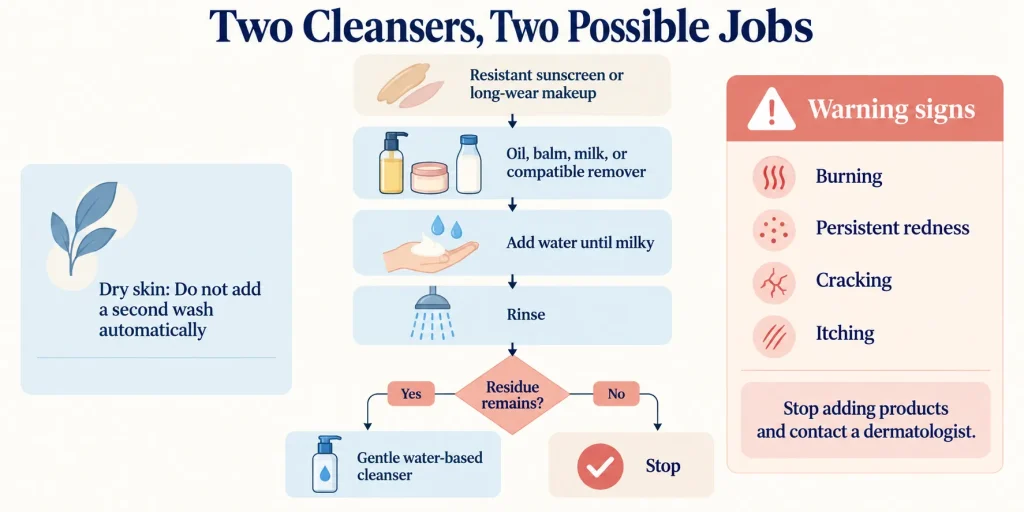
Data shown:
- Input A: water-resistant sunscreen or long-wear makeup
- Stage A: oil, balm, milk, or compatible remover
- Visible cue: oil becomes cloudy or milky after water is added
- Decision point: residue remains — yes or no
- If yes: gentle water-based cleanser
- If no: stop after rinsing
- Dry-skin branch: avoid an automatic second wash
- Warning labels: burning, persistent redness, cracking, itching
- Action for warning labels: stop adding products and contact a dermatologist
- Evidence labels: water-resistant sunscreen favored cleansing oil; non-water-resistant sunscreen was removed effectively by oil and foam
- Units: no numerical dose, temperature, or massage duration because the checked evidence does not establish a universal value
Frequently asked questions
Is double cleansing necessary after every sunscreen?
No. The checked study found a meaningful difference between water-resistant and non-water-resistant sunscreen. Cleansing oil was more effective for the resistant product, while oil and foaming cleanser both worked for the non-resistant product. The sunscreen instructions and the cleanser formulation matter more than a universal two-step rule.
Does cleansing oil make oily skin oilier?
An emulsifying cleansing oil is designed to mix with oily material and rinse with water. That is different from leaving a plain facial oil on the skin. Individual tolerance varies, and a product that repeatedly causes irritation or breakouts should be discontinued and discussed with a dermatologist.
Should dry skin be double-cleansed?
There is no general evidence-based reason to double-cleanse dry, bare skin every day. If resistant makeup or sunscreen must be removed, a compatible first cleanser may still be useful. The second wash should have a defined task rather than being performed automatically.
Is foam required after every Japanese cleansing oil?
No. Some Japanese oils are explicitly labeled ダブル洗顔不要, meaning that another face wash is unnecessary. Follow the directions for the individual product rather than assuming that all cleansing oils leave the same residue.
How long should each cleansing step take?
The sources checked for this draft do not establish one universal cleansing duration. Product directions differ, and publishing an arbitrary number would turn a marketing convention into a health instruction. Use the product as labeled and avoid prolonged rubbing.