Seventeen sunscreen active ingredients now sit within the United States’ over-the-counter monograph framework after the FDA added bemotrizinol in June 2026. That new decision immediately dates a familiar japanese sunscreen vs american comparison: it is no longer accurate to say the United States has approved no new UV filter since the 1990s. The broader distinction remains real, however. Sunscreen claims place American products within the OTC drug system, while Japanese products are generally regulated as cosmetics or, when they meet a separate approved category and claim structure, quasi-drugs. Japan’s permitted cosmetic ingredients include filters such as diethylamino hydroxybenzoyl hexyl benzoate, commonly sold to formulators as Uvinul A Plus, alongside bemotrizinol, long known by the trade name Tinosorb S.
That difference expands the Japanese formulator’s toolkit, but it does not prove that Japanese chemistry is inherently superior. A finished sunscreen is a mixture of UV filters, solvents, emulsifiers, powders, film-forming ingredients, preservatives, fragrance, and other components. Changing the available filters changes what can be formulated, not how every resulting product must feel. The light finish associated with some Japanese sunscreens comes from the complete formula and its intended use, not from nationality printed on the bottle. What J-Beauty Actually Does Differently places that formulation culture inside the wider Japanese skin-care routine.
The current count changed in June 2026
The American system historically carried sixteen sunscreen active ingredients through the OTC monograph established under earlier FDA rulemaking. The regulatory status inside that group was not as simple as “sixteen modern filters fully endorsed by the agency.” In its 2021 proposed order, the FDA proposed zinc oxide and titanium dioxide as generally recognized as safe and effective, identified PABA and trolamine salicylate as not GRASE, and requested additional data for twelve other ingredients. Those proposals did not instantly remove the legacy ingredients from lawful monograph marketing.
On June 9, 2026, the comparison changed. The FDA issued an order allowing bemotrizinol within the OTC sunscreen framework, making it the first new sunscreen active added in more than twenty-five years. The ingredient is a broad-spectrum organic filter that was already used in several markets outside the United States. It had often appeared in Japanese and European formulas under supplier trade names including Tinosorb S. Any draft claiming that bemotrizinol remains unavailable for American OTC sunscreen is therefore obsolete as of that date.
The arithmetic is straightforward:
- Begin with sixteen legacy monograph active ingredients.
- Add one newly permitted active ingredient, bemotrizinol.
- The updated framework contains seventeen active ingredients.
- Only one of those seventeen was newly added in 2026.
- Uvinul A Plus was not added by that FDA action.
| U.S. regulatory component | Number of ingredients | Status used for this count | Source date |
|---|---|---|---|
| Legacy monograph sunscreen actives | 16 | Carried into the deemed final order | FDA, 2021 |
| Newly added bemotrizinol | 1 | Added through an administrative order | FDA, June 9, 2026 |
| Uvinul A Plus added by that order | 0 | Not included in the bemotrizinol decision | FDA, June 9, 2026 |
| Updated counted total | 17 | Sixteen legacy actives plus one addition | Checked September 10, 2026 |
This is a regulatory count, not a guarantee that seventeen filters are already common on American shelves. A new ingredient requires manufacturers to develop, test, label, produce, and distribute finished formulas. Commercial availability can therefore lag behind legal permission. The order also does not approve every newer filter used in Japan. It changes one important line in the comparison rather than erasing the two regulatory systems.
Japanese sunscreen vs American regulation
In the United States, a product marketed with sunscreen claims is an OTC drug. Its active UV filters, labeling, broad-spectrum claims, testing, and directions must fit the applicable FDA framework. Cosmetic features such as a matte finish or tint can exist in the same product, but they do not remove the drug requirements attached to sun-protection claims. This is why the Drug Facts panel is a defining feature of an American sunscreen package. The active ingredients appear separately from the inactive formula.
Japan uses a different legal structure. Most everyday 日焼け止め, hiyakedome, literally “sunburn stopper,” products are sold as cosmetics under the Standards for Cosmetics and related labeling rules. Japan maintains a positive list of UV absorbers permitted in cosmetics, with concentration limits attached to individual substances. Some products are marketed as 医薬部外品, iyakubu-gaihin, literally “quasi-drugs,” when they have the required approval and make claims permitted for that category. “Quasi-drug” is therefore not a casual synonym for a powerful sunscreen.
The distinction is important because online descriptions often collapse three separate questions:
- Which UV filters may be included?
- What claims may the finished product make?
- Which testing and labeling system supports those claims?
- Is the item a cosmetic, quasi-drug, or OTC drug in its home market?
- Does that home-market classification remain valid when the product enters another country?
A Japanese cosmetic does not become FDA-compliant simply because its ingredients are permitted in Japan. Likewise, an American OTC drug is not chemically inferior because it follows a monograph. The systems ask manufacturers to establish marketability through different legal routes. Regulatory category, formulation quality, and personal preference are related but separate issues.
The filters widen the formulation choices
Bemotrizinol absorbs across portions of both UVA and UVB radiation. Uvinul A Plus is principally a UVA filter. Japanese formulators can combine permitted filters to build a required protection profile while also adjusting transparency, oiliness, spread, and film formation. Mineral filters such as zinc oxide and titanium dioxide remain available too. The practical difference is a broader set of combinations, not a rule that every Japanese bottle must use the newest organic ingredients.
| Filter or filter group | United States status checked September 10, 2026 | Japanese cosmetic status | Main formulation relevance |
|---|---|---|---|
| Zinc oxide | Legacy monograph active; proposed GRASE in 2021 | Permitted subject to Japanese rules | Broad-spectrum mineral option |
| Titanium dioxide | Legacy monograph active; proposed GRASE in 2021 | Permitted subject to Japanese rules | Primarily UVB with some UVA coverage |
| Bemotrizinol | Added by FDA order on June 9, 2026 | Permitted within Japanese concentration limits | Broad-spectrum organic filter |
| Diethylamino hydroxybenzoyl hexyl benzoate | Not added by the 2026 FDA order | Permitted within Japanese concentration limits | UVA-focused organic filter |
| Resulting formula | Must comply with the U.S. OTC framework | Must comply with the applicable Japanese category | Performance depends on the whole formula |
The brand names Tinosorb and Uvinul can also mislead shoppers. They are supplier trademarks or ingredient-family names, not regulatory classifications. An ingredient list may use the standardized chemical or INCI name instead of the familiar trade name used in beauty discussions. Bemotrizinol is the relevant identity behind Tinosorb S; “Tinosorb” by itself can refer to more than one commercial filter. You need the actual ingredient declaration before concluding what the product contains.
The Japanese sunscreen filters available to a formulator can make transparent, high-protection fluids easier to design, particularly when several organic absorbers share the required work. Yet feel remains formula-specific. A product can still be shiny, drying, fragranced, sticky, or incompatible with makeup. Another formula using older filters may feel excellent because its solvent and emulsion system has been engineered well. Ingredient permission creates possibilities; it does not create a sensory result by itself.
PA signs measure a different part of protection
Japanese packages commonly show SPF and a PA grade. SPF primarily communicates protection against sunburn-producing UVB under a standardized test. PA is based on the measured UVA protection factor and appears as one to four plus signs. The Japan Cosmetic Industry Association added the fourth grade to accommodate products reaching the highest measurement band under its standard. PA++++ therefore represents the top labeled Japanese UVA category, not “four times better” than PA+.
The current bands are numerical:
| Japanese PA grade | UVA protection factor |
|---|---|
| PA+ | 2 to less than 4 |
| PA++ | 4 to less than 8 |
| PA+++ | 8 to less than 16 |
| PA++++ | 16 or higher |
| Number of grades | 4 |
American broad-spectrum labeling does not translate directly into this four-level display. Under the FDA test, a product that meets the broad-spectrum requirement may carry that claim, but the front label does not normally give consumers a PA grade. You therefore cannot convert “Broad Spectrum SPF 50” into a specific number of PA plus signs by looking at the package alone. Nor should you assume that two products with the same SPF have identical UVA performance. Their labels were built under different test and communication systems.
The PA++++ meaning is narrower than many retail listings suggest. It reports that the tested UVA protection factor reached at least sixteen under the applicable method. It does not tell you how the formula will feel, whether it will irritate a particular person, or how consistently someone will apply it. It also does not make the protection unlimited. The plus signs are a rating band, not a promise about an individual outcome.
Texture comes from the whole bottle
A lightweight sunscreen may contain volatile solvents, fluid emollients, small amounts of powder, flexible film formers, or an emulsion designed to break quickly during application. These choices affect slip, drying time, shine, pilling, and the way a product sits under makeup. UV filters participate in that structure because each one has solubility and concentration requirements. They are not the only ingredients controlling the result. Two products containing the same principal filters can have noticeably different finishes.
Japanese product design also responds to an everyday market in which sunscreen may be worn during commuting, school, shopping, and humid summers. That commercial context encourages milk, gel, essence, and watery formats. It is evidence of product positioning, not evidence that every resident follows the same routine. “Japanese people prefer weightless sunscreen” is too broad to function as a technical explanation. Individual products and verified market data are better evidence than a cultural stereotype.
A larger filter palette gives the chemist more routes to a texture; it does not make every route successful.
The phrase Japanese sunscreen texture should therefore describe an observable product property, not a claim about national superiority. Some Japanese formulas use alcohol for fast evaporation, and some users find that finish comfortable. Others find the same formulas drying or irritating. Fragrance, botanical extracts, powders, and film-forming ingredients can also affect tolerance. If you have eczema, allergies, a history of reactions, or questions about a child’s product, a dermatologist or pharmacist can interpret the ingredient list more safely than a country-of-origin comparison.
What the label can and cannot tell you
The front of a Japanese package may contain SPF, PA, water-resistance information, and marketing language about feel or intended setting. The back provides the ingredient list, responsible company, directions, warnings, and other legally required information. A high rating does not establish that the product was designed for every activity. Water-resistance claims, for example, require their own supporting test and should not be inferred from SPF or PA alone.
If you are shopping in Japan and cannot read a warning or usage instruction, ask staff to confirm what it says. The site’s Japanese phrasebook contains 337 phrases, including shopping language, but it is not a substitute for professional interpretation of a medical concern. A pharmacist can help distinguish a standard cosmetic from a medicated or quasi-drug product. They can also identify whether a package contains a specific ingredient you are trying to avoid.
A sensible label comparison records facts rather than ranking countries:
- Regulatory category printed on the product.
- Declared active or full ingredient list.
- SPF value and the system under which it was tested.
- UVA claim, such as PA or U.S. broad spectrum.
- Water-resistance statement and test-based duration where stated.
- Directions and warnings for the market in which it is sold.
What J-Beauty Actually Does Differently explains where sunscreen sits in a broader routine without treating extra steps as automatically beneficial. Removal is a separate question. Oil First, Foam Second, and Why covers the reasoning behind two-stage cleansing and when the phrase describes a method rather than a necessity. Neither routine changes the legal status of the sunscreen itself.
The American import caveat
A sunscreen legally marketed in Japan can become an unapproved drug when offered for sale in the United States if its active ingredients or labeling do not comply with the American OTC framework. Japanese approval does not transfer automatically across the border. The FDA assesses products according to U.S. law and maintains import controls for drugs that appear noncompliant. A foreign package being available through an online marketplace is not proof of FDA-compliant marketing.
Personal-importation discussions are often oversimplified too. FDA policy describes limited circumstances in which enforcement discretion may be considered, but that policy is not a general consumer authorization to import any foreign sunscreen. The facts can depend on the ingredient, claim, quantity, intended use, and shipment. Travelers should consult current FDA and U.S. Customs and Border Protection information rather than relying on a retailer’s assurance. Rules and enforcement practices can change after the September 10, 2026 check used for this article.
Bemotrizinol’s new status makes the question product-specific. A Japanese sunscreen containing bemotrizinol is not automatically compliant in the United States merely because that one active has entered the monograph. Its concentration, other active filters, dosage form, testing, manufacturing, labeling, and responsible marketer still matter. If it also contains an active filter outside the American framework, the bemotrizinol decision does not legalize the complete formula. One permitted ingredient cannot confer approval on the rest of the bottle.
Why “better” is the wrong comparison
The regulatory contrast is factual: American sunscreen is an OTC drug, while Japanese sunscreen commonly enters the market as a cosmetic and sometimes as an approved quasi-drug. Japan permits combinations that have not all been incorporated into the American system. Its PA scale also gives consumers a graded front-label expression of tested UVA protection. Those differences help explain why the markets produce different formulas and packages.
The leap from “different” to “better” is not a regulatory finding. Protection depends on the finished product meeting its test claims and being used under the conditions described on its label. Cosmetic elegance can influence whether a person likes a formula, but pleasant texture is not a chemical synonym for superior protection. A mineral American sunscreen can be the appropriate product for one user, while a light Japanese fluid can be unsuitable for another. Country alone cannot resolve skin tolerance, allergies, medical history, or intended exposure.
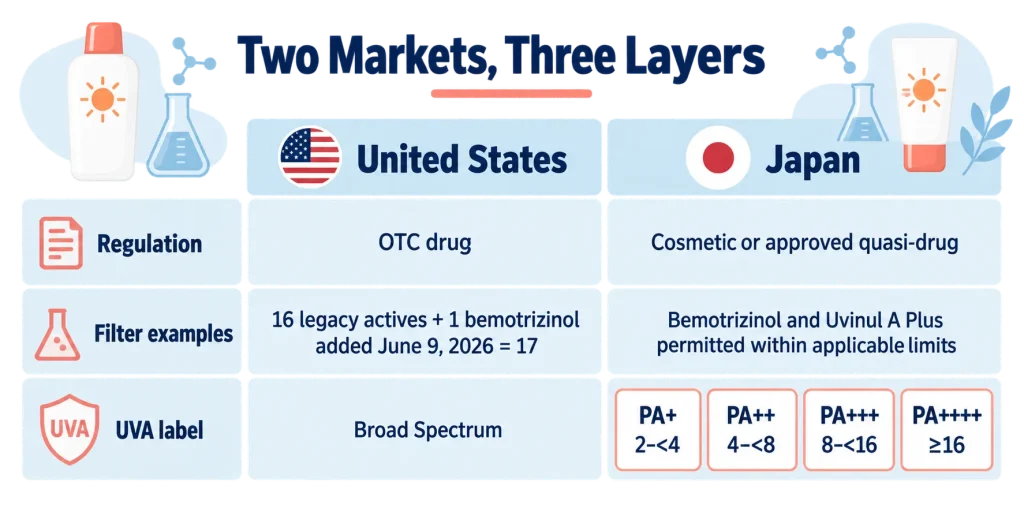
The clearest comparison has three layers:
- Law: OTC drug in the United States versus Japanese cosmetic or approved quasi-drug pathways.
- Testing and labels: U.S. broad-spectrum language versus Japan’s PA grades alongside SPF.
- Formulation: different permitted filter combinations, plus the inactive ingredients that determine finish.
That framing survives the June 2026 change. The United States now has bemotrizinol, but it has not adopted Japan’s entire positive list or its PA labeling convention. Japan still offers formulators a different set of permitted combinations. The texture may be lighter because of how a particular formula uses those options. It is not lighter because chemistry works differently in Japan.
Frequently asked questions
Is Japanese sunscreen regulated as a cosmetic?
Many Japanese sunscreens are cosmetics governed by Japan’s Standards for Cosmetics. Some products may be approved and marketed as quasi-drugs when they fit that separate category and its permitted claims. The package and official product record determine the category. “Japanese sunscreen” is not itself one legal classification.
Is sunscreen a cosmetic in the United States?
Products making sunscreen claims are regulated by the FDA as OTC drugs. A product may also have cosmetic functions, such as tinting or moisturizing, but those functions do not remove the drug requirements. The package normally identifies active ingredients in a Drug Facts panel. That format differs from a Japanese cosmetic ingredient declaration.
Is Tinosorb S still unavailable in American sunscreen?
No. Bemotrizinol, widely associated with the Tinosorb S trade name, was added to the U.S. OTC sunscreen framework by an FDA order dated June 9, 2026. That was the first new American sunscreen active addition in more than twenty-five years. Products containing it must still meet all other applicable U.S. requirements.
Is Uvinul A Plus approved by the FDA?
The June 2026 bemotrizinol order did not add diethylamino hydroxybenzoyl hexyl benzoate, the filter commonly known as Uvinul A Plus. It remains an example of a UVA filter available to Japanese formulators but not included through that American decision. Regulatory status should be checked again before publication or purchase because monograph orders can change. Trade names should also be confirmed against the declared chemical ingredient.
Does PA++++ mean the product is stronger than SPF 50?
The ratings describe different measurements. SPF primarily expresses protection against sunburn-producing UVB, while PA communicates a tested UVA protection-factor band. PA++++ means a UVA protection factor of sixteen or higher under the Japanese system. It is not a multiplier applied to the SPF number.
Why can Japanese sunscreen feel lighter?
Permitted UV-filter combinations can give formulators different ways to reach a protection target. Solvents, emulsifiers, powders, emollients, and film formers also influence the finish. No single Japanese filter guarantees a light texture. The ingredient list and finished formula matter more than the flag associated with the brand.
What number should be remembered?
Remember seventeen: sixteen legacy U.S. monograph actives plus bemotrizinol, added by the FDA on June 9, 2026. That count should be rechecked by September 22, 2027, or sooner if the FDA issues another sunscreen administrative order. Japan’s positive list and JCIA labeling standards also require rechecking on that date. The old “no new filter since the 1990s” comparison expired in June 2026.