Japan’s animal of the year works less like a horoscope and more like a seasonal design system. The Japanese New Year zodiac animal begins appearing on cards, stamps, decorations, packaging, and shrine goods before the year it represents has even started, then rapidly loses its retail purpose once the New Year season ends.
The mechanism is simple. Japan assigns one of the traditional twelve animals to each calendar year, and businesses use that animal as a shared visual shorthand for the coming New Year. Printers, post offices, stores, shrines, and families do not need to coordinate their designs: everyone already knows which motif comes next.
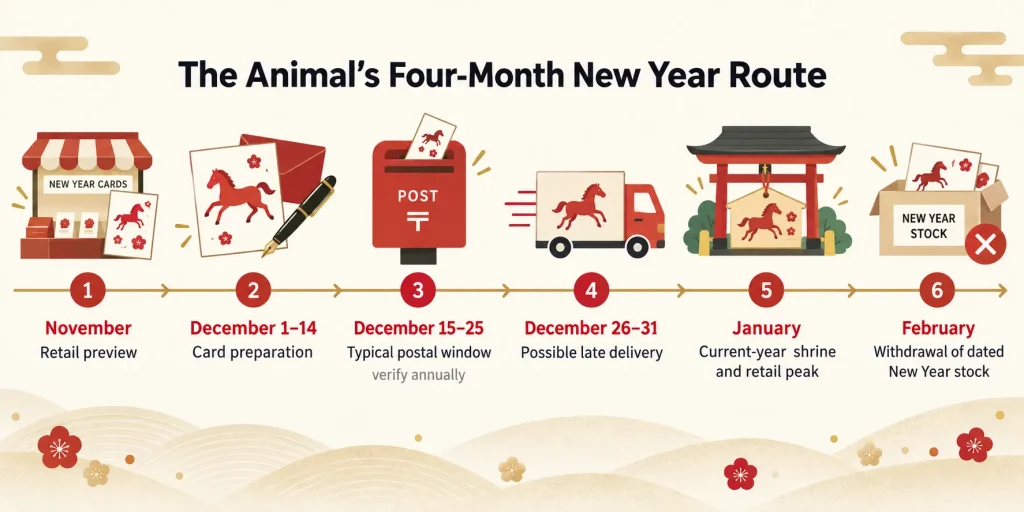
This creates a practical calendar from November through February. November is when you start seeing the incoming animal in stores. December is when the design becomes useful, especially on New Year cards. January is when the animal belongs to the current year. By February, most explicitly New Year merchandise has disappeared, although ordinary souvenirs and shrine items may remain.
The animal does not predict what your year will be like. In everyday Japanese New Year use, its main job is to tell you which year is arriving.
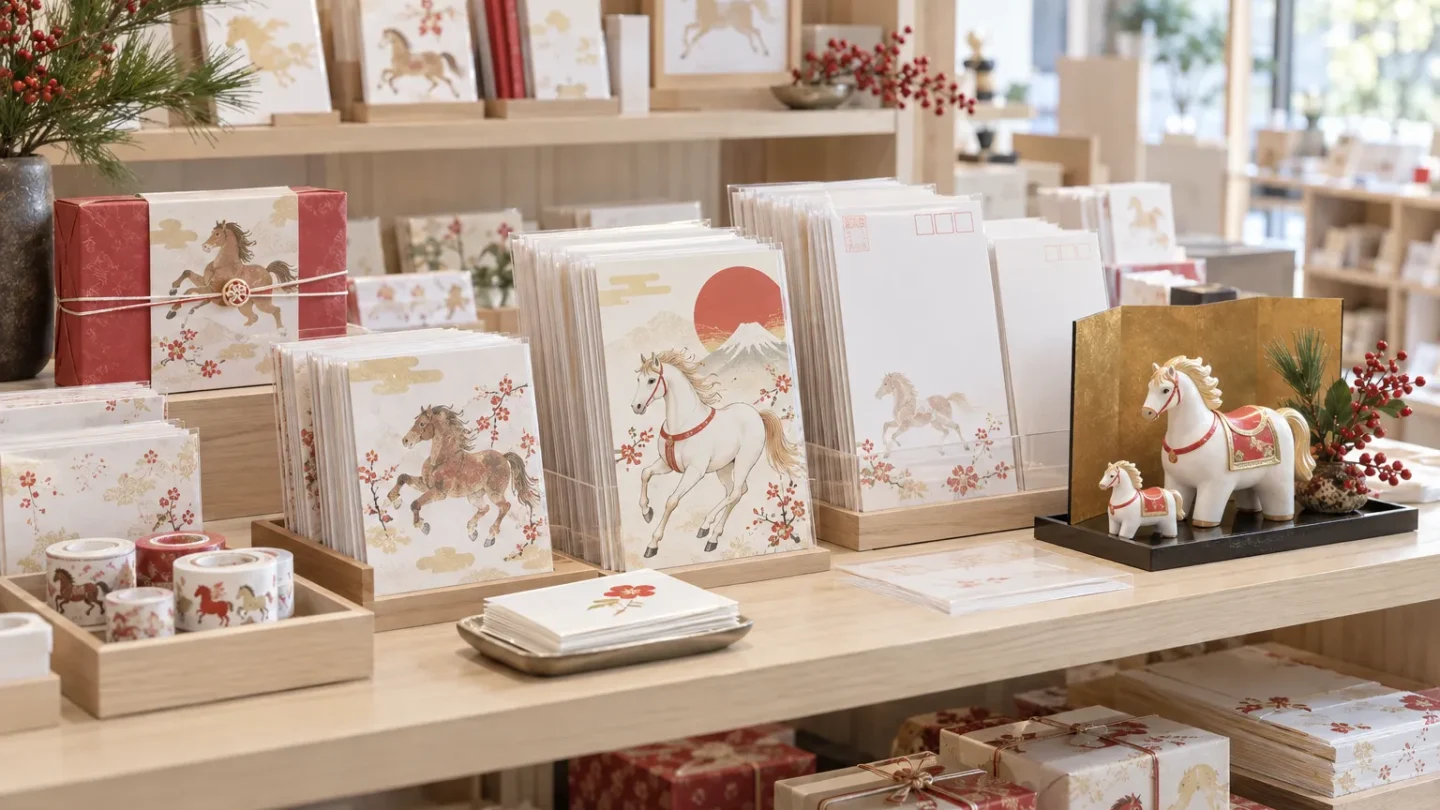
Japanese store display of New Year cards and goods bearing the incoming year’s animal
The animal changes on January 1 in Japan
The Japanese system is called 干支, eto, literally the “heavenly stems and earthly branches.” In casual conversation, however, eto often means the familiar sequence of twelve animals. The full calendrical system is more complicated than the animal printed on a postcard, but you do not need that machinery to understand a department-store display.
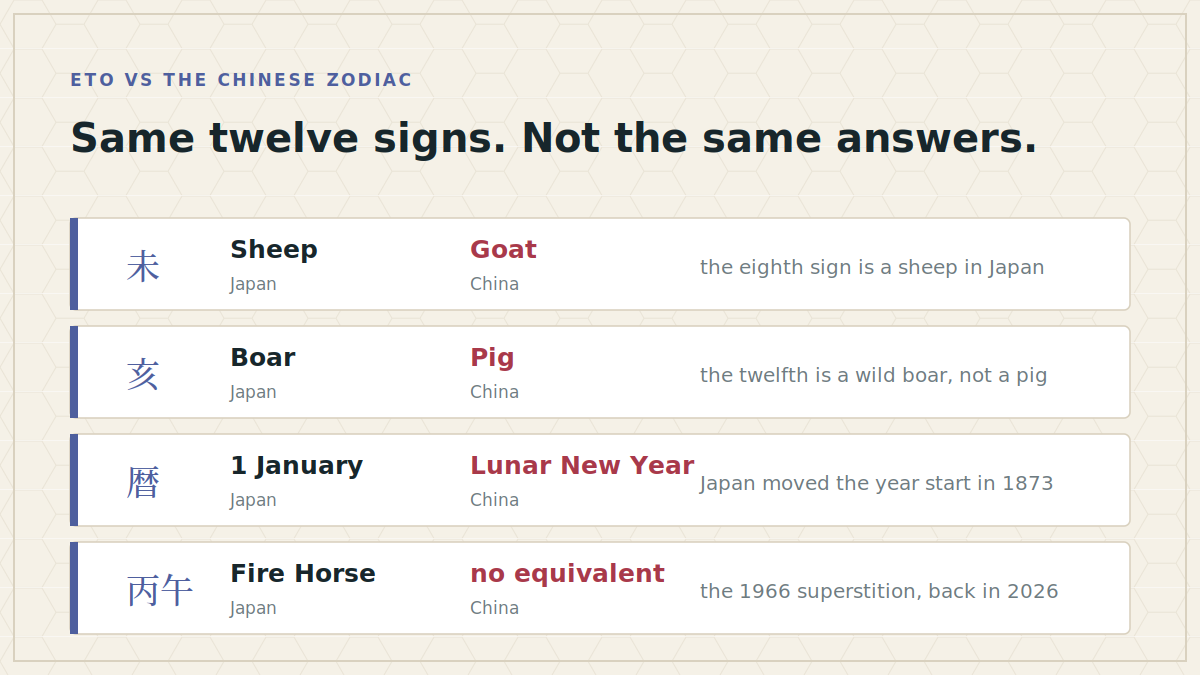
Japan’s modern calendar year begins on January 1. That matters because Chinese zodiac calculations generally change at Lunar New Year, which falls later. Someone born in January or early February can therefore receive different answers depending on whether the question concerns Japanese eto or the Chinese calendar.
This is the detail outsiders most often miss. The horse, rabbit, or dragon on a Japanese January display is not waiting for Lunar New Year. It represents the Japanese calendar year already in progress. Born in January or February? Your Zodiac Sign May Be Wrong explains the birth-date boundary without duplicating it here.
Question
Japanese New Year use
Chinese calendrical use
When does the animal change?
January 1
Lunar New Year
What does the animal mark in this article?
The Japanese calendar year
A separate lunisolar year
What should a visitor follow in Japan in January?
The animal displayed locally
Not the previous Chinese-calendar animal
November is the preview, not the celebration
The next animal normally becomes visible during the late-autumn retail changeover. Greeting-card materials, calendars, small ornaments, craft supplies, stamps, and 年賀状, nengajō, literally “New Year congratulation cards,” begin preparing customers for an event that is still weeks away.
There is no national rule requiring every shop to unveil Japanese zodiac decorations on the same date. A convenience store, stationery chain, department store, and shrine shop can all work to different schedules. “The animal appears in November” is therefore a useful shopping expectation, not a legally fixed opening day.
This distinction saves you from planning a trip around an imaginary launch date. Early in the month, one retailer may have a full display while another is still selling autumn merchandise. As December approaches, the motif becomes much easier to find because it has jobs to perform: cards must be prepared, gifts wrapped, windows changed, and household decorations bought.
The most time-sensitive use of the animal is the New Year card. A typical nengajō may combine the coming animal with a greeting, a family photograph, a short personal update, or restrained business branding. The animal is optional, but it lets the recipient identify the year before reading anything else.
Japan Post traditionally opens a special acceptance period in December so cards can be held and delivered for New Year’s Day. Its recurring public guidance has asked senders to post by December 25 for expected January 1 delivery. That date should be treated as an annual operational deadline, not a permanent guarantee: check the Japan Post notice for the specific season before mailing.
You do not need fluent Japanese to participate. Buy a designated New Year postcard, ask a stationery store about printing, or use a simple commercially printed card. The postal address must still be correct, and international delivery does not enter the domestic New Year sorting system simply because the card has an animal on it.
For a domestic card, the practical sequence is:
Obtain the recipient’s current Japanese address.
Choose a card or template for the coming calendar year.
Add a brief New Year greeting and your name.
Confirm the season’s Japan Post acceptance dates.
Post it by the published deadline if January 1 delivery matters.
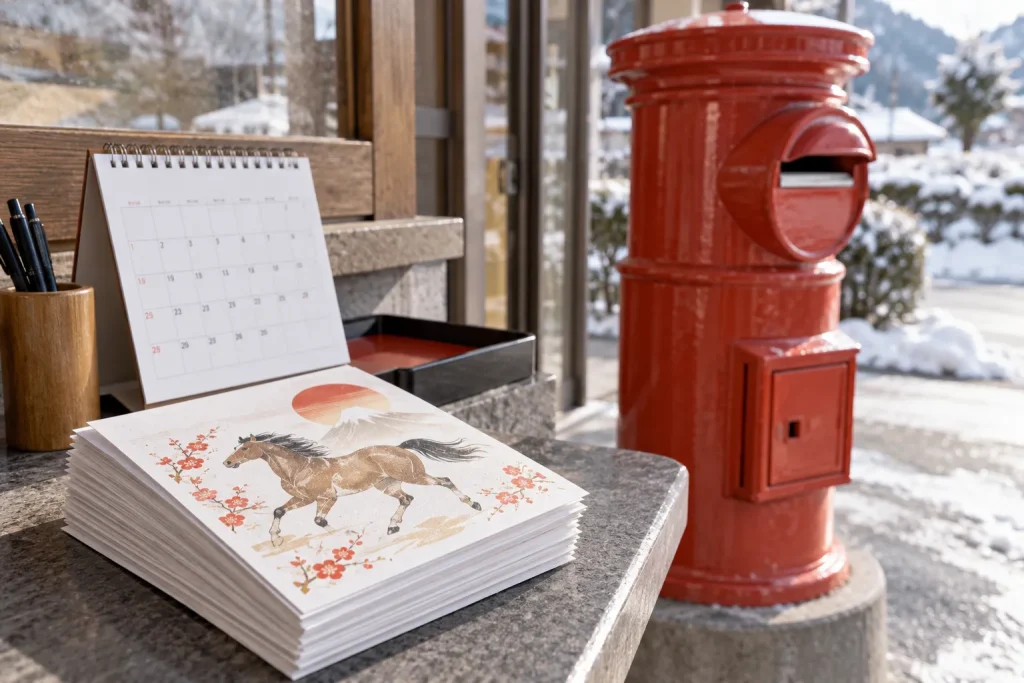
New Year postcards with the coming animal beside a Japanese mailbox and calendar
The December 25 date is not the last day you can send
Visitors sometimes hear “December 25” and assume cards mailed later will be refused. That is not what the deadline means. It is the recommended cutoff associated with New Year’s Day delivery under that season’s postal arrangements.
A later card may arrive after January 1. Whether that is acceptable depends on the relationship and the date, not on a mechanical rule that destroys the card’s meaning at midnight. The uncomfortable part is that no amount of elegant calligraphy can restore a delivery date missed because you relied on an old travel blog.
There is also a social exception. Households observing mourning may send 喪中はがき, mochū hagaki, literally “mourning-period postcards,” to say that they will not exchange celebratory New Year greetings. If you receive such a notice, do not answer it with a brightly celebratory animal card. This is not a belief about the animal; it is etiquette surrounding the greeting.
Item
What the date controls
What it does not mean
Start of special acceptance
When designated New Year mail enters the seasonal system
The first day cards can be written
December 25 recommendation
Best target for January 1 domestic delivery
A legal ban on later mailing
January 1
Start of the Japanese animal year
Lunar New Year
After the New Year period
Greeting conventions change
Every animal object becomes unusable
Stamps and postal products make the motif official-looking
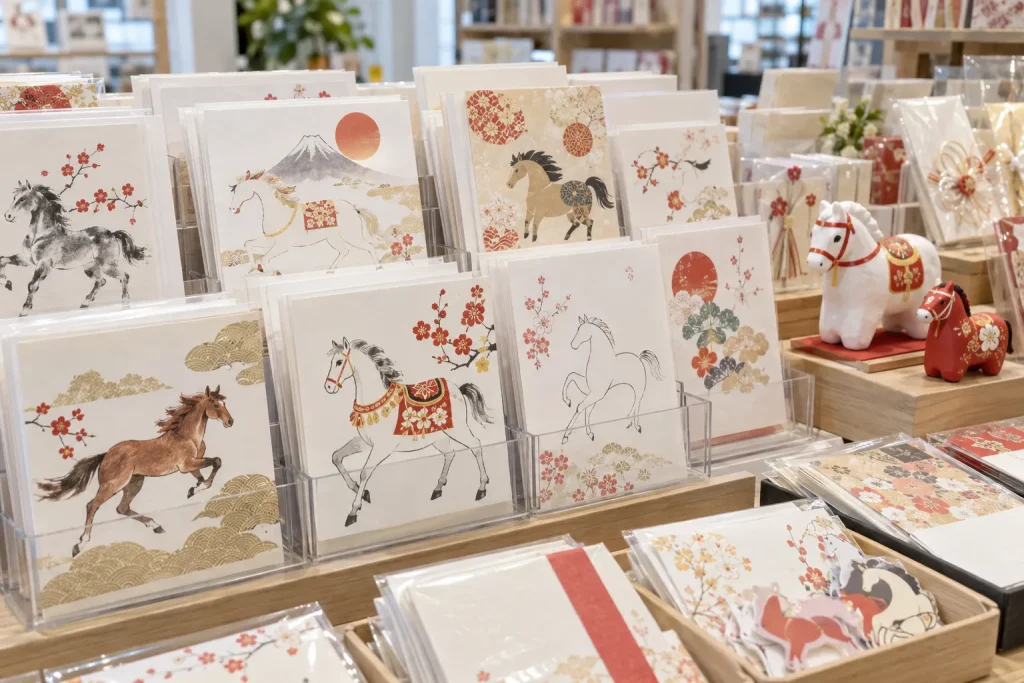
Postal products give the annual animal unusual visibility. A stamp, printed postcard, or official template can make the image look as though the government has prescribed one correct design. It has not. Artists can render the same animal traditionally, comically, minimally, or through visual wordplay.
The outsider’s mistake is to search for a single canonical picture. The shared information is the animal, not its pose, color, costume, or personality. A horse can appear as a brush painting on a formal card and as a rounded cartoon character on children’s stationery without either version being “wrong.”
Japan Post’s designs also change by season. Do not assume that a photograph of an older stamp shows the product currently available. If collecting matters to you, verify the issue year and denomination on the official postal listing rather than buying from an unlabeled marketplace image.
The New Year postcard deadline matters more than finding the supposedly perfect animal drawing. A plain card mailed correctly can participate in the custom; a beautiful card posted to the wrong address cannot.
Shrine plaques use the animal without making it mandatory
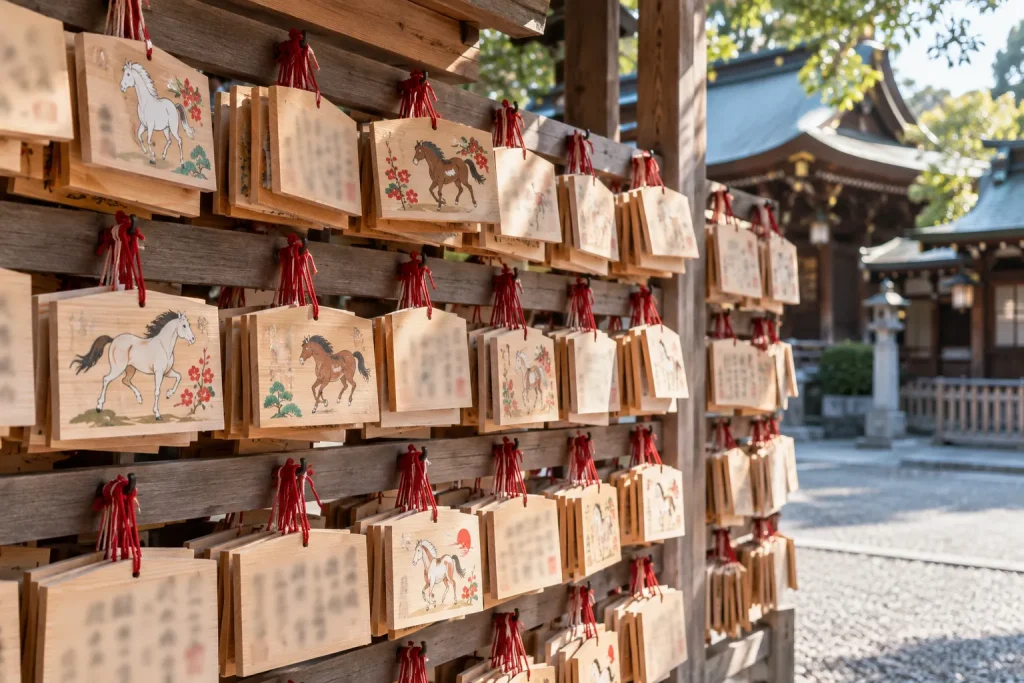
At many shrines, you may see 絵馬, ema, literally “picture horses”: small wooden plaques on which visitors write requests or messages. Despite the name, modern plaques can carry many images, including the current year’s animal. Some shrines offer a special annual design, while others emphasize a deity, local story, building, or festival.
You can usually buy an ema without speaking much Japanese. Write a short message in your own language if you wish, then follow the shrine’s indicated practice for hanging or keeping the plaque. Do not copy a stranger’s private message for translation practice, and do not treat the plaque rack as a free souvenir display.
The crucial correction is that an animal plaque is not universal shrine equipment. Availability varies by shrine, and a shrine associated with a particular creature may keep that creature in its designs regardless of the calendar. An annual eto plaque and a shrine’s permanent iconography can occupy the same shop without one replacing the other.
Department-store windows amplify a motif they do not control
Department stores, supermarkets, confectioners, and household-goods shops use the annual animal because customers recognize it immediately. It can appear on gift boxes, sweets, towels, figurines, chopstick rests, envelopes, and temporary window displays. The result feels coordinated, but there is no central design office issuing instructions to every retailer.
This commercial layer explains why the motif arrives early. A New Year product needs time to be ordered, displayed, purchased, wrapped, and sometimes mailed. By the time January begins, much of the buying has already happened.
It also explains why some goods vanish quickly. The printed year makes merchandise perishable even when the object itself is durable. A ceramic figurine without a date may be sold as a general zodiac object, but a package that explicitly welcomes a particular year becomes harder to sell once the season passes.
For a visitor, the useful opportunities are modest:
Browse stationery and department-store seasonal floors in November or December.
Buy an undated animal ornament if you want a souvenir that will not look obsolete.
Choose packaged sweets for their contents, not only the annual wrapper.
Check whether a shrine plaque is meant to be hung there or taken home.
Ask before photographing handwritten plaques or private cards.
Shrine display containing wooden plaques with the current year’s animal
January is the center of the cycle, not its beginning
Retail promotion begins before January, but the animal actually belongs to the new Japanese year from January 1. This is when it appears most naturally in greetings, first shrine visits, household decorations, media illustrations, and shop displays.
The surprising consequence is that the animal’s busiest visual period straddles two years. In December, you see the next animal because people are preparing. In January, you see the same animal because its year has arrived. A photograph without context can therefore be difficult to date unless it includes a printed year or another identifiable detail.
The site’s article on the five elements and the sixty-year cycle handles the larger calendrical structure. For seasonal participation, the animal alone is normally the visible layer you need.
February reveals what was seasonal and what was permanent
By February, dedicated New Year card displays and dated gift packaging have usually lost their purpose. Retailers may discount, remove, or replace them. This does not mean Japan has formally stopped using the year’s animal; it means the New Year sales window has closed.
Shrines, museums, craft shops, and souvenir stores can continue selling related items. A permanent zodiac set contains all twelve animals, while a shrine with a lasting connection to one creature may feature it in any year. These are genuine counterexamples to the idea that every animal image disappears after January.
Regional Lunar New Year observances are another exception. Communities and events influenced by Chinese and other East Asian traditions may follow a lunisolar date. That calendar should not be used to reinterpret the ordinary January 1 change in Japanese eto.
A final exception is personal ownership. People do not throw away a ceramic animal, charm, or keepsake merely because February arrives. The disappearing act belongs mainly to retail displays and dated consumable goods, not to every object in the home.
What the calendar lets you do without Japanese
The annual motif is unusually accessible because recognition does not depend on reading a sentence. You can identify the animal, compare designs, purchase stationery, visit seasonal displays, or choose an ema with very little Japanese. The difficult parts are logistical and social rather than linguistic.
You still need to distinguish a New Year card from an ordinary postcard, confirm the recipient’s address, and check that year’s mailing notice. You also need to recognize when a mourning notice makes a celebratory reply inappropriate. Translation software can help with a label, but it cannot decide whether a specific person expects a card.
The most useful phrase may simply be 来年の干支はありますか, rainen no eto wa arimasu ka, literally “Do you have next year’s zodiac animal?” In a stationery or souvenir shop, pointing to the relevant display will often do the rest. If you want a personal item rather than a prediction, ask for the animal connected with a year and leave character claims out of the conversation.
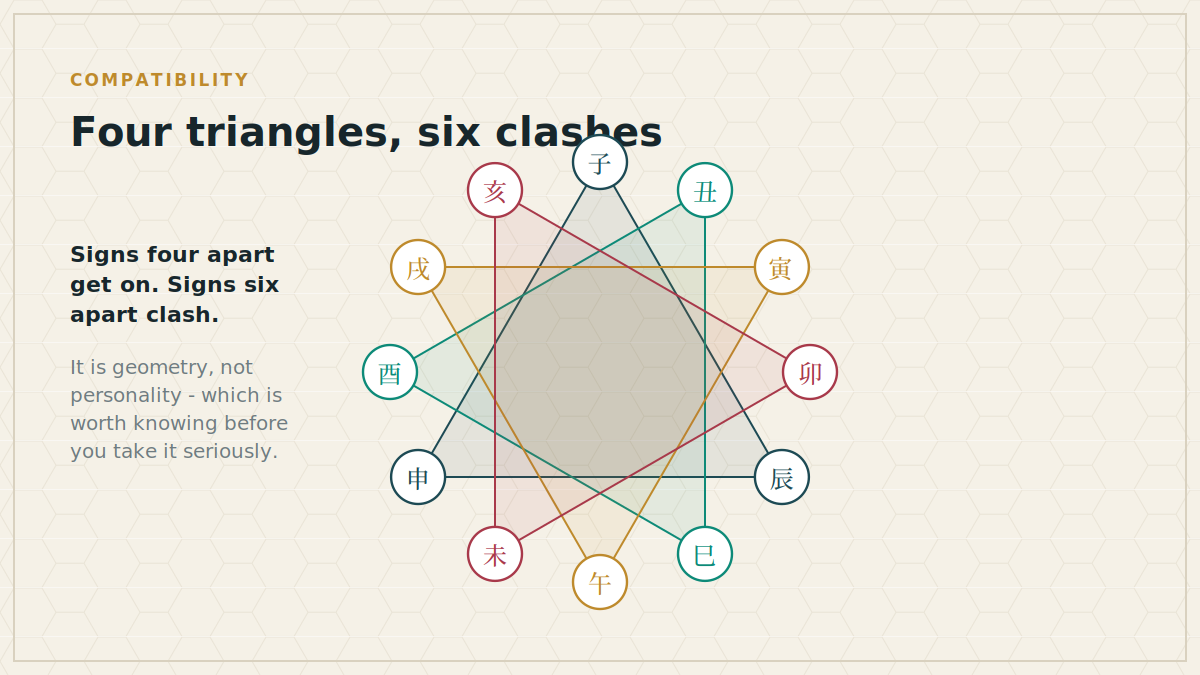
The separate article on zodiac compatibility traditions explains those inherited pairings. They are not required for buying cards, visiting a shrine, or understanding the animal of the year in Japan.
The Japanese New Year zodiac animal is a calendar label, not a forecast
The most useful consequence of the system is predictability. Once you know the next animal, you know what will dominate seasonal design even if you cannot read the packaging. You also know why it appears before its year begins and why shops remove dated versions so quickly afterward.
A second consequence is that the same animal can carry different levels of formality. A restrained brush drawing suits a business card; a playful illustration suits a family card; a wooden plaque belongs to a shrine context. The animal identifies the year, but the surrounding object identifies the social use.
A third consequence is that participation does not require accepting claims about personality, luck, or compatibility. You can send a card, buy a small ornament, or notice a display as part of the New Year calendar. This article treats eto as dated cultural notation and seasonal design, not as evidence about anyone’s future.
The rule of thumb is simple: follow the animal shown in Japan from November onward, but follow the calendar date—and Japan Post’s current notice—when you need to act.
The animal’s New Year working calendar
The Animal’s Four-Month New Year Route
Period
Main role of the animal
What a visitor can do
November
Preview on cards, calendars, stamps, and retail goods
Browse designs and buy undated souvenirs
December 1–14
Card preparation and gift packaging
Confirm addresses and prepare cards
December 15–25
Typical special postal acceptance window; annual dates require confirmation
Mail domestic nengajō according to the current Japan Post notice
December 26–31
Late preparation, with January 1 delivery less certain
Send only after accepting possible later arrival
January
Current-year motif at shops, homes, and shrines
Visit displays or choose an annual ema
February
Dated New Year stock recedes
Look for permanent zodiac sets and shrine-specific items
Short FAQ
Is the Japanese animal year the same as the Chinese zodiac year?
Not at the beginning of the year. Modern Japanese eto changes on January 1, while the Chinese zodiac year changes at Lunar New Year. This is especially important for people born in January or early February.
Must a Japanese New Year card show the year’s animal?
No. The animal is a widely recognized design choice, not a postal requirement. A card can use a photograph, calligraphy, scenery, or another suitable New Year design.
Can a visitor write an ema in English?
Many shrines receive international visitors, and a message in English is generally possible. Follow the instructions at that shrine and ask staff if you are unsure whether the plaque should be hung or taken home.
Will a card mailed by December 25 definitely arrive on January 1?
Do not treat the date as an unconditional guarantee. Japan Post publishes operational guidance for each season, and weather, address problems, collection times, and the type of mail can matter. Check the notice issued for the year in which you are sending.
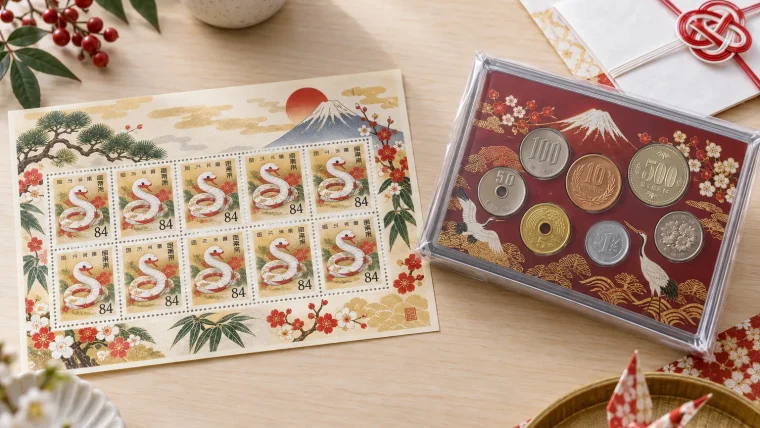
Japan’s animal-year stamps are regular seasonal products, but the matching Mint set follows a different calendar and buying process. Here is when each collectible appears, where to find it, and when an application may lead to a lottery.
The famous pairings come from the geometry of a twelve-point circle, not from anything about the animals. How the system works, how seriously it is taken, and where to stop.
Japan starts the zodiac year on 1 January, calls the eighth sign a sheep and the twelfth a boar - and has one combination that cut the national birth rate by a quarter.