Calling the 2017 statute a permanent right to abdicate is the most consequential mistake. The Akihito abdication law did not rewrite Japan’s general succession system or create a procedure any future emperor can invoke. It was a 特例法, tokureihō, literally “special-case law,” designed around the circumstances of the reigning emperor identified in its text. Emperor Akihito abdicated on April 30, 2019, and Crown Prince Naruhito succeeded him on May 1, but the ordinary Imperial House Law remained centered on succession following an emperor’s death. If another emperor seeks to leave the throne during his lifetime, the 2017 statute does not automatically provide the answer.
Mistaking a one-off exception for a permanent abdication system
The statute’s full Japanese title is 天皇の退位等に関する皇室典範特例法, Tennō no taii-tō ni kansuru Kōshitsu Tenpan Tokureihō, literally “Special Act on the Imperial House Law concerning the Emperor’s abdication and related matters.” Its wording matters. The law refers to the emperor then occupying the throne and creates legal consequences for his abdication, his successor, his post-abdication title, and related institutions. It does not set general eligibility tests for future abdications.
This seems counterintuitive because the statute is formally connected to the Imperial House Law. A reader may assume that anything called a “special act concerning” that law permanently adds a new path to succession. Instead, the act instructs officials to treat its provisions as special provisions of the Imperial House Law for this case. That is a legal bridge, not a reusable application form.
| Question | Standing Imperial House Law | Special Act of 2017 |
|---|---|---|
| What triggers succession? | Death of the emperor | Akihito’s abdication on the designated enforcement date |
| Who does it cover? | The imperial succession system generally | The emperor described in the act and the resulting transition |
| Does it create a future application process? | No | No |
| Does it establish a general retirement age? | No | No |
| Can the next emperor invoke it automatically? | No | No |
| What happens after abdication? | Not generally provided | Akihito receives the title Emperor Emeritus |
The law therefore solved a named constitutional and institutional problem without settling the larger policy question. The Diet could legislate again in a future case, but that possibility is different from an existing right.
What to do instead: Describe the statute as a one-time exception incorporated alongside the Imperial House Law, not as a permanent abdication clause.
Saying the Emperor changed the law by announcing his wish
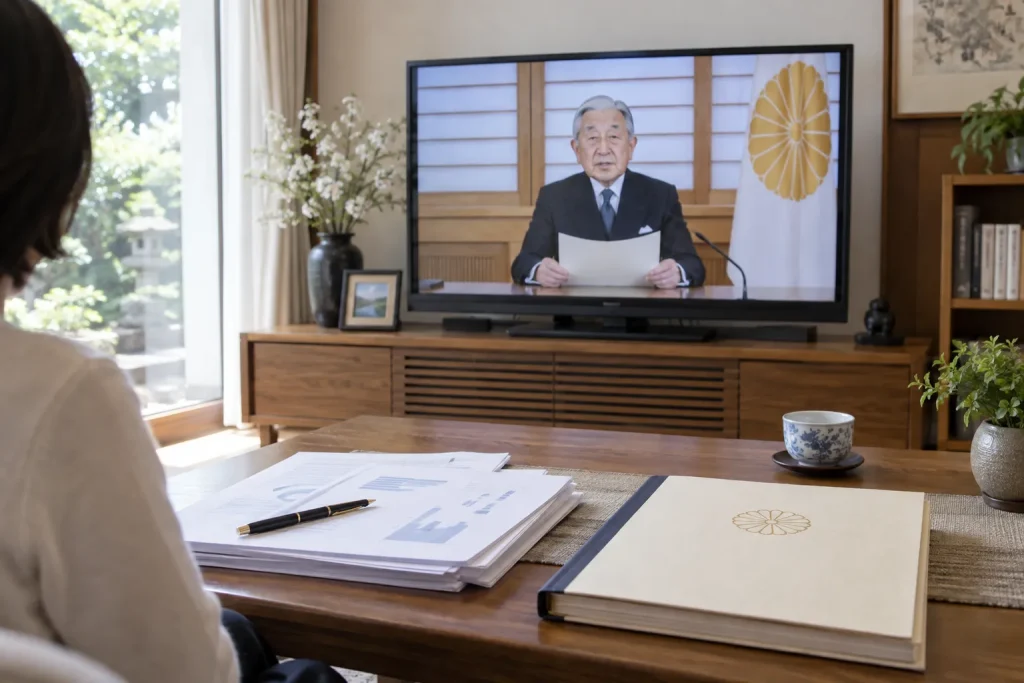
Akihito’s televised message of August 8, 2016, is often treated as an abdication announcement. He did not use the message to issue a legal order, set a departure date, or direct the Diet to pass a particular bill. Under Japan’s Constitution, the emperor performs acts of state defined by the Constitution and has no powers related to government. A direct political demand from the throne would therefore have created a serious constitutional problem.
The message instead discussed Akihito’s age, physical condition, and concern that he might become unable to perform his duties fully as the symbol of the state. Listeners understood the institutional implication, but the legal work belonged to the elected government and National Diet. An advisory process followed, the Cabinet submitted legislation, and the Diet enacted it. The abdication became possible because the statute created the exception, not because the speech itself had legislative force.
Choosing Two Kanji for the Next Thirty Years explains the government process behind selecting a new era name. The same division of responsibility applies here: imperial transition involves the emperor, but legal and administrative decisions are made through state institutions.
The message created political urgency, but it did not create legal authority.
What to do instead: Treat the 2016 message as the public catalyst and the 2017 act as the legal instrument.
Reading the Akihito abdication law as an amendment to the normal rule
A half-informed account says that the Diet amended the Imperial House Law to permit abdication. This gets close to the legal architecture but lands on the wrong description. The Diet enacted a separate special statute and directed that it operate as special provisions of the Imperial House Law. The general succession language was not replaced with a standing rule allowing an emperor to retire.
The difference is practical, not semantic. A permanent amendment could specify conditions, decision-makers, safeguards, timing, and procedures for later emperors. The special act instead dealt with a transition involving one reigning emperor and the crown prince who would succeed him. It also established post-abdication titles and administrative arrangements tied to that transition.
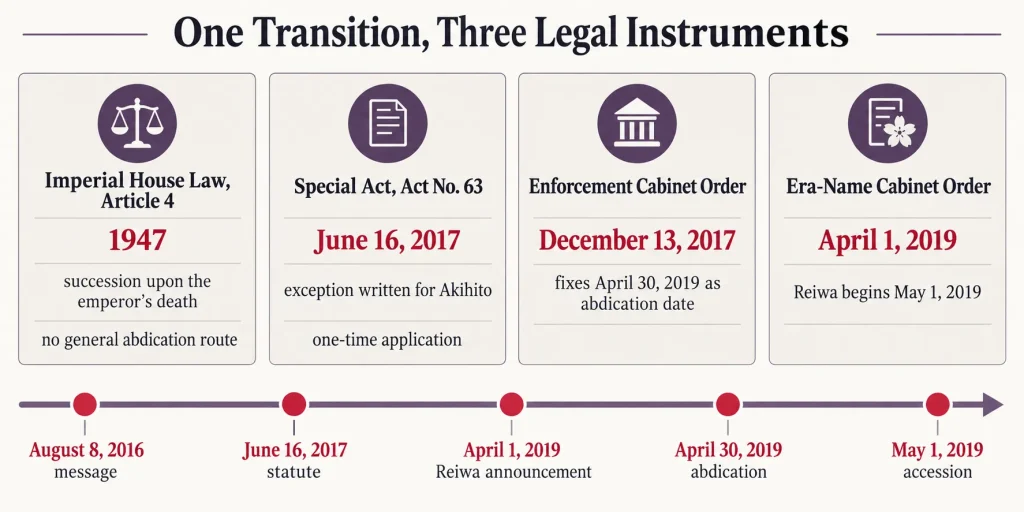
The ordinary rule appears in Article 4 of the Imperial House Law: when the emperor dies, the imperial heir immediately accedes to the throne. The special act supplied the alternative trigger needed in 2019. Once that transition occurred, the exception did not become a general mechanism waiting for another applicant.
What to do instead: Write that the Diet enacted a separate special law operating as an exception to Article 4, while leaving the general rule intact.
Ending Heisei on the day Reiwa was announced
The name 令和, Reiwa, officially rendered by the Japanese government as “beautiful harmony,” was announced on April 1, 2019. That announcement did not end 平成, Heisei, commonly translated as “achieving peace.” Heisei continued through April 30, while Reiwa began with Naruhito’s accession on May 1. A document dated in April remained a Heisei document even after the public knew the next era name.
The gap between announcement and commencement was deliberate. Government offices, software providers, calendar printers, businesses, and the public received advance notice before the transition. 1 April 2019, and the Board Held Up covers the announcement itself, including the display that made the two characters instantly recognizable. It should not be confused with the later legal start of the era.
| Event | Gregorian date | Japanese-era date | Legal effect |
|---|---|---|---|
| Special act promulgated | June 16, 2017 | Heisei 29 | Statute officially published |
| Abdication date fixed by Cabinet Order | December 13, 2017 | Heisei 29 | Transition date legally specified |
| Reiwa name announced | April 1, 2019 | Heisei 31 | New name disclosed in advance |
| Akihito abdicated | April 30, 2019 | Heisei 31 | Heisei reign ended |
| Naruhito acceded | May 1, 2019 | Reiwa 1 | Reiwa era began |

The First Era Name Not Taken From China explains the literary source used for Reiwa. The source of the characters is a different question from the statute authorizing the abdication.
What to do instead: Separate the April announcement from the May commencement when dating documents or describing the transition.
Saying Akihito personally selected Reiwa
The succession and the era change occurred together, so it is easy to imagine the incoming or outgoing emperor choosing the new name. Modern Japanese law assigns that governmental act elsewhere. The Era Name Act provides that an era name is established by Cabinet Order, and the Cabinet approved Reiwa before Chief Cabinet Secretary Yoshihide Suga announced it. Neither Akihito’s abdication statute nor Naruhito’s accession turned the era name into a personal royal choice.
This distinction protects the constitutional position of the emperor. The Constitution defines him as the symbol of the state and the unity of the people, deriving his position from the will of the people. It also denies him governmental powers. Attributing a Cabinet decision to the emperor blurs that boundary.
The two-kanji name and the legal transfer of the throne were coordinated but governed through different instruments. The special act enabled abdication, a Cabinet Order fixed its effective timing, and another Cabinet Order changed the era name. One historical event can therefore rest on several legal acts.
What to do instead: Attribute Reiwa’s legal adoption to the Cabinet, while describing the imperial succession as the event that triggered its commencement.
Describing 2019 as an ordinary imperial succession
The 2019 transition produced the same final result as another succession: a new emperor occupied the throne. The legal route was different. Akihito remained alive, acquired the title 上皇, Jōkō, literally “Emperor Emeritus,” and ceased to be the reigning emperor. Naruhito succeeded immediately on the date specified through the special-law framework.
That difference also changed the handling of the era calendar. A death-based transition cannot be scheduled in advance, while Akihito’s departure date was fixed before it occurred. Advance scheduling made it possible to reveal Reiwa before the new reign began. It also created a rare modern year in which the exact day, rather than the year alone, determines whether Heisei or Reiwa is correct.
Japanese Era Years: Meiji to Reiwa, Explained covers how era years are counted. Showa, Heisei and Reiwa Year Tables provides direct year mappings, so those conversion tables do not need to be duplicated here.
What to do instead: Call 2019 a scheduled lifetime succession under a special act, not a routine application of the death-based rule.
Turning “Emperor Emeritus” into a general office
The special act gave Akihito the title 上皇, Jōkō, “Emperor Emeritus,” after abdication. It also provided for the title 上皇后, Jōkōgō, literally “Empress Emerita,” for Empress Michiko. These titles can look like permanent offices newly inserted into the Imperial House Law. Their legal basis, however, remains tied to the one-off statutory arrangement.
This matters when discussing future transitions. Japan does not now have a general queue of retired emperors governed by a reusable abdication chapter. The act specified how existing legal provisions concerning the emperor, imperial family, finances, institutions, and related matters would apply to Akihito in his new position. It solved the consequences of this abdication alongside the abdication itself.
The title also did not create two reigning emperors. Naruhito became emperor, while Akihito ceased performing the constitutional role attached to the throne. Translating Jōkō as “former emperor” may communicate the basic distinction, but “Emperor Emeritus” better reflects the official English usage.
What to do instead: Present Emperor Emeritus as Akihito’s status under the special act, not as proof of a permanent retirement system.
Rounding the previous abdication into a vague legend
Akihito was the first Japanese emperor to abdicate since Emperor Kōkaku in 1817. Descriptions such as “the first in about two centuries” are broadly understandable, but replacing the named predecessor with a vague ancient tradition hides the legal break between premodern practice and the current constitutional order. Abdication existed repeatedly in earlier imperial history. What was missing in 2016 was a procedure under the postwar Imperial House Law.
Kōkaku’s abdication did not establish a precedent that Akihito could simply activate. Different constitutional documents, political institutions, and ideas of imperial authority governed the two moments. The 1817 event explains the historical interval; it does not supply the legal authority for 2019. That authority had to come from the Diet.
This is another half-informed error: knowing that earlier emperors abdicated and assuming custom could fill the modern statutory gap. In a system where succession is governed by written law, historical precedent and current authorization are different kinds of evidence.
What to do instead: Name Emperor Kōkaku and 1817 as the historical comparison, then identify the 2017 special act as Akihito’s modern legal basis.
Converting 2019 without checking the exact day
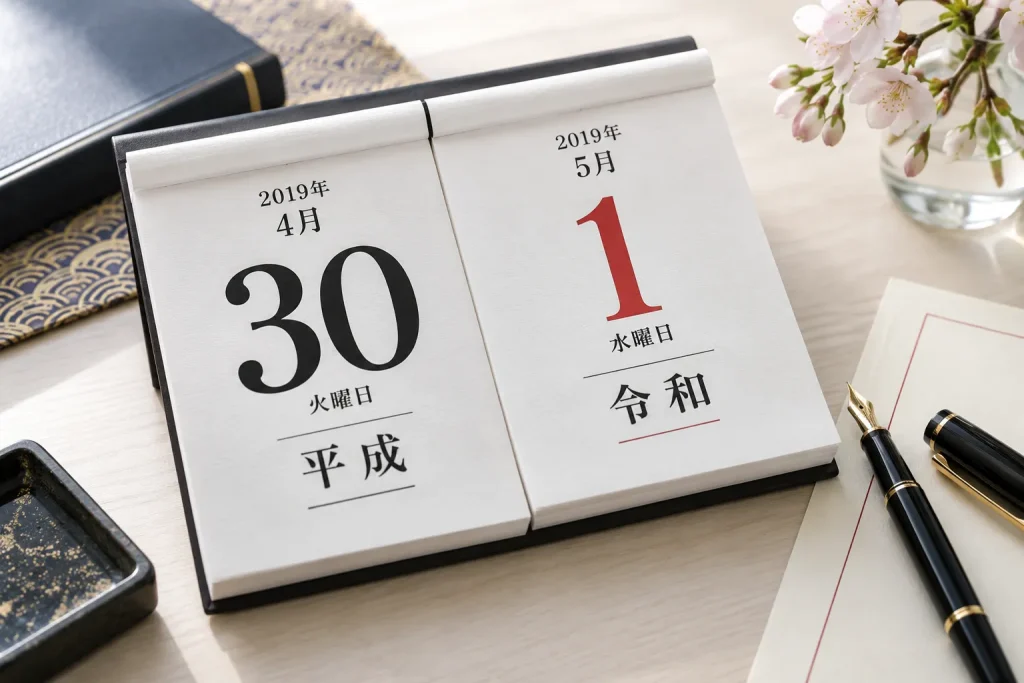
A reader who knows the eras may still write “2019 equals Reiwa 1.” That is incomplete because the year was divided between two era names. Dates through April 30 belong to Heisei 31, while dates beginning May 1 belong to Reiwa 1, written 令和元年, Reiwa gannen, literally “Reiwa first year.” The transition cannot be converted correctly from the Gregorian year alone.
This becomes important when reading contracts, certificates, newspapers, receipts, and government records issued during the transition. A document dated Heisei 31 is not necessarily older than a document dated Reiwa 1 by an entire year. The documents may be separated by a single day. The site’s era converter covering every year from 1868 through 2050 and all five modern eras handles the day-level boundary instead of assigning one label to all of 2019.
A worked conversion keeps the rule visible:
- Identify whether the date falls before or after the accession.
- Use Heisei for dates no later than April 30.
- Use Reiwa for dates beginning May 1.
- Write the first year as 元年, gannen, rather than 1年.
- Preserve the month and day when citing the transition year.
The habit that prevents most errors is to read the operative clause before summarizing a statute. Ask who the law names, what event it authorizes, when it applies, and whether it rewrites the general rule. In this case, every answer points back to one emperor and one transition.
What to do instead: Convert a 2019 date only after checking its month and day.