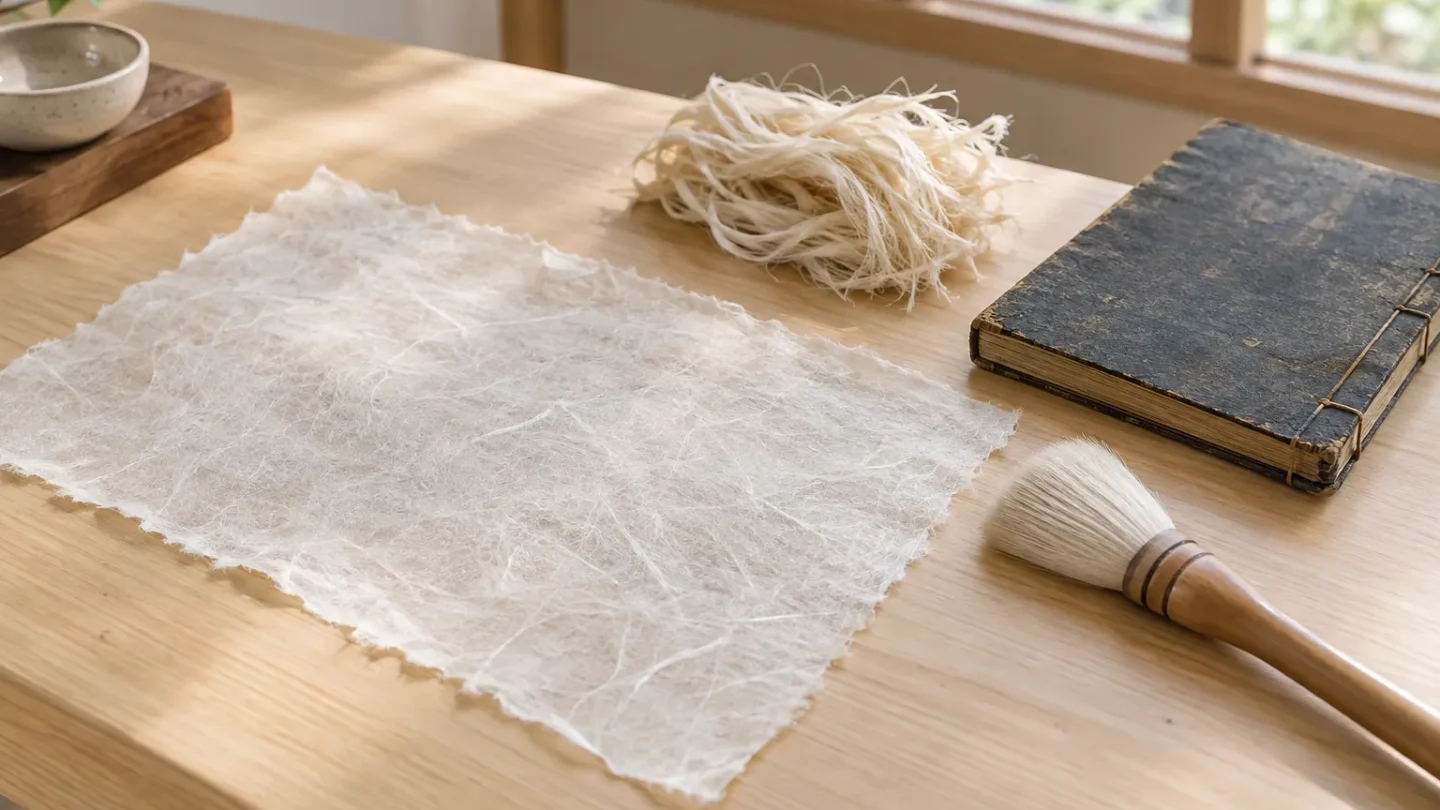
On November 26, 2014, UNESCO inscribed the craftsmanship behind three Japanese handmade papers on its Representative List of the Intangible Cultural Heritage of Humanity. That recognition changed the international status of a working material without turning every sheet sold as washi into protected heritage. If you ask what is washi paper, the useful answer begins with plant anatomy: it is Japanese paper traditionally formed from cleaned bast fibers taken from the inner bark of plants such as kōzo, mitsumata and gampi. Those fibers are generally longer than the short fibers produced from heavily processed wood pulp, allowing them to overlap and lock together across a thin sheet. This combination of strength, flexibility and low visual weight explains why Japanese washi paper appears both in historic collections and on a conservator’s repair bench.
The preserved documents associated with the Shōsōin repository demonstrate that Japanese paper can remain legible across many centuries, but they do not prove that fiber length alone guarantees survival. Storage, handling, impurities, adhesives, light and humidity matter as well. A strong sheet kept wet or exposed to insects can still fail. Conversely, a carefully stored paper made from shorter fibers may outlast a badly treated sheet of handmade washi. The material is unusually capable, not indestructible.
Before washi became a heritage label
Paper reached Japan from the Asian continent and was already being produced domestically during the Nara period. Papermakers adapted the process to local plants whose useful fibers sit beneath the outer bark rather than inside the timber. Instead of reducing a log to wood pulp, they harvested branches, removed the dark exterior, cooked the pale inner bark and cleaned away unwanted material. The remaining fibers were beaten rather than ground into a uniform slurry, helping much of their length remain intact. Sheets were then formed in water on a flexible screen and dried.
和紙, washi, literally “Japanese paper,” is an umbrella term rather than the name of one recipe. The first character, 和, wa, means Japanese or Japanese-style in this compound, while 紙, shi, means paper. Regional producers differ in plant material, water, tools, formation technique, drying and finishing. Some sheets are thick and textured, while others are almost transparent. Calling all of them “rice paper” is misleading because rice is not the defining fiber.
The wider question of what an official craft designation actually guarantees belongs in The Law, the Mark, and the Price Difference. Here, the essential distinction is between a broad material category and a protected practice. UNESCO did not certify every notebook, lamp or decorative sheet bearing the word washi. It recognized the knowledge and transmission of specified handmade traditions.
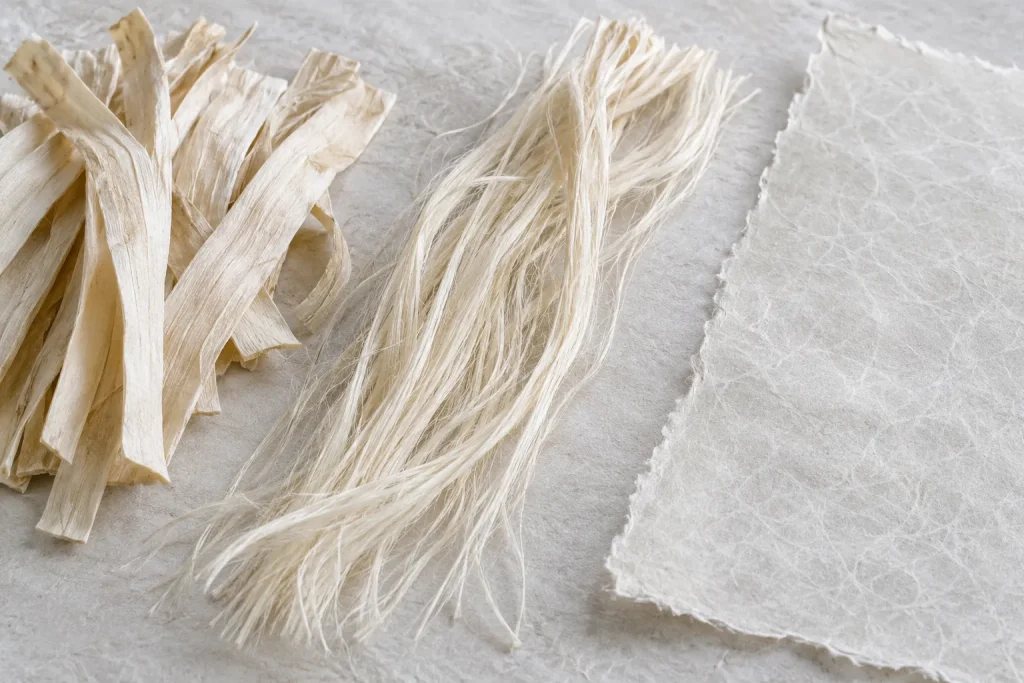
What is washi paper made from?
The three fibers named most often are kōzo, mitsumata and gampi. All are bast fibers, meaning that the papermaking material comes from tissue inside the bark. They do not produce identical paper, and the plant name alone cannot tell you whether a sheet is suitable for a particular repair. Processing quality, fiber purity, weight, color and sizing remain decisive. The following comparison describes their usual tendencies rather than a guaranteed specification.
| Japanese material | Reading and literal sense | Typical paper character | Common uses |
|---|---|---|---|
| 楮, kōzo, paper mulberry | Plant name; commonly rendered “paper mulberry” | Long, conspicuous fibers; strong and flexible even in thin sheets | Book repair, printmaking, screens, craft paper |
| 三椏, mitsumata, “three forks” | Named for branches that divide into three | Fine, smooth, dense surface with a warm tone | Printing, calligraphy, documents and selected conservation infills |
| 雁皮, gampi, gampi shrub | Plant name rather than a descriptive phrase | Fine, naturally lustrous surface; often crisp and resistant to insect damage | Fine writing paper, printmaking and specialist papers |
Kōzo is the material most closely associated with kozo conservation paper because it can be made thin without losing much tensile strength. A conservator can feather or tear its edge so that a repair does not create a hard ridge across an old page. Mitsumata may be chosen when its color, density or surface better matches the original object. Gampi can produce an exceptionally smooth sheet, but it is not simply a premium substitute for every other fiber. Matching the paper to the object is more important than buying the most expensive plant name.
Long fibers need careful preparation
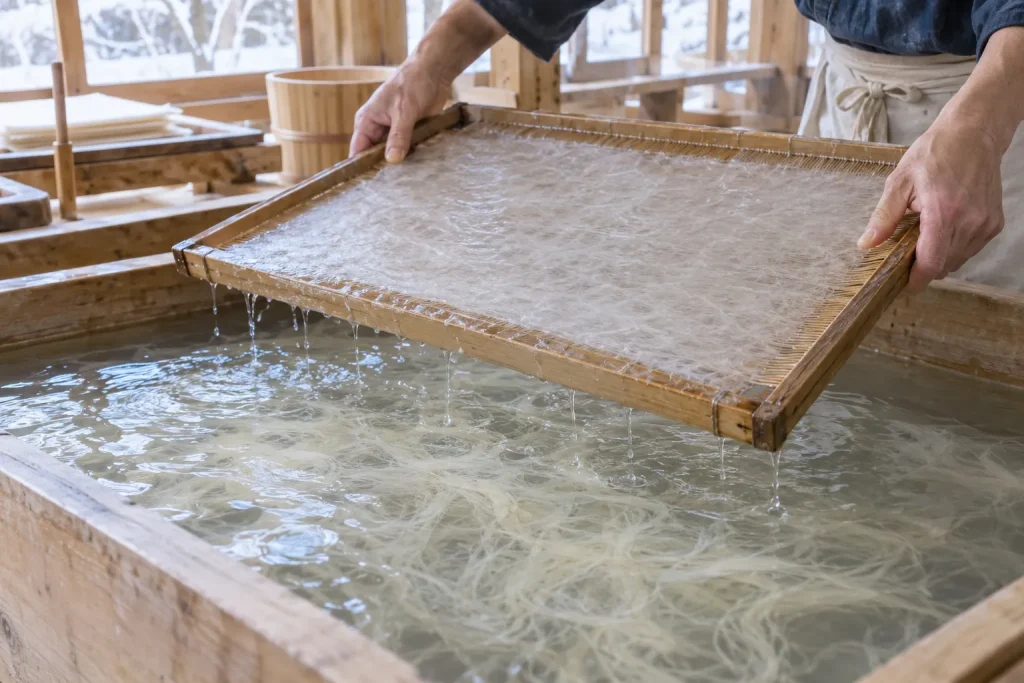
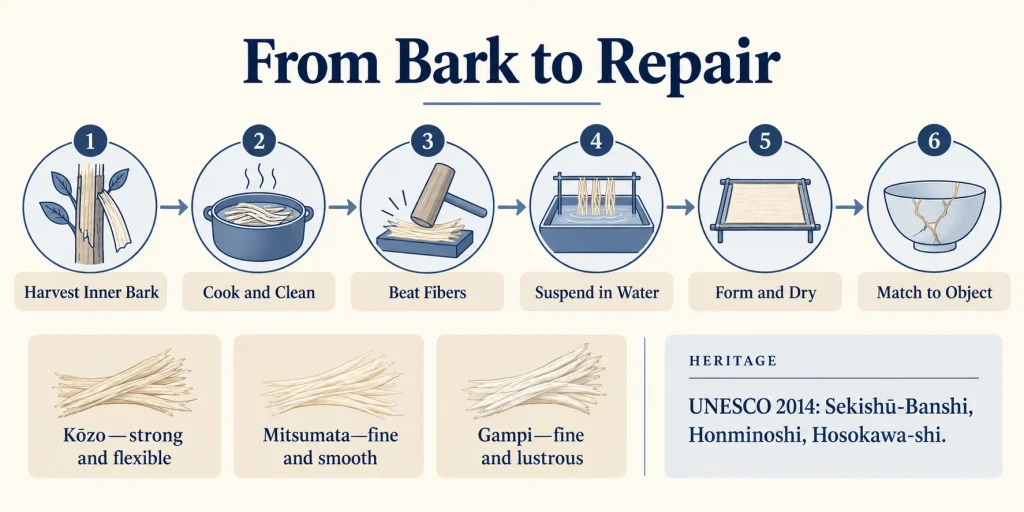
Harvested bark does not become durable paper merely by soaking it. The outer bark and damaged areas must be removed, the inner fiber cooked, and remaining knots or dark particles picked out. The cleaned material is beaten until the fiber bundles separate without being pulverized into excessively short fragments. Papermakers then disperse the fibers in water instead of pressing a ready-made mat into shape. Each stage affects what remains in the finished sheet.
Traditional sheet formation often uses 流し漉き, nagashi-zuki, literally “flowing scooping.” The papermaker moves a screen through a vat so that successive washes of fiber cross and reinforce the forming sheet. 粘り, neri, “viscosity” or “stickiness,” is supplied by a formation aid traditionally prepared from トロロアオイ, tororo-aoi, the sunset hibiscus plant. It slows drainage and helps keep long fibers suspended instead of allowing them to sink or gather immediately. Cool working conditions help the plant mucilage remain effective, which is one reason traditional production is associated with colder months, but temperature is only one variable in a controlled process.
The material logic can be summarized without romantic language:
- Long bast fibers provide a large overlapping network.
- Cleaning removes bark fragments and other unwanted matter.
- Beating separates fibers while limiting destructive cutting.
- Water formation distributes the fibers through a thin sheet.
- Repeated screen movement creates multidirectional reinforcement.
- Controlled drying consolidates the finished structure.
That sequence explains why handmade Japanese paper can feel light yet resist tearing. It also explains why a cheap decorative sheet with a few visible fibers is not automatically equivalent to conservation-grade material. Appearance can imitate washi more easily than structure can. A machine-made sheet may still be excellent, while a badly processed handmade sheet may contain weaknesses. The manufacturing label should never replace examination.
Ancient sheets are evidence, not a warranty
The Shōsōin was built in the middle of the eighth century, and its holdings include manuscripts, records and other written materials connected with the imperial court and Tōdaiji. According to the Imperial Household Agency, the repository received a major donation from Empress Kōmyō on June 21, 756. The collection’s long survival provides physical evidence that paper made and used in that period can endure on a scale measured in centuries. It does not mean that every surviving document spent its entire history under unchanged conditions. Nor does it allow a modern seller to promise that any product labeled washi will last for a millennium.
The phrase thousand-year paper is therefore useful only as shorthand for demonstrated potential. Shōsōin survival reflects material quality together with restricted access, controlled custody and later professional storage. The Imperial Household Agency notes that the original wooden repository remained in use for nearly thirteen centuries, while the treasures were subsequently transferred into modern repositories constructed in 1953 and 1962. Material and storage worked together. Separating them creates better advertising than conservation science.
“Old paper proves that survival is possible; it does not tell you which modern sheet will survive under your conditions.”
A buyer should also distinguish an ancient document from an artificially aged product. Brown coloring, rough deckled edges and visible fibers can be deliberate design choices. They reveal little about acidity, sizing, residual chemicals or long-term stability. A genuine handmade origin does not automatically make a paper archival. For important work, request technical information rather than relying on an antique appearance.
Why conservators still buy it
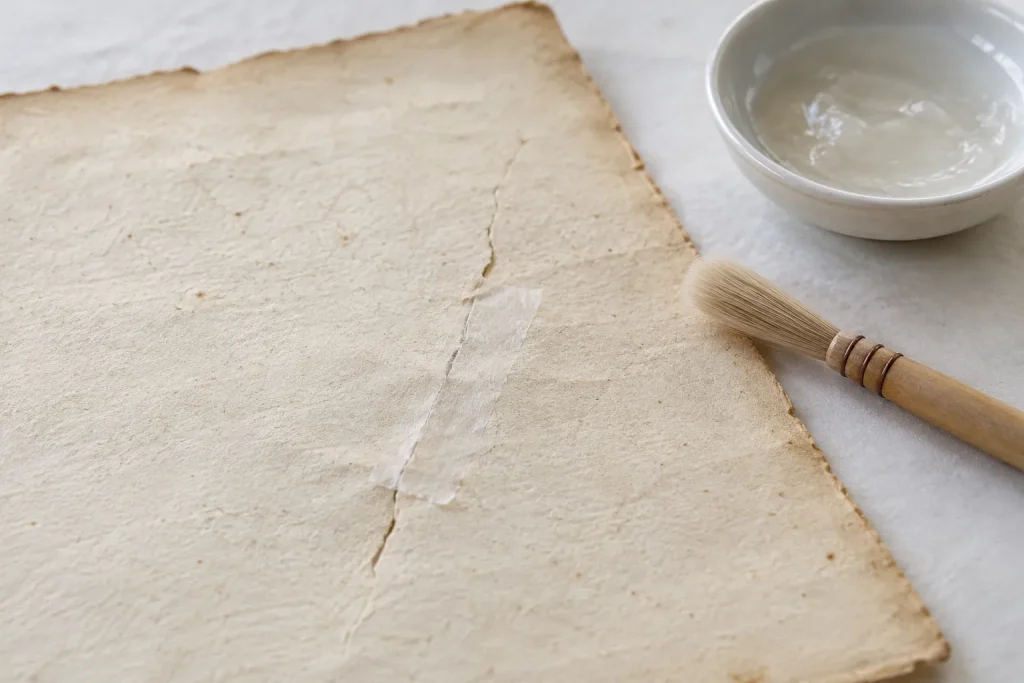
Museum and library repairs need material that can support a weakened object without overwhelming it. Thin kōzo paper is useful because long fibers can bridge a tear while adding little bulk. It can also be toned, shaped and applied with a conservation adhesive selected for the original object. Different weights let a conservator reinforce a translucent page, fill a loss or support a damaged fold. The repair paper is chosen as part of a treatment system, not as a universal patch.
The Metropolitan Museum of Art provides a concrete worked example. During treatment of a fifteenth-century herbal, its conservator first stabilized missing areas with 10.5 grams-per-square-meter Akaso Kōzo paper. A second paper, 40 grams per square meter Seikosen Mitsumata, was then used where the repair needed to match the original sheet’s thickness and color. The two papers performed different jobs on the same book. This is what washi paper restoration looks like in practice: matching strength, weight and appearance instead of assuming that one famous paper suits everything.
| Conservation need | Useful washi property | What must still be checked |
|---|---|---|
| Closing a tear | Strong fibers across a thin repair | Grain, adhesive, tear direction and reversibility |
| Supporting a weak area | Low weight with good tensile strength | Transparency, stiffness and added stress |
| Filling missing paper | Range of tones, surfaces and weights | Match with the original sheet |
| Reinforcing a fold | Flexible fiber network | Whether the fold must remain movable |
| Treating a translucent object | Very thin specialist papers are available | Optical change after adhesive is applied |
The uncomfortable part is that buying “museum-quality washi” does not make a home repair safe. Pressure-sensitive tape, craft glue and unknown paste can stain or distort an old document even when the patch itself is excellent. A valuable manuscript, print or family record should be assessed by a paper conservator. Washi provides options; it does not supply the treatment decision.
What UNESCO recognized in 2014
UNESCO’s 2014 inscription covers 和紙:日本の手漉和紙技術, washi: Nihon no tesuki washi gijutsu, “washi: Japanese hand papermaking techniques.” The three named traditions are 石州半紙, Sekishū-Banshi, “Sekishū half-paper”; 本美濃紙, Honminoshi, “true Mino paper”; and 細川紙, Hosokawa-shi, “Hosokawa paper.” Each is connected to a particular producing community and inherited body of skills. The protected element is living craftsmanship and its transmission. UNESCO status is not a blanket quality seal for retail paper throughout Japan.
| UNESCO-listed tradition | Production area identified in the nomination | Principal fiber | Status change |
|---|---|---|---|
| Sekishū-Banshi | Misumi area, Hamada, Shimane Prefecture | Kōzo | Earlier UNESCO element expanded into the joint inscription in 2014 |
| Honminoshi | Mino, Gifu Prefecture | Kōzo | Included in the joint inscription in 2014 |
| Hosokawa-shi | Ogawa and Higashi-Chichibu, Saitama Prefecture | Kōzo | Included in the joint inscription in 2014 |
The wording “three kinds of washi hold UNESCO status” is convenient but imprecise. UNESCO lists cultural practices rather than awarding protected status to every physical sheet carrying those names. A seller may stock authentic paper from one of the communities, comparable paper made elsewhere, or an industrial product that merely uses washi in its marketing. You need the producer, place, fiber and manufacturing method to know which claim is being made. The inscription’s year alone cannot authenticate merchandise.
What you are buying today
For ordinary writing, wrapping or folding, conservation specifications may be unnecessary. You may care more about texture, opacity, printability or how sharply the sheet holds a crease. Folds That Ended Up in Space and Surgery covers folding as a design system rather than treating every paper craft as the same tradition. Similarly, How a Square of Cloth Carries a Bottle is the relevant guide when reusable wrapping—not paper manufacture—is the real question. Material choice should follow the task.
Before paying a premium for authentic washi paper, check the product description for facts rather than mood. Look for a named fiber, a production location, handmade or machine-made status, sheet weight and any sizing or dye information. “Natural,” “traditional” and “Japanese-style” are not interchangeable specifications. If the sheet is intended for conservation, ask for permanence or aging data and confirm that the supplier serves conservation professionals. If it is intended for ink, printing or folding, request a sample because archival stability does not guarantee the surface behavior you want.
The site’s name converter provides 898 checked names in katakana if you need to place a foreign personal name on a paper label or gift enclosure. Use that tool for the spelling rather than asking a paper seller to improvise it. Katakana accuracy and paper authenticity are separate questions. A correct name can be printed on unsuitable paper, just as excellent washi can carry incorrect Japanese. Keeping the questions separate prevents one attractive detail from standing in for the rest.
What has not changed yet
The 2014 inscription did not freeze the craft at one moment. Raw-material cultivation, access to clean water, availability of skilled labor and transmission to younger papermakers remain practical constraints. Workshops may use different tools or combine hand processes with modern equipment while still producing useful paper. Conservation suppliers also sell Japanese tissues that are machine-made to consistent specifications. “Modern” does not automatically mean inferior, and “traditional” does not automatically mean suitable for a museum object.
No primary source checked on September 11, 2026 announced a scheduled replacement or expansion date for the UNESCO element. That absence should not be turned into a prediction that the listing will remain unchanged forever. UNESCO records can be updated, national designations can change and producers can alter their catalogs. Product specifications are even more changeable than heritage status. Recheck the official listing and the manufacturer’s current data before publication or purchase.
The details worth checking on the label
Remember four questions: Which fiber is present, where was the sheet made, how was it formed, and what job must it perform? Kōzo, mitsumata and gampi describe raw materials, not universal grades. Shōsōin documents demonstrate remarkable survival, but their condition reflects custody and storage as well as paper construction. Conservators choose Japanese paper because it offers a useful combination of long fibers, strength, thinness and workability—not because every sheet possesses supernatural permanence. This article should be rechecked before its scheduled publication on October 5, 2026 and whenever UNESCO, the Imperial Household Agency or cited conservation institutions revise the underlying records.