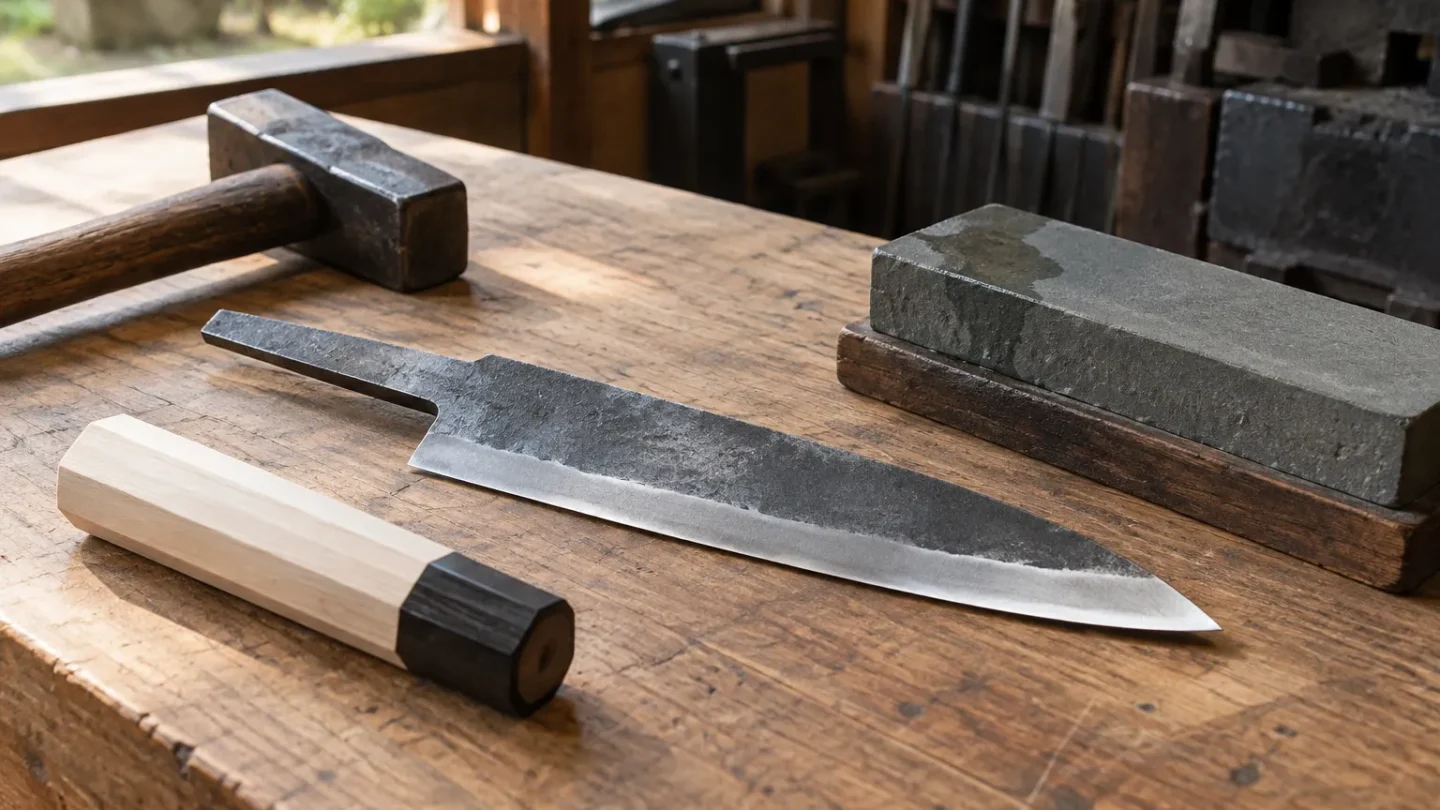
A Sakai blade follows a repeating production cycle, but it is not an hour-by-hour performance by one celebrated smith. How Japanese knives are made in Sakai is better understood as a relay: the forge produces the blade, a specialist sharpener establishes its cutting geometry, and another workshop completes the fitting and handle work. The stages may occur on different days, and work from several smiths can reach the same sharpener in batches. A visitor usually sees only one portion of that chain at a time. The finished knife carries the accumulated labor of separate businesses, which is one reason its maker attribution and price are not as simple as the name stamped on the blade.
The first working period begins at the forge
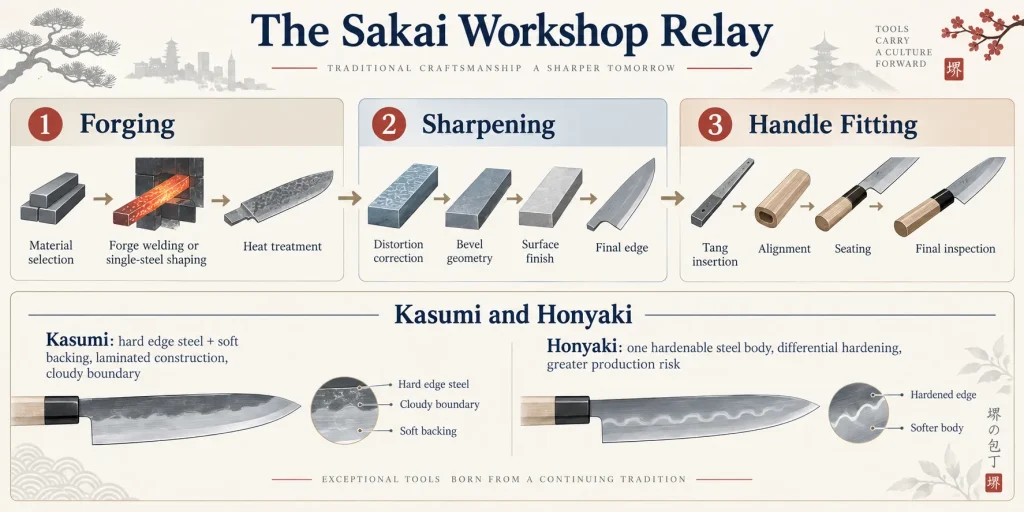
鍛冶 kaji, literally “smithing,” is the first major stage in the Sakai division of labor. The smith selects the steel construction, heats the material, forms the blade and completes the heat-treatment stages required by that construction. Official Sakai tourism information divides production broadly into forging, sharpening and handle attachment, with a specialist responsible for each part. The system is a production fact rather than a romantic story about one master doing everything alone. When you buy a finished knife, you are paying for coordination as well as manual skill.
A common traditional construction is 合わせ鍛え awase-gitae, literally “combined forging.” Hard edge steel is forge-welded to softer iron or another supporting material, producing a laminated blade. The harder steel supplies the cutting edge, while the softer layer makes the blade less difficult to manufacture and maintain than a comparable single-steel blade. After polishing, the boundary between the materials can remain visible as a cloudy surface transition. That appearance is associated with 霞 kasumi, literally “mist” or “haze.”
Kasumi is sometimes advertised as though the cloudy finish itself were a separate steel. It is not. In Sakai knife terminology, it commonly describes a laminated construction and its characteristic finish, although exact materials and finishing standards vary between producers. A shiny kasumi blade may still contain reactive carbon steel at the edge. You need the seller to identify the core steel and cladding instead of treating “kasumi” as a complete specification.
The wider question of which objects qualify as formally recognized crafts is explained in The Law, the Mark, and the Price Difference. That guide covers official designation and labeling, while this article stays with the production chain. “Traditional,” “handmade” and “made in Sakai” do not necessarily communicate the same legal or manufacturing claim. A retailer should be able to explain who forged and sharpened the blade when those identities are part of the price. If it cannot, the customer is being asked to pay for a story that cannot be checked.
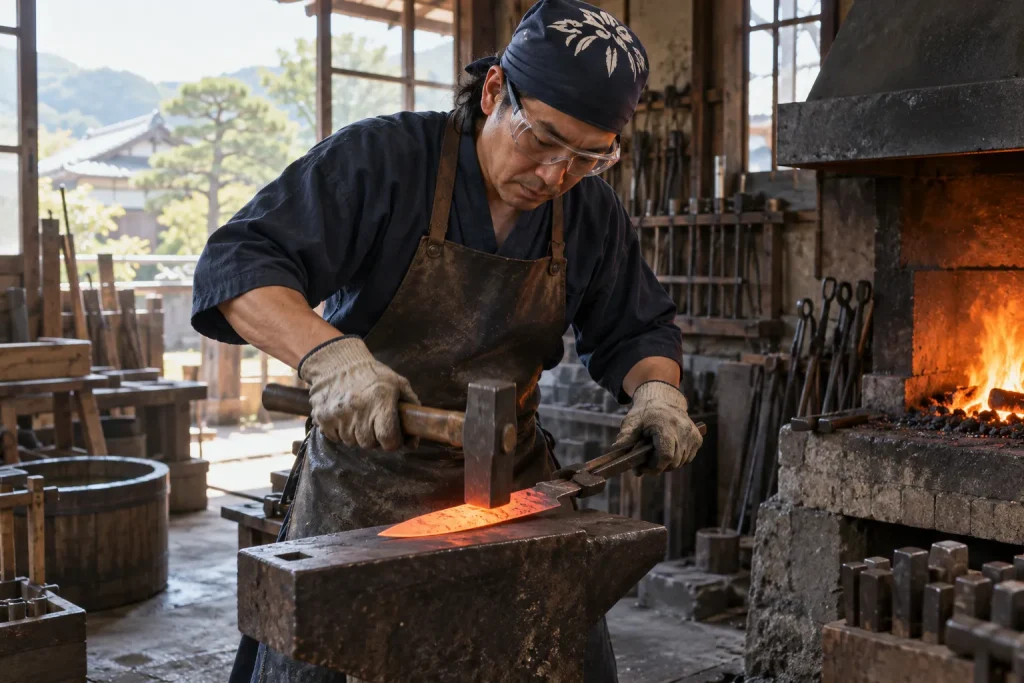
How Japanese knives are made before they leave the fire
The forge stage contains several operations rather than one dramatic round of hammering. For a laminated knife, the smith prepares the hard steel and softer backing, heats them, joins them and draws the material toward the intended profile. The blank is shaped with allowances for later grinding because the sharpener still has to establish the final geometry. Heat treatment then determines whether the steel reaches the intended hardness and structure. A visually impressive forging demonstration shows only part of that work.
An approximate production sequence is:
- The smith selects the edge steel and supporting material.
- The materials are prepared and joined for laminated construction.
- The heated blank is forged toward the required profile.
- The surface and outline are adjusted before heat treatment.
- The blade is hardened and tempered according to the steel and maker’s process.
- The unfinished blade moves to the sharpening workshop.
- The cutting geometry, finish, markings and handle are completed through later specialists.
These are stages, not a promise that one blade moves through the entire chain in a single day. Cooling, batch production, inspection and transport between businesses interrupt the sequence. Individual workshops also protect technical details developed through experience, so public demonstrations do not disclose every temperature or timing decision. If a retailer presents an exact universal recipe for every Sakai blade, that recipe is too neat. Sakai knife making is standardized enough to have recognizable stages but varied enough that steel, workshop and product line still matter.
| Production period | Specialist | Work performed | What a visitor may notice |
|---|---|---|---|
| Initial stage | Smith | Material preparation, forge welding, shaping | Heat, hammering and an unfinished thick blank |
| Heat-treatment stage | Smith | Hardening, tempering and distortion control | Less spectacle and more controlled handling |
| Geometry stage | Sharpener | Grinding, correcting, bevel creation | Water-cooled wheels, stones and repeated inspection |
| Finishing stage | Sharpener or finisher | Surface finish, edge refinement and markings | Kasumi haze, polished areas and engraved information |
| Assembly stage | Handle fitter or wholesaler | Handle installation and final inspection | Blade alignment, fit and a completed kitchen tool |
Honyaki takes a different route through the same system
本焼 honyaki, literally “true-fired,” refers to a blade forged from a single piece of hardenable steel rather than a hard edge layer joined to soft iron. The smith selectively hardens the blade so that the edge and spine do not behave identically. This makes heat control, straightening and later sharpening more demanding. Failed hardening can leave a blade cracked, badly warped or unsuitable for sale. That lost work is part of the economics even though the failed pieces never appear in a store.
Honyaki is often compared with a traditionally differentially hardened sword, but the comparison can become marketing shorthand. A kitchen knife remains a kitchen tool with a geometry chosen for food preparation. Its value does not come from a supernatural property or from looking like a sword in a display case. The relevant production facts are single-steel construction, demanding heat treatment, greater risk of failure and specialist finishing. Those factors help explain the higher price of a honyaki knife.
Kasumi and honyaki therefore leave the forge with different structures:
| Feature | Kasumi construction | Honyaki construction |
|---|---|---|
| Japanese term | 霞 kasumi, “mist” | 本焼 honyaki, “true-fired” |
| Blade structure | Hard edge steel joined to softer backing | Single piece of hardenable steel |
| Visible feature | Cloudy transition between materials | Hardened pattern may appear after finishing |
| Manufacturing difficulty | Lower than comparable honyaki work, but still skilled | More demanding heat treatment and straightening |
| Common ownership issue | Core and cladding may require different care | Reactive steel and thin geometry can be unforgiving |
| Price implication | Labor from multiple workshops | Multiple workshops plus higher forge risk and finishing demands |
The uncomfortable part is that a higher price does not automatically give you a better knife for your kitchen. Honyaki can be harder to sharpen, more reactive and less tolerant of careless lateral force. A professional cook who understands a specialized single-bevel blade may value what it offers. A home cook who leaves it wet beside the sink may mainly purchase extra maintenance. Kasumi vs honyaki is a construction choice, not a ranking from ordinary to magical.
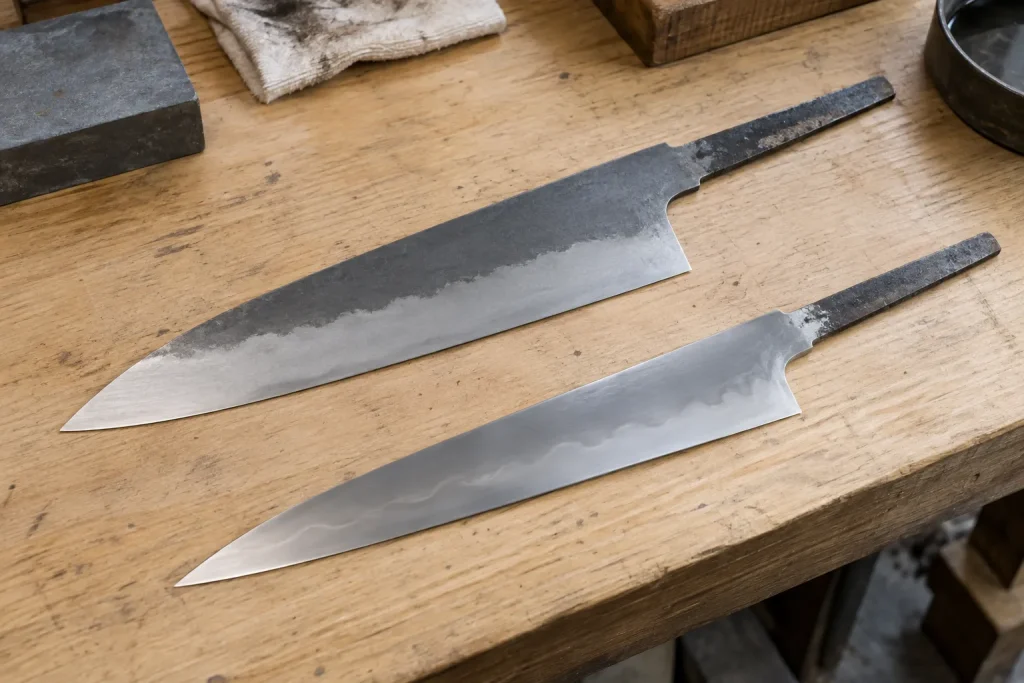
The second workshop decides how the blade cuts
刃付け hatsuke, literally “attaching the edge,” refers to the sharpening and geometry work that turns a heat-treated blank into a functional knife. The sharpener corrects warping, grinds the faces, establishes the bevel and refines the edge. On a traditional single-bevel knife, this work includes the relationship between the front bevel and the concave back. A blade can come from an excellent smith and still perform poorly if its geometry is badly executed. The sharpener is not merely polishing someone else’s achievement.
This stage also explains why two knives forged from similar steel may feel different on a cutting board. Thickness behind the edge, bevel consistency, blade straightness and surface finish affect the way the knife enters and releases food. Steel labels cannot describe those properties by themselves. Online comparisons often concentrate on alloy names because they are easy to place in a chart. The person grinding the blade may have at least as much influence on its immediate cutting character.
Grinding removes material that the smith deliberately left for the next specialist. Water and abrasive wheels control the cut and limit unwanted heat, while stones refine the surface and edge. The precise sequence varies by workshop, knife style and finish. There is no universal number of stones or passes that proves quality. What matters is whether the finished geometry suits the blade’s purpose and remains consistent along its length.
The cloudy kasumi surface is developed during this finishing work rather than emerging fully formed from the forge. The harder steel and softer layer respond differently to abrasives, allowing the boundary to remain legible. On honyaki, polishing may reveal the transition created by differential hardening. Both finishes require controlled abrasion, but they are evidence of different underlying constructions. A cloudy finish applied to a laminated blade should not be confused with a honyaki hardening line.
The third workshop turns steel into a kitchen tool
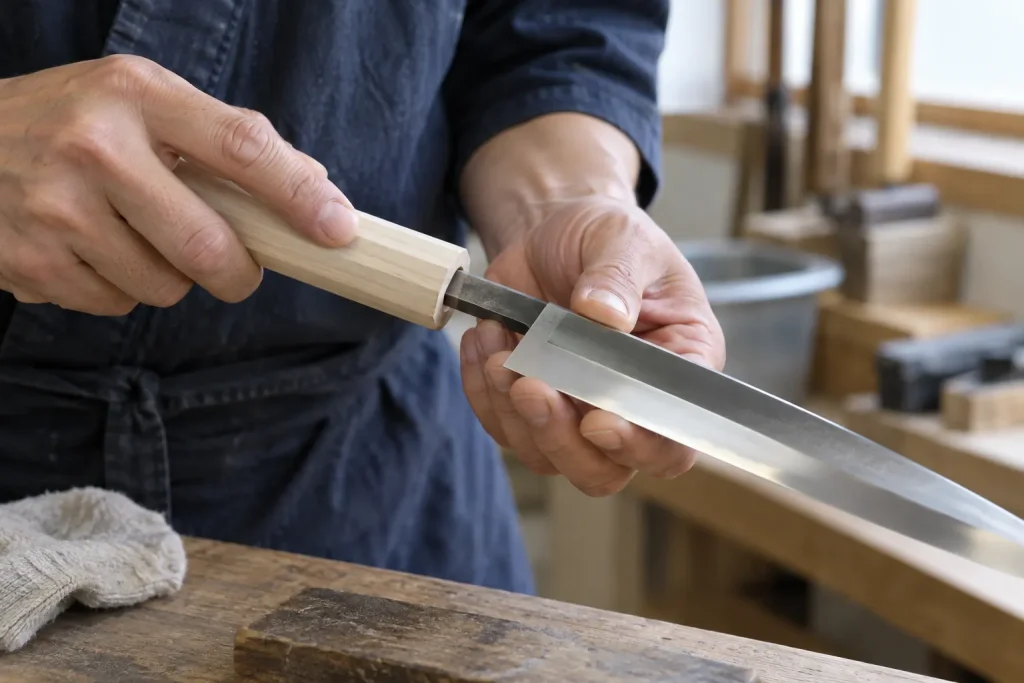
柄付け e-tsuke, literally “handle attachment,” is the stage at which the finished blade receives its handle. Traditional Japanese handles may be replaced later, which makes the fit important but not necessarily permanent for the life of the blade. The tang enters the handle, and the installer checks orientation, alignment and seating. A decorative wood does not correct a crooked blade or poor cutting geometry. Handle price, balance and water resistance should be considered separately from steel quality.
The word workshop can become misleading here because final assembly and inspection may be handled by a manufacturer, wholesaler or finishing business rather than an independent handle-only artisan. Official descriptions confirm handle attachment as a distinct major stage, but commercial arrangements differ. Some companies coordinate named smiths and sharpeners under one brand, while others keep those identities less visible. The logo on the blade may therefore name the seller or product line rather than every artisan involved. Ask who performed which stage if maker attribution influences your purchase.
An engraving request adds another distinction. Your name in katakana is not the same thing as the smith’s mark, a brand engraving or a formal craft label. If you want a personal inscription, the Japanese name converter provides checked katakana pages for 898 names, but the workshop should confirm character limits and engraving direction. The tool does not authenticate the knife or identify its makers. Personalization can also complicate returns, so verify the knife before adding it.
Spring brings the clearest public window
Production continues through the year, but ordinary workshops are workplaces rather than attractions with a universal visitor schedule. The clearest confirmed public event in 2026 was the Sakai Knife Festival, held on April 11 and April 12 at the Sakai City Industrial Promotion Center. Sakai City listed public hours from 10:00 a.m. to 4:00 p.m. on both days. The program included knife-related demonstrations, sales and services that brought several parts of the local industry into one accessible venue. For a visitor, that concentration is more reliable than arriving at an unannounced forge.
The festival date is movable because organizers publish it for each edition rather than tying it to a national holiday or a permanent statutory rule. As of the research check on September 13, 2026, an official 2027 date had not been published. It would therefore be inaccurate to convert the 2026 weekend into a guaranteed 2027 date. If you are planning for 2027, check Sakai City and the industry association after the new event notice appears. Hotel or flight decisions should not rest on an unofficial calendar prediction.
| Public period | Confirmed date | Status | What to plan around |
|---|---|---|---|
| Sakai Knife Festival 2026 | April 11–12, 2026 | Confirmed by Sakai City | Demonstrations, industry access and knife-related services |
| Regular museum period | Year-round, subject to published closures | Check current museum calendar | Exhibits and retail without assuming forge access |
| Sakai Knife Festival 2027 | Not announced at the checking date | Unconfirmed | Wait for an official event notice |
| Ordinary workshop weeks | No shared public calendar | Varies by business | Arrange visits directly and in advance |
Summer and fall are working periods, not festival seasons
During summer and early fall, knife production does not enter a special ceremonial phase. Smiths, sharpeners and finishers continue commercial work according to orders, capacity and workshop conditions. A visitor should not expect every workshop to accept drop-ins or provide an English-language explanation. Heat, machinery, abrasives and sharp objects also make a working shop unsuitable for casual unsupervised access. Arrange any visit through a published program, museum, retailer or tourism organization.
This is one of the quiet stretches the calendar brief needs to state plainly. No annual production milestone transforms the blade in July, August or September. The same forge-to-sharpener-to-handle chain continues without a public countdown. Retail shelves may change with stock and tourism demand, but that is not a craft rule. If your purpose is buying rather than watching production, availability of the correct blade type matters more than the season.
Sakai’s division of labor is easier to understand beside other Japanese crafts that organize skill differently. How a Square of Cloth Carries a Bottle follows a reusable textile whose function depends on wrapping technique rather than a metalworking supply chain. Folds That Ended Up in Space and Surgery shows how a folding principle can travel beyond decorative paper. Those comparisons are useful because “Japanese craft” is not one production model. Sakai’s defining fact is specialization across workshops.
Winter is useful for research, not guaranteed access
Late fall and winter do not create a separate knife-making method. Public facilities may publish year-end closures, and individual workshops can follow their own order schedules. Exact closure dates must be checked for the year of travel because they are not interchangeable across the museum, association, retailers and private workshops. This is another quiet period rather than a missing festival that needs to be filled with speculation. The production chain itself remains the same.
Winter can still be useful if your aim is to compare construction, steel and intended kitchen use without building a trip around a large event. At a museum or specialist retailer, you can inspect the visual boundary of a laminated blade and compare it with the finish on a honyaki knife. You can also ask who forged, sharpened and assembled the product. That conversation is more informative than counting decorative marks. Sakai kitchen knives should be evaluated as tools produced by a network, not as souvenirs carrying a single heroic signature.
When a trip to Sakai makes sense
The spring knife festival is the strongest period to plan around when you want several parts of the trade gathered in one public setting. A separately confirmed workshop or sharpening experience is worthwhile at any time of year because it gives you access that an ordinary drop-in visit does not. A quiet museum day is the better choice when your priority is comparing blade structures and asking purchasing questions without festival crowds. These are three different trips, even though all involve knives.
The period to avoid is an unconfirmed holiday week or an ordinary weekday for which you have assumed private workshop access. A forge visible on a map is not automatically a visitor facility. The production system works precisely because specialists concentrate on their part of the chain, not because they stop whenever someone arrives with a camera. Confirm the location, opening status and permitted activity directly. For 2027, wait for the official festival announcement rather than copying the previous year’s dates.
A Sakai knife’s price begins to make sense once the blade is followed through the entire relay. The forge establishes the material and heat treatment; the sharpener establishes the geometry and much of the visible finish; the final workshop fits the handle and prepares the knife for sale. Laminated kasumi construction joins hard edge steel to softer support, while honyaki asks the smith to harden a single-steel blade with greater production risk. Neither label tells you whether the knife suits your kitchen. The useful purchase question is not “Which one is most traditional?” but “What was made, by whom, and what will it require from me?”