You are deciding whether to buy dense unglazed stoneware, bright porcelain, or a tea cup designed to change through use, and choosing by color alone can leave you with the wrong object for the job. The main japanese pottery styles are not interchangeable regional decorations placed on identical clay. Your choice turns on three factors: the body material, the way the surface is produced, and whether you want the vessel to remain visually stable. Geography matters because each production center developed around particular materials, firing methods, markets, and uses. The useful comparison is therefore not “Which region is best?” but “Which regional logic fits what I will do with the piece?”
Start with two basic terms. 陶器, tōki, literally “pottery vessel,” generally describes clay-bodied earthenware or stoneware, while 磁器, jiki, literally “porcelain vessel,” describes a harder, usually paler body made from porcelain stone and fired differently. Shops may use the wider word 焼き物, yakimono, literally “fired things,” for ceramics collectively. Regional names can identify a production area without guaranteeing one uniform appearance from every workshop. Before treating a label as official proof of origin or method, read The Law, the Mark, and the Price Difference, which explains Japan’s craft-designation system and what its marks actually establish.
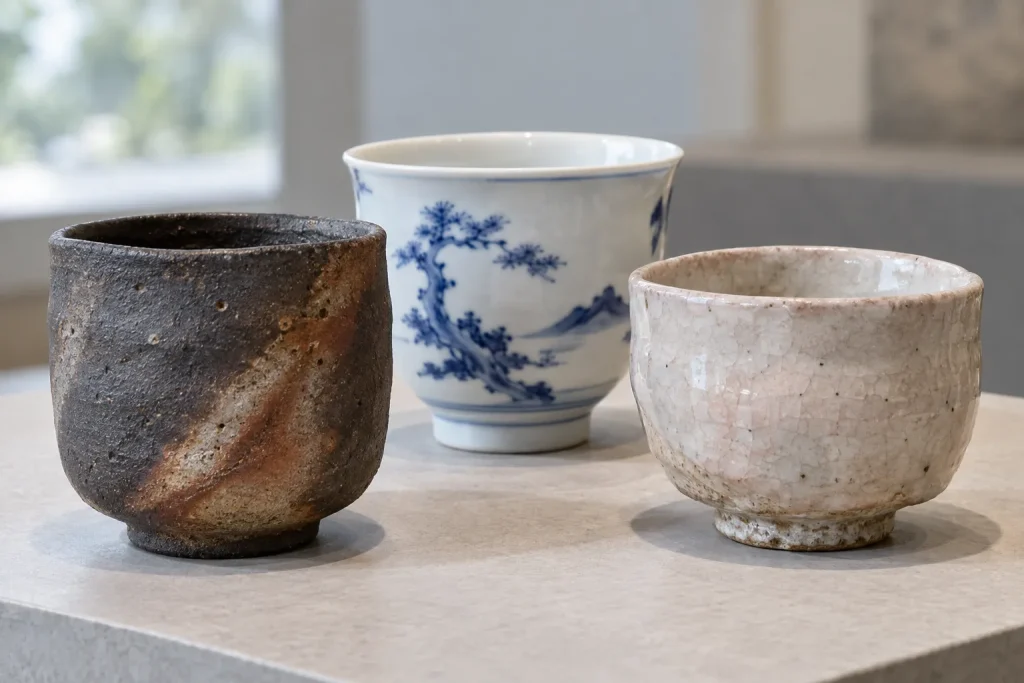
Choose the Six Ancient Kilns for clay, fire, and regional variation
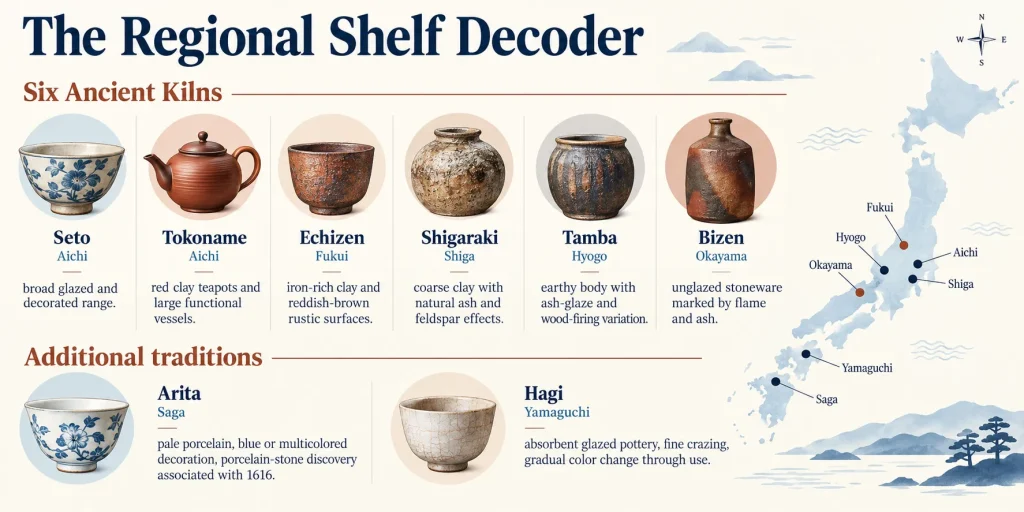
日本六古窯, Nihon Rokkoyō, literally “Japan’s Six Ancient Kilns,” names Seto, Tokoname, Echizen, Shigaraki, Tamba, and Bizen. Ceramics scholar Fujio Koyama grouped and named them around 1948, according to the Six Ancient Kilns Japan Heritage Utilization Council, and the group received Japan Heritage certification in 2017. The category concerns production centers that continued from the medieval period rather than six matching product lines. Buying from this group gets you long regional continuity, but it does not tell you whether an individual object is glazed, red, gray, rough, polished, decorative, or strictly functional. It suits you if you want clay and firing to remain visible and are willing to compare the six centers individually.
| Production center | Region | Useful shelf clue | What it gets you | Main tradeoff |
|---|---|---|---|---|
| Seto | Aichi | Broad range, including glazed and decorated ware | The widest stylistic choice among the ancient centers | The regional name alone may not identify one visual type |
| Tokoname | Aichi | Red clay teapots and large functional vessels | Practical forms and strong clay character | Red color is a clue, not proof of origin |
| Echizen | Fukui | Iron-rich clay, warm reddish-brown surfaces | Solid, restrained everyday stoneware | Subtle surfaces can look plain beside painted porcelain |
| Shigaraki | Shiga | Coarse body, natural ash and feldspar effects | Highly visible interaction among clay, ash, and flame | Pronounced texture may not suit every table setting |
| Tamba | Hyogo | Earthy body with ash-glaze and wood-firing variation | Functional shapes with individual kiln effects | Pieces from different workshops can vary substantially |
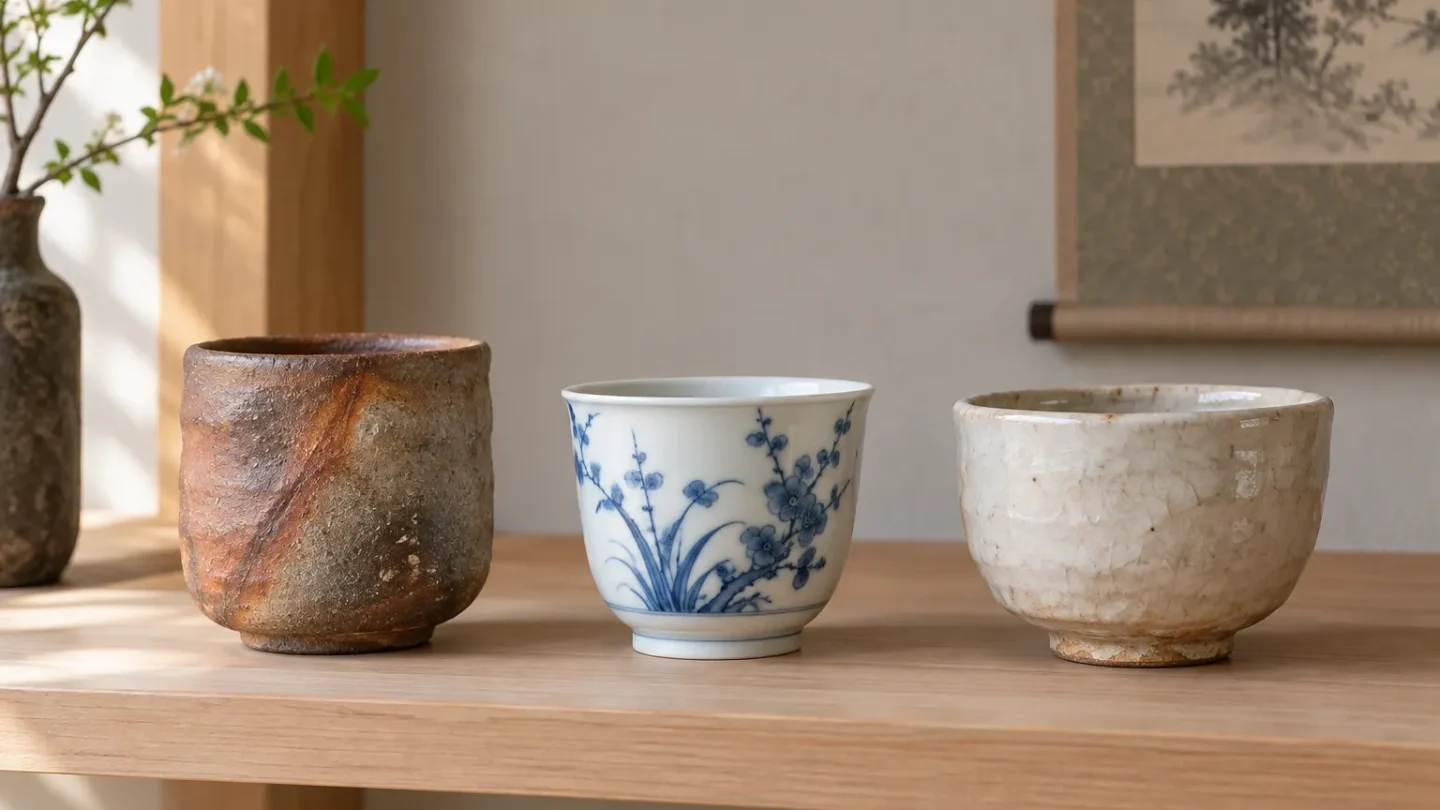
| Bizen | Okayama | Unglazed surface marked by flame and ash | Dense stoneware whose decoration comes from firing | No painted pattern or glassy glaze to hide surface variation |
| Arita | Saga | Pale porcelain, often painted blue or in multiple colors | Thin, hard tableware and detailed decoration | Generally less forgiving of impact than heavy stoneware |
| Hagi | Yamaguchi | Soft-toned glaze with fine crazing | Tea ware that develops visible signs of use | Absorbency demands prompt washing and thorough drying |
Seto is the least useful name if you expect one unmistakable look, because its history includes a particularly broad range of glazed production. Tokoname is easier to associate with red unglazed teapots, although the area also made large jars, pots, and later industrial ceramics. Echizen’s iron-rich local clay produces a warm, rustic body noted by its official producers’ association. Shigaraki is known for coarse clay and firing effects, while Tamba combines functional forms with ash and wood-kiln variation. These are families of production, so a visual clue should lead you to inspect a label rather than replace the label.
Bizen ware is the clearest choice when you want the kiln to provide the decoration. The body is traditionally left unglazed, and prolonged exposure to flame, fuel, ash, and placement inside the kiln can create reddish, brown, gray, and patterned surfaces. Two vessels with similar forms may emerge with visibly different markings even though neither was painted. You gain a surface produced through firing rather than an applied picture, but you must accept variation as part of the object. Bizen suits a buyer who prefers dense, restrained stoneware to the polished whiteness of porcelain.
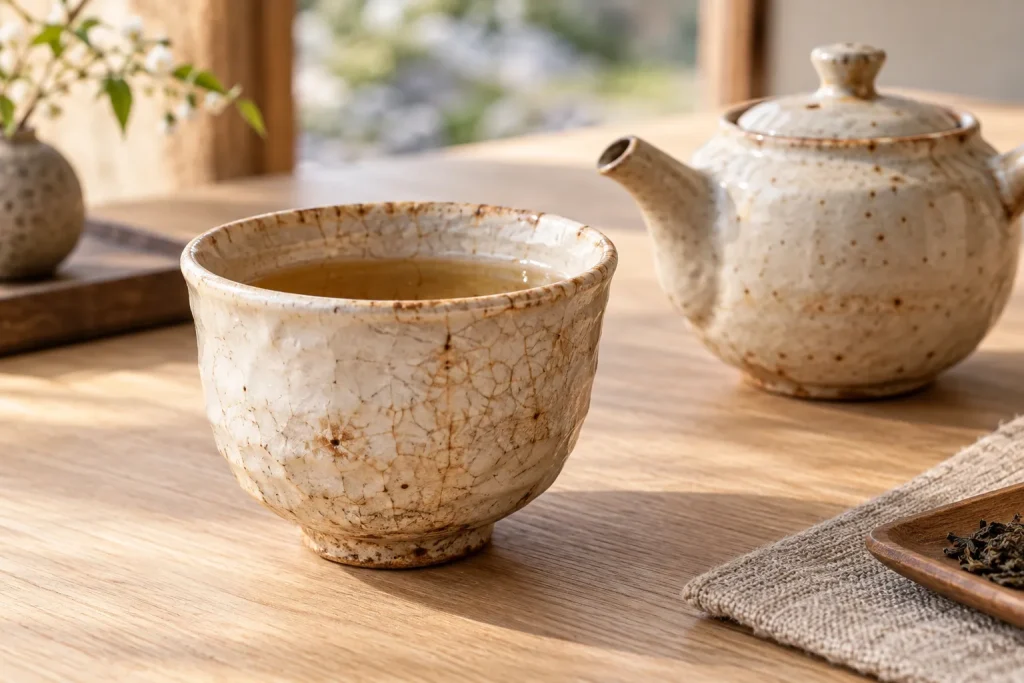
Choose Arita when you want porcelain rather than stoneware
Arita porcelain begins with a different material decision. Arita’s official history places the discovery of porcelain stone at Izumiyama in 1616 and associates it with the Korean potter Kanagae Sanbei, also known as Yi Sam-pyeong, and his associates. That discovery supported the development of Japanese porcelain production in the area. Arita ware later included blue decoration on pale bodies as well as increasingly elaborate colored and painted designs. It suits you if you want a hard, comparatively fine body, crisp decoration, and tableware that looks more formal than rustic unglazed stoneware.
The supplied angle calls the material “kaolin,” but the primary regional and national tourism sources checked for this article use “porcelain stone.” Those terms should not be substituted casually because Arita’s historical raw material was the stone quarried at Izumiyama, while kaolin is a particular clay mineral and ceramic raw material. The careful sentence is therefore that porcelain production followed the discovery of usable porcelain stone, not that a deposit officially identified simply as kaolin was found. Another complication is the name Imari: Arita-made porcelain was historically shipped through Imari, so older objects and trade histories may use Imari terminology. Place, port, production period, and decorative category all matter more than assuming that “Arita” and “Imari” describe two completely separate materials.
Choose Hagi when use should alter the surface
Hagi ware asks you to accept change rather than prevent every trace of it. Its characteristic glaze can develop 貫入, kannyū, literally “penetrating cracks,” the fine crazing formed as the glazed vessel cools. Government of Japan reporting published in March 2026 explains that Hagi’s comparatively absorbent body allows tea or alcohol to enter the crazing gradually, changing the color and appearance. The process is called 萩の七化け, Hagi no nana-bake, literally “the seven transformations of Hagi.” It suits someone who wants tea ware to record use, but it does not suit a buyer who expects the cup to remain visually identical to the day it left the shop.
The number seven is not a technical promise of seven measurable color stages. The Hagi Pottery Cooperative Association explains that it symbolizes the many ways the appearance develops over years of use. Tea does not repaint the vessel overnight, and every cup will not follow a standardized sequence. Fine crazing, absorbency, liquid, washing, drying, and frequency of use all affect what you eventually see. The uncomfortable part is that the same permeability admired as maturation also means the owner must wash the vessel promptly and dry it thoroughly.
Which japanese pottery styles fit the way you will use them?
The first threshold is material: choose porcelain when a pale, hard body and detailed decoration matter more than earthy texture. Choose stoneware when weight, clay color, kiln marks, and tactile variation are the point. The second threshold is surface behavior: Arita is the clearer choice if you want painted decoration to remain the visual focus, while Hagi makes sense if gradual change is desirable. The third threshold is breadth: choose one of the Six Ancient Kilns when you want to compare firing traditions rather than purchase a single supposedly representative “Japanese” style. None of these tests establishes quality, because region and quality are separate judgments.
Use this short inspection sequence before buying. It keeps the regional story connected to the physical vessel rather than to a sales card alone. You do not need specialist equipment, but you do need to look beyond the front-facing decoration. Ask the seller for the workshop and production location if the label gives only a broad style name. For expensive work, also ask what documentation accompanies the piece.
- Identify pottery or porcelain by examining the body, weight, translucency, and exposed foot.
- Check whether the surface is painted, deliberately glazed, naturally ash-marked, or unglazed.
- Look for crazing and ask whether continued color change is expected.
- Confirm the production area and workshop instead of inferring origin from color alone.
- Ask for washing, drying, microwave, dishwasher, and food-use instructions for that exact piece.
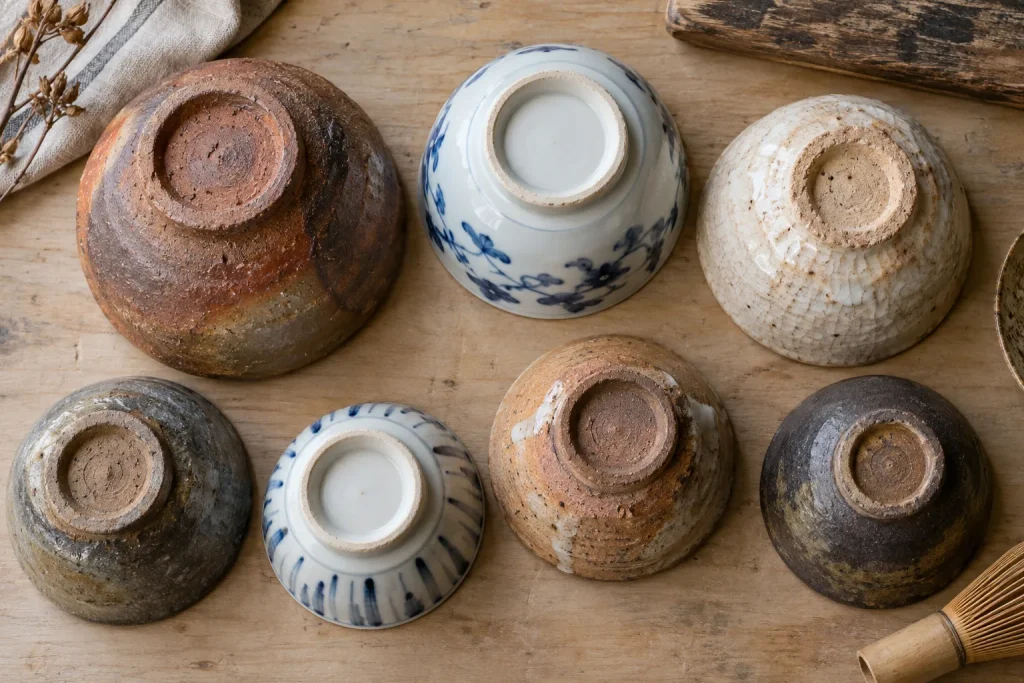
Three buying profiles, with the tradeoffs counted
A first-time visitor with nine days might plan three pottery stops, leaving a hypothetical average of three days per stop: nine divided by three equals three. Arita, Hagi, and Bizen form a coherent comparison because the traveler sees porcelain, absorbent glazed pottery, and unglazed stoneware rather than three minor variations of one surface. The arithmetic is an editorial itinerary example, not a transport recommendation, and actual travel time must be checked against the visitor’s route and current timetables. The benefit is contrast; the cost is distance, packing risk, and time taken from the rest of the trip. If the purpose is learning rather than collecting, three distinct materials teach more than hurried visits to every famous kiln name.
Someone staying in one city should not force a national pottery tour into a local schedule. If that traveler has room for two purchases, a practical division is one everyday vessel plus one piece chosen primarily for regional technique: two objects, two different jobs. A Tokyo, Kyoto, or Osaka department store and a reputable specialist gallery may represent several regions without the transport cost of visiting each production center. The tradeoff is that you lose the workshop landscape and direct kiln context. You gain time to compare foot rings, clay bodies, labels, care instructions, and prices on one shelf.
A tea drinker choosing one cup has the simplest calculation: one intended drink, one care routine, and one tolerance for change. Hagi wins if gradual staining and maturation are part of the appeal, while Arita wins if a pale porcelain surface and painted design matter more. Bizen becomes the alternative when the buyer wants unglazed fire marks and a denser visual weight. The decision should be made from the actual vessel’s instructions because modern makers work beyond historical stereotypes. Regional tradition narrows the shelf, but the individual piece closes the sale.
The labels buyers trust too quickly
The default mistake is reading every brown unglazed vessel as Bizen. Tokoname, Echizen, Shigaraki, Tamba, contemporary studio pottery, and nonregional production can all produce earthy surfaces. The reverse error is assuming every blue-and-white porcelain object is Arita, even though that visual language appears across multiple production centers. A regional name should be supported by the maker, seller, mark, box, or documentation. Color is an efficient first clue and poor final evidence.
Another mistake is treating “Six Ancient Kilns” as a ranking of Japan’s six best ceramic regions. It is a historical grouping named by a ceramics scholar and later recognized as Japan Heritage, not a consumer league table. Arita and Hagi are absent because the category is not intended to contain every important tradition. Likewise, the phrase “seven transformations” does not give you a defect-free guarantee or a timetable for staining. These labels describe history and behavior; they do not replace inspection, care instructions, or provenance.
The final mistake is buying a fragile object before deciding how it will travel. If the seller supplies a box, keep the vessel immobilized inside it and place that package within protected luggage rather than relying on decorative wrapping alone. For a reusable carrying method after you arrive home, How a Square of Cloth Carries a Bottle explains the logic of cloth wrapping, while Folds That Ended Up in Space and Surgery covers paper folding rather than ceramic packaging. If a commission includes a recipient’s name, the site’s name converter with 898 checked names in katakana can supply a checked phonetic starting point, but the potter must confirm what can actually be inscribed. A transliteration tool does not authenticate a maker’s mark or regional origin.
The shortest rule at the shelf
If you want visible clay and fire, compare the Six Ancient Kilns; if you want pale decorated porcelain, begin with Arita. If you want the cup to record years of tea through its glaze, choose Hagi and follow the maker’s care instructions. Otherwise, buy the individual object rather than the regional story. Check the body, surface, workshop, documentation, and intended use before relying on any label. Regional names are maps into Japanese ceramics, not substitutes for examining what is in your hand.