How a Square of Cloth Carries a Bottle: How to Use Furoshiki
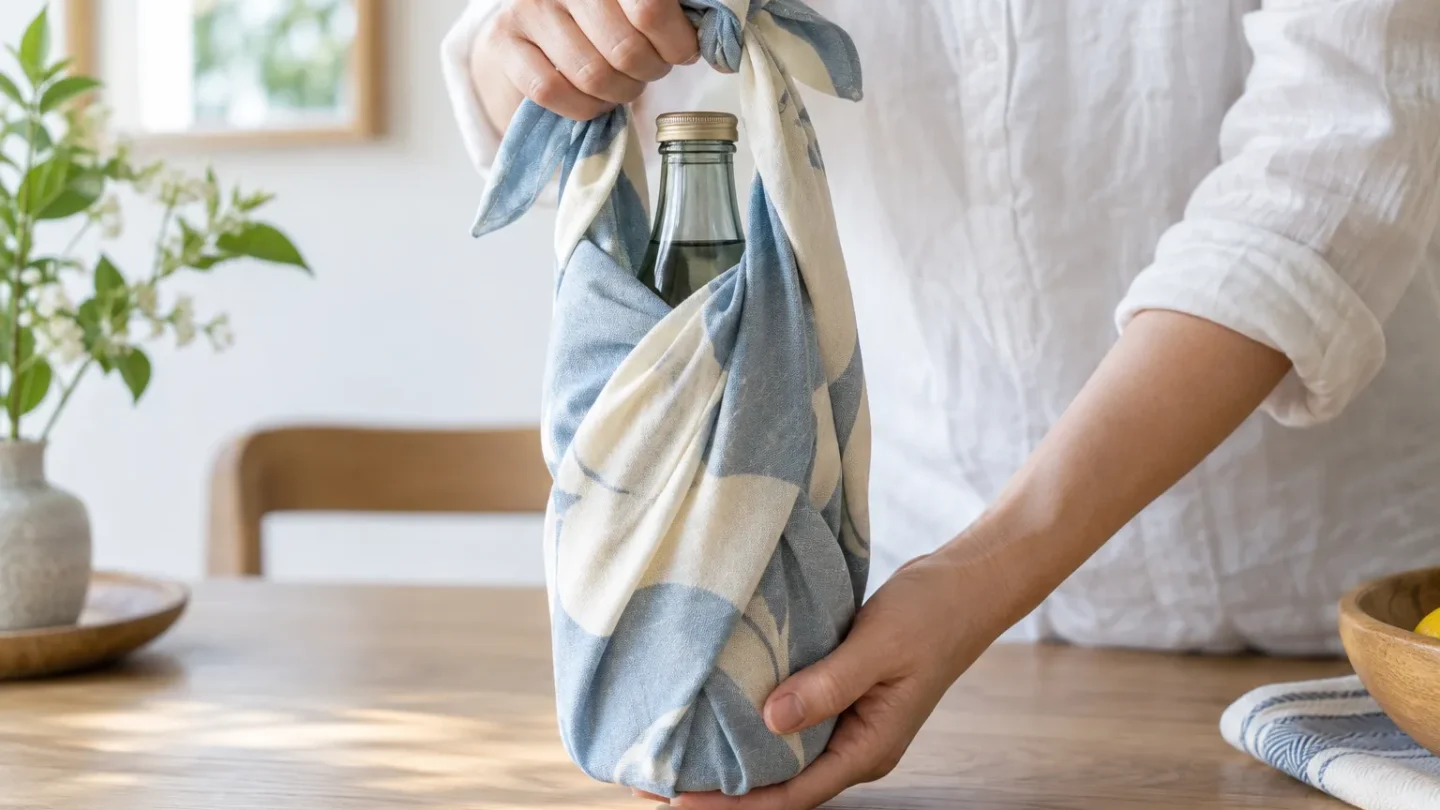
You are standing at a counter with a bottle, a square of cloth, and the growing suspicion that someone expects you to know what happens next. Learning how to use furoshiki does not require an elaborate folding repertoire. It requires the correct cloth size, two reliable knots, and an understanding of which corners must meet.
風呂敷 furoshiki, literally “bath spread,” is a square or nearly square cloth used to wrap, protect, present, and carry objects. The practical range for ordinary jobs runs from approximately 45 centimeters to 105 centimeters, or about 18 to 41 inches along each edge. A small cloth handles a book or compact gift; a medium one covers a lunch box or bottle; a larger one becomes a shopping bag.
This is a technique rather than a legally protected craft designation. If you are buying a costly cloth and want to understand why certification, production location, and workshop provenance change the price, The Law, the Mark, and the Price Difference separates recognized traditional crafts from products that merely borrow a traditional appearance.
How to use furoshiki in eight controlled steps
The sequence below begins before the first knot. That matters because most failed wraps are already too small, badly aligned, or made from the wrong fabric before anyone starts tying. The worked example uses one upright bottle, but the same preparation applies to boxes and rounded groceries.
- Measure the object before choosing the clothMeasure the object’s longest useful dimension, including the height that the fabric must climb. The cloth needs enough diagonal reach for opposite corners to meet above or around the object with material left for a knot. A 45-centimeter cloth is approximately 17.7 inches square, while a 105-centimeter cloth is approximately 41.3 inches square. If the corners barely touch, the cloth is too small for a secure carrying wrap even if it technically covers the object.
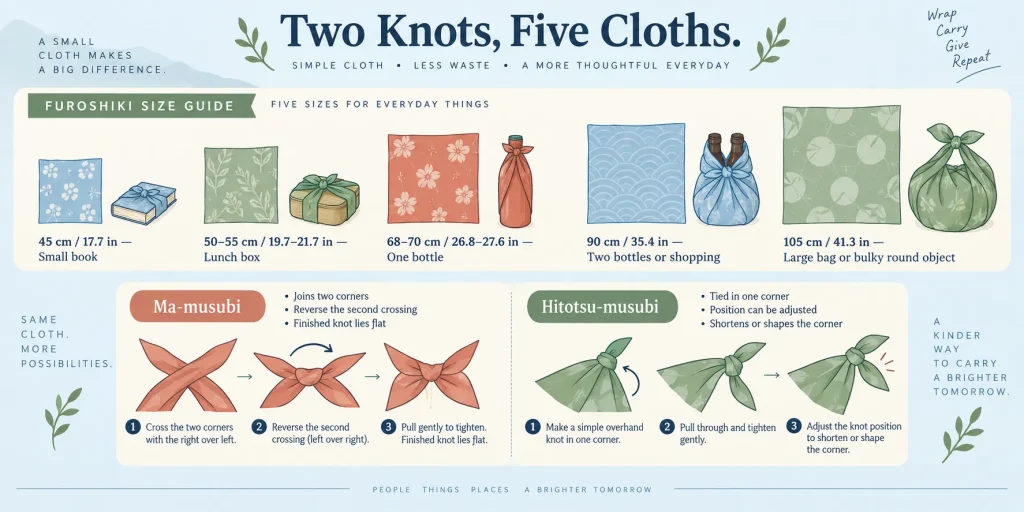
- Match the size to the jobUse approximately 45 centimeters for a paperback, small box, or compact personal item. A cloth around 50–55 centimeters works well for a lunch box or similarly sized container. Approximately 68–70 centimeters is the versatile middle size for a gift box, one bottle, or a small carrying bag. A 90-centimeter cloth can handle two bottles, several books, or a broader shopping load, while approximately 105 centimeters gives you enough fabric for a practical shoulder or market bag.
| Cloth edge | Approximate inches | Suitable jobs | Main limitation |
|---|---|---|---|
| 45 cm | 17.7 in | Paperback, small box, compact gift | Too short for most carrying handles |
| 50–55 cm | 19.7–21.7 in | Lunch box, medium gift box | Limited capacity for tall objects |
| 68–70 cm | 26.8–27.6 in | One bottle, general gift wrapping, small bag | May be tight around bulky shopping |
| 90 cm | 35.4 in | Two bottles, books, shopping bundle | More fabric than a small gift needs |
| 105 cm | 41.3 in | Large bag, shoulder carry, bulky round object | Knot can become heavy in thick fabric |
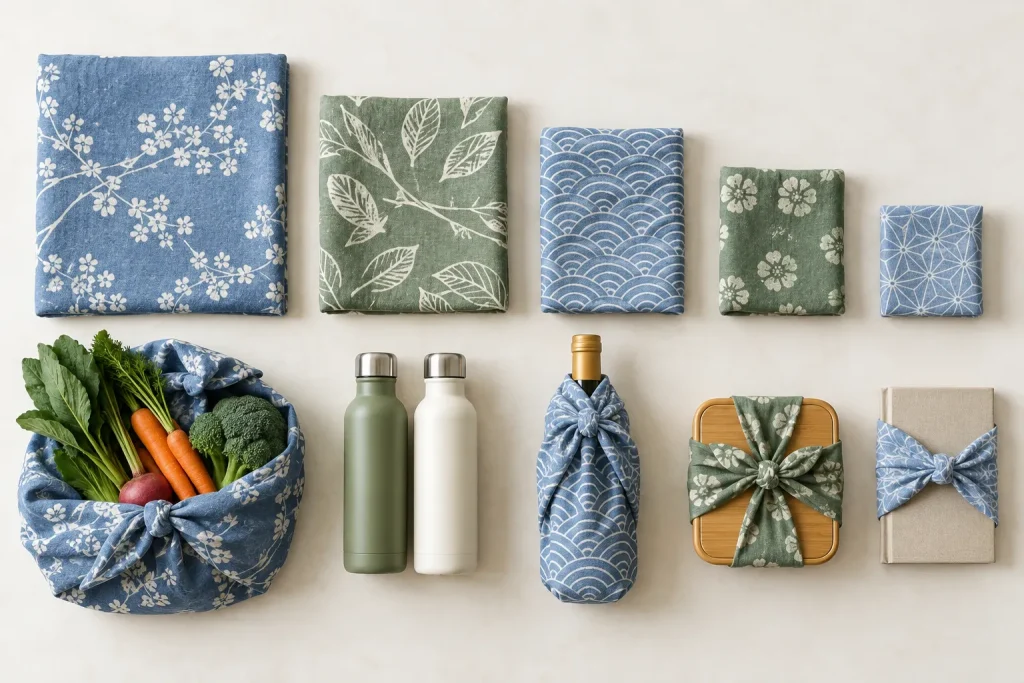
These are job ranges, not a compulsory Japanese standard. Object shape, fabric stretch, seam construction, and the amount of material needed for handles can move the useful size up or down.
- Put the visible side underneathSpread the cloth diagonally so that it looks like a diamond rather than a square from your position. If the fabric has a clear front and back, place the decorative face downward. Set the object in the center and check that the design will appear where you want it after the corners rise. A directional print can finish upside down even when the wrap itself is structurally correct.
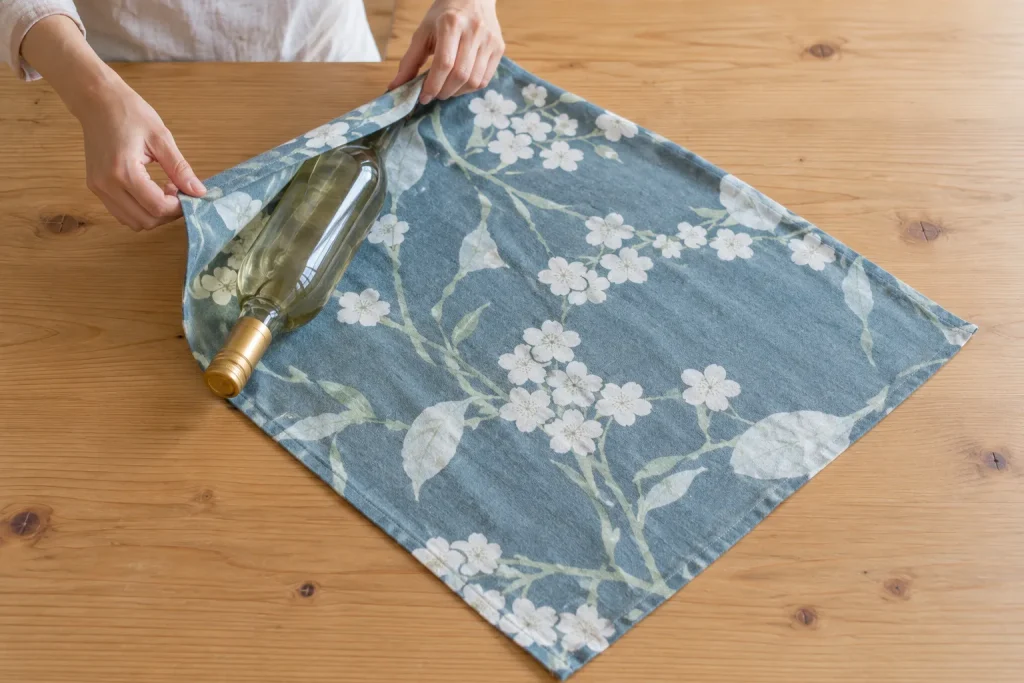
- Stabilize the object before tyingPlace a box with its edges reasonably aligned to the cloth. For one bottle, lay it near one corner, roll it toward the opposite corner, then stand it upright. For a watermelon or another round object, keep the item centered and gather the corners without lifting until you know the load is balanced. Smooth glass needs closer fabric contact than a cardboard box because loose material allows the bottle to slide.
- Make the first secure crossingBring the relevant corners around the object and cross them once. Pull horizontally rather than upward so the fabric closes around the load. The cloth should feel fitted but not distorted. Thin silk-like material may need gentler tension, while cotton generally tolerates a firmer pull.
- Tie 真結び ma-musubi, the “true knot”Cross the left end over the right and pass it underneath. Then cross the end now on the right over the other end and pull both ends horizontally. A correct ma-musubi knot lies flat, with both loose ends emerging in the same line as the knot. This is structurally the same family of knot commonly called a square or reef knot in English.A granny knot looks deceptively similar but twists, points the ends in an awkward direction, and may jam or loosen under uneven force. If the knot rises vertically instead of sitting like a flat belt across the cloth, undo it and reverse the second crossing.
- Use 一つ結び hitotsu-musubi, the “single knot,” to control a cornerForm a loop in one cloth corner, take the end around the standing section, and pass it through the loop. Tighten the knot at the position where you need the fabric shortened or gathered. The hitotsu-musubi knot does not usually join two separate corners; it shapes one corner into a stopper, handle end, or adjustable section.Move the knot closer to the object when the wrap feels loose. Move it toward the tip when you need more usable fabric below it. This positional control is especially helpful when forming bag handles or working with a cloth slightly larger than the object requires.
- Test the wrap before carrying itHold the completed handles close to the object and lift only an inch or two. Check that the bottle remains vertical, a box does not rotate, and a round object cannot roll through an opening. Retie anything that shifts before carrying it farther. For glass or a heavy load, support the bottom with your free hand rather than treating the cloth as certified load-bearing equipment.
Where the sequence usually breaks
Foreign visitors rarely stall because the technique is culturally inaccessible. They stall because the cloth is too small, the second crossing goes in the wrong direction, or an attractive fabric behaves badly under tension. Each problem has a visible warning sign.
The corners meet but leave no knotting length
A cloth can cover a box without being large enough to wrap it securely. You see the mistake when two opposite corners meet only at their tips. Pulling harder compresses the package or wrinkles the fabric, but it does not create useful length.
What to do instead: choose a larger furoshiki size and test the diagonal reach before wrapping.
The finished knot twists upward
The first half of the knot feels correct, so the second half is repeated in the same direction. That produces a granny knot. It may tighten into an untidy lump, and its tails often sit at right angles to the cloth instead of forming a flat line.
What to do instead: retie the furoshiki square knot with the second crossing reversed.
The bottle moves inside the cloth
A bottle wrap fails when the fabric is decorative but too slick, or when the bottle was not rolled tightly enough before it was stood upright. The exterior may look polished while the glass shifts inside. That movement becomes more dangerous as soon as the package is lifted.
What to do instead: tighten the Japanese bottle wrapping around the body and support the base while carrying glass.
The handle looks correct but feels uncomfortable
Large knots made from thick cloth can press into your hand. A 105-centimeter fabric may provide excellent capacity but create an unnecessarily heavy knot around a small lunch box. More fabric is not always more practical.
What to do instead: match reusable cloth wrapping to both the object’s dimensions and the fabric’s thickness.
What changes with the object and occasion
A square box is the easiest formal presentation because its edges give the cloth a stable geometry. Center it, bring two opposite corners across the top, then use the remaining pair to make a flat ma-musubi. Keep the visible panel smooth and place the final knot deliberately rather than letting it drift toward one edge.
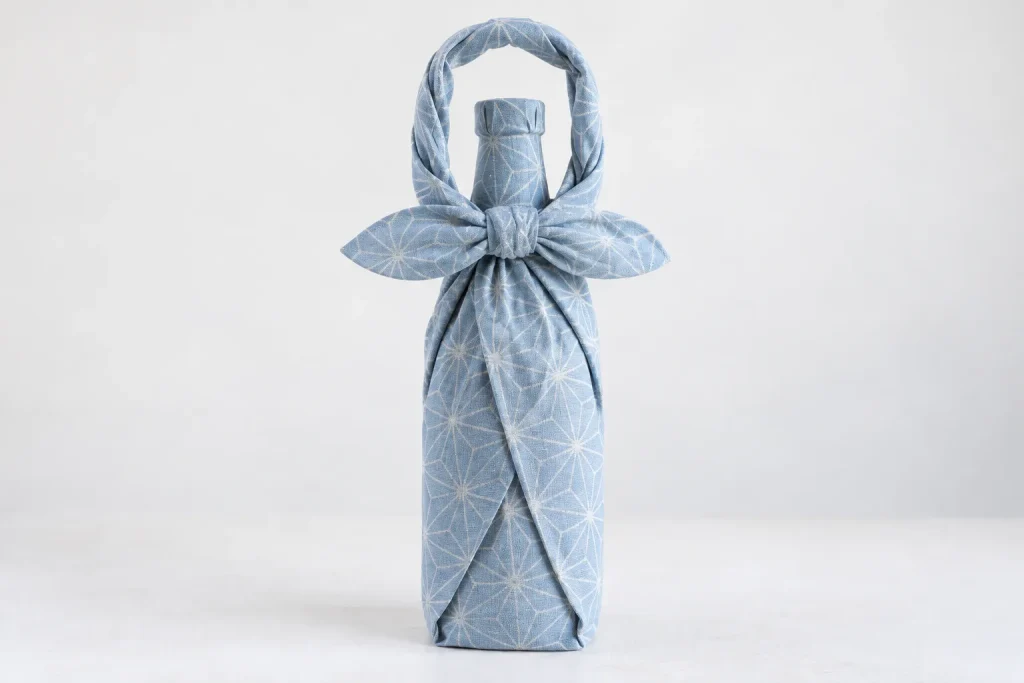
One bottle needs a medium cloth that can rise above the neck after the body has been rolled. Two bottles use a larger cloth and are normally separated by fabric before being raised together. The internal layer helps prevent glass-to-glass contact, but you should still support the base when the contents are valuable or heavy.
A watermelon represents the rounded-load problem rather than a fixed prescription for one fruit. Place the round object in the center of a large cloth, join corners securely, and test every opening close to the floor. A 90- or 105-centimeter cloth may be appropriate, but the actual circumference and weight decide whether the wrap works.
| Object form | Starting position | Knot function | Recommended range |
|---|---|---|---|
| Small rectangular box | Centered diagonally | Closes and decorates the top | 45–55 cm |
| Lunch box | Centered with even corner reach | Secures lid and creates grip | 50–70 cm |
| One bottle | Laid near one corner, then rolled | Holds body and forms handle | 68–70 cm |
| Two bottles | Positioned apart with cloth between | Separates glass and joins handles | About 90 cm |
| Round grocery | Centered before corners are gathered | Closes openings and creates handles | 90–105 cm |
| General shopping bag | Contents placed in formed fabric basin | Shapes sides and handles | 90–105 cm |
Material changes the result as much as size. Cotton is forgiving for practice because it grips itself and holds a flat knot. Polyester is light, washable, and often strong for repeated shopping use, but a very smooth finish needs careful tightening. Fine silk may suit formal presentation, yet it is an expensive material on which to learn a bottle wrap.
Season and formality affect pattern choice rather than the mechanics of a secure knot. A formal gift benefits from controlled alignment, clean fabric, and a design appropriate to the recipient. An ordinary grocery bundle does not need ceremonial precision. For questions about whether a textile is a recognized craft product or simply craft-inspired merchandise, The Law, the Mark, and the Price Difference explains what official labeling can and cannot prove.
The bag charge changed the practical question
Japan introduced mandatory charging for covered plastic shopping bags on July 1, 2020. The national system required retailers to charge for specified disposable plastic bags, although it did not establish one universal price that every store had to use. Exemptions applied to certain bags meeting defined environmental criteria, including qualifying biomass content, marine biodegradability, or sufficient thickness for repeated use.
“Charging for plastic shopping bags became mandatory nationwide.”
That policy did not legally require shoppers to carry furoshiki. It did, however, turn reusable carrying methods from an environmental suggestion into a recurring checkout decision. A folded cloth could now replace a bag for groceries, purchases, lunch containers, and spontaneous loads while occupying little space before use.
The uncomfortable part is that a nationwide revival cannot be proved merely from the start of the charge. The government documented the policy and promoted reusable alternatives, while retailers and makers presented furoshiki as one such option. That supports a renewed practical context, but not the stronger claim that the charge alone caused a measured national return to everyday furoshiki use.
The environmental connection also predates the 2020 rule. Japan’s Ministry of the Environment published its English “How to Use Furoshiki” guide in 2006, showing multiple ways to wrap and carry objects. The bag charge reinforced an existing reuse campaign rather than discovering the cloth fourteen years later.
What nobody minds
Nobody expects your first everyday wrap to look like department-store gift presentation. A slightly off-center pattern does not make a grocery bundle incorrect. Unequal tails are not a social offense if the knot is secure, and using a modern polyester cloth does not mean you have misunderstood the tradition.
People also do not inspect whether your cloth is a mathematically perfect square. Commercial furoshiki can vary slightly because of weaving, finishing, and seam construction. What matters is usable diagonal reach and a weave that handles the intended load.
You do not need to assign symbolic meaning to every printed motif before carrying lunch. Patterns can have seasonal, celebratory, or historical associations, but ordinary use remains ordinary use. If you personalize a cloth with a name and need a checked katakana form, the name converter with 898 checked names handles that job without turning a wrapping guide into a transliteration lesson.
No one minds if you unfold the cloth and start again. In fact, easy recovery is one of the format’s strengths: there is no adhesive tape to tear, no paper crease that permanently records the error, and no bag shape dictating what must fit inside.
Five checks before you lift
Use this final checklist after the wrap looks finished:
- Correct cloth size.
- Flat ma-musubi.
- Tight corners.
- Stable load.
- Support under glass.
Measure. Center. Cross. Reverse. Test.
Frequently asked questions
What size furoshiki should a beginner buy?
Approximately 68–70 centimeters, or about 27 inches, is the most versatile starting range. It can wrap many medium boxes, lunch containers, and individual bottles while remaining manageable for knot practice. A 45-centimeter cloth is easier to fold but too small for many carrying configurations.
Which knot is most important?
Start with ma-musubi, the flat square knot that joins two cloth corners securely. The second useful knot is hitotsu-musubi, which ties one corner to shorten it or create a stopper. Those two knots support a large share of everyday wraps.
Can a furoshiki safely carry a wine bottle?
It can secure and carry a bottle when the cloth is large enough, undamaged, and tied correctly. Test the wrap close to a table or floor and support the base with your other hand. Do not assume that decorative fabric has a certified weight capacity.
Is a 45-centimeter cloth large enough for a bottle?
Usually not for a conventional carrying handle around a standard bottle. It may cover a compact object or serve as decorative wrapping, but approximately 68–70 centimeters gives more useful reach for a one-bottle wrap. Always test against the actual bottle rather than relying only on its category.
Is furoshiki wrapping only for gifts?
No. It can carry lunch boxes, groceries, books, bottles, clothing, and other everyday objects. The same cloth can function as wrapping, a temporary bag, a protective layer, or a small surface after it is untied.
Did Japan ban plastic shopping bags in 2020?
No. Japan made charging mandatory for covered plastic shopping bags beginning July 1, 2020; it did not impose a complete national ban. Certain qualifying bags were outside the mandatory-charge requirement, and retailers determined their own prices.