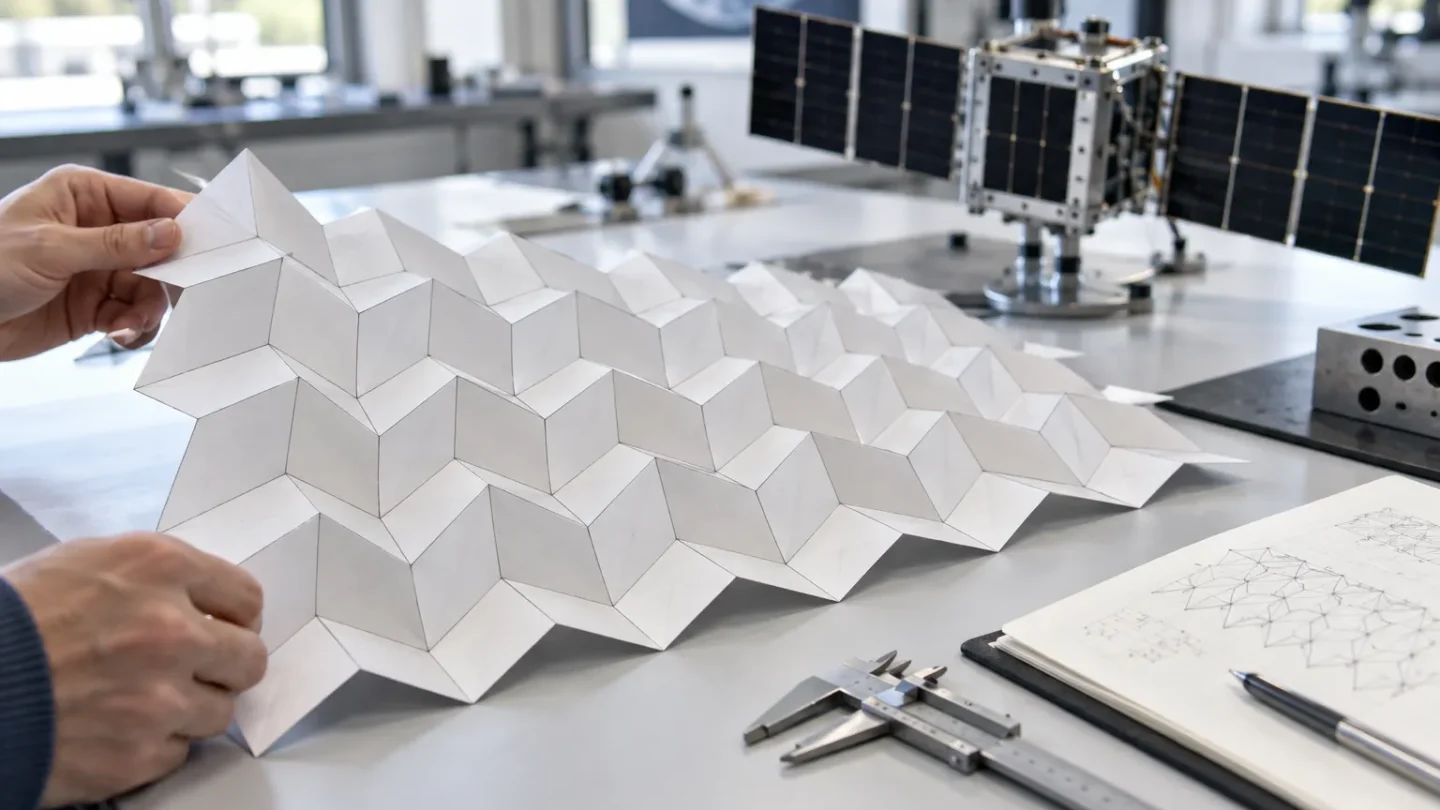
Two innovations turned folded paper into a modern design language: standardized diagrams made complicated models reproducible, and wet folding gave a flat sheet controlled curves and volume. That is the starting point for origami beyond crane imagery. Akira Yoshizawa developed the diagramming approach that Samuel Randlett and other writers helped circulate internationally, while Yoshizawa’s wet-folding method treated paper as a material that could be shaped rather than merely creased. Decades later, Koryo Miura approached folding as geometry, using a repeating pattern that could compact and deploy a large surface through coordinated movement. A version of that pattern reached orbit in a Japanese solar-cell-array experiment aboard the Space Flyer Unit in 1995.
The last fact needs precision. The Space Flyer Unit did not depend on a conventional operational solar wing folded exactly like a classroom sheet of paper. Its 2-D Array experiment tested a deployable membrane structure using ミウラ折り, Miura-ori, literally “Miura folding,” with solar-array development among the project’s goals. JAXA’s mission record says the experiment’s deployment, stowage, and vibration tests were completed successfully. The achievement was real, but describing it simply as “the fold that powered a satellite” would overstate what the experiment demonstrated.
Origami beyond crane models begins with two systems
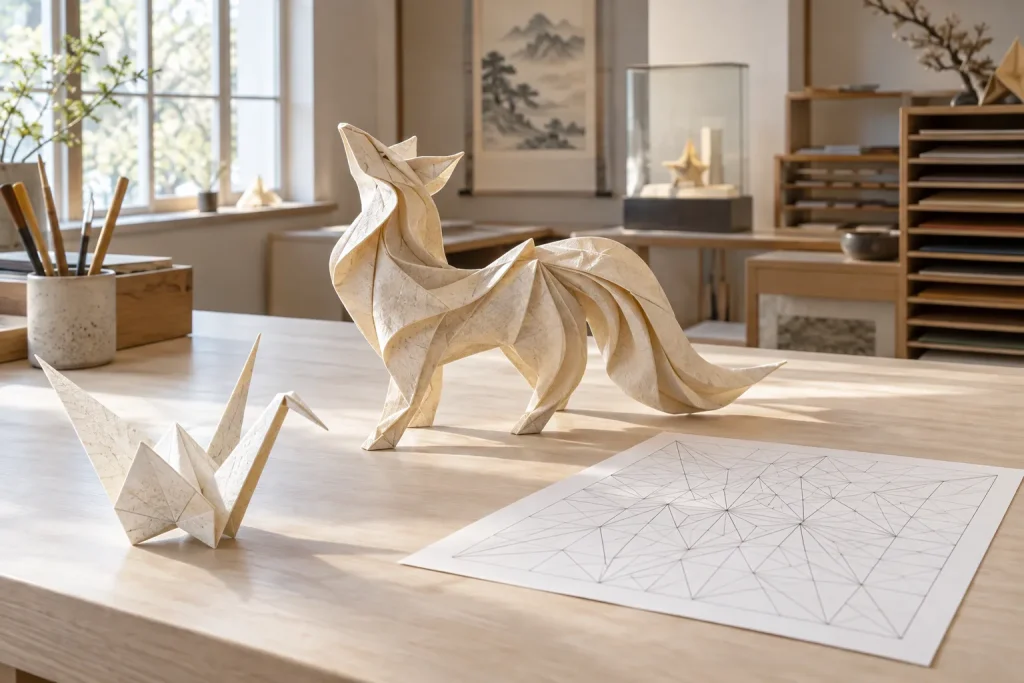
折り紙, origami, literally “folded paper,” names both a practice and the objects made through it. The familiar crane is one model produced from a traditional bird base, not the definition of the field. Modern creators use sequences of mountain folds, valley folds, reversals, sinks, pleats, collapses, and curved shaping. Some models remain recreational sculptures, while others test geometric principles applicable to sheet materials. The change from folk procedure to transportable technical knowledge depended heavily on a way to record the sequence.
The first count is therefore two:
- A notation system tells another person where and how to fold.
- A shaping method lets the maker control volume and curved surfaces.
- Together, those two developments support repeatable sculptural design.
- Engineering adds calculation, material properties, and deployment requirements.
- The result is not “paper magic,” but a documented transformation from one state to another.
The Law, the Mark, and the Price Difference explains how Japan legally identifies selected traditional crafts and why a protected designation is not the same as a general cultural label. Origami does not fit neatly into the same product-certification story. Its modern development crossed publishing, education, sculpture, mathematics, and engineering. A model can be culturally Japanese without carrying a government craft mark, and an origami-inspired structure can be engineered outside Japan.
| Counted component | Quantity | What it contributed | Source checked |
|---|---|---|---|
| Reproducible diagramming system | 1 | Shared lines, arrows, and step sequences | OrigamiUSA history, September 10, 2026 |
| Wet-folding method | 1 | Curved shaping and sculptural volume | Papermaking museum history, September 10, 2026 |
| Foundational modern developments counted here | 2 | Communication plus material shaping | Editorial calculation |
| Miura engineering pattern | 1 additional system | Compact storage and coordinated deployment | Miura and JAXA records |
| Total systems examined | 3 | Notation, wet folding, and deployable geometry | Checked September 10, 2026 |
This cannot honestly be converted into the requested cost total. Yoshizawa’s diagramming conventions, wet folding, and Miura’s geometry are techniques rather than products sold at one documented national price. Paper, books, workshops, engineering materials, and spacecraft tests all have different costs. No primary source establishes a standard yen or dollar charge for “modern origami.” A counted table is more accurate than attaching an invented price to intellectual work.
A shared notation made folds portable
Before a dependable diagramming language, instructions could rely on finished illustrations, prose, or incomplete intermediate views. Those methods worked for familiar forms but became fragile as sequences grew longer. A reader could see what the next shape should resemble without knowing which layer moved to produce it. Modern notation addressed that problem by separating visible edges, hidden features, crease types, and movement. In effect, it turned folding into a procedure that could travel without its designer.
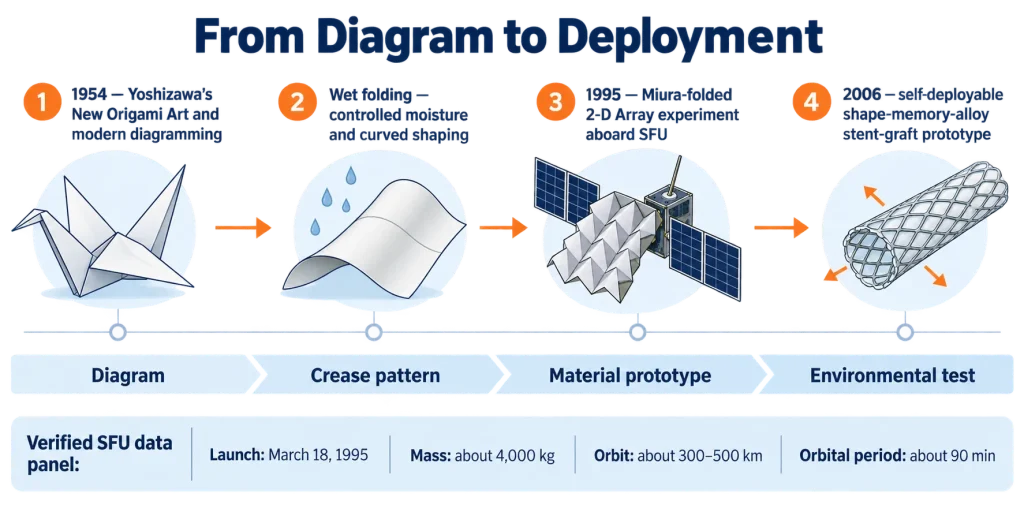
Akira Yoshizawa’s 1954 book Atarashii Origami Geijutsu, or New Origami Art, presented a compact system using differentiated lines and directional arrows. Dashed and alternating dash-dot lines came to distinguish valley and mountain folds, while arrows showed movement. Samuel Randlett and Robert Harbin later adapted and expanded conventions for English-language readers. Randlett’s The Art of Origami, published in 1961, was especially important in circulating the approach. The resulting Yoshizawa–Randlett notation became an international working language rather than a collection of explanations tied to one spoken language.
The convenient origin story says Yoshizawa invented the entire code alone. Historical research published by OrigamiUSA shows a more layered development. Mountain and valley conventions had precedents in technical drawing and earlier folding books, and an introductory symbol guide appeared before Yoshizawa’s major publications. His contribution was still decisive: he organized, refined, and demonstrated a system clear enough for increasingly sophisticated work. “Developed and popularized” is more defensible than “invented every symbol.”
The breakthrough was not a new line on paper; it was a visual grammar another folder could reliably follow.
A diagram also changed authorship. Once a model could be recorded step by step, designers could publish an identifiable sequence rather than pass along only a finished shape. Readers could reproduce, teach, compare, and modify that sequence. Complexity no longer depended entirely on watching the designer’s hands. The fold became transferable information.
Wet folding made paper behave like a surface
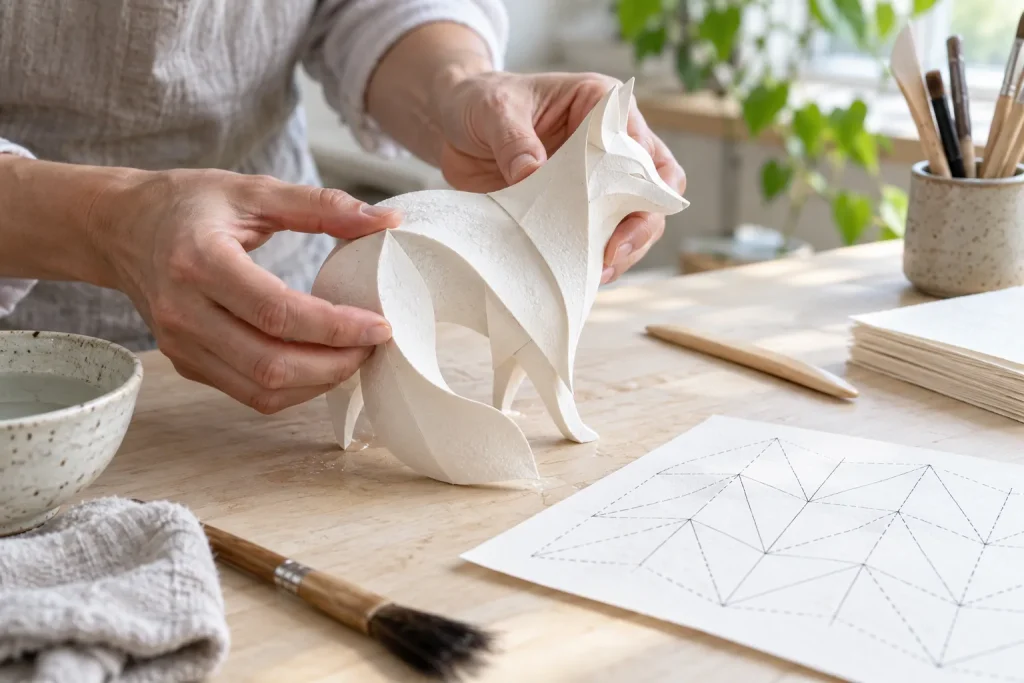
Yoshizawa’s other major contribution was 湿らせ折り, shimerase-ori, meaning folding with the paper slightly dampened and generally known as wet folding. Moisture temporarily changes how suitable paper responds to shaping. Instead of forcing every form into sharply intersecting planes, a folder can create rounded backs, fuller limbs, softened transitions, and controlled curves. As the model dries, an appropriate paper can retain much of that sculptural form. The technique is particularly associated with animal and figure models.
Wet-folding origami does not mean soaking ordinary printer paper until it loses strength. The process depends on paper composition, thickness, sizing, moisture distribution, and timing. Too little moisture offers limited shaping; too much can weaken fibers, damage the surface, or make precise control impossible. Yoshizawa’s result came from understanding material behavior, not from adding water as a shortcut. The method sits closer to restrained paper sculpture than to casual damp folding.
The notation system and wet folding solved different problems:
| Modern problem | Diagramming response | Wet-folding response |
|---|---|---|
| Another person cannot reconstruct the sequence | Record creases and movements with shared symbols | Not the primary purpose |
| Flat planes dominate the finished form | Diagrams can document shaping stages | Moisture enables controlled curvature |
| Complex work is difficult to transmit | Repeatable steps support publication | Material handling still requires judgment |
| The designer needs both accuracy and expression | Geometry records the structure | Shaping modifies the surface |
| Combined result | Reproducible structure | Sculptural volume |
The combination helped redefine what a single sheet could represent. Yoshizawa’s animals did not merely add more folds than a crane. Their posture and volume depended on a deliberate distinction between structural creases and final shaping. That approach encouraged later designers to treat the crease pattern as a designed system. The visible object became the final state of an underlying plan.
Miura turned a crease pattern into a mechanism
Koryo Miura’s pattern begins with a sheet divided into repeating parallelograms. Mountain and valley creases alternate so the surface contracts into a compact stack and opens through linked motion. Pulling at an edge does not unfold one isolated panel at a time. Movement propagates across the tessellation because the units are geometrically connected. The Miura fold is therefore better understood as a mechanism made from a surface.
The useful comparison is a conventional map. An accordion fold compacts a sheet in one direction, after which the folded strip normally needs another set of folds in the perpendicular direction. Opening it can require several separate motions, and the creases may not cooperate. A Miura-patterned sheet contracts across two dimensions through a coordinated network. For deployable structures, that means a broad surface can be packaged into a smaller area without relying on many independent hinges.
The geometry can be adjusted. Designers can change parallelogram dimensions, acute angles, material thickness, crease stiffness, and the intended folded volume. Those variables alter the packed shape and the forces required for movement. A paper demonstration hides many engineering difficulties because paper is thin and forgiving. A space-qualified membrane must survive manufacture, launch vibration, temperature changes, vacuum, and repeated handling on the ground.
The same principle appears in How a Square of Cloth Carries a Bottle, but the governing logic differs. Furoshiki uses flexible cloth, knots, friction, and tension to conform around an object. Miura-ori assigns a repeatable crease network to a sheet so that its transformation is geometrically constrained. Both begin with a flat surface. Only one is designed as a linked deployment mechanism.
What actually flew on the Space Flyer Unit
Japan launched the Space Flyer Unit, or SFU, from Tanegashima Space Center on March 18, 1995. According to the Institute of Space and Astronautical Science mission record, the spacecraft carried a 2-D Array experiment among its scientific and engineering payloads. That experiment used Miura folding as its planar storage-and-deployment method. Pulling the edge allowed a large-area structure to open in space. JAXA identifies the development of an efficient deployable solar-cell array as one objective.
SFU’s history supplies several dated numbers:
| Mission fact | Verified value | Source |
|---|---|---|
| Launch | March 18, 1995, at 5:01 p.m. JST | ISAS/JAXA mission archive |
| Launch vehicle | H-II Test Flight No. 3 | ISAS/JAXA |
| Spacecraft mass | Approximately 4,000 kilograms | ISAS/JAXA |
| Operating orbit | Approximately 300–500 kilometers | ISAS/JAXA |
| Nominal orbital period | Approximately 90 minutes | ISAS/JAXA |
| Retrieval | January 13, 1996 | ISAS/JAXA |
| Miura-pattern array experiments | Deployment, stowage, and vibration testing completed successfully | ISAS/JAXA |
The 2-D Array should not be confused with SFU’s main solar-array paddles. The mission record lists the experimental 2DSA payload separately and describes its work on lightweight tension structures and deployable solar-cell arrays. This distinction corrects the neat but imprecise claim that “Miura folded the satellite’s solar panel.” A more accurate sentence is that a Miura-folded experimental solar-array structure deployed aboard a Japanese spacecraft. That is still a direct movement from folded geometry to orbital engineering.
SFU was later retrieved by the Space Shuttle Endeavour during mission STS-72. The retrieval occurred on January 13, 1996, and the shuttle landed on January 20. Those dates make SFU unusual among Japanese spacecraft because the platform and its experimental equipment returned to Earth. The mission allowed engineers to test deployable structures in orbit rather than treating a paper model as proof. Paper established the geometry; the spacecraft established whether a fabricated system could operate in its intended environment.
Where folding meets medical-device research
A medical device can face a related packaging problem. It may need to pass through a narrow delivery route and then expand into a larger working form. Fold patterns offer one way to coordinate that change without assembling numerous rigid sections. Researchers have therefore studied collapsible stents, grafts, surgical tools, implants, and electrode arrays using origami-inspired geometry. The phrase “origami surgery,” however, can conceal how early many of these projects remain.
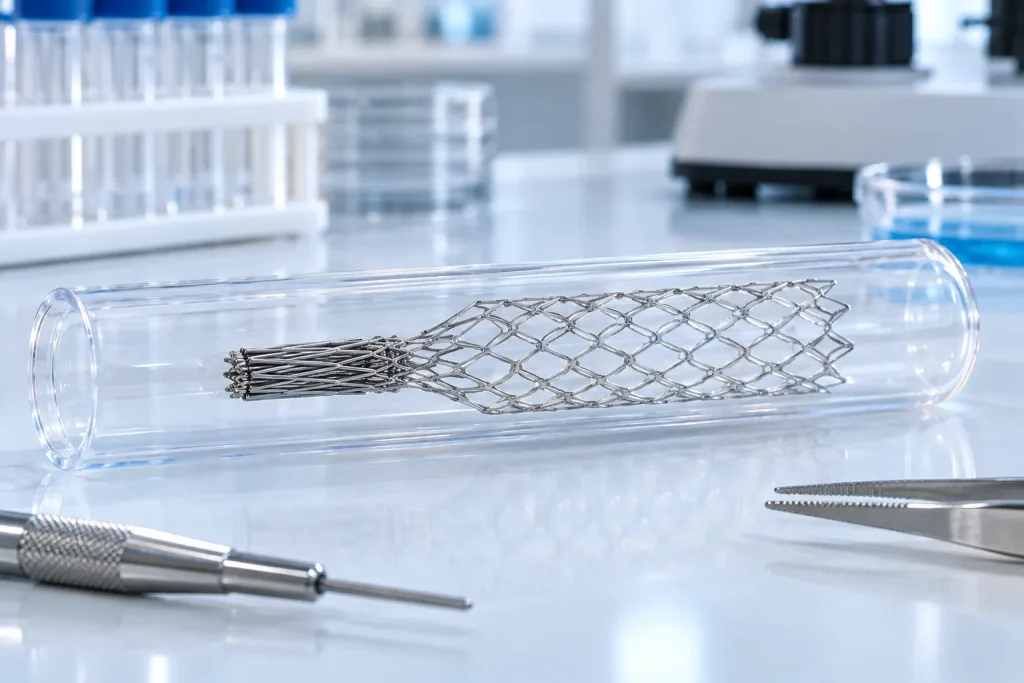
Kaori Kuribayashi and collaborators reported a self-deployable origami stent graft in 2006. Their prototype used a nickel-rich titanium shape-memory alloy and a fold pattern designed to compress and expand. The material could recover a programmed configuration when heated, combining fold geometry with a temperature-responsive alloy. The research demonstrated a biomedical engineering concept. It did not establish that the device had become a routine implant used in hospitals.
That qualification matters. A laboratory model, animal study, engineering dissertation, patent, regulatory submission, and approved clinical product are different stages. Articles often move from “researchers designed” to “surgeons use” without documenting the transition. For the 2006 origami stent graft, the checked sources support prototype development and material testing. They do not support a claim that it became standard surgical care.
Origami medical devices are also rarely made from paper. The transferable element is the fold pattern: a rule for transforming a broad or voluminous object into a compact state and then deploying it predictably. Metals, polymers, hydrogels, and electronic substrates introduce stresses that paper exercises do not reproduce. Engineering begins when the designer calculates those material constraints. The craft supplies a geometric vocabulary, not an automatic medical solution.
What paper models prove—and what they do not
A paper model can reveal whether a crease pattern moves, locks, collides with itself, or requires inaccessible hand movements. It can expose a poor sequence before costly materials are cut. Designers can change angles quickly and compare folded volumes without manufacturing a full mechanism. That makes paper valuable for early reasoning. It does not make paper a substitute for structural testing.
Real sheets have thickness. Layers accumulate, hinges resist movement, coatings crack, and creases concentrate stress. A mathematical surface may be treated as having no thickness, while an engineered panel cannot occupy the same space as its neighbor. Designers respond with offset hinges, flexible joints, cuts, compliant regions, or modified tessellations. Each response moves the design farther from recreational single-sheet rules.
Scale changes the problem too. A fold that works under finger pressure may resist deployment when built in metal. A membrane stable on a table can behave differently in microgravity or during launch vibration. A medical structure must address biocompatibility, sterilization, fatigue, imaging, delivery, and regulation. The folded geometry remains important, but it becomes one component of a larger system.
The honest progression is:
- Paper model: demonstrates the motion concept.
- Geometric model: defines angles, crease relationships, and possible states.
- Material prototype: tests thickness, stiffness, fatigue, and recovery.
- Environmental test: reproduces launch, body, temperature, or loading conditions.
- Qualified device: meets the standards required for its actual use.
Calling every folded prototype “origami” can also flatten important differences. Some structures use true rigid-foldable tessellations, while others borrow only the visual idea of compact deployment. Some require cuts, hinges, elastic deformation, or external motors. Engineers often use “origami-inspired” precisely because the material system departs from paper-folding conventions. That wording is a useful technical qualification, not a dismissal.
Engineering is where the crane comparison ends
A crane is judged by whether the folding sequence produces the intended figure. A deployable array is judged by packed volume, mass, deployment force, repeatability, stiffness, vibration response, and failure risk. A stent prototype adds material recovery and biomedical requirements. The same mountain and valley logic may be present, but the acceptance criteria have changed. Origami engineering turns a crease pattern into a set of measurable constraints.
The notation system made complex sequences communicable. Wet folding showed that the sheet’s material state could be manipulated for controlled form. Miura-ori demonstrated that a crease network could coordinate the deployment of a large surface. Medical researchers then applied related thinking to structures that must enter compactly and expand at a target location. These are connected developments, but they are not one uninterrupted Japanese invention story.
Names also need the same care as mechanisms. Koryo Miura’s given name appears in Roman letters with different long-vowel conventions, while Japanese sources write 三浦公亮. If you need to check how a personal name may be represented in Japanese phonetic script, the site’s name converter contains 898 checked first names in katakana. It is not an authority for historical kanji names, engineering terminology, or the identity of a researcher. A name tool and a scholarly source solve different problems.
The Law, the Mark, and the Price Difference returns to the legal and commercial meaning of traditional craft labels. Origami’s engineering afterlife requires another category. No official mark turns a crease pattern into aerospace technology. Calculation, fabrication, testing, and documented performance do that work.
Frequently asked questions
Did Akira Yoshizawa invent modern origami?
Yoshizawa was central to modern origami’s development and international recognition. He refined and popularized an effective visual notation and pioneered wet folding as a sculptural method. Earlier folding publications and technical diagrams contained precedents for some symbols. His achievement was a major development of the system, not the isolated invention of every line and arrow.
What is the Yoshizawa–Randlett system?
It is a set of diagramming conventions used to show origami steps. Different line patterns distinguish mountain and valley folds, while arrows and other symbols communicate movement, rotation, opening, inflation, and repetition. Yoshizawa developed the influential Japanese presentation, and Samuel Randlett helped adapt and spread it through English-language publication. Variations exist, but the core conventions remain widely recognizable.
What is wet folding?
Wet folding uses controlled moisture to make suitable paper easier to curve and shape. The model is formed while the fibers are responsive and retains sculptural volume after drying. It is associated particularly closely with Yoshizawa’s animal models. It requires appropriate paper and material judgment rather than simply soaking a sheet.
Did Miura-ori deploy a satellite solar panel?
A Miura-folded 2-D Array experiment flew aboard Japan’s Space Flyer Unit in 1995. JAXA states that the experiment used Miura folding for planar stowage and deployment and supported research into efficient deployable solar-cell arrays. It was an experimental array structure, distinct from the spacecraft’s main power paddles. “A Miura-folded solar-array experiment deployed in orbit” is the precise description.
Is origami currently used in surgery?
Origami-inspired geometry is actively researched for medical devices, including compact stents, grafts, electrode arrays, and deployable tools. The 2006 self-deployable stent graft was a research prototype made with shape-memory alloy. The checked evidence does not establish it as routine clinical equipment. Each medical device requires separate safety, performance, and regulatory evidence.
What single number should be remembered?
Remember 1995: that is the year a Miura-folded 2-D solar-array experiment reached orbit aboard SFU. Recheck the mission description and the clinical status of cited medical technologies by September 22, 2027. Historical launch data should remain stable, but institutional pages and the development status of medical devices can change. The figure marks the point where a calculated fold was tested beyond paper.