There is a right answer to this, and it is not the one most people book. The best weather in Japan and the busiest weeks in Japan do not coincide, and the gap between them is the single most useful thing to know when choosing dates.
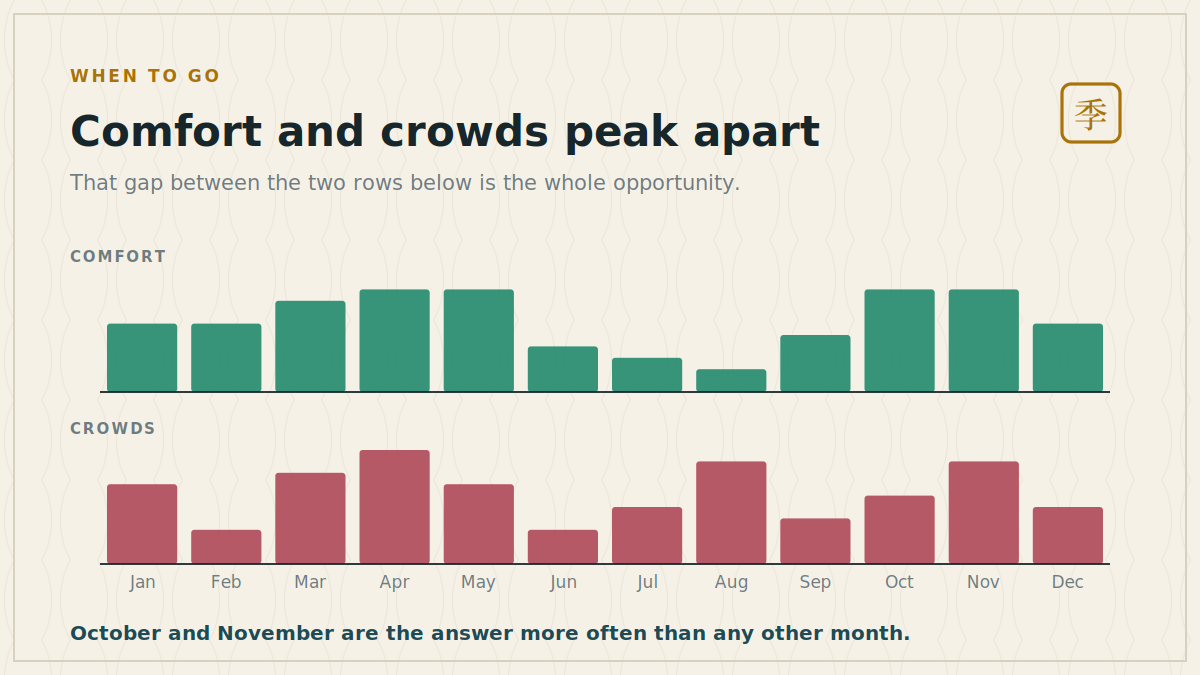
The short answer: late October and November
The weather from mid-October to late November is the best Japan gets. The summer humidity has gone, the cold has not arrived, the skies are clear, and it barely rains. Daily highs run 17 to 22°C.
Crowds are moderate until the leaves turn, which in Kyoto means roughly the second half of November. That fortnight is genuinely busy and worth planning around — but the six weeks before it are the quietest good weather of the year.
If you can go once and want the highest chance of a comfortable trip, go then.
Month by month
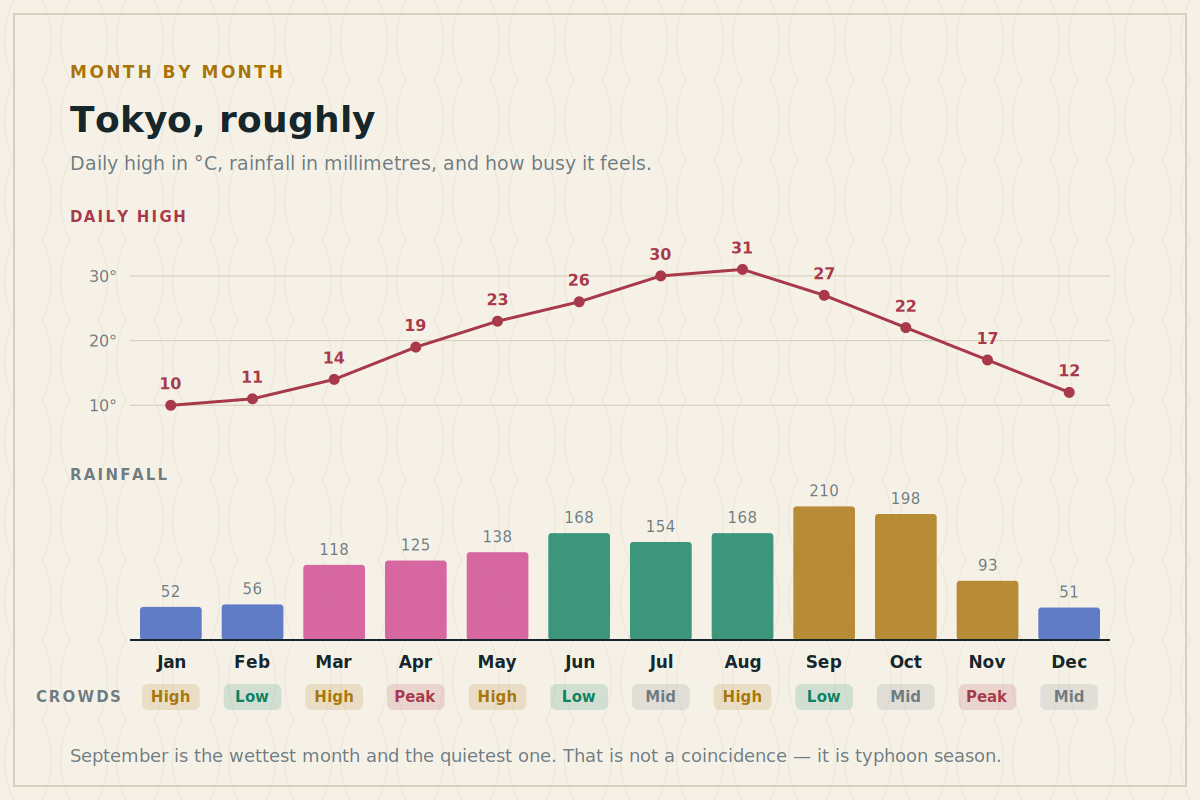
January and February. Cold and dry — Tokyo highs around 10°C, and it rarely rains. The cheapest months, the clearest views of Mount Fuji, and the least crowded temples. The Sea of Japan side gets serious snow, which is either the point or the problem.
March. Warming, unpredictable, and the plum blossom comes before the cherry. The last two weeks turn into blossom season in the south.
April. Peak on every axis. Cherry blossom, best-looking Japan of the year, highest prices, thickest crowds, and Golden Week at the very end.
May. After Golden Week, one of the year’s best-kept windows: warm, dry, green, and comparatively quiet.
June. The rainy season, tsuyu. It does not rain all day every day, but it is grey and humid. Hydrangeas at temples are the compensation, and Hokkaido has no rainy season at all.
July and August. Hot and very humid — Tokyo highs of 30 to 31°C with humidity that makes it feel worse. Also the great festival season, and the fireworks. A real trade-off rather than a simple no.
September. The wettest month on paper and typhoon season, which is precisely why it is one of the quietest. If you can tolerate the risk of a washed-out day or two, it is good value.
October and November. The answer, as above.
December. Cold, clear and cheap until the last week, when New Year arrives and everything changes.
The three weeks to avoid
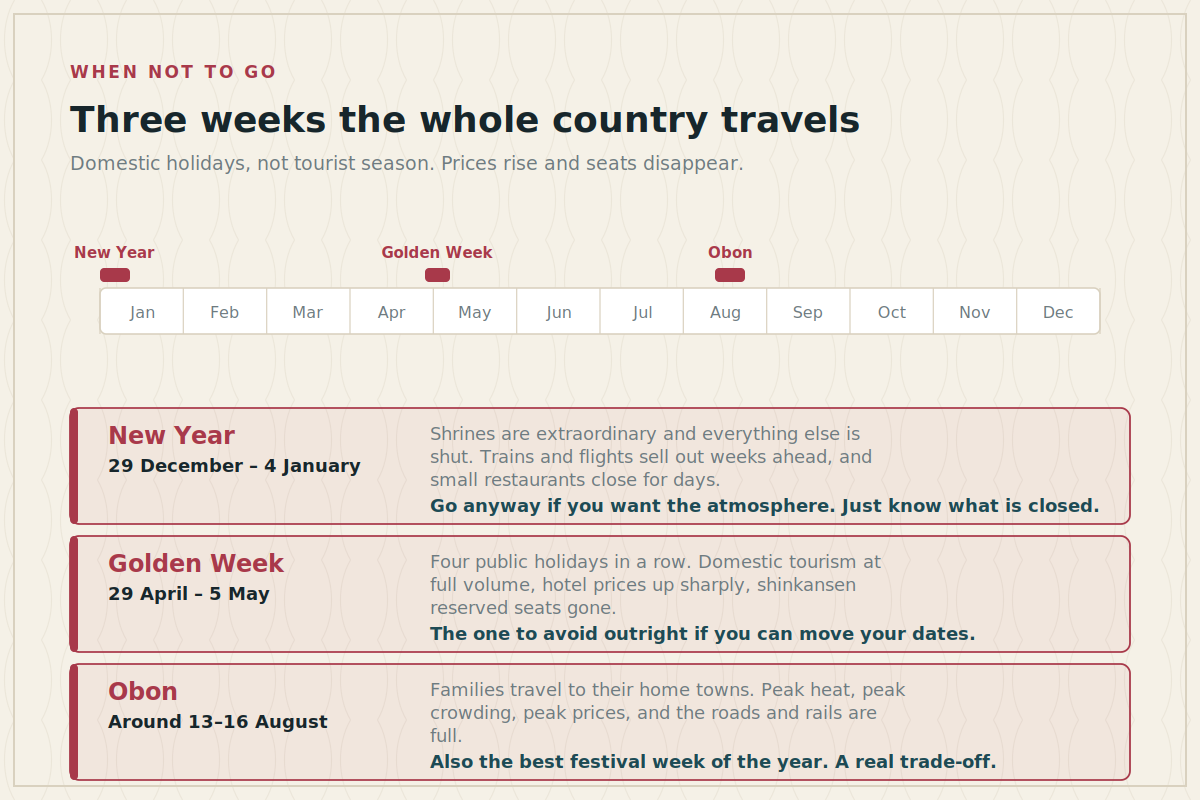
This matters more than the weather, because it affects availability rather than comfort.
Golden Week, 29 April to 5 May. Four public holidays in a row. Domestic tourism at full volume, hotel prices sharply up, shinkansen reserved seats gone weeks ahead. The one to avoid outright if your dates can move.
Obon, around 13 to 16 August. Families travel to their home towns. Peak heat, peak crowding, peak prices. It is also the best festival week of the year, so this one is a genuine trade-off rather than a warning.
New Year, roughly 29 December to 4 January. The shrines are extraordinary and everything else shuts. Small restaurants close for days, trains and flights sell out, and museums keep holiday hours. Go if you want the atmosphere — just know what will be closed.
What you are actually choosing between
Four different trips, depending on when you go.
| Season | Weather | Crowds | Price | What you get |
|---|---|---|---|---|
| Spring | Mild, variable | Highest | Highest | Blossom, and the country at its most photographed |
| Summer | Hot, humid | High in August | Mid | Festivals, fireworks, mountains and the north |
| Autumn | Best of the year | Moderate to high | Mid to high | Clear skies, autumn leaves, comfortable walking |
| Winter | Cold, dry, clear | Lowest | Lowest | Snow, onsen, empty temples, visible Fuji |
If you are going for the blossom
Two things are worth knowing before you commit.
The window is about a week in any one place, and it moves. The front travels north from Kyushu in mid-March to Hokkaido in early May, and the date in any given city shifts by a week or more year to year depending on the winter.
You cannot book it in advance with confidence. Hotels sell out four to six months ahead, forecasts only firm up in February, and by then the rooms are gone. Anyone who tells you they timed it exactly either got lucky or went for ten days and caught it somewhere.
The pragmatic approach: book the first week of April in Kyoto or Tokyo, accept you may get early buds or late petals, and treat full bloom as a bonus. Or go for the autumn leaves instead, which last three to four weeks rather than one and are just as beautiful.
Cherry blossom lasts about a week and cannot be booked. Autumn colour lasts a month and can. That asymmetry decides more trips than the weather does.Why autumn wins on planning grounds
Regional differences worth knowing
Japan runs about 3,000 km north to south, and treating it as one climate produces bad decisions.
- Hokkaido has no rainy season and a mild summer — it is the answer for July and August. Winter there is genuinely severe and genuinely spectacular.
- Okinawa is subtropical, has its rainy season in May and June rather than June, and is pleasant in winter when the main islands are cold.
- The Sea of Japan side — Kanazawa, Niigata, the Japan Alps — gets some of the heaviest snowfall in the world. Sunny Tokyo and buried Takayama happen on the same day.
- Kyushu runs warmer throughout, with earlier blossom and later leaves.
Are the crowds as bad as people say?
A fair question, and the honest answer is more nuanced than the headlines.
Japan’s inbound numbers have been extraordinary in recent years, and 2026 has actually softened somewhat — June 2026 saw about 3.15 million arrivals, down roughly 7% on the same month a year earlier. But visitors are concentrated in a handful of places, so a smaller total does not translate into a quieter Kiyomizu-dera.
The practical response is not to avoid Japan, but to be selective about where and when within a day. Famous temples are calm at opening time and again in the last hour. Kyoto in the middle of the afternoon in November is a crush; the same temple at eight in the morning is not.
And two stops off the main line is a different country. Nara instead of Kyoto for a day, Kanazawa instead of Kyoto for two, Takayama instead of anything — the crowd falls away fast.
Picking your dates
In order of how much they matter:
- Rule out the three holiday windows unless you actively want them.
- Decide whether you are choosing weather or an event. Blossom and leaves are events; they come with crowds and prices attached.
- If weather, pick late October to mid-November, or the first half of May.
- If budget, pick January or February, and pack properly.
- Then book accommodation immediately, because that is the thing that runs out.
Where those dates sit in the wider planning sequence is set out in our guide to planning a first trip to Japan. And if you are going to line the trip up with a specific festival, the year-round calendar is in Japanese festivals by season.