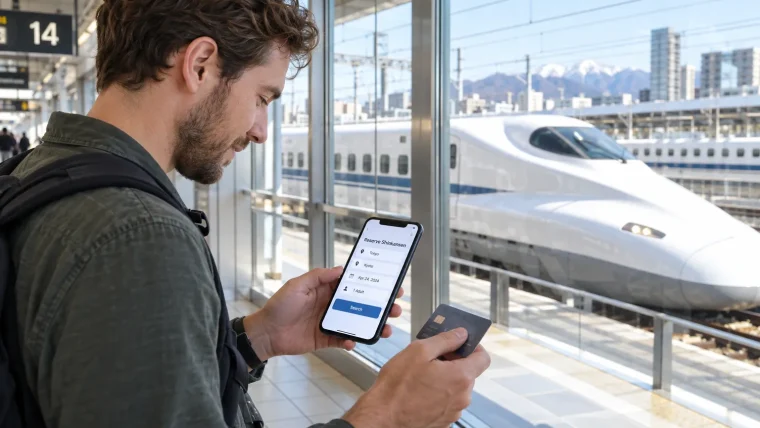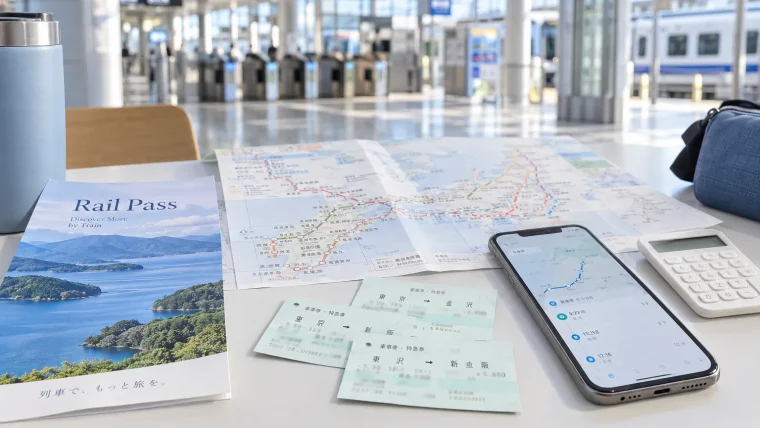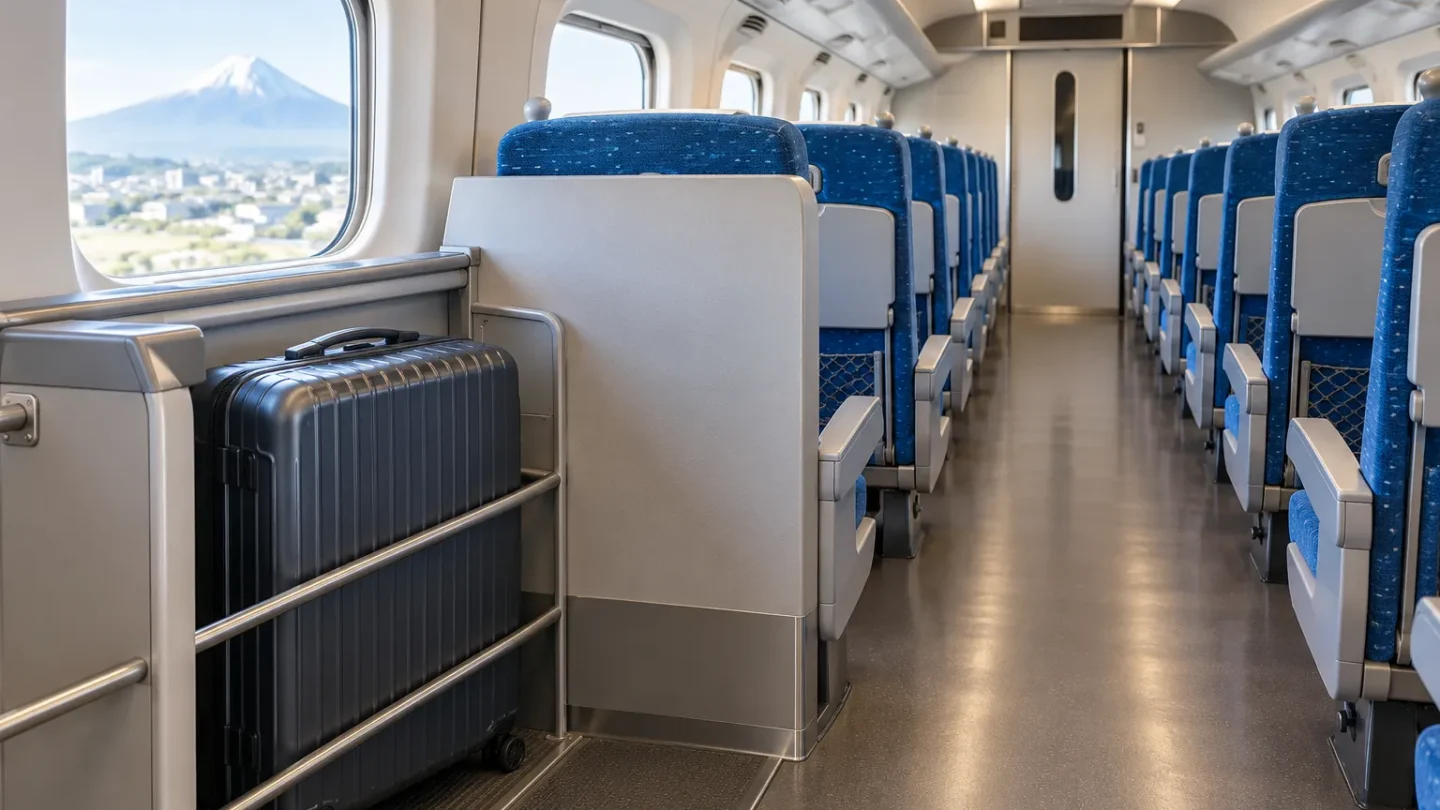
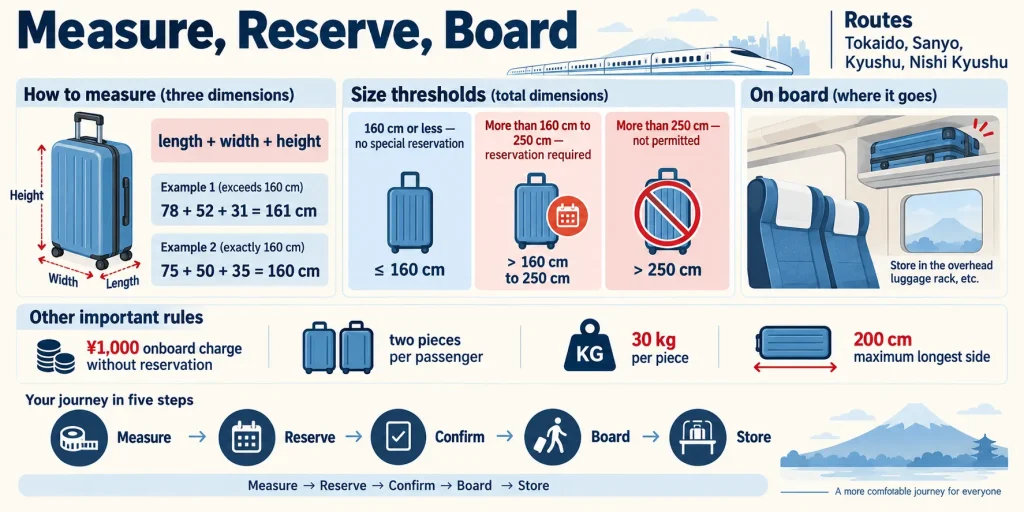
On May 20, 2020, Japan’s Tokaido, Sanyo, and Kyushu Shinkansen introduced a reservation requirement for bags measuring more than 160 cm and no more than 250 cm across their three external dimensions. The rule was later applied to the Nishi Kyushu Shinkansen when that route opened on September 23, 2022. Under today’s Shinkansen luggage size rules, you need a reserved seat linked to an oversized baggage area or compartment. The luggage reservation adds nothing to the price of an eligible reserved-seat ticket. Board with a qualifying bag but no reservation, however, and staff can charge ¥1,000 — approximately $7 at the Bank of Japan reference rate checked on September 11, 2026.
The size boundary is regularly misquoted. A bag totaling exactly 160 cm does not cross the threshold. The reservation requirement starts above 160 cm and ends at 250 cm. Anything over 250 cm cannot be carried as ordinary passenger luggage.
“Measure the suitcase you packed, not the dimensions you remember from the product page.”
Before the back row became reserved luggage space
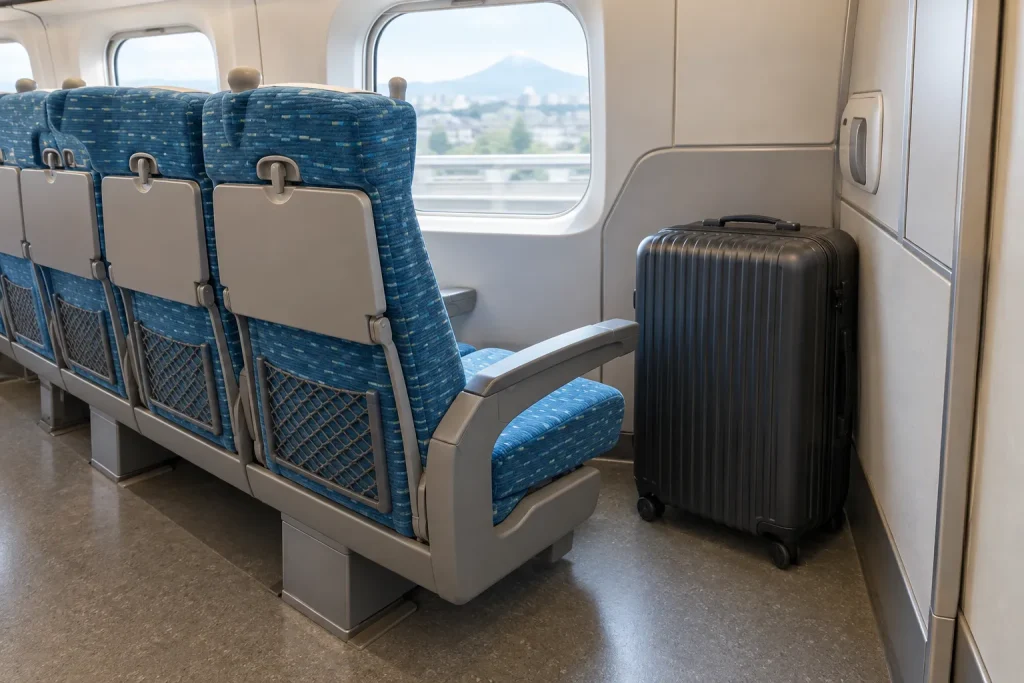
Before May 20, 2020, passengers regularly placed large suitcases behind the final row of seats. The empty floor looked like communal storage, but it was not formally attached to a luggage reservation. Travelers boarded without knowing whether another suitcase had already filled the area. Bags could also restrict the final-row passenger’s ability to recline.
You could instead use the overhead rack or keep a smaller case by your feet. JR Central says the luggage racks on the Tokaido Shinkansen extend back approximately 42 cm. A bag totaling no more than 160 cm, including the operator’s 30 × 50 × 80 cm example, can generally fit there if you can lift it safely.
JR Central also says a bag totaling approximately 120 cm or less, illustrated by a 25 × 40 × 55 cm case, can generally fit by your feet in an ordinary car. This is guidance, not a guaranteed compartment size. Your legroom, the suitcase’s shape, and the person sitting beside you still matter.
The baggage system did not change the way railway fares are calculated. How Japan’s Rail Fares Are Actually Built explains the basic fare and limited-express components without duplicating the luggage rules here.
What changed on May 20, 2020
The railway companies converted selected final-row seats into “seats with an oversized baggage area.” A reservation for one of these seats gives you access to the space behind that row. The change was intended to make boarding smoother, keep aisles clear, protect reclining space, and help travelers secure storage before departure.
The Japanese term is 特大荷物, tokudai nimotsu, literally “extra-large baggage.” The booking option may appear as 特大荷物スペースつき座席, tokudai nimotsu supēsu-tsuki zaseki, literally “seat with an oversized baggage space.” English booking screens generally call it “Seat with Oversized Baggage Area.”
The requirement applies only on these routes:
- Tokaido Shinkansen;
- Sanyo Shinkansen;
- Kyushu Shinkansen;
- Nishi Kyushu Shinkansen.
It is not a universal policy covering every bullet train. JR East’s Tohoku, Joetsu, and Hokuriku services have different train layouts and luggage arrangements. Conventional JR trains are also outside this specific reservation system.
A pass does not remove the requirement. If you use a Japan Rail Pass, you still need the correct seat reservation. Is the Japan Rail Pass Worth It in 2026? deals with the pass calculation itself, while The Break-Even Math on Kansai, JR East and Hokkaido covers regional alternatives.
| Before May 20, 2020 | From May 20, 2020 |
|---|---|
| Space behind the last row was often used informally | Designated rear spaces are linked to specific seats |
| Travelers could not secure that space with a booking | A compatible reservation secures the right to use it |
| Large bags competed for whatever room remained | Qualifying bags require advance planning |
| Other people’s luggage could block seat recline | Final-row reservation holders have priority |
| No later-system handling charge applied | Unreserved oversized luggage can trigger a ¥1,000 charge |
Shinkansen luggage size rules in practice
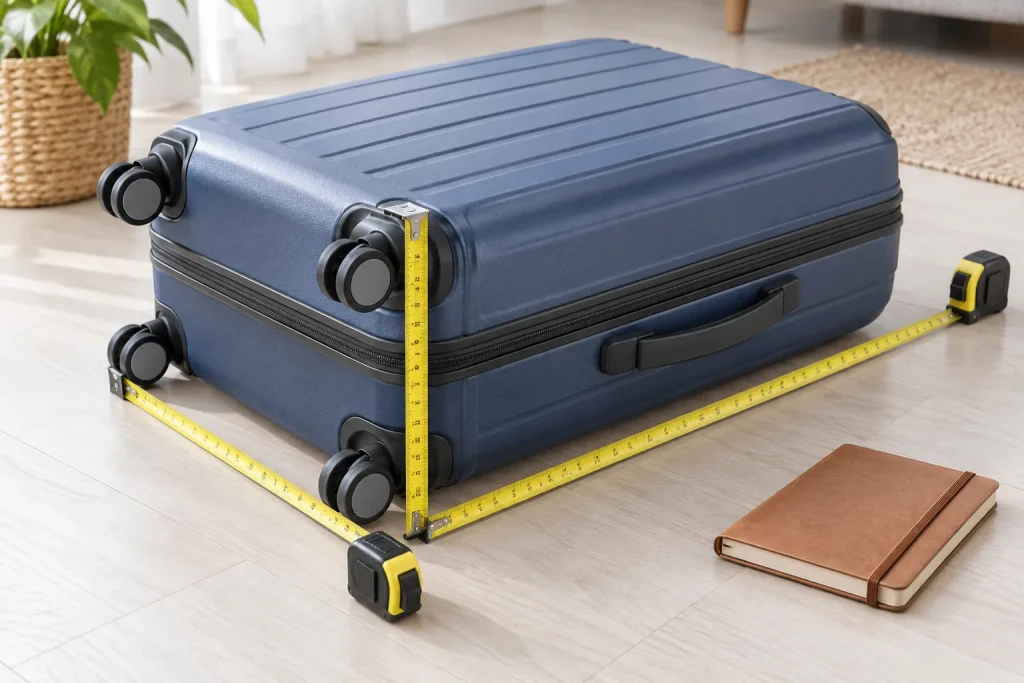
Measure the outside length, width, and height of the packed suitcase. Include wheels, handles, protective corners, and expanded compartments. Add the measurements rather than multiplying them.
For example, a bag measuring 78 × 52 × 31 cm has a combined size of 161 cm. That bag requires a qualifying reservation on one of the four affected Shinkansen routes. A 75 × 50 × 35 cm suitcase totals exactly 160 cm and remains outside the special reservation requirement.
| Total external dimensions | Classification | Reservation rule |
|---|---|---|
| Up to and including 160 cm | Small, medium, or large luggage | No special reservation required |
| More than 160 cm and up to 250 cm | Oversized luggage | Special reserved seat required |
| More than 250 cm | Outside the ordinary allowance | Not permitted as standard carry-on luggage |
The broader passenger-baggage allowance still applies. JR permits up to two pieces per passenger. Each piece may weigh no more than 30 kg, total no more than 250 cm across three dimensions, and measure no more than 200 cm on its longest side.
This creates the part travelers miss: a suitcase may be permitted on the train but still require a special seat. “Allowed as luggage” and “allowed without an oversized-baggage reservation” are separate tests.
An expansion zipper can move a suitcase from 158 cm to more than 160 cm after you have packed it.
To measure correctly:
- Pack the bag as it will be carried.
- Stand it on a level floor.
- Measure the full length, including wheels.
- Measure the widest external point.
- Measure its depth after closing or expanding it.
- Add the three measurements.
- Weigh each piece separately.
- Save the figures on your phone.
Where your suitcase goes after you reserve
The original option is a seat with an oversized baggage area. These seats are normally in the final row of selected cars, and their passengers share the open space behind them. The area is not a private luggage bay attached to a single seat.
On a standard Tokaido Shinkansen formation, up to five ordinary-car passengers may share the space behind one final row. Therefore, a reservation does not give you permission to spread several cases across the entire area. Keep handles folded and prevent wheeled bags from moving.
The newer option is a seat with an oversized baggage compartment. JR introduced these lockable deck compartments on selected Tokaido and Sanyo services on May 20, 2023. They are separate from the open space behind the last row.
JR Central lists a maximum item size of 80 × 60 × 40 cm for the compartment. You pass a security cable through the suitcase handle and lock it using a compatible transportation IC card or mobile device. Some cards and phones may not operate the lock, so do not assume that every contactless payment method will work.
The available numbers vary sharply by service. JR Central lists the following capacity for standard Tokaido formations:
| Train | Seats with baggage area | Seats with baggage compartment |
|---|---|---|
| Nozomi | 57 | 10 |
| Hikari | 42 | 8 |
| Kodama | 17 | 2 |
These figures explain why a train can show ordinary reserved seats while its luggage-compatible places are already full. Check the actual special-seat availability, not only the general reservation symbol.
How to reserve without paying extra
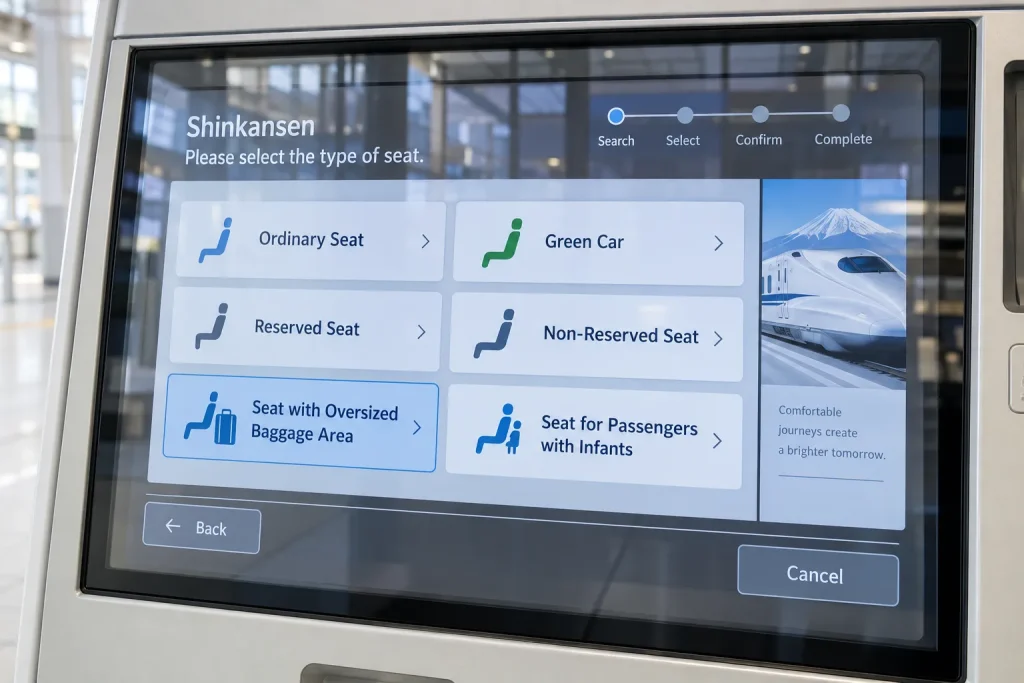
You can reserve through a JR ticket office, a compatible reserved-seat machine, SmartEX, JR West’s online service, or JR Kyushu’s reservation system. Select “Seat with Oversized Baggage Area” or “Seat with Oversized Baggage Compartment” rather than choosing an ordinary rear-row seat.
There is no additional fee for attaching the luggage space to an eligible ordinary reserved seat or Green Car seat. However, you still pay the normal fare and reserved-seat charge for your journey. There is no special oversized-baggage option for an unreserved seat.
SmartEX normally releases these seats when regular tickets go on sale one month before departure. Its guidance says the special seat cannot be secured through the after-hours or advance presale-request function. You must complete the reservation after normal sales open.
Machines, Apps and the Ticket Counter covers the wider buying process. At a staffed office, you can say:
特大荷物スペースつき座席をお願いします。
Tokudai nimotsu supēsu-tsuki zaseki o onegai shimasu.
“Please give me a seat with an oversized baggage area.”
For other useful station language, the phrasebook with 337 phrases sorted by situation is more practical than memorizing a long conversation.
What the ¥1,000 charge really means
If you bring oversized luggage on a Shinkansen without reserving the appropriate seat, staff can collect ¥1,000 including tax. Based on the Bank of Japan rate checked on September 11, 2026, that was approximately $7. The dollar equivalent must be refreshed before publication because JR charges the amount in yen.
Paying does not let you select any unused corner. The conductor decides where the suitcase must be stored. If safe space is unavailable, you may be asked to reserve another train instead of blocking an aisle, doorway, or passenger’s seat.
Therefore, the fee is not a convenient last-minute baggage product. It is a handling charge applied when you board without the required arrangement. The free advance reservation gives you more control and avoids the onboard negotiation.
Missing your reserved departure creates another problem. Depending on the ticket, you may normally be allowed to use an unreserved car on a later train. You cannot take a bag over the threshold into that unreserved car. To travel with it, obtain another seat linked to an oversized baggage space.
What the rule leaves unchanged
Bags totaling no more than 160 cm do not require the special reservation. You can usually place them on the overhead rack, by your feet, or in an ordinary deck storage area where one is provided. You remain responsible for lifting, supervising, and securing them.
Strollers, sports equipment, bicycles carried in suitable bags, and musical instruments are exceptions to the dimensional reservation requirement. They may be carried without the special seat when they satisfy the relevant transport conditions. However, you must reserve a linked seat if you want to use the designated oversized baggage area.
Railway staff may help lift a suitcase if their duties permit. JR Central warns that assistance cannot always be provided during busy boarding and departure periods. If you cannot lift the bag safely, book the rear storage space or send the suitcase ahead.
The policy also does not create an airline-style checked-baggage service. Your case receives no luggage tag and is not transferred when you change trains. You must move it between platforms yourself.
New storage has not replaced the original rule
The lockable compartments added in 2023 expanded the available choices, but they did not remove the reservation requirement. A qualifying suitcase still needs an eligible reservation unless the operator explicitly identifies a particular facility as reservation-free.
JR Central’s current guidance says some deck-based baggage areas may be made available without reservations on a trial basis. This wording is not a network-wide exemption. Availability can depend on the train, car, and current operating policy.
No confirmed future date for ending or replacing the core rule had been announced when this article was researched on September 13, 2026. That absence matters. Do not rely on blogs claiming that all Shinkansen trains are moving to open luggage racks or compulsory delivery services.
Luggage forwarding remains optional. It can be useful when changing stations, using small hotels, or moving through crowded cities. Yet a properly reserved qualifying suitcase is still allowed aboard.
If the bag is shaping your route and accommodation choices, handle it during the early planning stage. Planning a First Trip to Japan: The Order That Works covers the order for booking flights, cities, accommodation, and transport.
Frequently asked questions
Does a suitcase totaling exactly 160 cm need a reservation?
No. The detailed JR guidance requires the special reservation for luggage measuring more than 160 cm and no more than 250 cm. A bag totaling exactly 160 cm remains outside that category.
Is the oversized-baggage reservation free?
Yes. There is no additional luggage fee when you select a compatible ordinary reserved seat or Green Car seat. You still pay the normal passenger fare and reserved-seat cost.
Can I take a large suitcase into an unreserved car?
Not when it exceeds 160 cm on an affected route. Oversized baggage spaces are linked to reserved seats. Choose another train if the required places are unavailable.
Can I place my suitcase behind any final-row seat?
No. Designated rear spaces belong to passengers who reserved the linked seats. A normal back-row booking is not automatically an oversized-baggage reservation.
What happens if I forget to make the reservation?
You can be charged ¥1,000, and the conductor will determine where the bag must go. If no suitable space is available, you may need to take another train.
Do these rules apply to JR East trains?
This specific reservation policy applies to the Tokaido, Sanyo, Kyushu, and Nishi Kyushu Shinkansen. Check JR East’s current guidance for its routes because train layouts and luggage storage differ.
Do strollers and musical instruments need the reservation?
They are exempt from the dimensional rule under JR’s current guidance. Nevertheless, you need the special reservation if you want to use a designated oversized baggage area or compartment.
Can I reserve luggage space with a Japan Rail Pass?
Yes. Reserve the corresponding seat through an eligible JR counter or official reservation system. Holding the pass alone does not reserve luggage space.
Should I send my suitcase to the next hotel instead?
That depends on your transfer, hotel reception hours, and delivery schedule. Forwarding can remove the lifting and storage problem, but it is not compulsory for a bag that complies with the railway limits.
When should I verify the rule again?
Check the operating company, train formation, packed dimensions, and exact seat description before departure. This article should be reviewed on October 23, 2026, and after any new JR baggage announcement.