A Japanese rental listing can advertise an affordable monthly rent while placing a bill equal to several months of rent between you and the keys. The mechanism is a stack: the layout code describes how the home is divided, square meters and jō describe its size, and a separate group of deposits, fees, insurance charges, and advance payments determines what you must pay before moving in. If you are asking what does 1LDK mean, the answer is not complete until you can read all three layers together.
The listing is not necessarily hiding the costs. Most items appear in the property details, estimate, important-matters explanation, or proposed contract. The difficulty is that they are scattered and expressed in specialized shorthand. A low headline rent therefore cannot be compared responsibly until every initial charge has been placed on the same page.
The rules and official guidance cited here were checked on September 13, 2026. Rental conditions vary by property, landlord, region, and contract, and the applicable rules can change. Before transferring money, ask the licensed real estate company for a written itemized estimate and an explanation of every nonrefundable charge.
The code describes rooms, not spaciousness
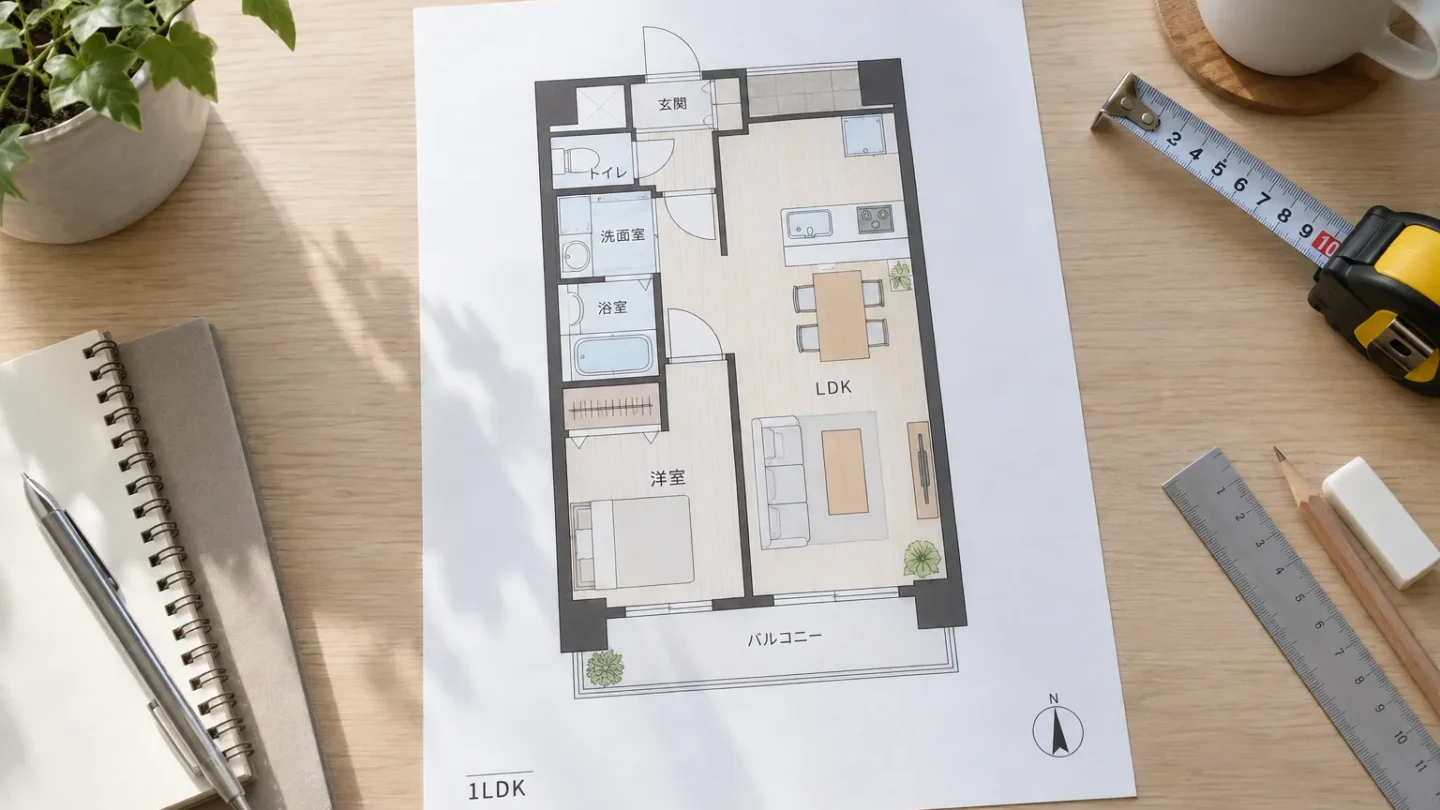
The letters in a Japanese floor-plan code identify functional areas. L means living room, D means dining area, and K means kitchen. The number at the beginning states how many separate rooms exist in addition to those shared functions. A 1LDK therefore has one separate room plus a combined living, dining, and kitchen area.
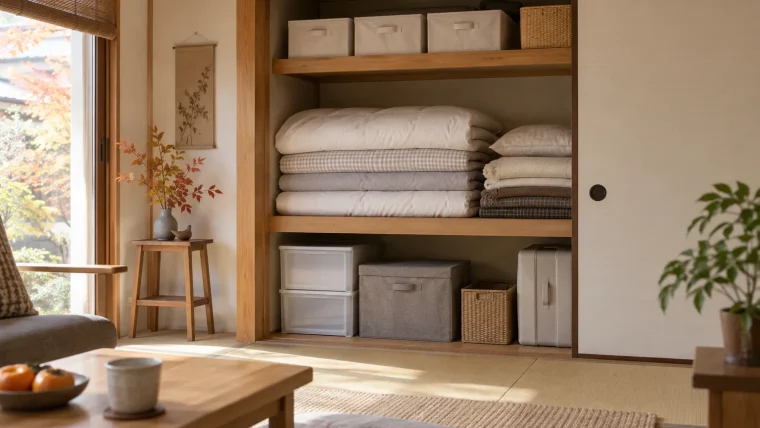
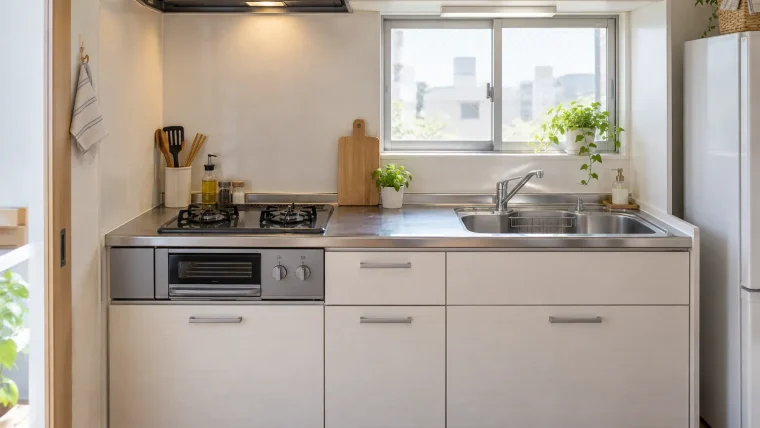
That separate room may be used as a bedroom, study, or storage-heavy multipurpose room. The code does not guarantee a large bedroom, an American-style living room, or a kitchen with extensive counter space. It also does not tell you whether doors, columns, hallways, and furniture placement make the floor plan practical.
A 1K has one main room separated from a kitchen area. A 1DK adds a dining-kitchen area, while a 1LDK indicates a larger shared zone intended to serve living, dining, and kitchen functions. Studio-style properties may be labeled 1R, meaning one room, with the kitchen located inside the main space rather than behind a separate door.
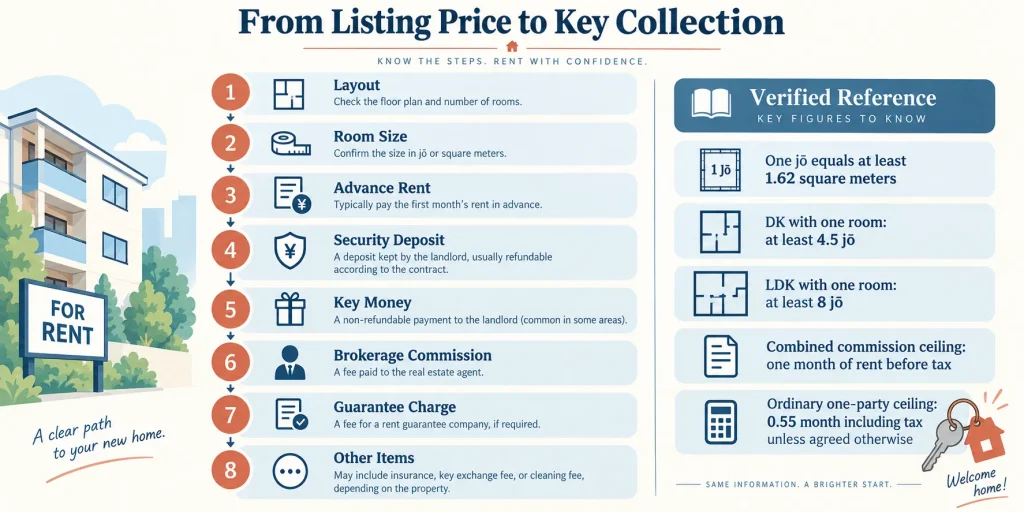
The Real Estate Fair Trade Council’s advertising guidance gives minimum reference sizes for using DK and LDK in listings. Where there is one separate room, the guidance uses at least four and a half jō for DK and at least eight jō for LDK. Where there are two or more separate rooms, it uses at least six jō for DK and at least ten jō for LDK. These are advertising guidance thresholds, not promises about comfort, furniture capacity, or legal occupancy.
| Code | What the listing describes | What it does not guarantee |
|---|---|---|
| 1R | One room containing the main living and kitchen functions | A separated cooking area |
| 1K | One main room plus a separated kitchen | Space for a dining table |
| 1DK | One separate room plus a dining-kitchen area | A full living room |
| 1LDK | One separate room plus a combined living, dining, and kitchen area | American-sized rooms or abundant storage |
| 2LDK | Two separate rooms plus the shared LDK area | Two conventional bedrooms of equal size |
The outsider’s common mistake is reading the initial number as the home’s total room count. In a 1LDK, the LDK area is additional to the numbered room. That still does not make it equivalent to a typical American one-bedroom apartment because the dimensions, storage, appliances, and circulation space may be very different.
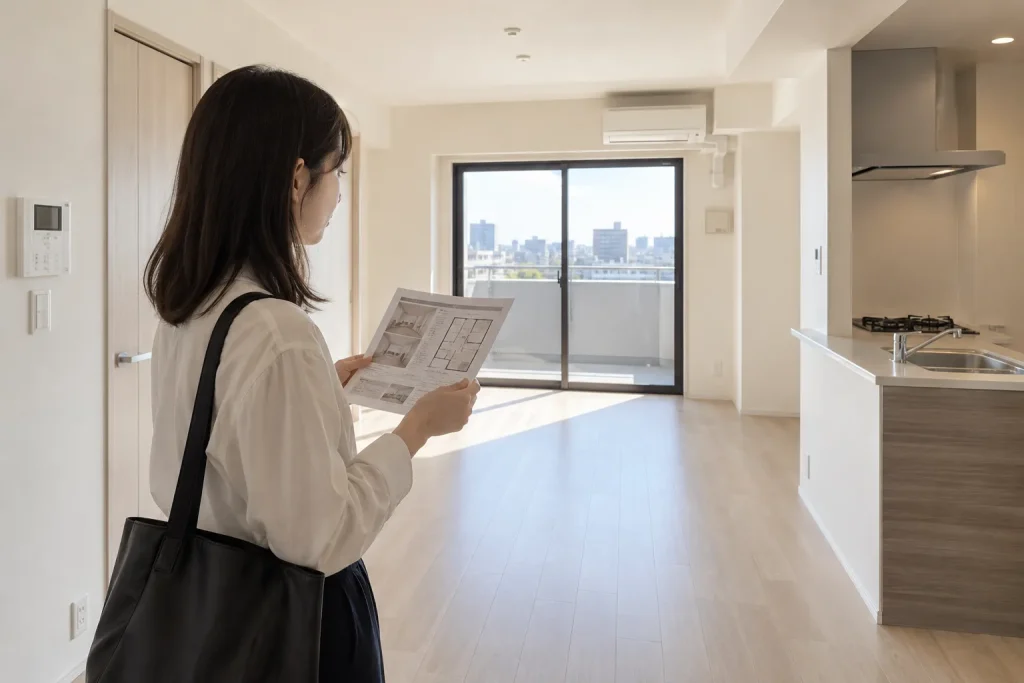
Jō is an advertising measure, not a loose guess
Apartment rooms may be described in 畳/じょう, jō, literally “tatami mat,” even when the floor is wood or vinyl. The notation may appear as 畳 or 帖, both read jō in this context. It gives readers a compact impression of room size, but it must not replace the listing’s total area in square meters.
Under Japan’s real estate advertising rules, one jō must represent at least 1.62 square meters when room size is advertised in tatami units. That equals approximately 17.4 square feet. A room advertised as six jō therefore corresponds to at least 9.72 square meters, or approximately 104.6 square feet, under that advertising conversion.
“One tatami mat” in a property advertisement means an area of at least 1.62 square meters.
The rule exists because physical tatami mats have not always been identical in every region or type of building. You should not take a tape measure to a traditional mat and assume that its dimensions define every online listing. In property advertising, the standardized conversion is the relevant figure.
The outsider’s mistake is multiplying the jō figure and treating the result as usable floor space. A room’s shape, inward-opening doors, structural columns, closets, and the position of electrical outlets can reduce the area where furniture actually fits. The total square-meter figure may also be calculated to boundaries that are not obvious from an interior photograph.
For a first screening, use Japanese apartment size in square meters to compare entire homes and jō to understand the proportions of individual rooms. Before committing to a layout, examine the dimensioned plan when one is available and measure any large furniture that must fit.
The monthly rent is only the first line
Japanese listings usually separate 賃料/ちんりょう, chinryō, literally “rental charge,” from 管理費/かんりひ, kanrihi, literally “management fee,” or 共益費/きょうえきひ, kyōekihi, literally “common-benefit fee.” The management or common-area charge may cover building services, but its exact purpose depends on the property. It is generally paid in addition to the advertised rent.
A listing can therefore place the rent in the largest type while displaying the recurring management fee elsewhere. Parking, bicycle storage, internet service, neighborhood association charges, or support services may also appear separately. None should be assumed to be included unless the listing or contract says so.
The total area deserves the same attention as the layout code. Two homes labeled 1LDK can have different total areas, storage arrangements, balcony depths, and LDK proportions. One may devote much of its area to a long hallway, while another opens directly into the shared room.
The outsider’s mistake is comparing two properties only by their rent and layout label. A useful comparison places recurring rent, recurring building fees, total floor area, access to transportation, and upfront charges side by side. The code tells you what rooms exist; it does not tell you what the home costs to occupy.
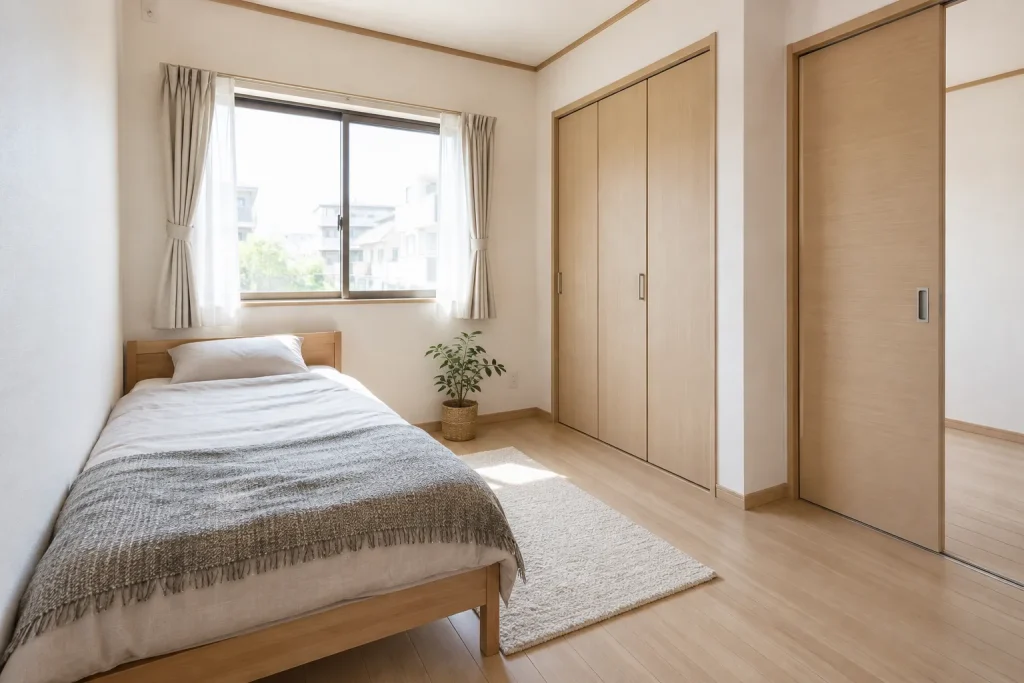
Shikikin is money held against obligations
敷金/しききん, shikikin, literally “laying-down money,” is a security deposit. It may be applied to unpaid rent, damage beyond the tenant’s responsibility under the agreement, or other outstanding contractual obligations. The unused balance is generally subject to return after permitted deductions are settled.
A deposit is not automatically the same as a cleaning fee. A contract may describe cleaning charges or restoration-related provisions separately, including charges due at departure. The Tokyo Metropolitan Government’s rental-housing guidance emphasizes the importance of explaining restoration responsibilities and special clauses before the contract is signed.
Ordinary deterioration and damage caused by tenant conduct are not the same category. Japan’s Ministry of Land, Infrastructure, Transport and Tourism publishes guidance on restoration disputes, but an individual deduction still depends on the facts and the contract. A tenant should request a written breakdown if money is deducted rather than assuming that the entire deposit is always lost or always refundable.
The outsider’s error is counting shikikin as a simple purchase cost. It affects the cash required at move-in, but some of it may later return. The written estimate should keep refundable deposits separate from charges that are not described as refundable.
Reikin leaves when you pay it
礼金/れいきん, reikin, literally “gratitude money,” is commonly translated as key money. It is paid to the landlord and is normally presented as nonrefundable. It is distinct from the security deposit, even when both are calculated as multiples of monthly rent.
Some properties advertise no reikin. That does not make them automatically cheaper overall because another charge, a shorter penalty period, a higher rent, or a required service may alter the total. Conversely, a listing with reikin is not automatically improper; the relevant question is whether the amount and refund status are disclosed before contracting.
Reikin is a market practice rather than a payment that every private lease must contain. Its presence and amount vary by location, property, and market conditions. You may see it more often in some conventional private rentals and not at all in certain public, agency-managed, monthly, or explicitly deposit-free products.
The uncomfortable fact is simple: key money in Japan does not buy equity, reduce later rent, or function as a security balance. When it appears as nonrefundable, it is part of the cost of obtaining that particular tenancy.
The agent’s commission has a legal ceiling
仲介手数料/ちゅうかいてすうりょう, chūkai tesūryō, literally “intermediation handling fee,” pays the real estate broker for arranging the transaction. It is not money held for the landlord and is not a deposit against future damage.
For an ordinary residential lease, the Ministry of Land, Infrastructure, Transport and Tourism sets limits on the brokerage remuneration that a licensed real estate company may receive. The combined commission collected from both sides is generally capped at one month of rent plus consumption tax. As a general allocation rule, the amount collected from either side is limited to half a month of rent plus tax unless that party agreed in advance to a greater share within the overall ceiling.
Because Japan’s consumption-tax rate is ten percent, one month of rent plus tax is often displayed as 1.1 months, while half a month plus tax appears as 0.55 months. Those figures describe the legal calculation of brokerage remuneration, not a guarantee that every renter will be billed the same amount.
The outsider’s mistake is treating any “one-month commission” line as self-explanatory. Ask which rent figure forms the base, whether tax is included, who pays the other share, and where prior consent is recorded. If the explanation conflicts with the written estimate, request clarification from the licensed broker before signing or paying.
The guarantor company is another contract
A landlord may require a personal guarantor, enrollment with a 家賃債務保証会社/やちんさいむほしょうがいしゃ, yachin saimu hoshō gaisha, literally “rent-debt guarantee company,” or another approved arrangement. The guarantee company compensates the landlord under the terms of its agreement if specified rent obligations are not paid, then may seek recovery from the tenant. It is not insurance that erases the tenant’s debt.
The tenant may face an initial guarantee charge, periodic renewal charges, or a recurring payment-processing fee. There is no single nationwide consumer price that can be stated responsibly for all companies and leases. Published property records show that some offers calculate the initial fee as a percentage of basic rent, but that example cannot be promoted as a universal market range.
The national government operates a registration system for rent-debt guarantee businesses meeting specified requirements and publishes related information. Registration does not mean every applicant will be accepted, every property will accept every company, or every contract will use the same fee structure.
The outsider’s mistake is assuming that providing a willing Japanese acquaintance necessarily removes the company requirement. The listing, landlord, management company, and screening process determine which arrangement is accepted. Before applying, request the guarantee company’s name, initial charge, renewal schedule, recurring fees, covered obligations, and cancellation terms in writing.
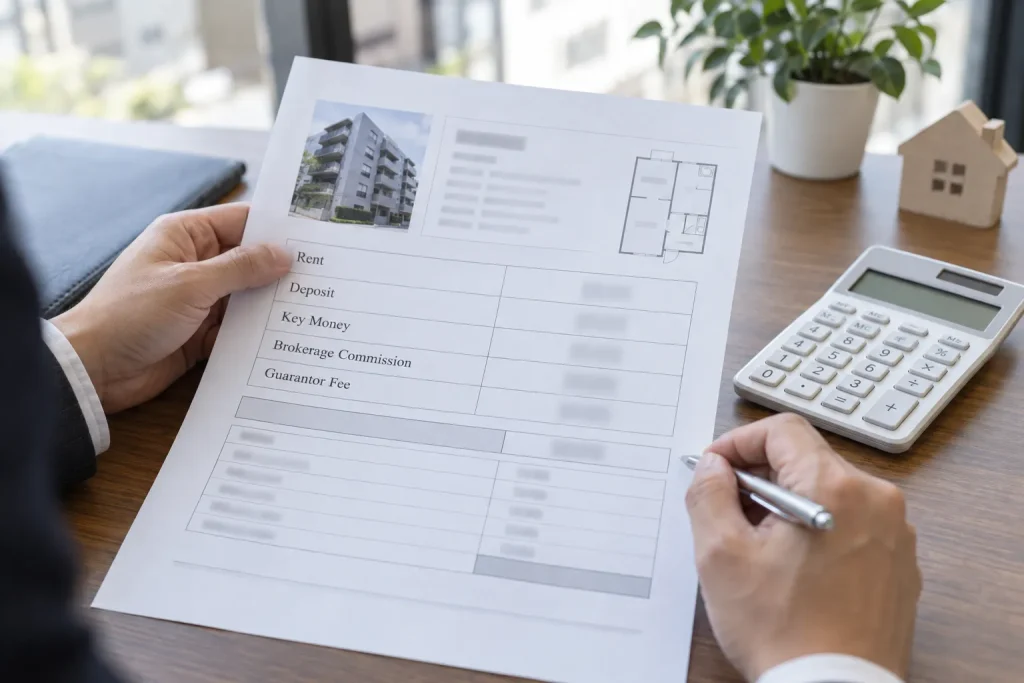
The move-in total is a stack, not a deposit
The initial estimate can combine advance rent, prorated rent, shikikin, reikin, brokerage commission, guarantee-company charges, fire insurance, lock replacement, cleaning provisions, and optional or mandatory support services. Whether each item appears depends on the property and contract. That is why descriptions of Japan apartment move-in costs often use several months of rent as a broad frame rather than a guaranteed total.
Consider the structure below as a reading guide, not a quotation for a specific home. No universal range can safely be assigned to every line. The only reliable total is the written estimate for the property being considered.
| Charge | Usually refundable? | Paid to or for | What must be checked |
|---|---|---|---|
| Advance or prorated rent | No; it pays for occupancy | Landlord or manager | Covered dates and recurring fees |
| Shikikin | Potentially, after allowed deductions | Held against tenant obligations | Deduction and restoration clauses |
| Reikin | Normally presented as nonrefundable | Landlord | Exact amount and refund status |
| Brokerage commission | No after the service is completed | Real estate broker | Calculation base, tax, consent, legal ceiling |
| Guarantee charge | Normally not a security balance | Guarantee company | Initial, renewal, and recurring charges |
| Insurance | Governed by the policy | Insurer | Coverage, period, insurer, cancellation |
| Lock or cleaning charge | Depends on the contract wording | Service provider, landlord, or manager | Whether mandatory and when charged |
Do not add only the items shown prominently on the portal. Request the full 初期費用/しょきひよう, shoki hiyō, literally “initial expenses,” before treating the apartment as affordable. If a line is unclear, the site’s phrasebook for 337 everyday situations can help with basic communication, but it cannot interpret a lease or decide whether a fee is lawful.
The shorthand changes how you compare homes
The first consequence is that identical layout codes do not describe identical living conditions. A compact 1LDK can devote most of its area to the combined room, leaving a narrow bedroom. Another may offer more storage but less open floor area. The plan and dimensions matter more than the code once you have narrowed the search.
The second consequence is that a “no deposit, no key money” label removes only named items. It does not confirm a low total. A guarantee charge, cleaning payment, insurance premium, lock replacement, short-term cancellation clause, or higher recurring rent may still be present.
The third consequence is that the timing of payment matters. Advance rent and prorated rent are payments for occupancy, while shikikin is held against obligations and reikin is normally nonrefundable. Combining all three under the English word “deposit” makes the estimate harder to audit and can create false expectations about what returns later.
The fourth consequence is that screening and pricing are separate. Paying the advertised charges does not promise approval. A landlord, management company, or guarantee company may review identity, residence status, income, employment, emergency contacts, and other information permitted within the application process. The precise criteria are not standardized across every private property.
A careful comparison therefore records four different states:
- recurring monthly housing cost;
- potentially refundable money;
- nonrefundable entry charges;
- later or conditional obligations written into the contract.
This approach does not predict which home is “best.” It makes the offers comparable without pretending that every fee has the same legal or financial function.
The system has real exceptions
Not every Japanese rental uses reikin, shikikin, a private guarantor company, or conventional brokerage. Public housing, Urban Renaissance Agency properties, company housing, student residences, serviced apartments, share houses, and short-term furnished rentals can use different application rules and payment structures. Availability and eligibility depend on the provider.
Regional markets also differ. Practices common in Tokyo cannot be applied automatically to Osaka, Kyoto, Fukuoka, Sapporo, or a smaller city. Contract vocabulary and local customs may vary even when national brokerage rules and advertising standards still apply.
The jō conversion also has a narrow purpose. The advertising standard establishes at least 1.62 square meters per advertised jō, but a physical tatami mat can vary. A traditional room, modern apartment advertisement, and furniture retailer may therefore use related language for measurements that are not interchangeable in every context.
Newer “zero-zero” listings, meaning no stated shikikin and no stated reikin, are genuine counterexamples to the classic deposit-and-key-money stack. They do not disprove the mechanism. They show why you must read every remaining charge, recurring payment, cancellation condition, and restoration clause instead of relying on one marketing label.
| Listing field | Example | What it tells you | What remains unknown |
|---|---|---|---|
| Layout | 1LDK | One separate room plus living, dining, and kitchen space | Exact dimensions and usability |
| Total area | Square meters | Overall advertised floor area | Furniture fit and room proportions |
| Room area | Jō | At least 1.62 m² per advertised jō | Clear floor space |
| Monthly charge | Rent plus management fee | Regular stated housing payment | Separate services and utilities |
| Shikikin | Rent multiple or fixed amount | Security money held against obligations | Final deductions |
| Reikin | Rent multiple or fixed amount | Normally nonrefundable landlord payment | Whether another property omits it |
| Commission | Rent-based amount plus tax | Broker’s remuneration | Allocation and prior consent |
| Guarantee | Initial and possible recurring charge | Required rent-debt guarantee arrangement | Screening result and future fees |
Short FAQ
Is a 1LDK the same as an American one-bedroom apartment?
Not exactly. Both have one separate room in addition to a shared living area, but the Japanese code does not promise American room dimensions, storage, appliances, or furniture capacity. Compare the plan and total square meters rather than relying on the label.
Does one jō always equal 1.62 square meters?
For Japanese real estate advertising, one advertised jō represents at least 1.62 square meters. A physical tatami mat can differ by region and format, so the advertising conversion should not be treated as the universal size of every actual mat.
Is shikikin refundable?
It is a security deposit and may be returned after unpaid obligations and permitted deductions are settled. The actual amount depends on the contract and the condition of the property. Request an itemized explanation of deductions if part of the deposit is retained.
Can a renter avoid reikin?
Some listings do not charge it, but no-reikin wording does not determine the complete move-in cost. Compare the full written estimate, recurring rent, guarantee charges, cleaning terms, and cancellation clauses.
How much money is needed before moving in?
There is no reliable universal total. The amount depends on the rent, deposit, key money, commission, guarantee arrangement, insurance, advance rent, and property-specific charges. Obtain an itemized estimate from the licensed real estate company before transferring funds.
Read the layout code as a description, the jō figure as a standardized advertising measure, and the initial estimate as a stack in which every line has a different job.