You hear the snap before you understand what the tool is doing. A black line appears across the timber, straight and sharp. No ruler is sliding along the surface, and nobody is drawing from a paper plan. If you came to see Japanese joinery without nails, this is where the process really begins: not with an elaborate finished joint, but with geometry transferred accurately to wood.
The phrase japanese joinery joints often brings up photographs of interlocking blocks. Those photographs show the result, not the method. The more useful question is how a carpenter makes two complicated pieces meet. The answer starts with measuring and marking tools—especially the 曲尺, sashigane, literally “bent measure,” and the 墨壺, sumitsubo, literally “ink pot.”
Japanese Joinery Joints Begin with Permission
At a workshop or demonstration, you do not begin by picking up the sample joint. You begin by establishing what you may inspect.
見てもいいですか。
Mite mo ii desu ka.
Literal: “Is it all right if I look?”
In practice: You are asking to approach or examine the work more closely.
Looking and touching are separate permissions.
触ってもいいですか。
Sawatte mo ii desu ka.
Literal: “Is it all right if I touch?”
In practice: You are asking before handling a tool, timber or fitted joint.
This distinction matters because a fitted sample may look like a visitor object while still being a sharp-edged teaching piece. A plane blade may also project only slightly from its wooden body but remain ready to cut.
If you need the wider context for certified crafts, workshop labels and the difference between a legal designation and a loose marketing term, The Law, the Mark, and the Price Difference covers that system. Joinery is a technique, not by itself a government certification.
| Stage | What you do | What the craftsperson expects | Current state |
|---|---|---|---|
| Permission | Ask before approaching or touching | Separate looking from handling | Object remains in place |
| Observation | Watch the marking sequence | Follow the line, not only the tool | Geometry transferred to timber |
| Inspection | Identify the meeting surfaces | Look for shoulders, recesses and grain direction | Joint understood before separation |
| Handling | Move the sample only when invited | Support both pieces and avoid forcing them | Joint can be examined safely |
| Clarification | Ask whether metal fittings are used | Define the construction rather than repeat a slogan | “No nails” becomes a testable claim |
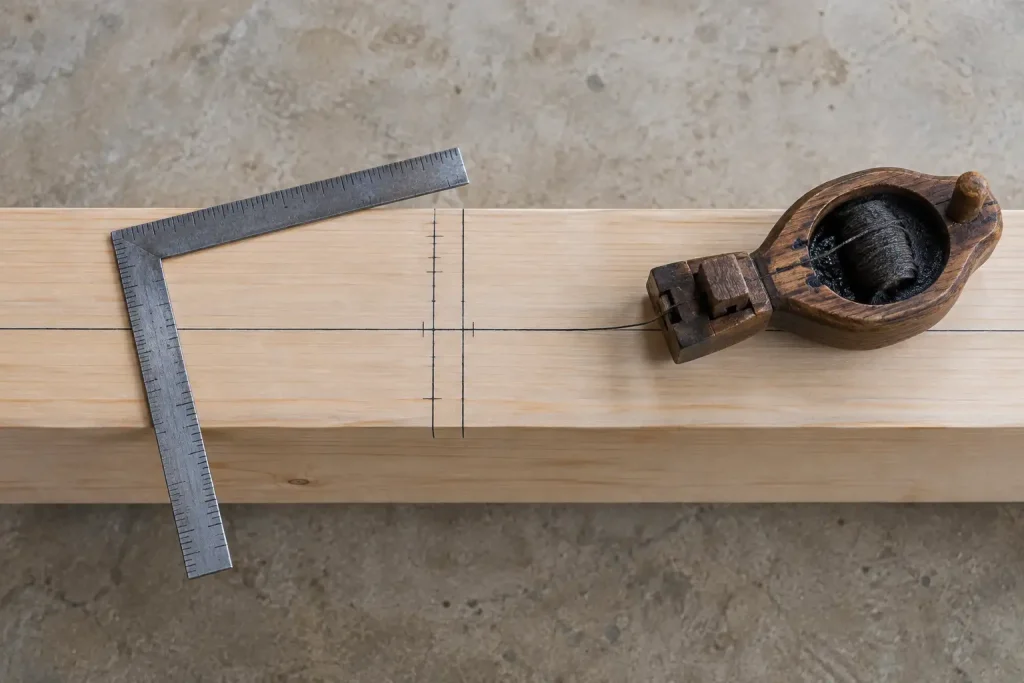
The Line Appears Before the Cut
The craftsperson places a flexible L-shaped square against the timber. The sashigane square establishes a right angle, but that is only its most obvious job.
Traditional versions carry several scales. The ordinary scale is called 表目, hyōme, literally “front scale.” A reverse scale called 裏目, urame, literally “back scale,” is enlarged by the square root of two. A length read through that scale corresponds to the diagonal of a square whose side has the same reading on the ordinary scale.
Here is the worked example without turning the bench into a mathematics lesson:
| Operation | Ordinary geometry | What the marked scale does |
|---|---|---|
| Start with a square side | Side = a | Read a on the ordinary scale |
| Find its diagonal | Diagonal = a × √2 | Read the corresponding value directly on the reverse scale |
| Set a forty-five-degree relationship | Compare equal legs and their diagonal | Transfer the relationship on the timber |
| Continue the layout | Carry reference faces and centerlines forward | Reduce repeated calculation and transcription |
The scale does not eliminate mathematics. It stores a mathematical relationship in the tool. That is more precise than saying a carpenter “builds by intuition.”
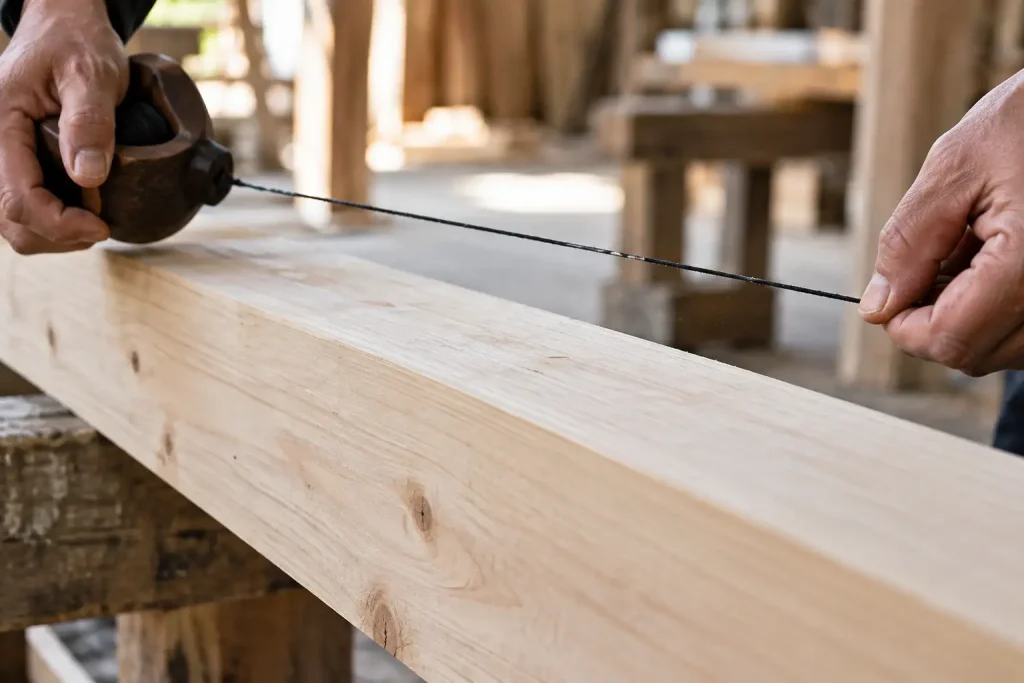
Next comes the sumitsubo ink line. The tool holds ink and a cord. The carpenter draws the inked cord over the timber, lifts it and releases it against the surface.
墨を打ちます。
Sumi o uchimasu.
Literal: “I strike the ink.”
In practice: The carpenter is about to snap a straight reference line.
The verb is revealing. The carpenter does not merely draw the line; the cord strikes it onto the wood. A bamboo 墨差し, sumisashi, literally “ink marker,” can add shorter marks and written layout information.
この線で切ります。
Kono sen de kirimasu.
Literal: “Cut at this line.”
In practice: The marked line controls the saw or chisel work that follows.
The sashigane supplies relationships; the sumitsubo extends them. Together, they let the carpenter move geometry from a reference surface across long timbers without first producing a separate calculation sheet for every line.
From Reference Lines to Mating Surfaces
The lines do not yet make a joint. The carpenter must decide what material stays, what material leaves and which surface controls the final fit.
Two terms help you read the work:
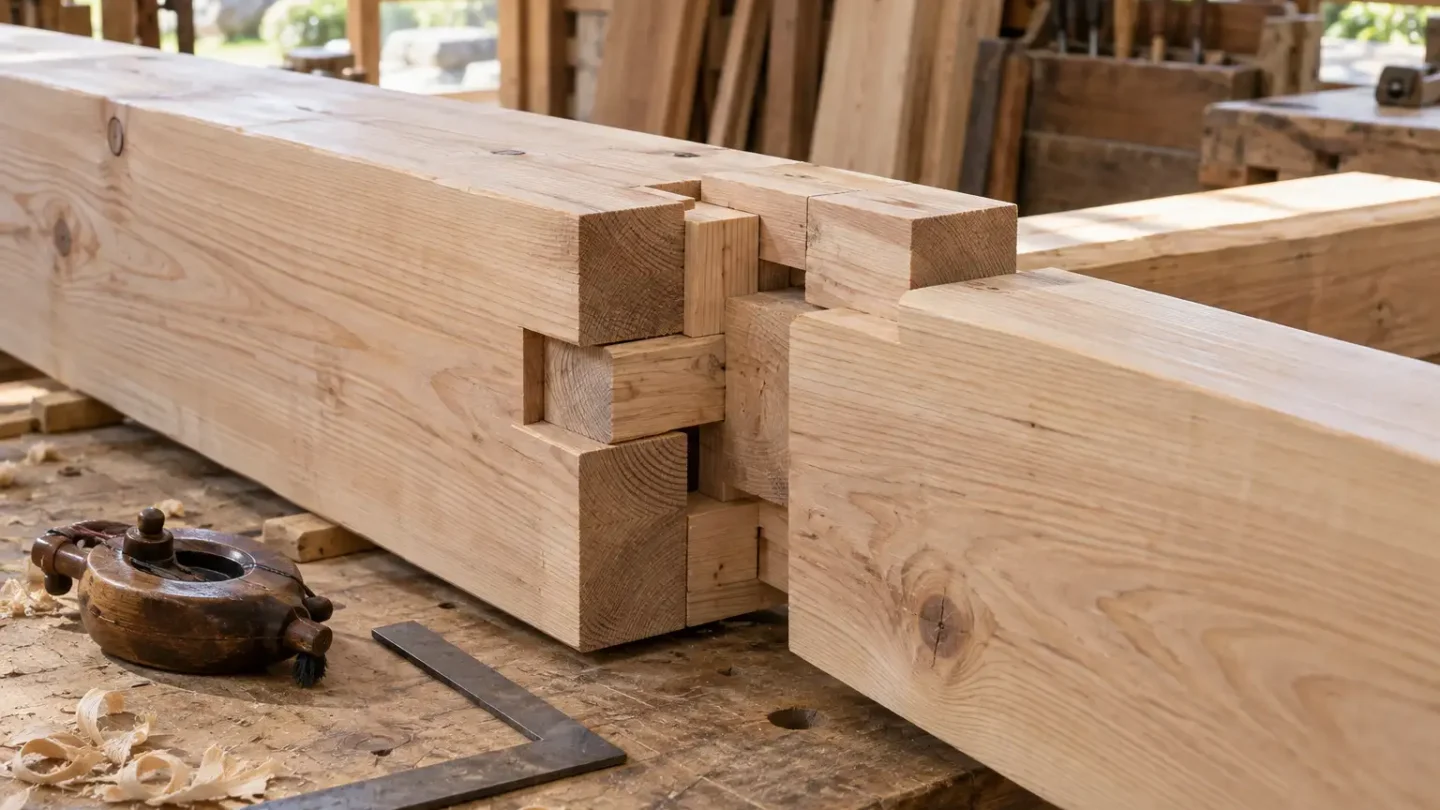
- 継手, tsugite, literally “connecting hand,” joins timbers along their length.
- 仕口, shiguchi, literally “worked opening,” connects members where they meet, commonly at an angle or intersection.
These are useful categories, not promises that every joint has only one universally agreed English name. Regional vocabulary and workshop practice can differ.
これは継手ですか、仕口ですか。
Kore wa tsugite desu ka, shiguchi desu ka.
Literal: “Is this a splice or an intersection joint?”
In practice: You are asking about the joint’s structural job rather than guessing from its shape.
| Tool or element | Japanese term | Job at the bench | Error it helps prevent |
|---|---|---|---|
| Carpenter’s square | 曲尺, sashigane | Transfers right angles, proportions and diagonal relationships | Incorrect layout geometry |
| Ink-line reel | 墨壺, sumitsubo | Snaps a long straight reference line | Wandering cut lines |
| Bamboo marker | 墨差し, sumisashi | Adds local marks and notation | Ambiguous shoulders or waste areas |
| Saw | 鋸, nokogiri | Defines cuts beside the reference line | Removing the fitting surface |
| Chisel | 鑿, nomi | Clears recesses and refines corners | Rounded or crushed internal surfaces |
| Plane | 鉋, kanna | Tunes exposed and mating surfaces | Uneven contact or poor finish |
Japanese hand saws generally cut on the pull stroke. The important point here is not national superiority; it is control. A narrow kerf and a marked reference face help the carpenter approach the line without erasing it.
For another example of a Japanese technique being flattened into one decorative image, How a Square of Cloth Carries a Bottle explains how function changes with the fold. Folds That Ended Up in Space and Surgery does the same for origami beyond display objects.
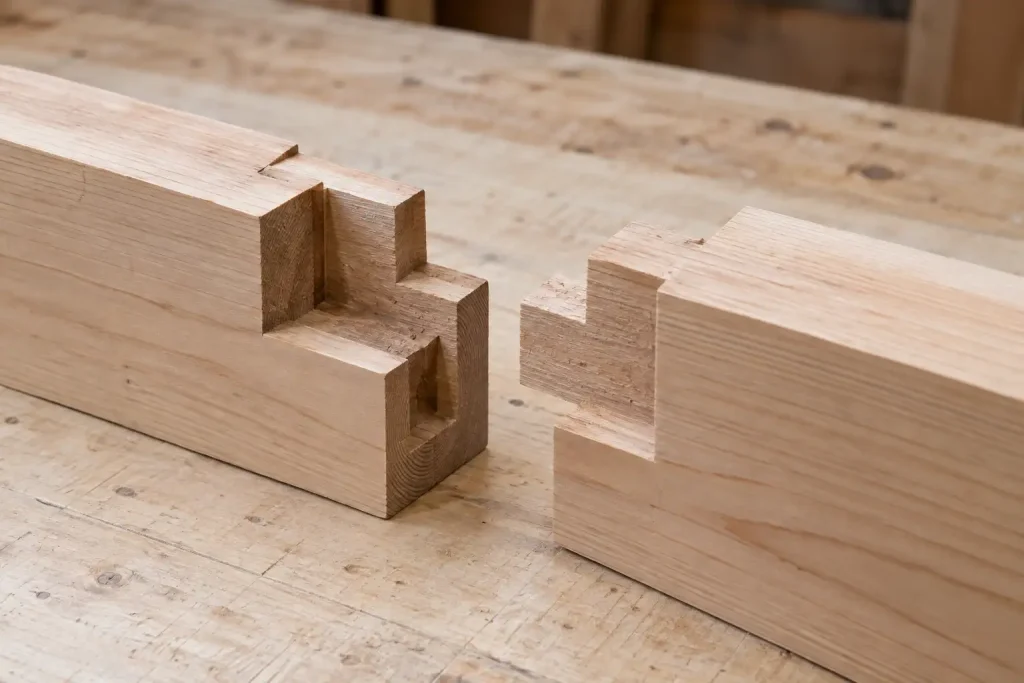
What the Craftsperson Is Checking
You may be studying the visible puzzle. The carpenter is studying contact.
A successful joint is not simply difficult to pull apart. Its shoulders must meet where loads need to pass. Its internal surfaces must not prevent the visible faces from closing. The grain must not be weakened by a badly placed notch. Assembly also has to remain possible in the intended order.
That is why a demonstration may include repeated fitting, separation and shaving. Removing a thick curl because the joint feels tight can ruin the fit. The high spot may be somewhere else.
The craftsperson is effectively asking:
- Are you watching the reference face or only the dramatic cutout?
- Do you understand which surfaces carry load?
- Are you treating the sample as a mechanism rather than a souvenir?
- Will you stop when resistance signals misalignment?
- Do you know whether the example is structural, decorative or designed for disassembly?
If a registration form asks for your name in katakana before a workshop, use the site’s name converter with 898 checked names rather than inventing kanji for yourself. That tool solves name transcription; it does not translate joinery vocabulary.
Where “No Nails” Goes Wrong
The phrase traditional Japanese woodworking is regularly reduced to “buildings made without a single nail.” That is too broad to use as a technical description.
A wooden frame may depend primarily on mortises, tenons, splices, pegs and wedged connections while still containing metal added for roofing, reinforcement, repair or later conservation. A small furniture joint and a temple frame also solve different structural problems.
The sentence that fixes the exchange is more specific:
金物を使わない構造ですか。
Kanamono o tsukawanai kōzō desu ka.
Literal: “Is this a structure that does not use metal fittings?”
In practice: You are asking whether this particular structural system relies on wooden connections rather than assuming the entire object contains no metal.
You can narrow it further:
この継手に釘を使いますか。
Kono tsugite ni kugi o tsukaimasu ka.
Literal: “Do you use nails in this splice?”
In practice: You are asking about the joint in front of you, not every phase of the building’s history.
The uncomfortable fact is that “nail-free” often functions as a sales phrase. It tells you nothing about the precision of the layout, the species and condition of the wood, the direction of the load or whether the joint is appropriate for structural use.
The American Comparison Is Not Hand Tools Versus Machines
An American carpenter may begin the same task with a framing square, chalk line, combination square, layout knife, shop drawing or digital cut list. A Japanese carpenter may also use drawings, machines and metal hardware. The useful contrast is therefore not “ancient Japan” against “modern America.”
The closer comparison is between layout systems.
A US framing square can encode roof and stair relationships in tables stamped into the tool. The sashigane can encode proportional relationships in its scales. A chalk line and a sumitsubo both transfer a long straight line by snapping a coated cord. In both systems, the tool carries information so the worker does not have to reconstruct every relationship from scratch.
What differs is the surrounding vocabulary, the standard sequences taught in the trade and the kinds of joints emphasized. The shared principle is less romantic: accurate reference surfaces produce accurate assemblies.
What Hōryū-ji Proves—and What It Does Not
The strongest evidence for wooden temple construction is not a viral video of two blocks sliding together. It is the surviving architecture in the Hōryū-ji area of Nara Prefecture.
UNESCO’s official record identifies forty-eight wooden structures within the World Heritage property. Eleven date from the late seventh or early eighth century. UNESCO describes them as among the oldest surviving wooden buildings in the world and explains that the structures use a modified post-and-lintel system with intricate bracketing to transfer heavy roof loads into large wooden columns.
“Several date from the late 7th or early 8th century.”
That sentence needs context. The original Hōryū-ji buildings were destroyed by fire in 670; rebuilding began afterward and continued into the early eighth century. The surviving buildings therefore prove the durability of a maintained structural tradition—not the untouched survival of every original piece of wood.
They have been inspected, repaired and conserved. UNESCO notes that damaged members are replaced when necessary and that Japanese conservation work has included dismantling and reconstruction. Survival here means continuity of form, materials, techniques and maintenance.
Hōryū-ji also does not prove that every piece was assembled without any metal. It demonstrates the structural achievement of timber framing, bracketing and fitted wooden connections. That is impressive enough without turning a qualified fact into a myth.
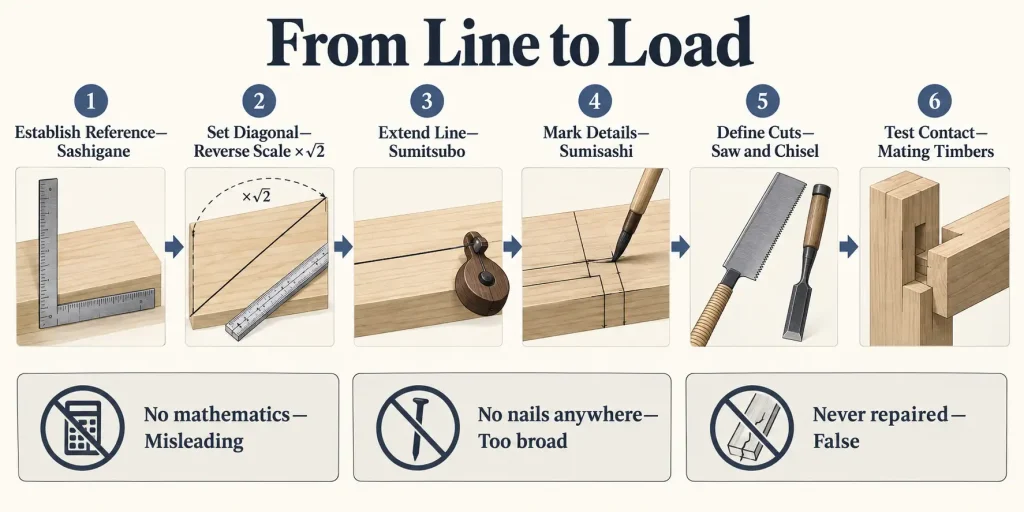
The Transferable Rule
When you watch a joint being made, follow the information rather than the spectacle:
- Find the reference face.
- Watch how the sashigane establishes the relationship.
- Follow the snapped line across the timber.
- Identify whether the connection is a tsugite or shiguchi.
- Ask which surfaces carry the load.
- Clarify exactly where metal is or is not used.
The tools are not props from a vanished craft. The square encodes geometry; the cord transfers it; the cutting tools preserve it. The finished connection works only because each stage keeps faith with the first line.
Two phrases carry the whole encounter:
触ってもいいですか。
Sawatte mo ii desu ka.
“May I touch?”
金物を使わない構造ですか。
Kanamono o tsukawanai kōzō desu ka.
“Is this a structure that does not use metal fittings?”