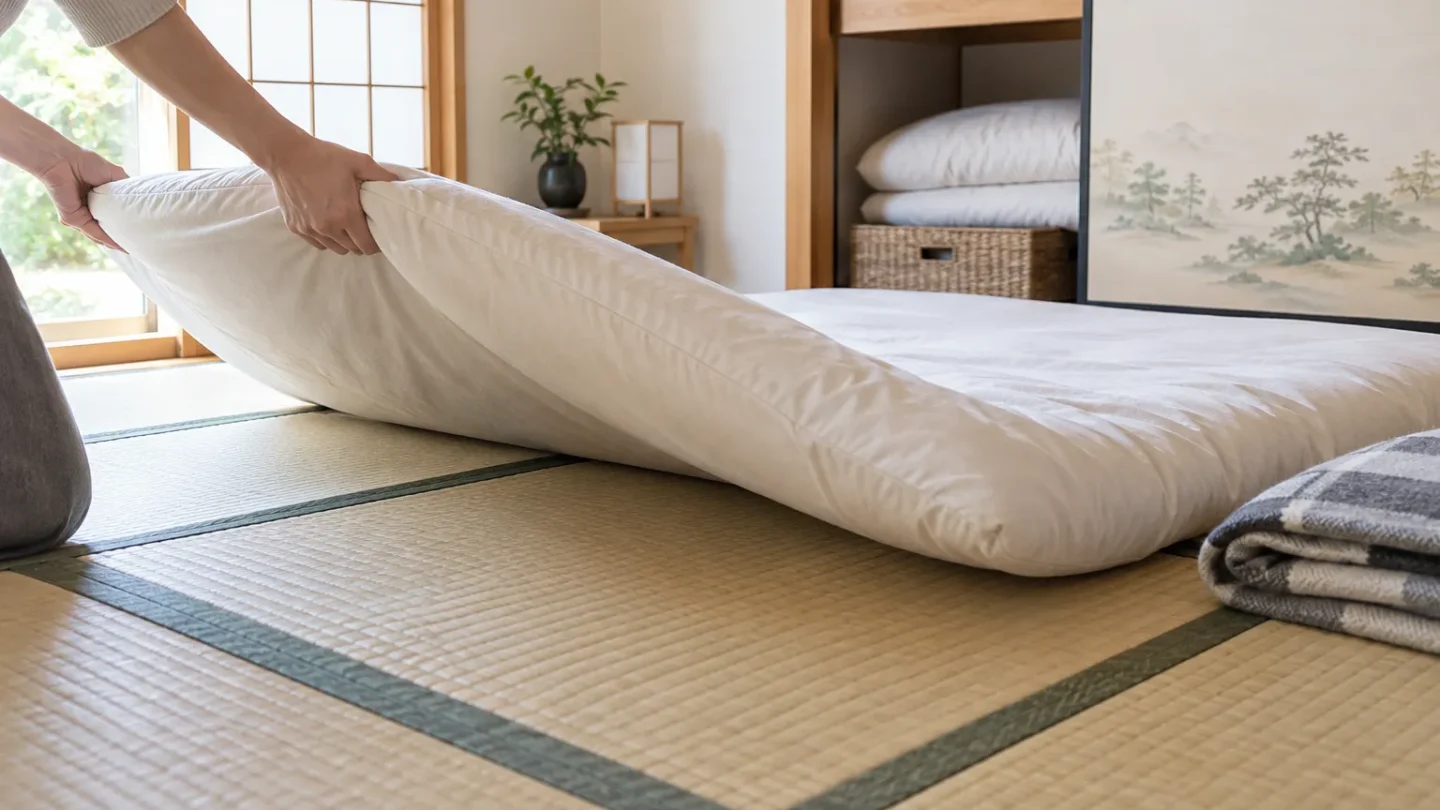
The costliest mistake in japanese futon care is leaving the bedding flat on the floor day after day. By the time you smell something musty or notice dark marks underneath, the problem may involve not only the futon but also the tatami, flooring, or rental deposit.
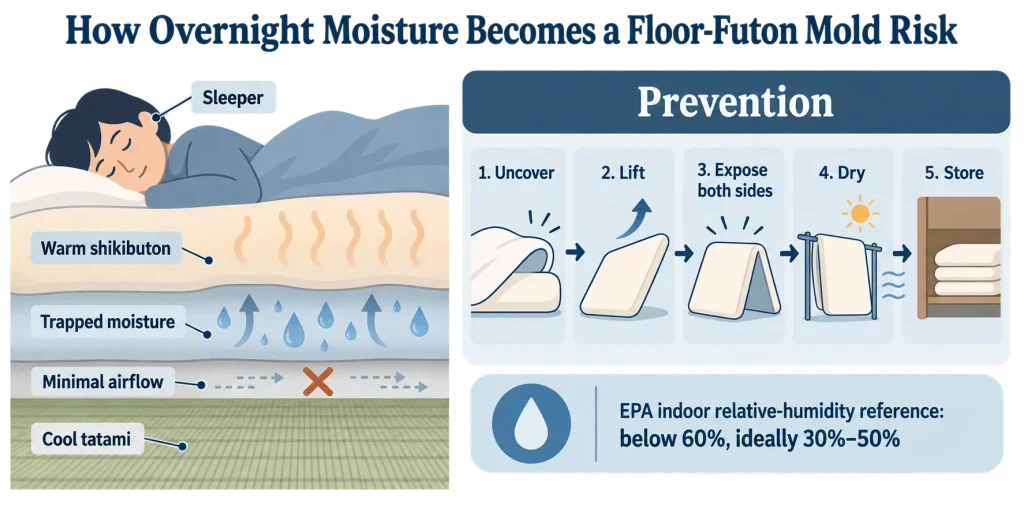
A sleeping person adds moisture to bedding through perspiration and breathing. A floor mattress has almost no ventilation beneath it, so that moisture can remain concentrated where the futon meets the floor. Folding, lifting, airing, and eventually placing the bedding in a closet are therefore moisture-control habits, not a daily performance of Japanese tidiness.
The often-repeated claim that every sleeper produces “about a cup” of moisture overnight sounds satisfyingly precise. However, I could not trace that exact figure to a strong primary source that applies universally to sleeping adults. The quantity changes with the person, room temperature, bedding, season, and length of sleep. What is well established is the mechanism: warm, damp bedding pressed against a cool, poorly ventilated surface creates favorable conditions for condensation and mold.
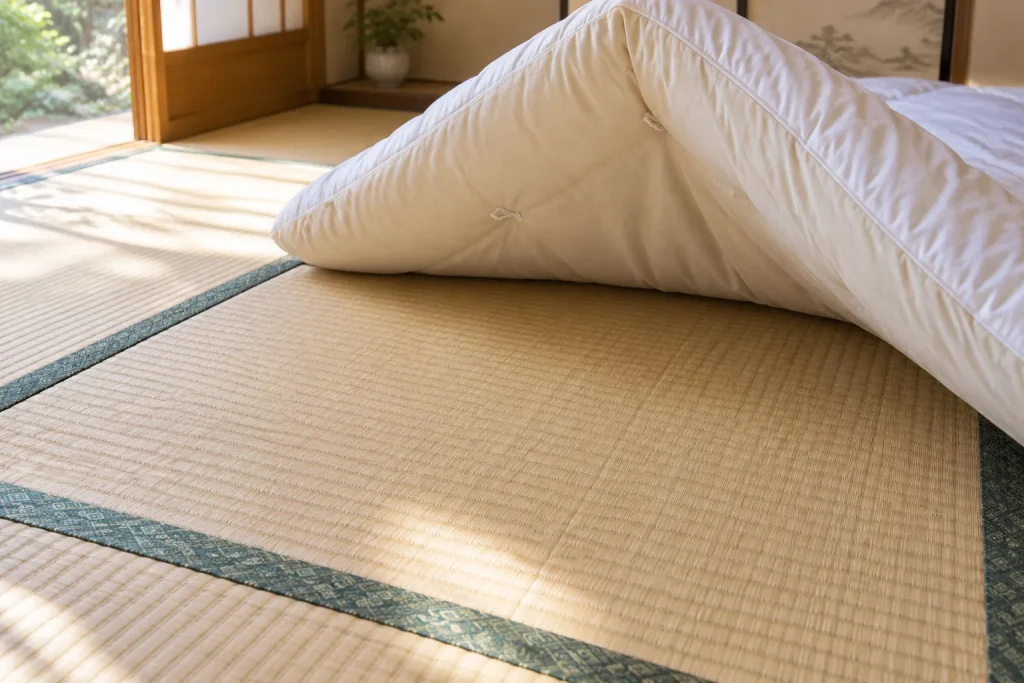
Leaving the futon down all day
You wake up, smooth the covers, and leave everything where it is. This seems reasonable because a bed in an American home normally remains assembled, and the Japanese bedding may look like a thinner version of the same thing. The difference is airflow: a bed frame leaves space under the mattress, while a floor futon places its underside directly against tatami, wood, laminate, or vinyl.
The lower surface can remain cool while the bedding above it holds warmth and moisture. If you repeat the arrangement without lifting the futon, the floor-facing side may never dry completely. Mold can then spread into the cover, filling, tatami surface, or joints in the flooring before it becomes visible from above.
This is also why the habit makes more sense after you understand Reading 1LDK, Jo and the Move-In Bill. A traditional-style room is often expected to change functions during the day, but freeing the floor is only the useful side effect. Moisture management is the practical reason not to leave the bedding sealed against it.
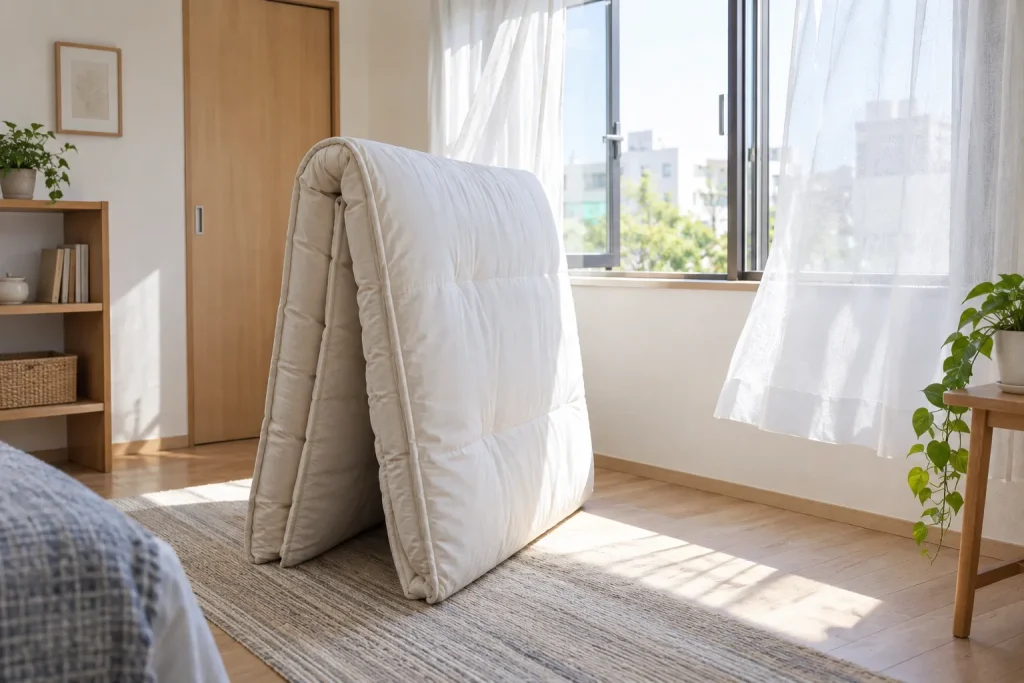
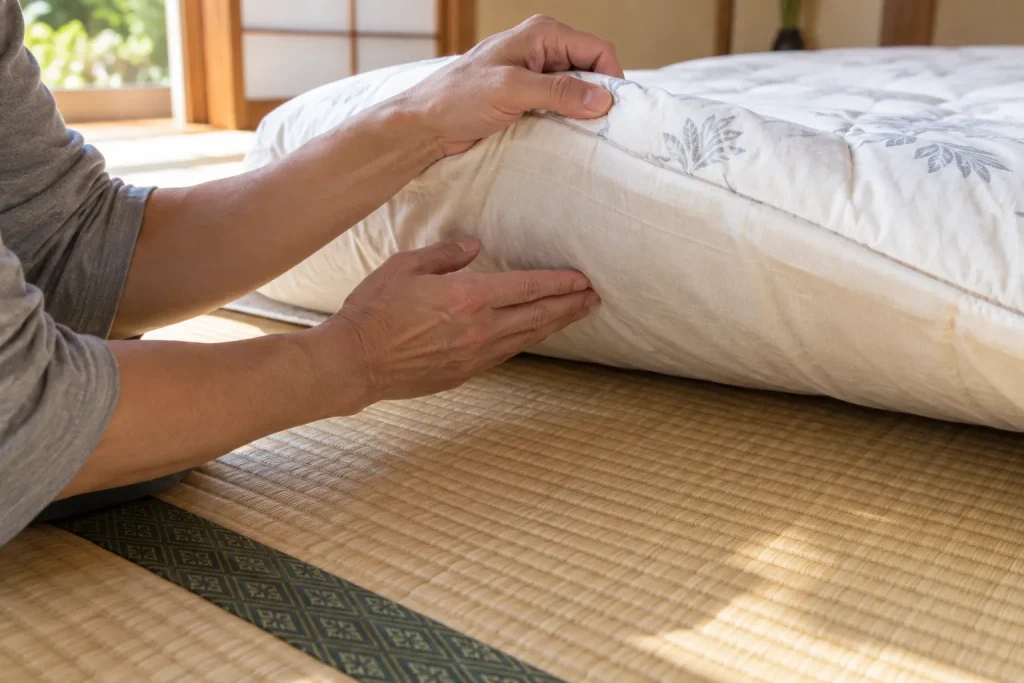
What to do instead: Lift the shikibuton after waking and expose both its underside and the floor before storing it.
Folding damp bedding straight into the closet
Some visitors learn that futons are placed in a closet, then follow the visible part of the custom too literally. They wake up and immediately fold warm bedding into 押入れ, oshiire, literally “push-in storage,” without giving it time to release moisture. It looks correct and restores the room quickly, but it transfers the damp microclimate from the floor to an enclosed cabinet.
A closed closet receives little moving air. When several pieces of bedding are packed tightly together, moisture can pass into adjacent quilts, closet panels, and items that were previously dry. The result may be a musty smell throughout the storage space rather than a single damp futon.
An oshiire is not a drying machine. It is only a storage compartment, traditionally proportioned for bedding and other bulky household items. The futon should be dry enough to store before the doors close.
What to do instead: Air the bedding first, then store it loosely only after the warmth and surface dampness have dissipated.
| Morning condition | Immediate action | Do not do |
|---|---|---|
| Futon feels dry | Lift it and ventilate the underside | Leave it flat until evening |
| Underside feels cool or clammy | Stand or drape it where air reaches both sides | Fold it into the closet |
| Tatami feels damp | Remove all bedding and ventilate the room | Cover the area with another mat |
| Rainy or humid weather | Use indoor airflow or a suitable dryer | Assume outdoor air will dry it |
Assuming tatami absorbs everything safely
畳, tatami, literally “folded or piled mat,” can buffer changes in room humidity because its plant-based materials take up and release moisture. That useful property is often misunderstood as permission to leave damp bedding on it. In reality, absorbent material is not the same as a surface that can remain wet indefinitely.
A futon blocks evaporation from the covered area. Moisture entering the mat may therefore leave more slowly than moisture entering an uncovered section of the same room. The hidden side of the bedding and the tatami beneath it can stay damp even while the room itself feels comfortable.
Tatami also makes damage expensive because mold may affect a fitted floor component rather than a washable cover. If you are comparing apartment listings, How Many Mats Is the Room You Are Renting explains what a room measured in 畳, jō, or mats, actually means.
What to do instead: Treat tatami as a material that needs ventilation, not as a moisture sink beneath permanent bedding.
Putting a futon protector underneath and forgetting it
A moisture-control pad or slatted support can be useful, which makes this one of the half-informed mistakes. You buy the correct accessory, place it under the futon, and assume the problem is permanently solved. Yet the moisture has only been intercepted or given a small air channel; it has not disappeared.
Absorbent pads become damp and require drying. Slats improve circulation, but their contact points, the floor beneath them, and the futon still need inspection. If a pad includes a humidity indicator, the signal helps only when you actually check it and follow the maker’s drying instructions.
The accessory can reduce risk, especially where lifting heavy bedding is difficult. It cannot replace ventilation or turn a floor setup into a maintenance-free bed.
What to do instead: Lift the futon and inspect or dry every layer, including the pad, slats, and floor.
Drying only the side that faces your body
You hang the futon where sunlight reaches its patterned top and assume the job is done. That seems logical because this is the side touching sheets, skin, and blankets. The highest-risk surface, however, may be the underside that remained pressed against the coolest part of the room.
Effective futon drying requires exposure on both sides. Outdoor sun may help when the care label permits it and the weather is suitable, but sun is not the only option. Moving indoor air, a dehumidifier, or an approved bedding dryer can be more useful during Japan’s rainy season than carrying a futon onto a humid balcony.
Always follow the product label because cotton, wool, feather, and synthetic fillings do not share one universal drying method. Strong sunlight can fade fabric or affect certain materials, while incomplete drying can leave moisture deep inside the filling.
What to do instead: Give the underside priority and rotate the futon so air reaches both faces.
Beating the futon hard after sunning it
The familiar image of someone striking bedding over a balcony rail has encouraged another researched-but-incomplete habit. Beating seems as if it should remove dust, mites, and anything loosened by sunlight. In practice, aggressive striking can damage fibers and filling, while failing to remove fine material trapped inside.
Bedding manufacturers commonly advise light surface care rather than forceful beating. A suitable vacuum attachment may remove surface debris more controllably after drying, provided the futon’s care instructions allow it. The main purpose of airing remains moisture removal; making noise with a plastic beater does not prove that the interior is dry.
This distinction matters because mite debris and mold are different problems. Drying reduces the damp conditions that support mold, while cleaning removes particles already present.
What to do instead: Dry according to the label, then clean the surface gently instead of striking the filling.
Trusting sunlight as a cure for existing mold
Sun drying is preventive care, not a reliable restoration method for deeply moldy bedding. Once visible growth or a persistent odor appears, placing the futon outdoors may dry the surface without removing contamination inside the filling. The item can look better temporarily and still return spores and odor to the room.
The EPA advises drying wet materials promptly and controlling indoor humidity, but it does not present sunlight as a universal treatment for contaminated porous materials. A thick futon is porous, difficult to inspect internally, and not always washable at home. Products also differ widely in what professional cleaning they can tolerate.
If mold has reached rental flooring or tatami, delay can increase the repair problem. Photograph the affected area, check the lease, and ask the landlord or property manager before applying chemicals that could bleach or damage the surface. If you need to explain the problem locally, the phrasebook with 337 phrases for everyday situations can help with practical housing conversations.
What to do instead: Isolate visibly affected bedding and ask the manufacturer, a professional cleaner, or the property manager what can be cleaned and what must be replaced.
Copying a fixed airing schedule from the internet
Advice such as “sun it every week” is attractive because it turns care into a calendar task. Unfortunately, an interval that works in a dry, air-conditioned room may fail during a humid summer or in a poorly ventilated ground-floor apartment. Filling material, body heat, indoor laundry, rainfall, and floor construction all change how quickly bedding dries.
The care label is more authoritative for the product than a universal online schedule. Daily lifting is still useful because it breaks contact with the floor and lets you inspect the underside. More intensive drying should respond to actual conditions rather than a borrowed timetable.
“Keep indoor humidity low.” — U.S. Environmental Protection Agency guidance on mold and moisture
A small hygrometer can provide context, but a room reading does not reveal moisture trapped at the center of a thick futon. Touch, odor, inspection, airflow, and the product instructions still matter.
What to do instead: Ventilate after every use and adjust deeper drying to the weather, room, filling, and manufacturer’s directions.
| Method | What it can do | Important limit |
|---|---|---|
| Lifting and folding loosely | Breaks contact with the floor and exposes hidden surfaces | Folding alone does not dry a damp core |
| Outdoor airing | Provides light, heat, and airflow in suitable weather | Follow the label; humid weather may be ineffective |
| Indoor fan or air conditioning | Keeps air moving when outdoor conditions are poor | Air must reach the underside |
| Dehumidifier | Removes water from room air | It does not replace inspection of the floor |
| Bedding dryer | Delivers controlled warm air to compatible bedding | Temperature and method must match product instructions |
| Absorbent underlay | Reduces moisture reaching the floor | The underlay must also be dried |
Assuming every Japanese household follows the same routine
A floor futon remains recognizable Japanese bedding, but it is not a census of how everyone sleeps. Many homes use Western-style beds, raised mattresses, hybrids, or futons placed on frames. Age, mobility, room size, housing design, and the effort of lifting bedding all influence the choice.
A raised bed reduces the need to convert the room each morning and usually provides more airflow beneath the mattress. It does not eliminate moisture care: mattresses, bed bases, and walls can also develop condensation where air circulation is poor. The difference is that a floor futon creates a particularly direct moisture trap.
I could not verify a current official national statistic proving that “most Japanese people now sleep in beds.” That claim should therefore not be presented as a measured fact. The safer point is that beds are common in contemporary Japan and that futon practice varies rather than representing a rule followed by every household.
What to do instead: Choose a sleeping system you can realistically lift, inspect, ventilate, and maintain.
Quick FAQ
Why do Japanese people put futons away every morning?
The practical reason is to separate the bedding from the floor and let hidden moisture escape. Restoring daytime floor space is useful, but tidiness alone does not explain the need to lift and air the futon.
Must a futon be placed in direct sunlight?
No. The correct method depends on the care label, filling, weather, and available ventilation. Indoor airflow, dehumidification, or a compatible bedding dryer may be more suitable when outside air is humid.
Can a futon stay on a slatted base?
A slatted base improves airflow, but it does not make inspection unnecessary. Lift the bedding regularly and check the futon, support, and floor for dampness, odor, discoloration, or condensation.
The morning habit that prevents most damage
After you wake, do not seal the night’s warmth into the floor or closet. Pull back the covers, lift the 敷布団, shikibuton, literally “laid bedding,” and let air reach the underside and the surface below. If either feels damp, continue drying before you store or remake it.
That simple interruption—body, bedding, air, then storage—prevents several expensive mistakes at once. It exposes early discoloration, keeps damp layers apart, and reminds you that how to store a Japanese futon depends on whether it is actually dry. The room may look neater afterward, but neatness is the bonus. Humidity is what runs the habit.