Why the Studio Rarely Owns the Show: Anime Production Committee Explained
You reach the end credits expecting the studio logo to identify the owner. Instead, a publisher, broadcaster, music label, distributor and merchandise company appear under 製作委員会, seisaku iinkai, literally “production committee.” The studio that made thousands of drawings may be listed separately as a contractor. That distinction explains the anime production committee.
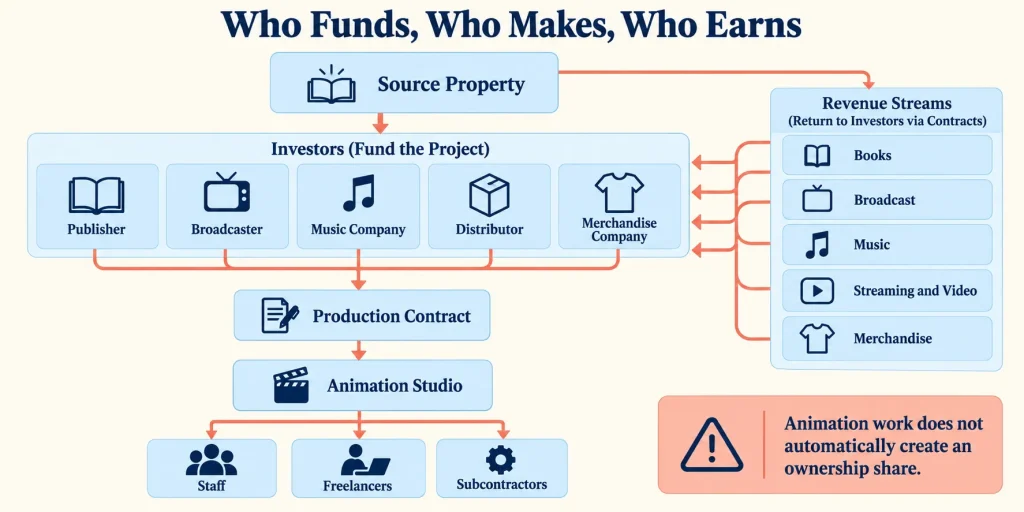
Committee members invest money, rights, distribution capacity or other resources and receive contractual interests in the project. Their businesses often indicate what they want: a publisher may seek book sales, a label music income and a merchandise company character-goods opportunities. The studio may invest too, but production credit alone does not prove ownership.
The company that makes the pictures is not necessarily the company that controls the business built around them.
How an anime production committee assembles a show
The contracts are normally private, but public evidence can still be read in a disciplined order. Credits identify participants, while official announcements, copyright notices and company reports can reveal particular rights. None of those sources should be stretched into an invented ownership percentage.
- Identify the property. A project may begin with a manga, novel, game or original proposal. The source holder controls permission to adapt an existing work.
- Find the lead planner. A publisher, broadcaster, film company or specialist producer may approach partners that expect different commercial benefits.
- Read the Japanese credit. 製作, seisaku, points to planning and commercial production, while 制作, also read seisaku, refers to physical or creative production. English credits often flatten both into “production.”
- Map members to their businesses. Publishers, broadcasters, labels, distributors and goods companies have recognizable interests. Those interests suggest a role but do not prove a contract’s exact terms.
- Check whether the studio invested. A studio named inside the committee or identified as an investor may hold a share. A studio listed only under animation production may instead be a commissioned contractor.
- Separate the production fee from later income. The commissioned budget pays for production, staff, subcontracting and overhead. Streaming, music and merchandise revenue follows separate agreements.
- Follow every commercial channel. Check who broadcasts the series, licenses it abroad, releases its music and sells its products.
- Treat a sequel as a new investment. Another season requires rights, financing, distribution, schedules and production capacity. Audience enthusiasm cannot authorize the studio to continue alone.
The Money Behind a Single Episode explains scripts, storyboards, animation, compositing, sound and delivery. This article stays with ownership and control.

| Participant | Typical interest | Possible contribution | What cannot be assumed |
|---|---|---|---|
| Publisher | Books and source rights | Property access, promotion, investment | Control of every screen right |
| Broadcaster | Television and advertising | Airtime, promotion, investment | Control of overseas streaming |
| Music company | Songs and recordings | Music, performers, marketing | Ownership of the animation |
| Distributor | Physical or digital release | Licensing network, investment | Authority to order a sequel alone |
| Merchandise company | Figures, toys and apparel | Products and retail access | A fixed committee percentage |
| Animation studio | Production of the screen work | Staff, pipeline and delivery | Ownership because it animated the show |
A worked example without invented percentages
Consider a fictional manga adaptation called Harbor Signal. Its publisher controls the source work, a broadcaster wants the premiere, a label supplies the songs, a distributor handles video licensing and a merchandise company plans character goods. Together they finance the project and commission Blue Pier Animation.
Blue Pier receives the agreed fee but does not invest in this example. If a soundtrack or figure succeeds, the relevant contracts determine where that income goes. The studio receives no automatic share because its artists created the movement on screen. This is an illustration, not a claim about a real title or a standard percentage.
If viewers support the first season, Blue Pier still cannot announce another one. The investors must clear the rights, assemble financing and secure a release plan. If the studio is booked, the group can wait, renegotiate or hire another producer.

Rights do not arrive in a standard box
The simplified model says each company buys a share and receives the right matching its business. That is useful as a first diagram, but it is not universal. A participant may contribute cash, intellectual property, advertising inventory, distribution access or services, while the agreement may assign licenses, revenue shares, approvals or territorial rights.
Committee membership creates an economic position, not one standard bundle. A participating studio may share risk and receive negotiated returns. A nonparticipating studio is paid to deliver the work and does not become an owner merely by doing more of the labor.
This is why anime ownership cannot be reconstructed from visual style or logo prominence. Credits establish who was named, while official filings may disclose more. The confidential agreement remains decisive.
| Commercial result | Business likely to value it | Why the studio may receive no direct share |
|---|---|---|
| Higher book sales | Publisher | Publishing income belongs to that business |
| Music streams | Music company | Recording rights follow music agreements |
| Overseas license | Distributor or licensor | Territory rights may sit outside the studio contract |
| Character goods | Merchandise licensee | Product rights can be allocated separately |
| Completed episodes | Animation studio | The studio may have received its production fee |
Why success does not guarantee a sequel
A sequel is not automatically issued after strong audience reaction. Members measure different outcomes: book sales, streaming licenses, broadcast value, music, events or merchandise. A title can perform well in one channel without persuading every company to reinvest.
Another season also needs adaptable material, available staff and a release window. Waiting can preserve continuity but miss a marketing opportunity; moving quickly may require another studio. That is why missing anime sequels cannot be explained from disc sales, followers or overseas popularity alone.
Where viewers misread the structure
The first mistake is treating every studio like a vertically integrated American entertainment company. Some studios invest and own intellectual property; others mainly provide production services. Title-specific evidence matters more than reputation.
The second is reading committee credits as a complete rights map. They rarely publish contribution amounts, voting rules or territorial limits. Credit order must not be converted into imaginary percentages.
The third is assuming that one successful product proves the whole project was profitable. A publisher may report stronger books while another participant sees limited results. The fourth is blaming the studio for every cancellation, although a contractor may lack authority to commission a sequel.
Anime Speech Styles, and What Subtitles Cannot Carry explains what English subtitles compress, while Japanese Honorifics in Anime covers forms such as -san, -kun and -chan.
How the structure reaches animator pay
A committee does not set every worker’s rate. Income varies by occupation, experience, employment status, studio and contract. It would be misleading to divide the entire anime market by the number of artists and call the result available wages.
The structural link is narrower. A studio working for a fixed fee must cover labor and operating costs within that arrangement. If it owns no project interest, later success does not automatically enlarge the budget or flow back to the artists.
JAniCA’s 2026 creator survey records substantial differences among roles and working arrangements. It supports describing conditions as uneven, not publishing one universal salary. Animator pay in Japan reflects contracting, bargaining power, schedules and employment structures as well as ownership.
A studio that invests may receive revenue beyond its fee, but ownership does not promise higher individual pay. It creates a possible route for long-term returns; management still decides how revenue is used.
What changes from title to title
Not every anime uses a conventional multi-company group. A studio or media conglomerate may finance an original property, retain rights or combine several relevant businesses. A streaming platform may commission production differently, and a film may not resemble a television project.
Some studios deliberately move upstream by investing or developing intellectual property. That brings influence and possible returns, but also exposes the company to losses. “Studio” and “investor” are roles that can overlap.
International distribution adds financing routes without making contracts transparent. A platform may obtain certain territories or release windows without owning every underlying right. Follow official title-specific evidence.
What nobody actually minds
Nobody informed expects you to memorize every company in the credits. Sort the names into functions: source rights, broadcasting, music, distribution, merchandise and animation. That is enough to see why control is divided.
Nobody minds if you say a contract is unavailable. Public credits establish participation, not the whole agreement. Admitting that limit is more accurate than drawing a fictional ownership chart.
Nobody serious treats a studio change as automatic proof of hostility. Scheduling, financing or strategy can produce the same result. A replacement studio may inherit designs and oversight while rebuilding the production pipeline.
If a production contact’s name must be rendered in katakana, the name converter contains 898 checked names. It is not a tool for decoding ownership.
What matters is keeping three roles separate: the committee finances the commercial project, the studio produces the animation and individual creators perform the labor.
Frequently asked questions
Does the studio ever join the committee?
Yes. Some studios invest directly or through a related company. Animation credit alone does not prove ownership.
Does each investor receive one category of rights?
Not automatically. A company’s business often explains why it joined, but contracts define its rights, revenue and responsibilities.
Can fans know the exact percentages?
Usually not from credits. A corporate filing, court record or official announcement may disclose part of a title’s structure.
Why can a popular anime change studios?
The original studio may be unavailable, the schedule may have changed or the investors may reorganize production. Popularity does not reserve the same team.
Does merchandise fund animators?
Not automatically. Revenue follows licensing, manufacturing, retail, employment and subcontracting agreements that are generally private.