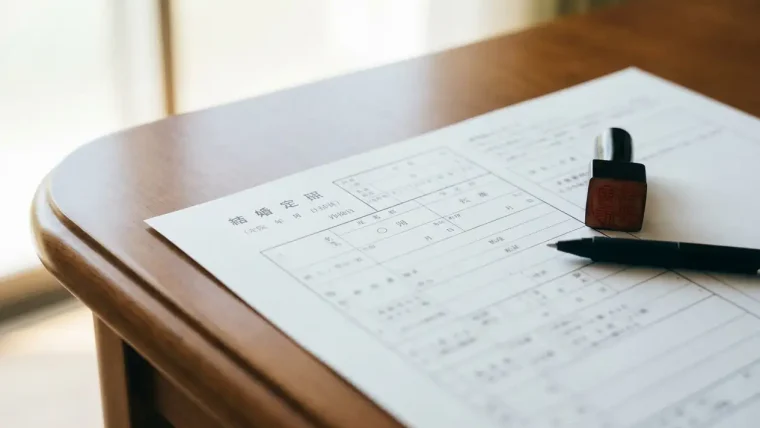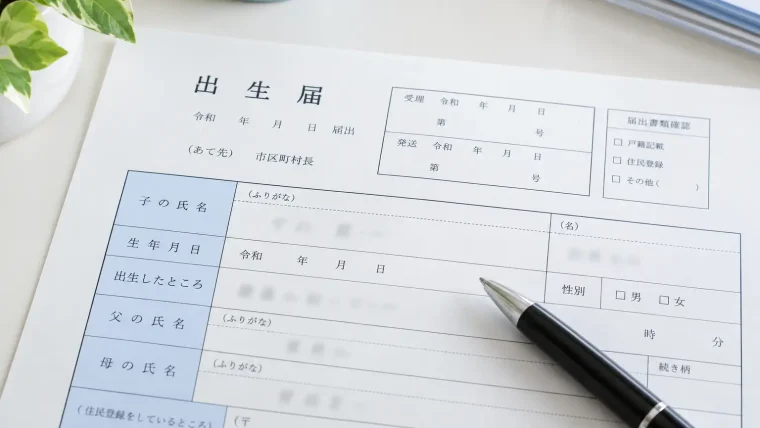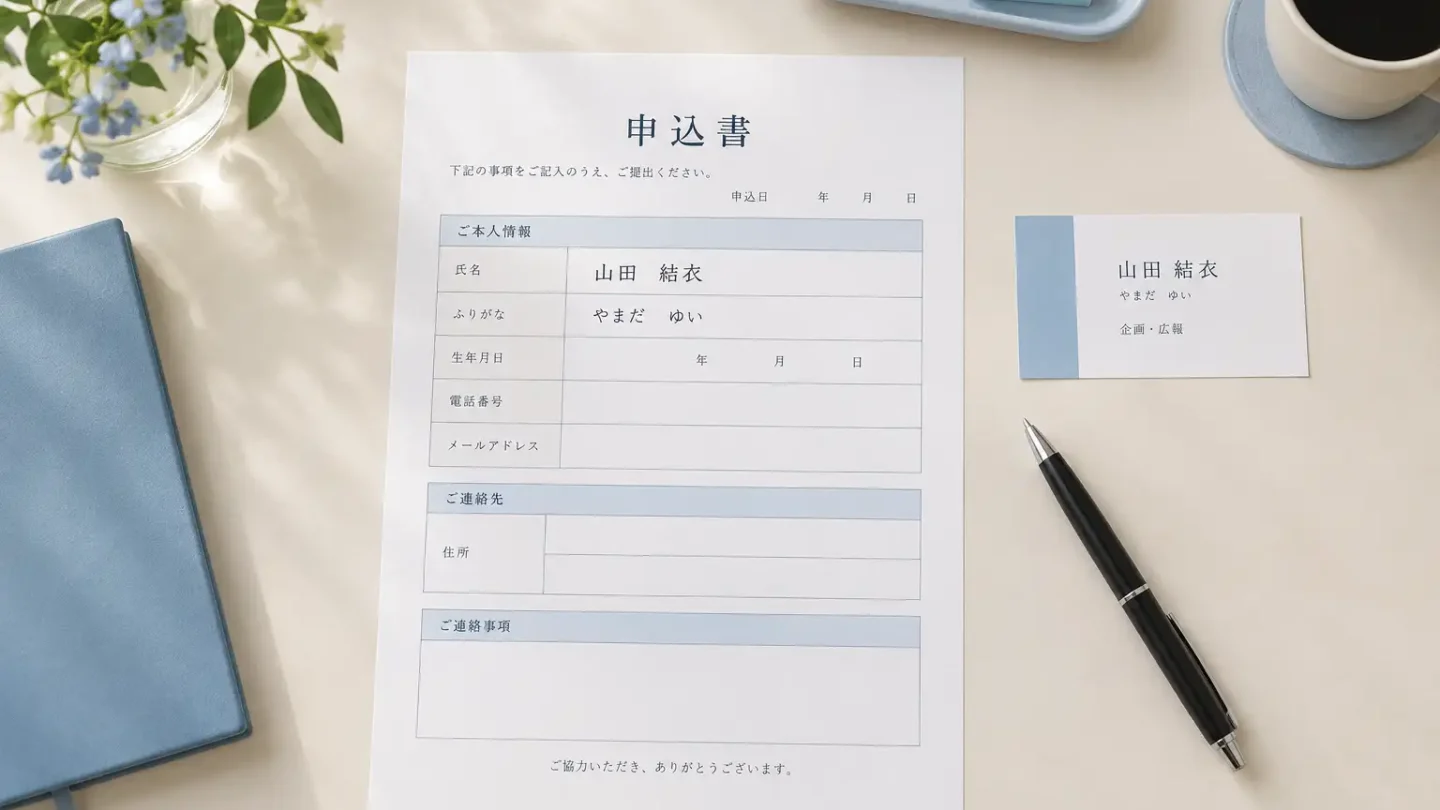
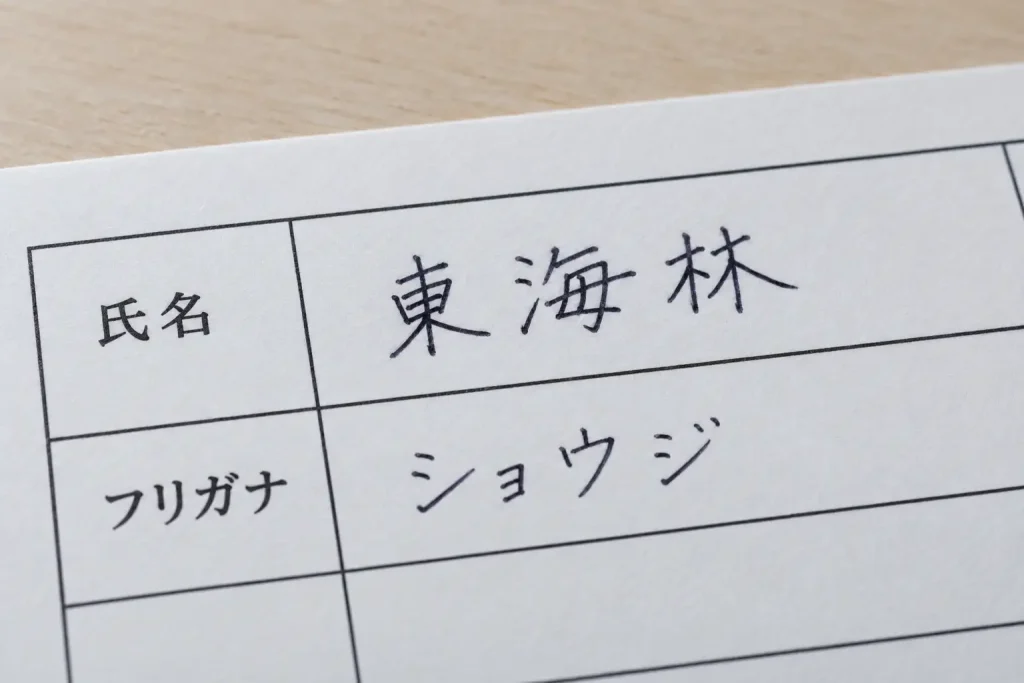
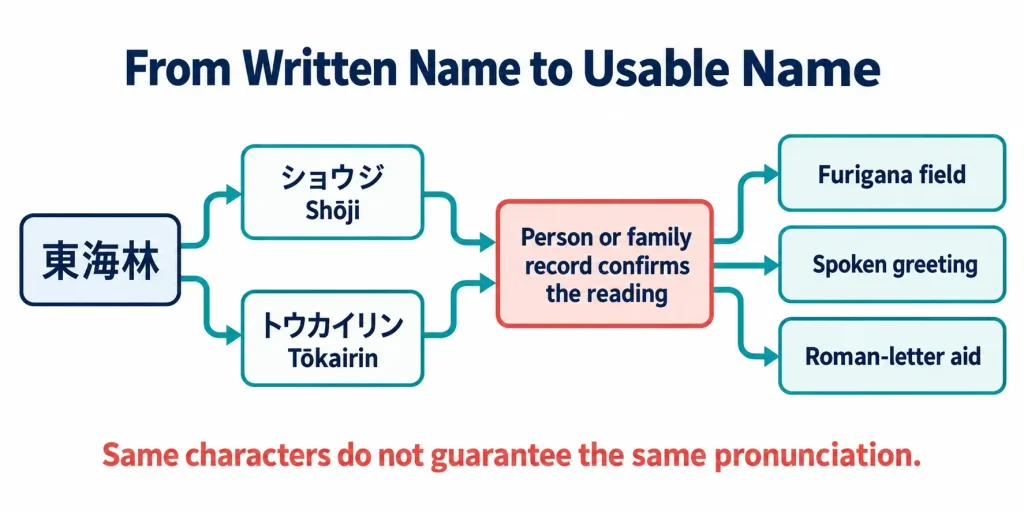
The kanji in a Japanese name do not uniquely encode its pronunciation. That is the mechanism behind Japanese name readings: 東海林 can identify a family that says Shōji and another that says Tōkairin, even though the written surname is identical. A clerk cannot recover the right answer by applying a single kanji-reading rule. A form therefore asks the person to supply the missing sound on a フリガナ, furigana, “reading aid” line. The extra line is not remedial Japanese; it is part of making the name operational.
The characters preserve the registered name and family identity. They do not always identify the established pronunciation. How a Japanese Name Is Built and Read covers the full architecture; this question is narrower. When sound matters, the document asks for it separately. Japanese people can therefore ask each other for a reading without admitting ignorance of the characters.
Why kanji alone cannot settle the pronunciation
Kanji carry readings from different periods and uses, while names preserve combinations ordinary vocabulary may not predict. A character can contribute an 音読み, on’yomi, “sound reading,” a 訓読み, kun’yomi, “meaning reading,” or a name-specific convention. Compounds may alter sounds or preserve an older local form. A personal name is not a vocabulary quiz with one answer. The family’s established use outranks a reader’s best guess.
| Written item | What it supplies | What it cannot guarantee |
|---|---|---|
| 東海林 | The surname’s kanji form | Whether this family says Shōji or Tōkairin |
| しょうじ / ショウジ | The pronunciation in kana | The kanji used to write the surname |
| SHOJI | A Latin-letter rendering | A universally mandatory spelling style |
Ambiguity does not make every pronunciation acceptable. A person named 東海林 does not choose freely between Shōji and Tōkairin. One reading belongs to that person; the other exists in another family. A dictionary lists possibilities but cannot identify the individual. The form records both written identity and declared sound.
How the Japanese name readings field repairs the gap
A フリガナ field asks you to rewrite the name phonetically in kana so staff and software can pronounce, sort, or search it. If the label is written フリガナ in katakana, the expected entry is normally katakana; when it is written ふりがな in hiragana, the expected entry is normally hiragana. This is a form convention, not a universal law, so follow the example printed beside the box. Do not translate the name or substitute a nickname. You are supplying sound, not a second identity.
For a Shōji, 東海林 goes in the name field and ショウジ in the reading field. A Tōkairin writes the same kanji but supplies トウカイリン. Kana makes the records distinguishable. It prevents a wrong greeting at a counter or on the phone. A rigid form may still reject a correct reading over script, spacing, or character width.
The surname and given name are separate data
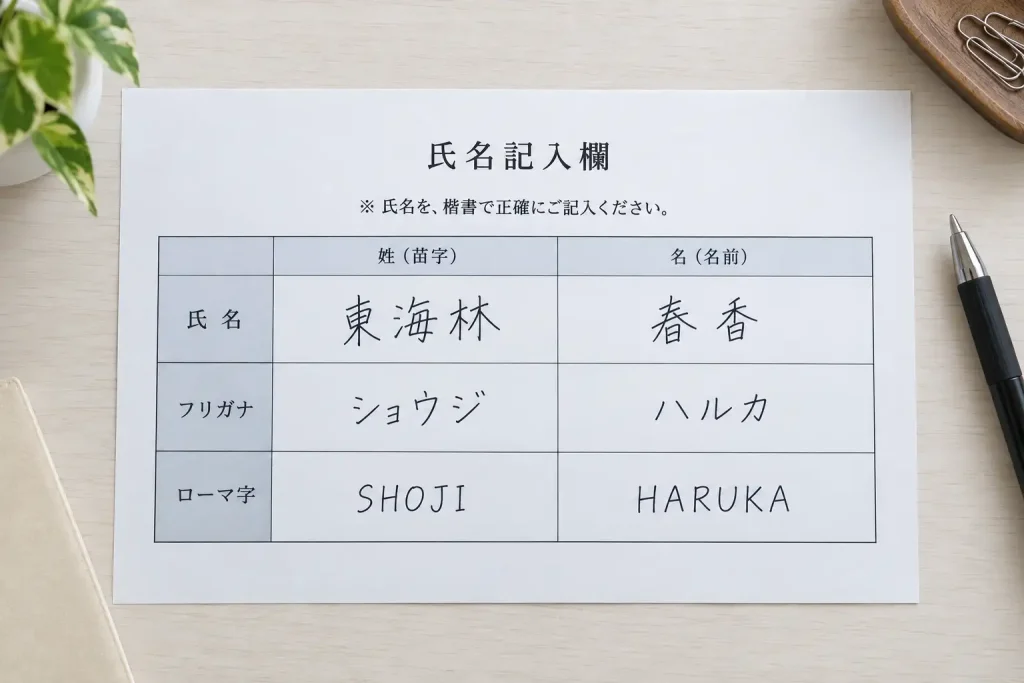
Japanese forms commonly divide 氏/姓, shi/sei, “family name,” from 名, mei/na, “given name,” and may repeat that division in the reading row. Keep each reading under the corresponding written part. Swapping the order can create a record that looks internally valid while addressing you by the wrong half. The outsider’s mistake is to see two boxes and assume they mean first name followed by last name. Read the labels, because Japanese domestic order normally places the family name first.
| Form label | Enter | Example for a Shōji Haruka |
|---|---|---|
| 氏名 / 姓名 | Written name in the requested script | 東海林 春香 |
| セイ | Surname reading in katakana | ショウジ |
| メイ | Given-name reading in katakana | ハルカ |
| Roman letters | The spelling requested by that system | SHOJI HARUKA or the specified order |
Foreign visitors face transliteration, not a choice of Japanese kanji. How to Write Your Name in Japanese explains why foreign names normally use katakana. Katakana Name Rules, and the Names That Break Them covers spellings English letters cannot predict safely. Reuse any katakana already established in your records. The name converter with 898 checked names is a starting point, not authority to replace that spelling.
Why a business card may show the answer twice
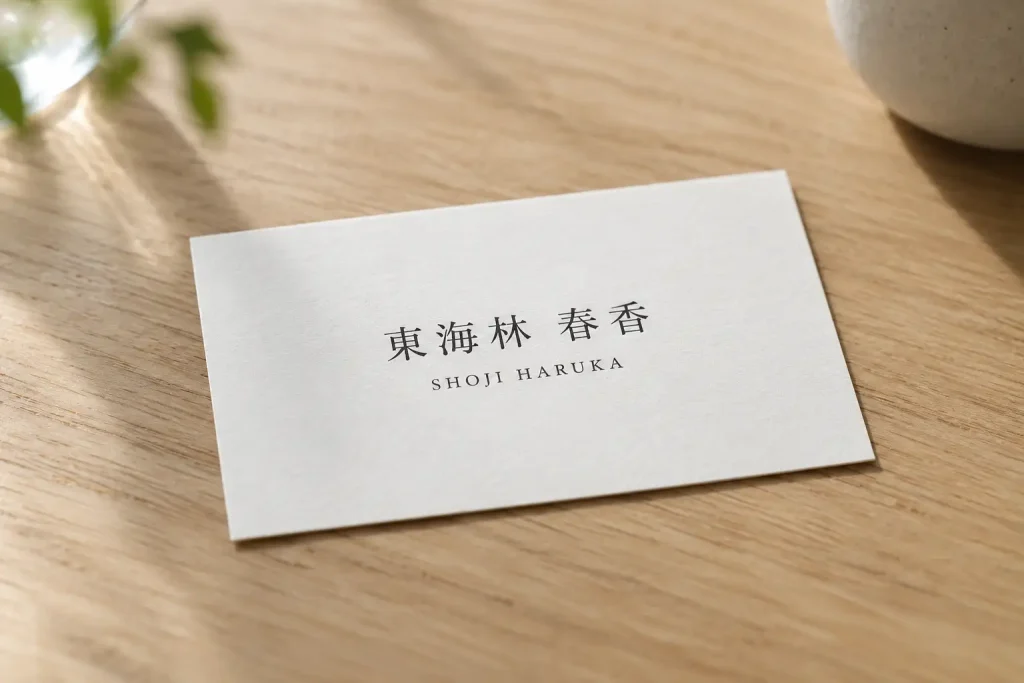
A Japanese 名刺, meishi, “name card,” can print the kanji name prominently and add Roman letters as an immediate pronunciation and identification aid. That arrangement is especially useful in international business, where the recipient may neither read the kanji nor know Japanese name order. It does not prove that Latin letters are legally required on every business card. Some cards use kana, some use Roman letters on the reverse, and some give no reading at all. The design solves the same information problem as a furigana field, but by convention rather than by a single national template.
The Roman line may clarify the family name, although order varies. Do not reverse the displayed order silently. Preserve the supplied spelling because romanization systems differ. Use the person’s pronunciation rather than rebuilding it from kanji. A card is evidence about an individual; a surname list shows only possibilities.
Guessing becomes a data-quality problem
The first consequence is practical: a wrong reading can split one customer into two database records. The second is social: a receptionist may know every character and still need the kana before calling the name aloud. The third is administrative: sorting by pronunciation requires a phonetic value because kanji order does not tell software how the name should be alphabetized in kana. The fourth is that autocomplete can be confidently wrong when several readings share one written form. Furigana for names is therefore not decorative annotation but structured data.
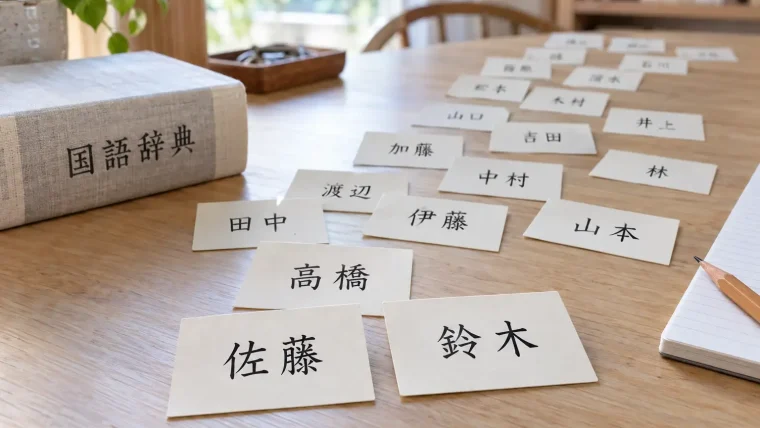
Familiar surnames are often recognized immediately. Sato, Suzuki and the Long Tail Behind Them explains why rare names remain a different problem. Context makes a reading probable, not certain. Regional knowledge helps, but the person remains the authority. Ask お名前は何とお読みしますか, onamae wa nan to oyomi shimasu ka, “How do you read your name?”
The family can preserve a reading the dictionary would not predict
東海林 is a useful example because the literal character sequence appears transparent: 東, higashi/tō, “east”; 海, umi/kai, “sea”; and 林, hayashi/rin, “woods.” Reading the pieces aloud still does not derive Shōji. Reference work collected by Japan’s National Diet Library points readers to surname studies explaining how the Shōji form developed historically, while municipal material documents both Tōkairin and Shōji within a family account. The example is therefore supported, but it should not be turned into a universal origin story for every bearer. Surname histories can branch, migrate, and acquire different explanations.
Character-by-character translation tells you little about sound. Meanings may be historical or no longer salient. Kanji name pronunciation is not solved by translating “east sea woods.” That produces a gloss, not the person’s name. Sound has to be supplied as its own fact.
Official records now make the reading more explicit
Japan’s amended Family Register Act began a new furigana-recording system on May 26, 2025. Municipalities notified people of the reading scheduled for their family register, and incorrect notices had to be corrected through the stated procedure. Where no correction was filed during the implementation period, the municipality could enter the notified reading after that period. The reform makes pronunciation more explicit in official identity data, including later use on resident records and My Number cards. It does not make old kanji spellings self-pronouncing.
The rule also creates a boundary: a newly submitted reading must be generally recognizable as a reading of the characters, with evidence potentially requested for an uncommon established reading. This is not the same as saying that only the most obvious dictionary reading survives. Existing, genuinely used family and given-name readings receive procedural protection rather than being erased for looking unusual. Why Japan Started Refusing Some Baby Names covers the newer limits on proposed readings; this article is about why a reading must be recorded at all. Japanese name furigana now serves both everyday usability and official identification.
Where the mechanism does not apply in the same way
Kana-only names already display their pronunciation, so a second reading may be redundant even when a form still requires the field. Foreign residents commonly have a legal name in Roman letters and a katakana rendering used for Japanese systems, which is transliteration rather than an ambiguous kanji reading. Stage names, pen names, corporate aliases, and historical figures may follow conventions different from a person’s current family register. A business card can prefer an international spelling that is helpful but not identical to the romanization another database generates. These are not counterexamples; they are cases where the paired fields solve a different matching problem.
The form itself can also narrow the answer. A bank, airline, hotel, school, or municipal portal may impose its own character limits and order, so “write the correct reading” is not sufficient operational advice. Match the script requested, the order shown, and the spelling already tied to the relevant identity document. If a system refuses a long vowel, middle dot, hyphen, or space, ask the organization which normalized form it expects rather than improvising a new name. How to read Japanese names and how to satisfy one database are related questions, but they are not identical.
The rule worth carrying to the next form
When a Japanese name matters, copy the kanji as written and take the pronunciation from the person or the supplied furigana—never from your best guess.