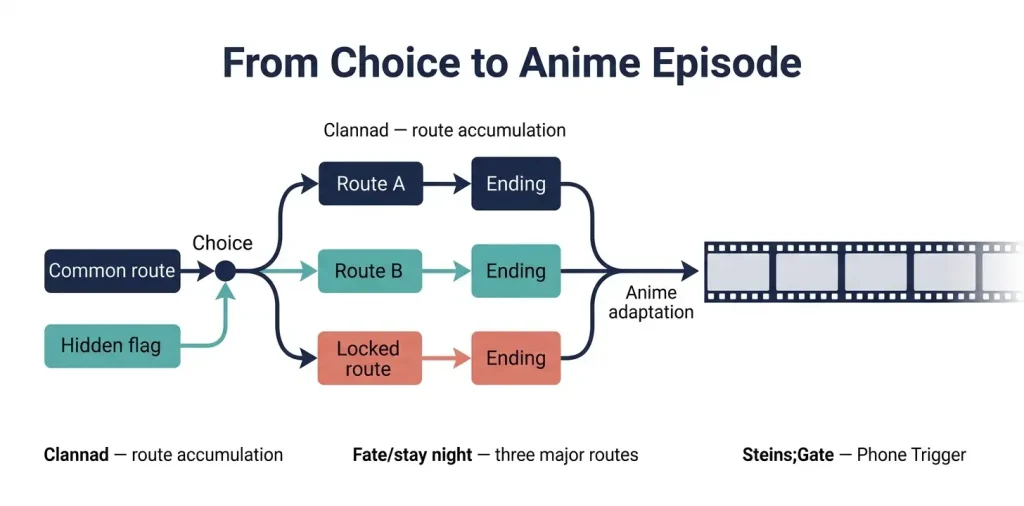
A visual novel repeats one cycle: read, reach a choice or hidden trigger, set a flag, follow the resulting route, finish an ending, then return with knowledge the protagonist did not have the first time. That is the clean answer to what is a visual novel for an anime fan. The screen may look like an adventure game, but movement, combat, and inventory are often absent or secondary. Your real actions are decisions, including decisions the interface may barely announce. Clannad, Fate/stay night, and Steins;Gate reached anime from exactly this form.
Do not wait for a battle system. You mostly read dialogue and narration over art, music, and voices. The software remembers choices and cleared routes. From Weekly Magazine to the Volume You Buy explains manga’s different pipeline. Here, the calendar is one reader’s cycle through a title.

Hour zero: what is a visual novel actually asking you to do?
The opening is intentionally quiet. You advance text and occasionally choose a response. A 選択肢, sentakushi, “choice option,” may open a branch or set an invisible variable checked later. Readers call that variable a flag. A long stretch may contain no branch at all.
You do not win a visual novel by pressing faster. You learn its structure by noticing what changes when you choose differently.
Every route needs a shared baseline. Writers establish the cast before branches separate. Skip-read-text exists because replays cross familiar ground. A route may depend on several earlier flags, not the latest choice alone. Visual novel gameplay is management of narrative state.
The first evening: choices become routes
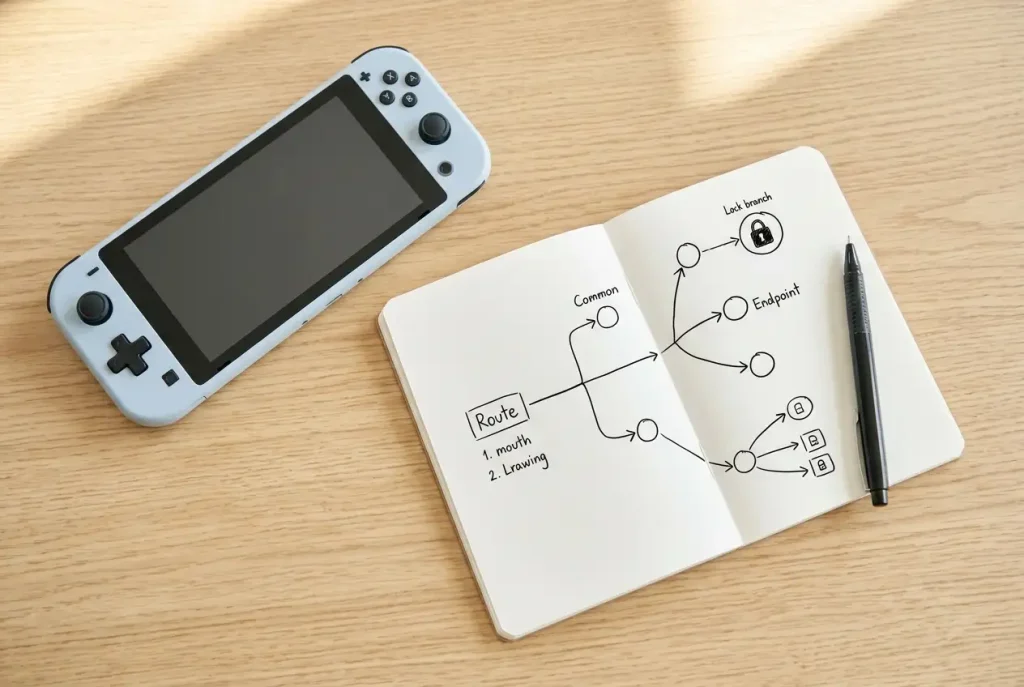
A route is a sustained branch centered on a relationship, conflict, or version of events. It is not necessarily a romance path, although romance visual novels made the term familiar. Once enough flags line up, the common route gives way to material other choices will not show. An anime adaptation must then decide whether to select one route, merge several, or reorganize them into a new linear sequence. That is why watching the anime does not automatically mean you have “seen the game with animation.”
| Mechanic | What the reader does | What the software does |
|---|---|---|
| Choice | Selects a line or action | Records a value or moves to a branch |
| Flag | Usually sees no explicit meter | Remembers an earlier condition |
| Route | Reads one sustained scenario | Loads scenes tied to satisfied conditions |
| Ending | Reaches a stopping point | Unlocks completion data or later material |
| Replay | Reloads or starts again | Skips read text and exposes alternatives |
This model explains why an anime may resolve a supporting character quickly. It borrows a route’s peak without its long setup. Nineteen Pages, Every Week, With Assistants covers weekly manga pressure, not branching software. Both can become anime, but their source structures differ. In a visual novel, the route is the work rather than bonus content.
Night two: Clannad makes replay part of the story
Key released Clannad for Windows on April 28, 2004, as an all-ages work. Its character routes accumulate conditions for later material, including After Story. Kyoto Animation credits Key/VisualArts as the source of its October 2007–March 2008 anime. Television creates one line from material distributed across routes. The repeated school days are machinery, not merely a slower anime.
The modern PC release is an easy English entry, and console editions exist. Clannad disproves the claim that every console port censors an adult game. Its original had no adult scenes to remove. Your choice concerns platform, interface, language, and portability. The Clannad visual novel is the cleanest introduction to route logic here.
The third night: Fate/stay night turns routes into arguments
Fate/stay night began as TYPE-MOON’s 2004 commercial PC release. Fate, Unlimited Blade Works, and Heaven’s Feel are not cosmetic partner choices. Each reveals different facts and tests Shirou Emiya’s ideals differently. Later anime productions adapted different routes. The game expects progression where screen releases separate the material.
The official English remaster launched in August 2024 on Steam and Switch. TYPE-MOON says it uses the 2012 Vita Realta Nua version in 16:9 HD. This is the all-ages console lineage, not every scene from the adult PC original. “Cuts scenes” is incomplete because the edition also revises content and presentation. Fate stay night visual novel buyers should not pretend one edition contains both histories.
The late-night phone check: Steins;Gate hides choices in ordinary behavior
Steins;Gate began in 2009 on Xbox 360. Its Phone Trigger lets you answer or ignore calls and reply to messages. Those ordinary actions alter flags and endings. Choices feel natural because they sit inside Okabe’s phone. Tiny communications then change an entire world line.
The English PC listing estimates 30–50 reading hours. Steins;Gate Elite arrived in North America on February 19, 2019, using television animation plus new sequences for some endings. Elite is not merely “the anime with choices,” nor does it erase the original. Choose the original for its artwork and Phone Trigger presentation, or Elite for continuous animation. Steins Gate game also defeats blanket console-censorship claims because it began on a console.

The weekend replay: flags reveal what the anime had to flatten
An ending makes the hidden structure visible. Flavor text may have been a condition. A phone reply may have closed a branch earlier. Anime must discard this conditional architecture because viewers cannot choose. Read after watching for agency, not only deleted dialogue.
You will notice language differently too. Anime Speech Styles, and What Subtitles Cannot Carry covers compressed register and dialect. Japanese Honorifics in Anime explains relationship-changing suffixes. The converter’s 898 checked American names writes your name in katakana; it does not decode fictional names. Use Four Words That Name a Magazine’s Readers for manga demographics, not visual-novel categories.
Release dates matter; there is no annual visual-novel season
These titles do not recur on a movable calendar. Publication dates replace holiday rules. No shared event moves through 2026 or 2027. The table records only publisher- or studio-supported dates. Later announcements need a new source.
| Title or edition | Confirmed date | Why it matters |
|---|---|---|
| Clannad original Windows release | April 28, 2004 | All-ages source visual novel |
| Clannad TV anime | October 2007–March 2008 | Kyoto Animation adaptation credited to Key/VisualArts |
| Steins;Gate original | 2009 | Console-origin visual novel with Phone Trigger |
| Steins;Gate Elite, North America | February 19, 2019 | Animated reconstruction with branching endings |
| Fate/stay night REMASTERED | August 7–8, 2024, depending on storefront time zone | Official English remaster based on Realta Nua |
The quiet stretches are the point, until they are not
Long passages without choices are normal. Voices, music, and repeated locations establish rhythm. Some readers will find that slow. If you need constant input, these works may not suit you. If you notice changed scenes, quiet stretches give those changes weight.
The bad stretch is unnecessary rereading. Use skip-read-text and several saves. Consult a spoiler-light guide after one blind ending. Read blind first, structured second, and completionist last. That preserves surprise without pretending every hidden flag is fair.
FAQ about visual novels for anime fans
Are visual novels games or books?
They are software built around reading, audiovisual presentation, and stored player decisions. Some contain puzzles or other systems, while others offer only occasional choices. Calling them books ignores flags, routes, saves, and unlock conditions. Calling them conventional games can overpromise mechanical action. “Interactive narrative game” is accurate enough for a beginner.
Should I read the visual novel before watching the anime?
Not necessarily. The anime is the easier commitment and can tell you whether the cast and premise work for you. Reading first preserves route surprises and makes adaptation choices obvious. Watching first makes the novel feel like an expansion with alternate possibilities. For these three, either order works, but the novel always exposes more of the branching structure.
Do console ports always remove adult scenes?
No. Some console editions of adult-origin PC novels remove or replace explicit material, and Fate/stay night’s Realta Nua lineage is the relevant example here. Clannad was all-ages from its original release. Steins;Gate originated on Xbox 360 rather than as an adult PC title. Check the history of the specific edition instead of treating “console port” as a universal censorship label.
Which one should an anime fan read first?
Choose Clannad for a clear lesson in character routes and cumulative unlocking. Choose Fate/stay night if you want separate routes that reinterpret the same protagonist and conflict. Choose Steins;Gate if you prefer choices disguised as phone behavior inside a thriller. Avoid beginning with a completion guide unless missing content bothers you more than spoilers. The best first title is the one whose anime left you asking what happened off the chosen path.
The reading periods worth planning around
Plan one blind opening session, one uninterrupted route-ending session, and a later replay with a route guide. Avoid starting the final locked material when you have only a few minutes, because these stories earn their endings through accumulated context rather than a quick boss fight.