Choose recipes only after you inspect the small Japanese kitchen you will use. Getting that order wrong can leave you with a tray that fits no appliance, three pots competing for two burners, or a countertop oven with nowhere safe to stand. In a japanese apartment kitchen, the answer depends on three things: how many burners you have, whether the cooktop includes a grill drawer, and whether the microwave can actually bake.
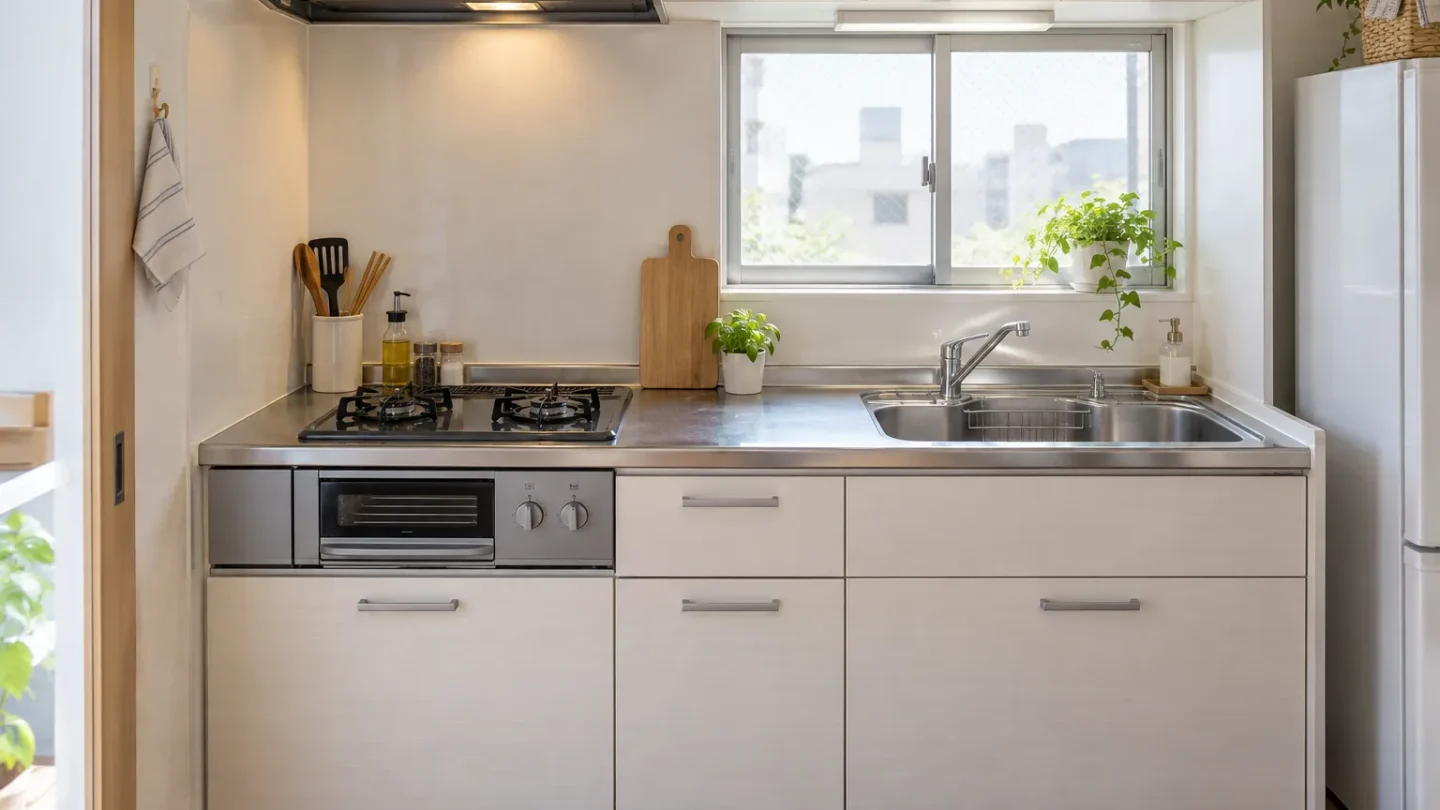
Two burners, a fish grill, and no full-size Western oven is a common setup, not a housing rule. A studio may have one burner and no grill; a family kitchen may have three. Ask what this kitchen can do at the same time.
Count heat sources, not cabinet doors.
Start with the cooktop you already have
The cheapest option is to use only the installed コンロ, konro, literally “stove” or “burner.” It costs no counter space and suits stir-fries, simmered dishes, noodles, soup, rice cooked in a pot, and meals built around one pan.
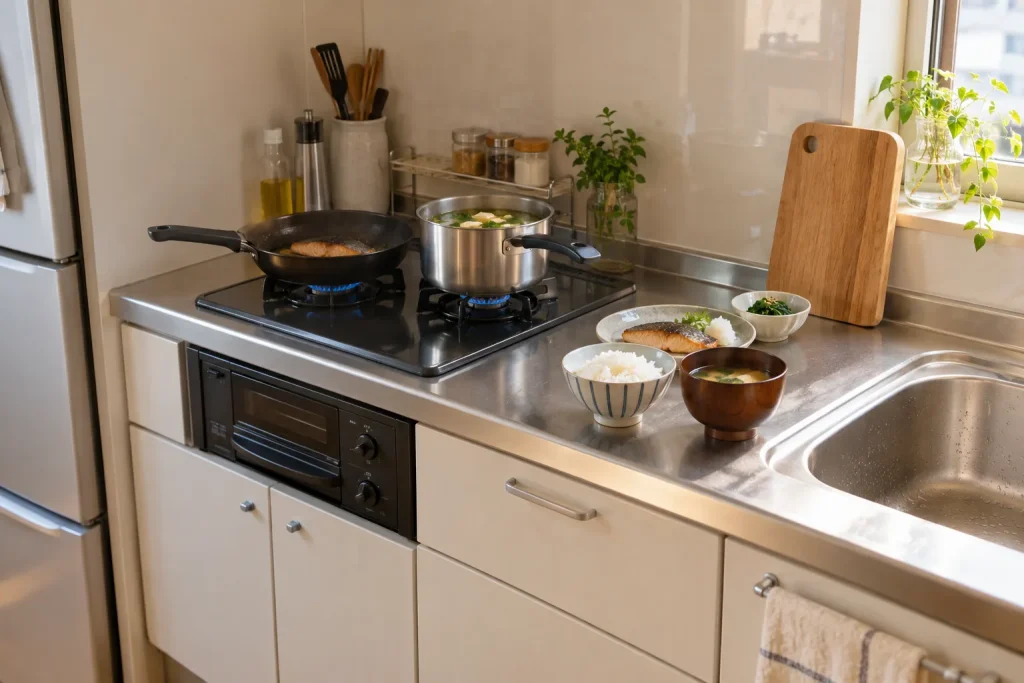
Two burners suit a main pan and soup pot; that workflow does not prove every home is identical. Before signing, read Reading 1LDK, Jo and the Move-In Bill for apartment terms and move-in costs.
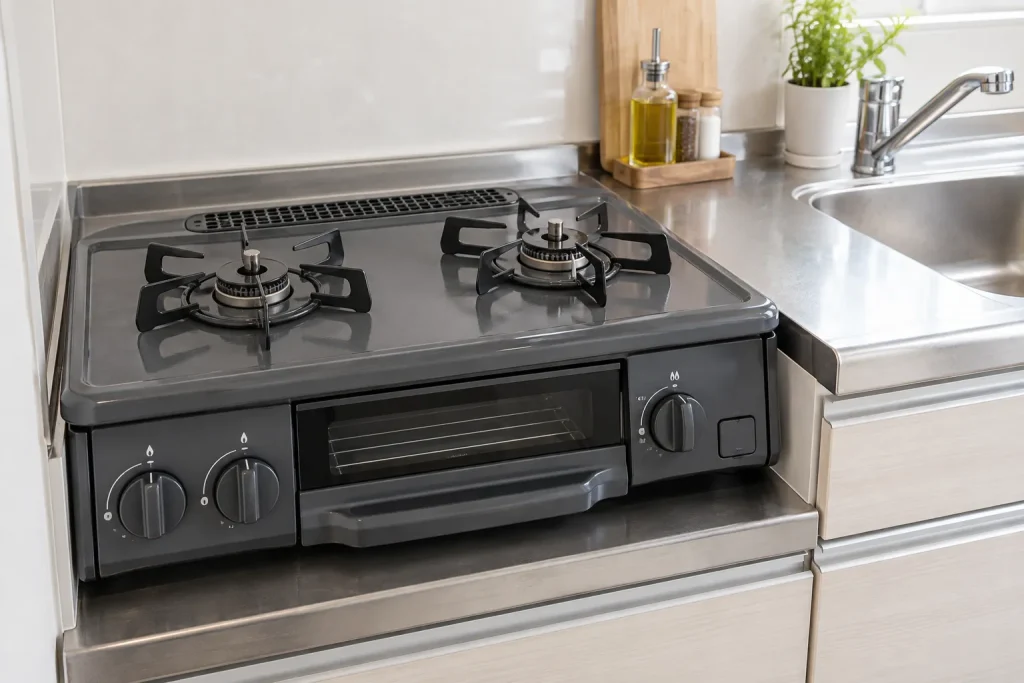
The compromise is concurrency. If one burner holds a simmering pot and the other is frying, none remains for sauce or a side. A recipe with three stovetop components is a scheduling problem in disguise.
| Installed setup | Extra purchase | What it handles well | What usually stalls | Best fit |
|---|---|---|---|---|
| One burner | None | One-pot meals, noodles, skillet dishes | Separate soup and side dishes | Short stays and very small rentals |
| Two burners | None | Main dish plus soup or rice | Three hot components at once | Most everyday cooking plans |
| Three burners | None | Several pans at once | Counter and ventilation can still be limited | Households cooking larger meals |
Use the drawer as a second cooking zone
The shallow drawer under many gas cooktops is 魚焼きグリル, sakana-yaki guriru, literally “fish-grilling grill.” The English loanword grill can mislead Americans: this is not a backyard grate. It is a compact high-heat compartment closer in use to a broiler.
The Japanese fish grill frees the burners for a pot and pan while it browns fish, vegetables, or other food allowed by the manual.
It costs no counter space when built in, but it costs attention. The chamber is shallow, and instructions differ on trays, cookware, timing, and cleaning. Read your model’s manual.
Do not treat the drawer like storage. It becomes hot, so forgotten plastic or paper is dangerous. At a viewing, look inside rather than assuming every two-burner unit includes one.
Why the Floor Steps Up Inside the Door explains the entry boundary; How Many Mats Is the Room You Are Renting explains why room-size numbers resist simple American comparisons.
Add an oven-microwave only when baking earns the counter
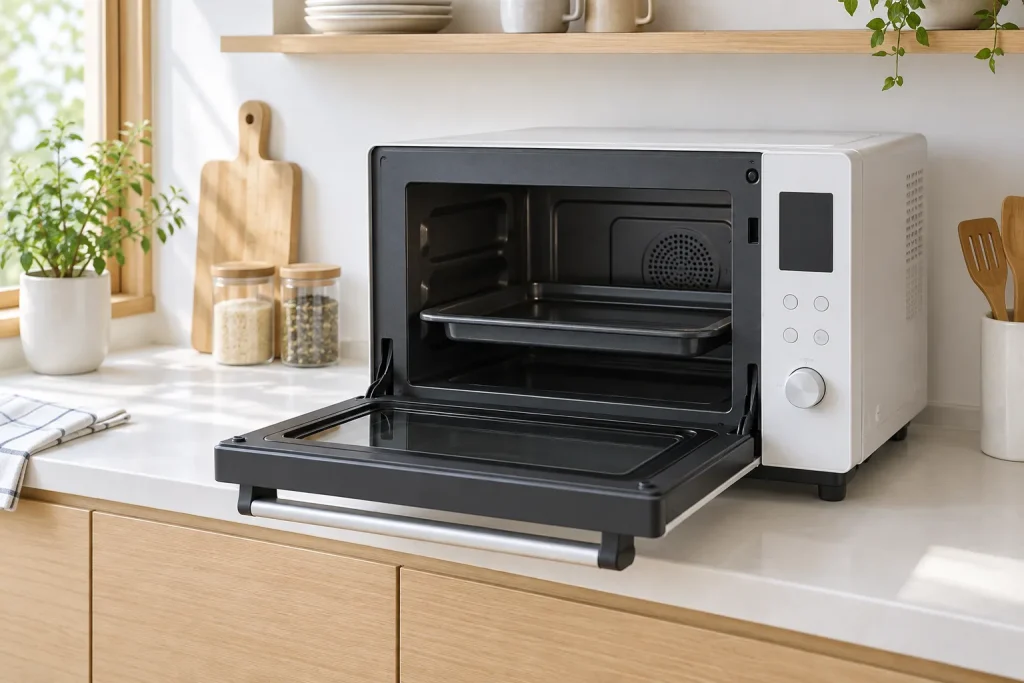
The appliance labeled オーブンレンジ, ōbun renji, literally “oven range,” combines microwave and oven functions in one countertop body. This is another loanword trap: レンジ, renji, commonly means microwave in everyday kitchen speech, not a freestanding American stove.
A convection microwave oven adds baking and roasting without a full-size range. It suits regular bakers who can dedicate a ventilated footprint.
Its real cost is counter space. It needs the clearances in its manual and may accept smaller pans than an American recipe assumes. Capacity alone does not prove a sheet pan fits; internal dimensions and the supplied tray matter more.
Skip the appliance and rewrite the method
If you bake rarely, do not buy a machine merely because a foreign recipe says “preheat oven.” Change the method. Use a lidded frying pan for steam-baking, the grill for surface browning, or choose a stovetop dessert. This costs adaptation time but preserves the scarce counter.
That is often sensible for cooking in a Japanese apartment during a short stay. You are choosing dishes that fit the equipment, not rebuilding your home kitchen in miniature.
Useful adaptations include:
- split a large batch and cook it in sequence;
- replace a sheet-pan dinner with a covered-pan braise;
- grill the protein while soup and vegetables use the burners;
- buy bread from a bakery instead of purchasing an oven for occasional toast;
- measure the appliance cavity before buying pans.
To ask whether a rental has a microwave or working grill, use the phrasebook—337 phrases sorted by situation instead of memorizing a paragraph here.
The three checks that flip the decision
Burner demand
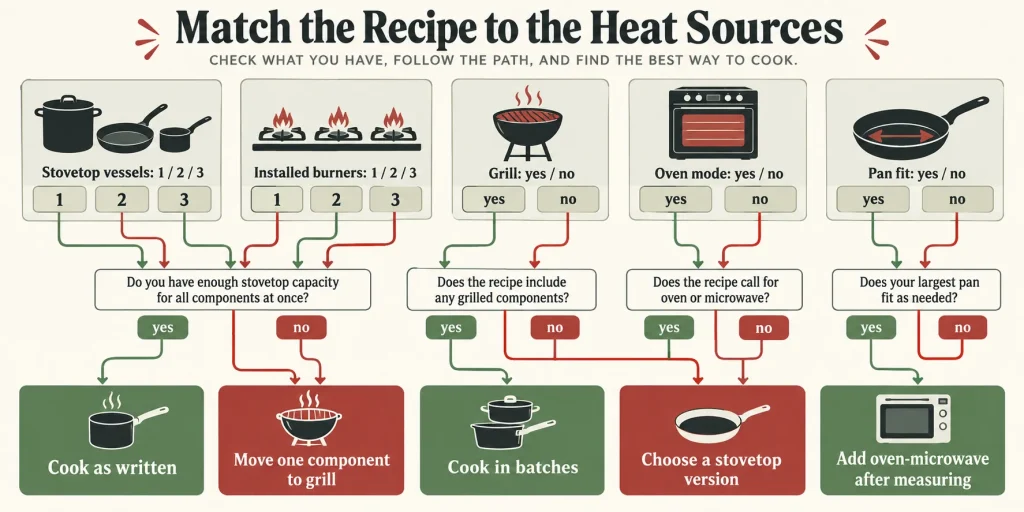
Count the stovetop vessels needed at once. If demand exceeds the burners, move one component to the grill, batch-cook, or change dishes.
Oven frequency
Count actual oven meals, not imagined ones. Occasional baking favors adaptation; recurring weekly baking may justify the footprint. No universal threshold is honest because appliance size, clearance, and your menu change the answer.
Pan fit
The answer flips when the pan exceeds the grill cavity or oven tray. Check usable internal dimensions and approved cookware, not outside width.
| Deciding factor | Keep the installed setup | Use the grill | Add an oven-microwave |
|---|---|---|---|
| Simultaneous stovetop vessels | Demand fits available burners | One item can move off a burner | Oven method removes a pan from the stove |
| Browning | Not essential | Small, close-to-heat portions | Larger or gentler oven cooking |
| Baking frequency | Rare | Only very small grill-safe items | Recurring enough to justify permanent space |
| Pan size | Fits burner and hood safely | Fits the model’s grill cavity | Fits the internal cavity or supplied tray |
| Counter space | Preserve all of it | Uses no extra counter when built in | Requires a permanent, manual-compliant footprint |
Three kitchens, three correct answers
A solo renter with one burner
Dinner calls for noodles, sauce, and soup at the same time: three vessels minus one burner leaves a deficit of two heat positions. Buying more cookware does not solve it. Combine the sauce with the noodles, serve a cold side, and cook soup first if it reheats well. Answer: rewrite the menu.
A couple with two burners and a grill
Dinner needs one pot of rice, one pan of vegetables, and one browned fish portion: three hot jobs minus two burners leaves one job. Move the fish to the grill and the deficit becomes zero. Answer: use the installed grill; no countertop appliance is needed.
A long-term renter who bakes
The kitchen has two burners but the recurring recipe needs one oven tray and one saucepan. Burner demand is only one, so the stove is not the problem; missing oven function is. If the intended tray fits a model’s usable cavity and the manufacturer’s clearance fits the counter, answer: buy an oven-microwave. If either measurement fails, choose a smaller appliance or change the recipe.
These are equipment calculations, not lifestyle judgments. A small space is not automatically efficient, and more Japanese kitchen appliances are not automatically an upgrade.
The limits a recipe never mentions
A recipe may fit your pans and still be wrong for the kitchen. Steam, smoke, splattering oil, and appliance heat matter more when the preparation area is close to the living space. Check the 換気扇, kankisen, literally “ventilation fan,” before planning frequent frying or grill use. You should also confirm that an oven-microwave can stand near a suitable outlet while keeping the installation clearances required by its manual. An extension cord is not a substitute for the manufacturer’s electrical instructions.
Open-plan studios create another practical cost: cooking smells do not stay in the kitchen. The fish grill may save a burner, but it can also require immediate cleaning and longer ventilation. If the fan is weak or the grill is difficult to clean, covered-pan recipes may suit the apartment better. This is why an equipment checklist should include ventilation, electrical access, and cleaning—not just the number of burners. The best cooking method is the one the room can support repeatedly, not the one that works once.
Defaults that waste money or dinner
- Buying pans before measuring. Exterior appliance dimensions do not prove interior tray fit.
- Assuming every microwave bakes. 電子レンジ, denshi renji, literally “electronic range,” may be microwave-only; look for an oven mode and its manual.
- Calling the fish drawer an oven. It can brown quickly, but its dimensions, controls, and approved cookware are model-specific.
- Planning every recipe as if both burners stay free. Rice, soup, and a simmering dish occupy real burner time.
- Treating “Japanese kitchen” as one specification. One-, two-, and three-burner products all exist, with grilled and grill-less configurations.
The uncomfortable part: an appliance that restores one method may remove the counter needed for every other method. Measure first.
A kitchen workflow you can see at a glance
FAQ
Do all Japanese apartments have a fish grill?
No. Grill-equipped two-burner cooktops are sold, but so are grill-less one-burner units. Confirm the actual appliance in the listing or at the viewing.
Can I bake in a Japanese microwave?
Only if it has an oven function. An ōbun renji is designed to combine functions; a microwave-only denshi renji is not a substitute.
Is the fish grill only for fish?
No, but use only foods and cookware allowed by that model’s manual. The shallow chamber and close heat change timing sharply.
Should I buy an oven before moving in?
No. Measure the counter, electrical location, required clearances, internal cavity, and tray first. The right appliance on paper can be the wrong appliance in the room.
If the recipe needs no more burners than you have, cook it as written.
Otherwise, move one job to the grill—or change the method before buying an oven.