The words you will actually meet in a Japanese home bath are printed on the water-heater panel, molded into the bath lid, written beside the washing-machine controls, or spoken when someone tells you the bath is ready. The important ones are not decorative cultural vocabulary. They tell you where to wash, whether the tub is filling, how to warm the same water again, and whether that water will be needed for laundry. Learn them in the order you encounter them and the room becomes much easier to use.
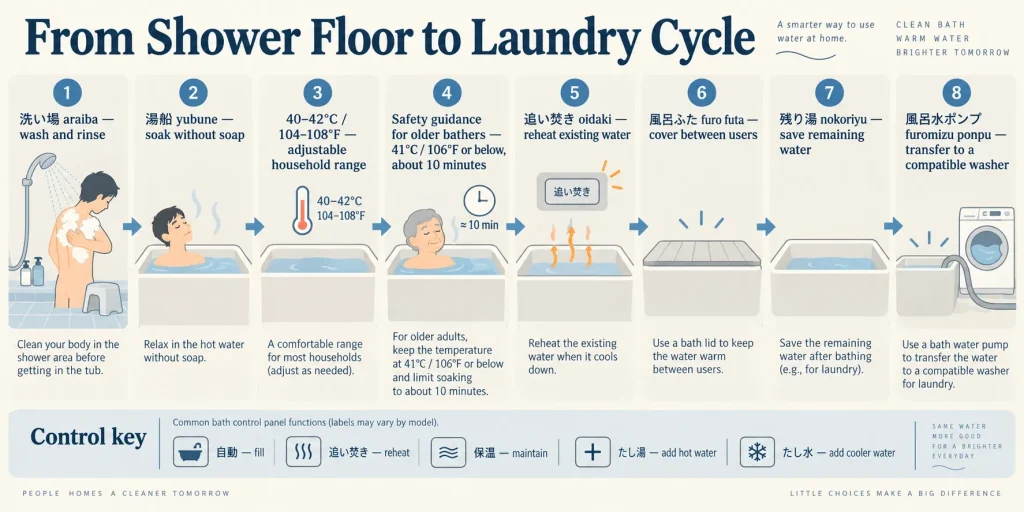
The basic household sequence is straightforward. You wash and rinse in the shower area before entering the tub. Then you soak without soap in water that other members of the household may use after you. A control can reheat that water, and compatible washing machines can draw the remaining water through a hose for selected laundry stages.
“The shared part is the hot water, not the dirt from washing.”
Words you meet before entering the bathroom
Japanese apartment listings rarely explain the bathing routine. Instead, they describe the rooms and installed equipment. Before learning the buttons, you need to recognize what kind of bathroom the apartment has.
お風呂 — ofuro: bath or bathing
お風呂, ofuro, literally “bath,” can refer to the bathtub, the bathroom, or the whole act of bathing. You meet the word when someone says お風呂が沸きました, ofuro ga wakimashita, meaning the bath is ready, or when an appliance announces that the filling cycle has finished.
The common mistake is translating ofuro as “bathtub” every time. In conversation, お風呂に入る, ofuro ni hairu, means to take a bath, not merely to climb into a tub. It includes washing before soaking.
If apartment terminology is still unfamiliar, Reading 1LDK, Jo and the Move-In Bill explains how Japanese listings describe the whole home. The bathroom is only one part of a floor plan whose labels may not map neatly onto American real-estate language.
浴室 — yokushitsu: bathing room
浴室, yokushitsu, literally “bathing room,” is the physical wet room containing the tub and washing area. You will see the term in appliance manuals, ventilation controls, inspection documents, and rental information.
The mistake is assuming that yokushitsu always contains a toilet. In many Japanese homes, the toilet is in a separate room. This separation is as deliberate as the level change at the entrance explained in Why the Floor Steps Up Inside the Door.
ユニットバス — yunitto basu: unit bath
ユニットバス, yunitto basu, literally “unit bath,” is a prefabricated bathroom module. This is one of the terms whose meaning differs from what its English sound suggests. “Unit” describes the construction method, not necessarily a tiny room where the toilet and tub are combined.
Some modules contain only the bathing area. Others are two-piece or three-piece arrangements that place a sink or toilet in the same molded space. The mistake is rejecting an apartment merely because the listing says unit bath. Check the floor plan or photographs to see which fixtures share the room.
Terms that control the washing sequence
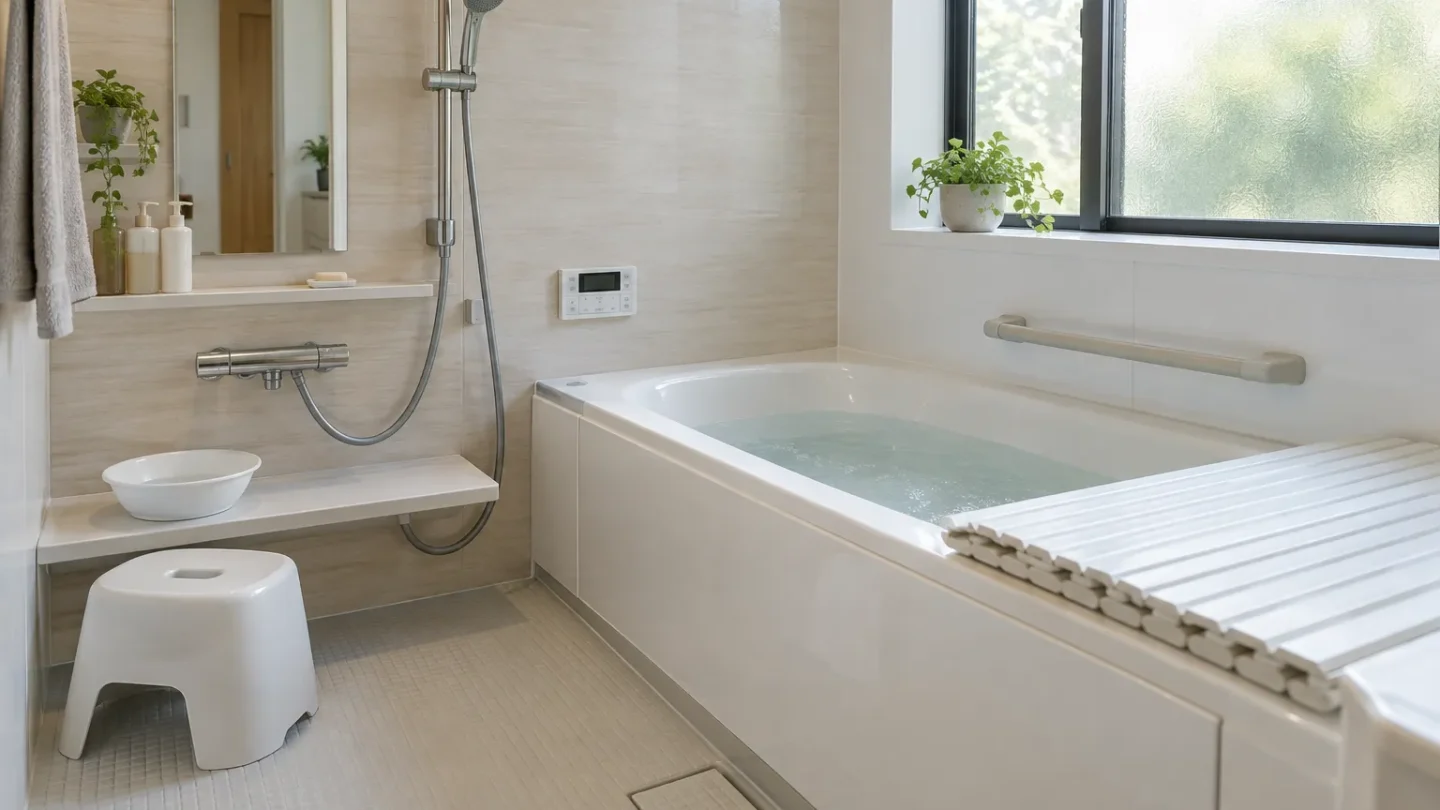
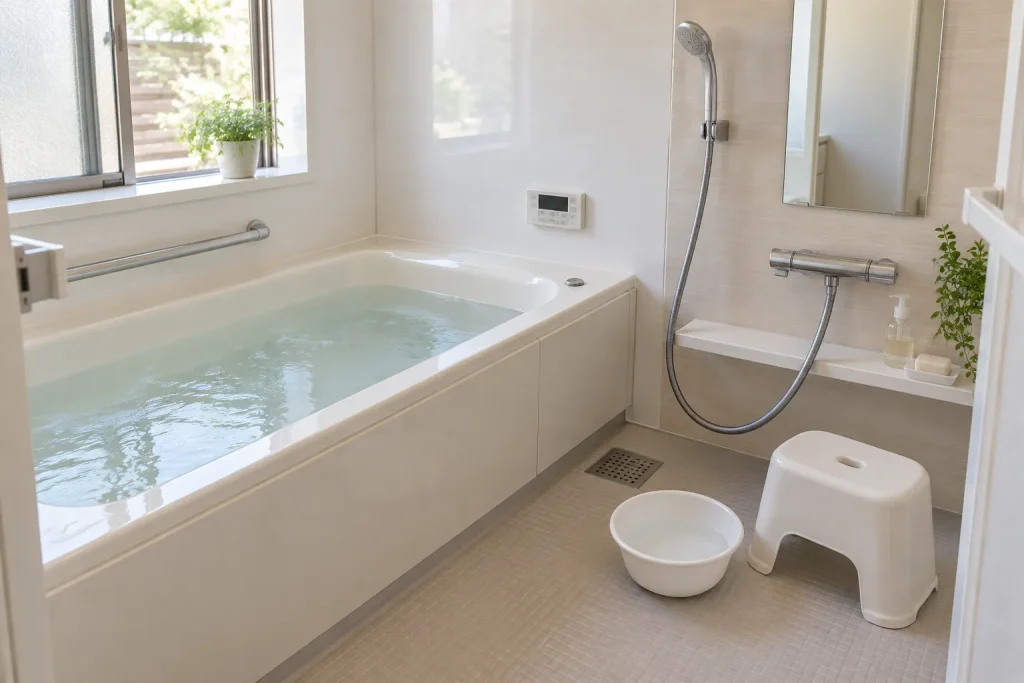
The tub is not the place where you perform the main wash. The waterproof floor beside it is designed for showering, shampooing, and rinsing. This is why the Japanese room can look unusually wet to an American visitor without being misused.
洗い場 — araiba: washing place
洗い場, araiba, literally “washing place,” is the open floor beside the bathtub. You meet it as soon as you notice that the showerhead, stool, faucet, and drain are outside the tub.
You sit or stand here to wash. Rinse away soap and shampoo before entering the tub, especially when the household intends to share or reuse the water. The usual visitor mistake is showering inside the bathtub as if the room were an American tub-and-shower combination.
風呂椅子 — furo isu: bath chair
風呂椅子, furo isu, literally “bath chair,” is the small waterproof stool used while washing. The loanword 椅子, isu, means chair, but this is not a mobility aid or a decorative seat. It keeps you low enough to use the hand shower without spraying the room unnecessarily.
You meet it on the washing floor, sometimes tucked beneath a counter. The common mistake is placing it in the tub. It stays outside, and you should rinse it after use.
洗面器 — senmenki: washbowl
洗面器, senmenki, literally “face-washing vessel,” is the plastic bowl usually stored near the stool. You can fill it from the faucet and use it to rinse yourself or the washing area.
Its name does not limit it to washing your face. However, it is not a drinking vessel and should not be left floating in shared bath water. Rinse it and return it to its storage position.
かけ湯 — kakeyu: pouring hot water over yourself
かけ湯, kakeyu, literally “poured hot water,” means rinsing your body with warm water before soaking. In a private home, you will more often perform a complete wash, including soap and shampoo, before entering the tub.
The mistake is treating a quick splash as a substitute for washing when several people will use the same water. That shortcut may appear in public-bath instructions, but household expectations depend on the family. When in doubt, wash fully and rinse well.
| Term | Reading | Literal meaning | Where you meet it |
|---|---|---|---|
| お風呂 | ofuro | Bath | Conversation and appliance announcements |
| 浴室 | yokushitsu | Bathing room | Listings, manuals, and ventilation controls |
| ユニットバス | yunitto basu | Unit bath | Apartment descriptions |
| 洗い場 | araiba | Washing place | Floor beside the tub |
| 風呂椅子 | furo isu | Bath chair | Showering area |
| 洗面器 | senmenki | Face-washing vessel | Beside the stool or faucet |
| かけ湯 | kakeyu | Poured hot water | Before entering the tub |
Words on the tub and heater panel
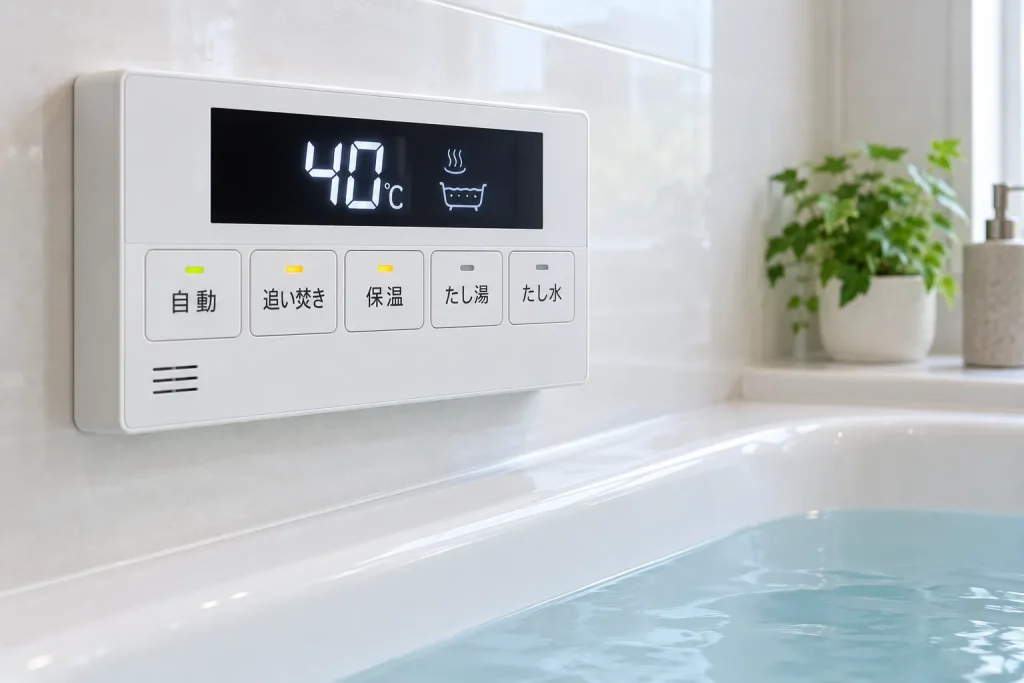
The control panel is where visitors hesitate longest. Fortunately, you do not need every button. You need to distinguish filling the tub, reheating existing water, adding more hot water, and maintaining a selected temperature.
湯船 — yubune: bathtub
湯船, yubune, literally “hot-water vessel,” means the bathtub itself, particularly when discussing soaking. It is usually deeper and shorter than a typical American bathtub, allowing you to sit more upright.
You enter the yubune after washing and rinsing. Do not bring a soapy washcloth into the water. The mistake is assuming the tub is too small because it is not long enough for lying flat; its shape is intended for seated soaking.
Households select their own temperature, and controls allow it to be adjusted. Water around 40–42°C (104–108°F) is commonly associated with hot Japanese bathing, but 42°C (108°F) is not a universal target and may be too hot for some people. Japanese government safety guidance for older bathers advises keeping water at 41°C (106°F) or below and limiting immersion to about 10 minutes.
The control panel shows a setting, not a challenge. Lower the temperature if the water feels too hot.
自動 — jidō: automatic
自動, jidō, literally “automatic,” starts an automatic bath-filling program on compatible water heaters. You meet it on the wall panel, often as one of the largest buttons. The system fills the tub to a configured level and temperature and may announce when the bath is ready.
This is the second term that can mislead English speakers. “Auto” does not mean the bathroom cleans itself or that every later temperature change happens without limits. Its exact functions depend on the heater model and settings.
The practical mistake is pressing it when the tub still contains water. Depending on the equipment, you may trigger another filling or maintenance cycle. Check the water level and ask the household before using an unfamiliar panel.
追い焚き — oidaki: reheating bath water
追い焚き, oidaki, literally “additional heating,” reheats water already in the tub. You use the ofuro reheat button when the bath has cooled between household members. The system circulates the existing water through the heater and returns it warmer.
It does not replace visibly dirty water with fresh water. It also does not mean “add hot water” in every system. That distinction matters because repeated heating preserves the volume already in the tub.
The common mistake is draining cool water before pressing the button. If the household intends to reuse it, you have discarded the water the reheat system was designed to retain.
保温 — hoon: heat retention
保温, hoon, literally “heat preservation,” refers to keeping the bath near its selected temperature. You may see the word in manuals or settings linked to an automatic filling program.
It is not free passive insulation. Depending on the heater, maintaining temperature can involve monitoring and reheating. The mistake is leaving the function active long after the household has finished bathing.
たし湯 — tashiyu: adding hot water
たし湯, tashiyu, literally “added hot water,” sends more hot water into the bathtub. Unlike oidaki, it increases the amount of water. This is useful when the level is low or when adding hot water is more appropriate than circulating the existing water.
Do not confuse たし湯 with たし水, tashimizu, literally “added water,” which adds cooler water on compatible controls. Pressing the wrong one can leave the tub hotter, colder, or fuller than intended.
The objects that preserve the shared water
Japanese bathing equipment makes more sense when you understand that the water may remain in the tub for the next person. The lid reduces heat loss, while household order helps keep the water clean enough for soaking.
風呂ふた — furo futa: bath lid
風呂ふた, furo futa, literally “bath lid,” is the fitted cover placed over the tub. It may fold, roll, or consist of rigid panels. You remove it before soaking and replace it when another person will bathe later.
The lid is not a bench, shelf, or drying rack unless the manufacturer specifically says otherwise. Its main job is to cover the water and reduce cooling. The common mistake is leaving the tub uncovered between bathers and then relying entirely on reheating.
入浴 — nyūyoku: entering the bath
入浴, nyūyoku, literally “entering the bath,” refers to bathing or immersion rather than washing alone. You meet it in safety notices, heater instructions, and expressions such as 入浴中, nyūyoku-chū, meaning “bathing in progress.”
The household sequence is usually:
- Remove your clothes in the changing area.
- Enter the waterproof bathing room.
- Wash and rinse on the araiba.
- Enter the tub without soap.
- Soak at a comfortable temperature.
- Leave the water unless told that you are the last user.
- Replace the lid if another person will follow.
- Ventilate or clean the room according to the household routine.
Do not assume every family follows an identical bathing order. Work schedules, children, health needs, and personal preferences change who goes first. The stable part is washing outside the shared soaking water.
Laundry words you meet after everyone has bathed
The water may have one more job after soaking ends. Some Japanese washing machines can draw it from the tub through a dedicated hose. The feature is familiar, but it is not universal across every brand, model, or apartment.
残り湯 — nokoriyu: remaining hot water
残り湯, nokoriyu, literally “remaining hot water,” is the water left in the tub after bathing. You meet this word in washing-machine manuals, household conversations, and settings related to reusing bath water.
The water can be used for selected wash or rinse stages when the appliance permits it. However, the permitted stages differ by machine and program. Follow the manual rather than assuming that used bath water is suitable for every rinse.
風呂水 — furomizu: bath water
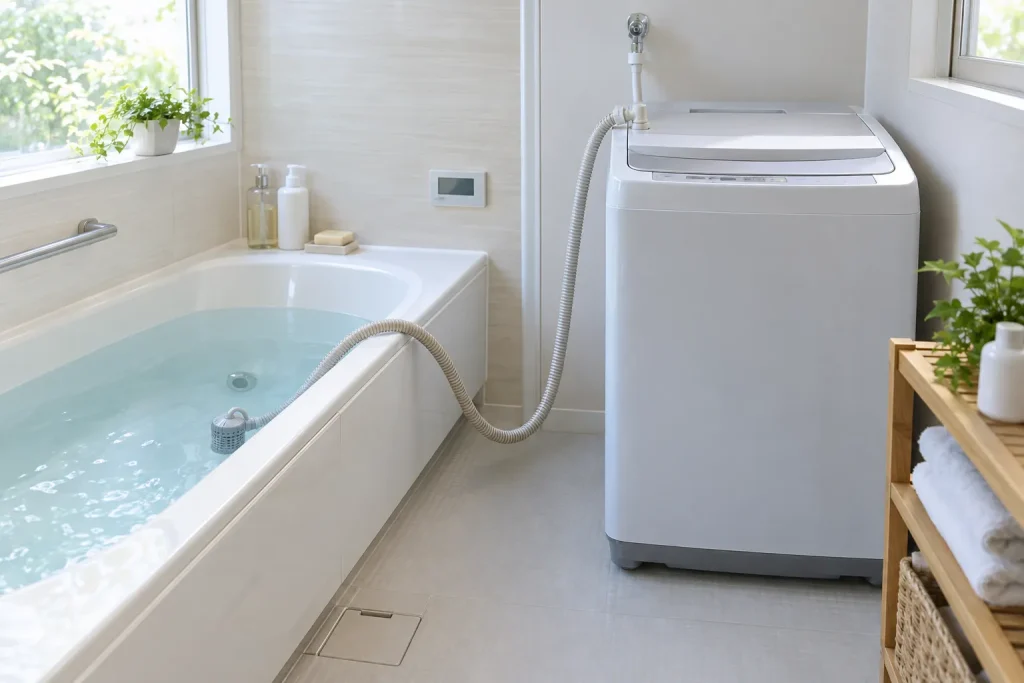
風呂水, furomizu, literally “bath water,” is the appliance term often printed beside a washing-machine setting or hose connection. Choosing it tells a compatible machine to draw water from the bathtub rather than relying only on the regular supply.
This does not mean you pour buckets into the drum. A compatible setup uses a suction hose and pump. Depending on the model, the pump may be built into the washer, supplied as an accessory, available separately, or absent.
風呂水ポンプ — furomizu ponpu: bath-water pump
風呂水ポンプ, furomizu ponpu, literally “bath-water pump,” moves water from the tub to the washing machine. Place the filtered hose end in the tub, connect the other end as the manual shows, and select the appropriate bath-water option.
Calling this a standard feature on all Japanese washers would be inaccurate. Hitachi, Panasonic, and other manufacturers sell machines and accessories that support the function, but specifications vary. Check the exact model before assuming the apartment has a working Japanese washing machine bath pump.
The uncomfortable part is maintenance. Hair, residue, and buildup can collect in the hose or filter. Reused water does not remove the need to clean the pump components, and bath additives may be incompatible with the machine.
| Control or item | What it does | What it does not guarantee |
|---|---|---|
| 自動 | Fills the tub under a programmed cycle | Identical behavior on every heater |
| 追い焚き | Reheats water already in the tub | Fresh replacement water |
| 保温 | Helps maintain the selected temperature | Zero energy use |
| たし湯 | Adds hot water | Reheating without raising the level |
| 残り湯 | Identifies water remaining after bathing | Suitability for every laundry stage |
| 風呂水ポンプ | Transfers bath water to a compatible washer | Inclusion with every Japanese washer |
Terms that English alone will not explain
“Bath” is the most troublesome translation. Depending on context, ofuro can mean the room, the tub, the hot water, or the entire bathing routine. Meanwhile, yokushitsu is the architectural room and yubune is specifically the soaking vessel.
“Unit bath” is equally deceptive. It identifies prefabricated construction, not one guaranteed fixture arrangement. You still need the apartment diagram to learn whether the toilet, sink, and tub share a space.
Room measurements can add another layer of confusion. How Many Mats Is the Room You Are Renting explains why 畳 or 帖, jō, cannot be treated as one perfectly fixed American square-foot conversion in every listing.
“Auto” also promises less than its English label seems to suggest. It starts a programmed process defined by that heater. It does not make every decision about temperature, water level, cleaning, ventilation, or drainage.
The vocabulary worth keeping
If you memorize only three terms, choose 洗い場, araiba, because it tells you where to wash; 追い焚き, oidaki, because it tells you how existing water is reheated; and 残り湯, nokoriyu, because it tells you why the water may still be needed afterward.
The remaining words can stay at recognition level. You only need to identify them on a control, floor plan, or appliance manual. For spoken help beyond the bathroom, the phrasebook with 337 everyday phrases is more useful than memorizing a long scripted exchange.
Keep this short checklist beside the longer glossary:
- Wash at the araiba.
- Soak in the yubune.
- Use oidaki to reheat.
- Replace the furo futa.
- Ask before draining nokoriyu.
Short FAQ
Does every Japanese family share the same bath water?
No. Sharing prepared soaking water is a familiar household practice, but family schedules, health concerns, personal preferences, and housing equipment differ. Never assume that a particular household saves the water without asking.
Should I shower before entering a Japanese bathtub?
Yes, when the tub is being used for soaking and especially when others will use the same water. Wash and rinse on the floor beside the tub. Keep soap and shampoo out of the soaking water.
Is 42°C safe for everyone?
No. That temperature may feel excessively hot and is not an obligation. Japanese safety guidance for older bathers recommends 41°C (106°F) or below and an immersion time of about 10 minutes or less.
Do all Japanese washing machines reuse bath water?
No. Many models support bath-water intake, but the necessary pump, hose, filter, and available programs vary. Check the exact model and its manual before connecting anything.