On January 17, 2017, Japan’s restroom-equipment industry published standardized pictograms for the controls most visitors struggled to identify. That change is the key to understanding Japanese toilet buttons meaning today. Before it, manufacturers used different symbols for similar functions, so a button learned in a hotel might look unfamiliar at a train station. Modern panels are more consistent, but older toilets, compact remotes, and brand-specific functions still require attention.
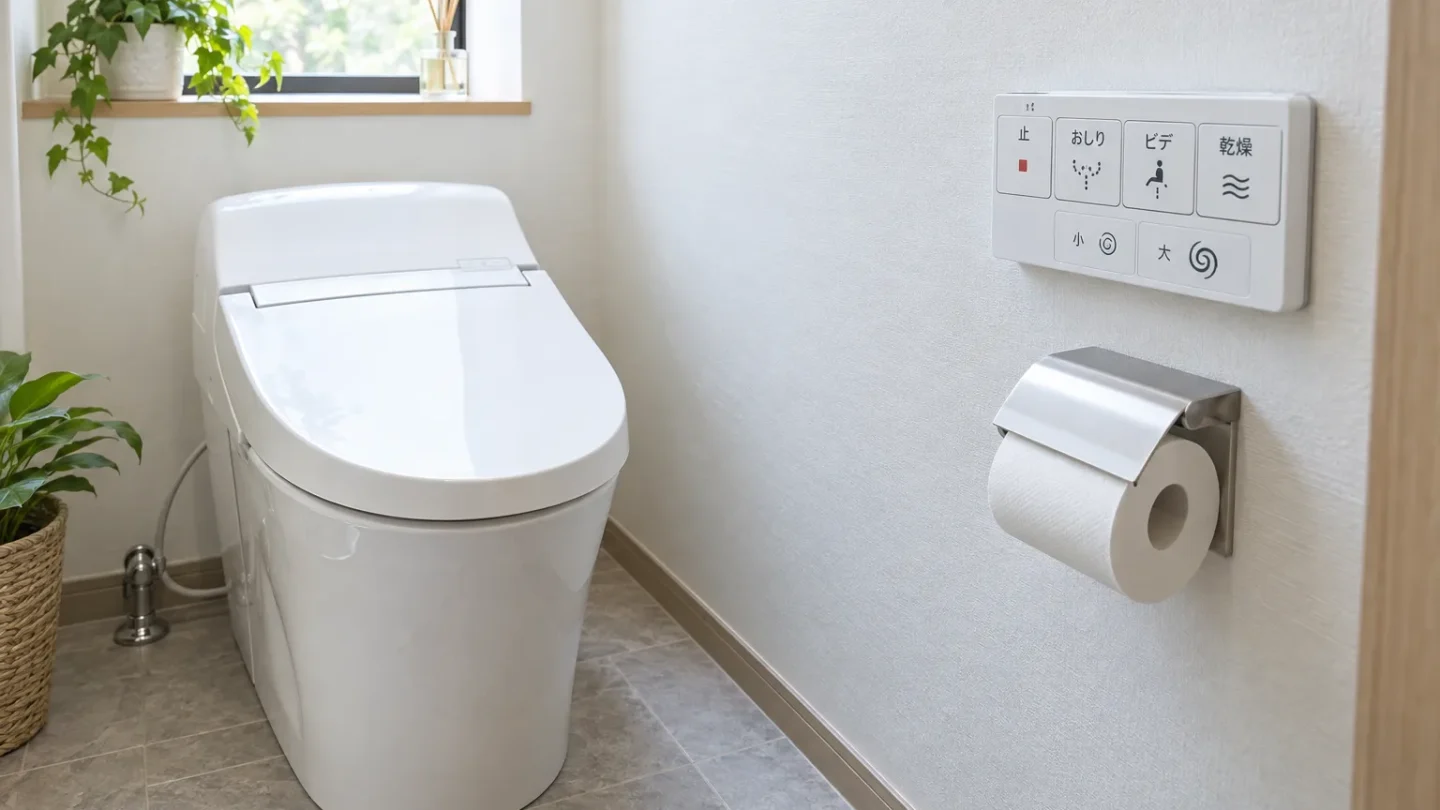
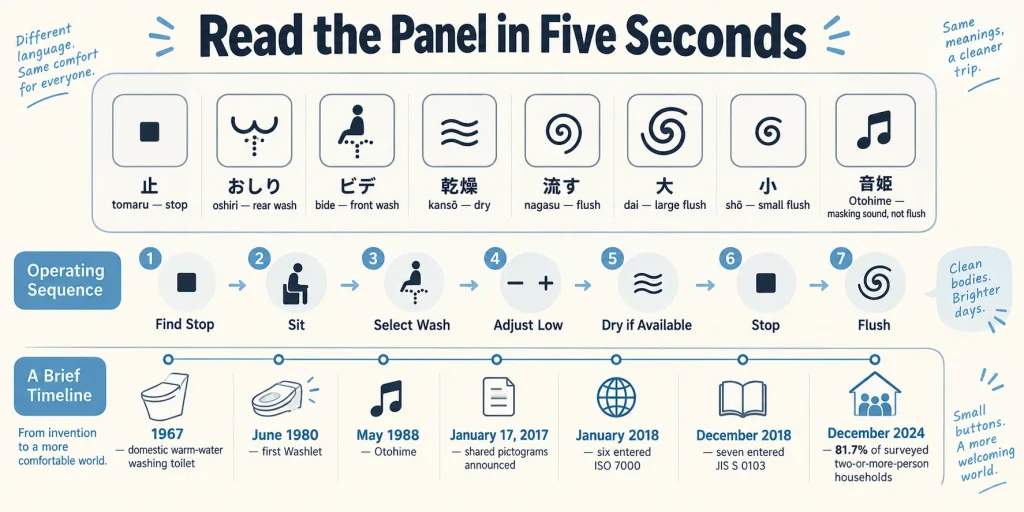
The controls you need first are 止, tomaru, literally “stop”; おしり, oshiri, literally “buttocks”; ビデ, bide, “bidet”; and 乾燥, kansō, literally “drying.” You may also see 音姫, Otohime, literally “Sound Princess,” which plays a masking sound. It is not a flush control.
Electronic bidet seats are ordinary household equipment, not an attraction installed only for tourists. Japan’s Cabinet Office reported that 81.7% of surveyed households with two or more people owned a warm-water washing toilet seat in its December 2024 survey. The result is close to the familiar “roughly 80%” description, but it does not represent every household, every toilet, or every public restroom in Japan.
Before the controls had a shared visual language
Warm-water washing seats existed in Japan well before their buttons looked consistent. LIXIL’s predecessor, Ina Seito, introduced a domestically produced warm-water washing toilet in 1967. TOTO released the first product carrying its Washlet brand in June 1980.
ウォシュレット, Woshuretto, is TOTO’s registered trademark, although people sometimes use the name casually for electronic bidet seats made by other companies. The general product category is 温水洗浄便座, onsui senjō benza, literally “warm-water washing toilet seat.” The mistake is calling every Japanese electronic toilet a Washlet in formal product descriptions.
Early and later panels reflected each manufacturer’s design decisions. Wording, colors, button order, and icons could vary. A visitor might recognize the spray function on one model but press the wrong control on another because both used abstract illustrations.
That inconsistency became more visible as international tourism grew. People were not confused because the toilets were inherently impossible to use. They were confused because the visual vocabulary changed from panel to panel.
If you are deciding whether an apartment is likely to include an electronic seat, start with Reading 1LDK, Jo and the Move-In Bill. A floor plan identifies the toilet room, but it does not guarantee which seat functions are installed. You must check the property specifications or photographs.
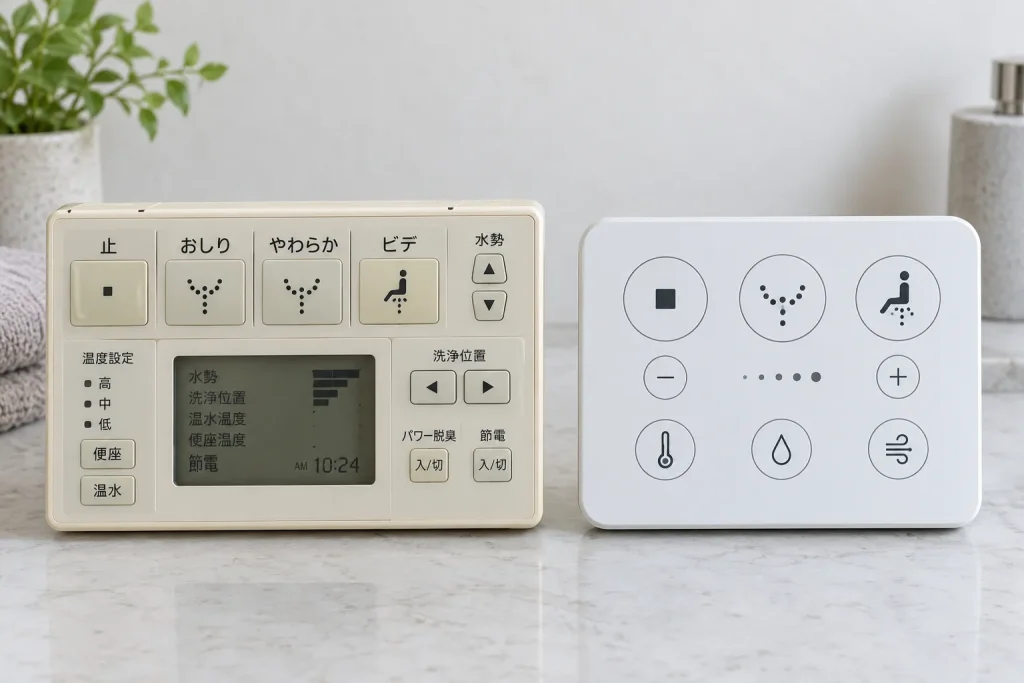
The 2017 change that made panels easier
The Japan Restroom Industry Association announced a common set of toilet-operation pictograms on January 17, 2017. Its April 2017 guideline explained that the symbols were intended to improve convenience and safety for users in Japan and abroad. Member manufacturers were encouraged to introduce them on new products released during and after fiscal 2017.
This was guidance rather than a law requiring every toilet to be replaced. Older panels did not suddenly disappear, and manufacturers retained additional controls for their own functions. The standard concentrated on basic operations that caused the most confusion.
The original industry project covered controls for:
- opening and closing the toilet lid;
- raising and lowering the seat;
- large flush;
- small flush;
- rear washing;
- bidet washing;
- drying;
- stopping an active function.
The international and domestic standards did not move in one step. Six of the principal pictograms were registered in ISO 7000 in January 2018. Seven, including the drying symbol, were added to the relevant Japanese Industrial Standard in December 2018, according to the industry association’s account published in January 2019.
“Standardized” means manufacturers can use the same visual language. It does not mean every installed panel already uses it.
| Period | What users encountered | What changed next |
|---|---|---|
| 1967 | A domestically produced warm-water washing toilet entered the Japanese market | Electronic washing began developing as a home fixture |
| June 1980 | TOTO released its first Washlet-branded seats | The category gained a widely recognized brand |
| Before 2017 | Basic controls could use different manufacturer-specific symbols | Visitors had to rely more heavily on Japanese labels |
| January 17, 2017 | Common pictograms were publicly announced | Participating manufacturers began adopting shared symbols |
| January 2018 | Six symbols entered ISO 7000 | Several basic controls gained international recognition |
| December 2018 | Seven symbols entered JIS S 0103 | The domestic standard included the drying pictogram |
| December 2024 | Cabinet Office survey recorded 81.7% household penetration | Electronic seats remained ordinary domestic equipment |
What each essential button does
A current panel may display Japanese text, a symbol, or both. Start by finding 止 before activating any spray. Once you know where the stop control is, the other functions become much less stressful.
止 — tomaru: stop
止, tomaru, literally “stop,” ends rear washing, bidet washing, or drying. It is commonly marked with a square pictogram. Some panels use 停止, teishi, also meaning “stop.”
This is the most useful button to identify first. If a spray starts unexpectedly or you selected the wrong mode, press 止. Do not stand up and search for the flush while the nozzle is operating.
The common mistake is assuming that the largest button stops everything, including flushing or seat heating. Usually, 止 ends the active personal-washing or drying function. Exact behavior still depends on the model.
おしり — oshiri: rear wash
おしり, oshiri, literally “buttocks,” activates the rear cleansing spray. The standard pictogram shows water directed toward a seated figure from behind. On some products, the label may include 洗浄, senjō, meaning “washing.”
Remain seated when you press it. Many electronic seats use a seating sensor and will not activate unless they detect a user. Water-pressure and nozzle-position buttons can then adjust the spray.
The mistake is pressing おしり while standing to test whether the toilet works. A safety sensor may prevent activation, but you should never rely on that. Use the function only while seated.
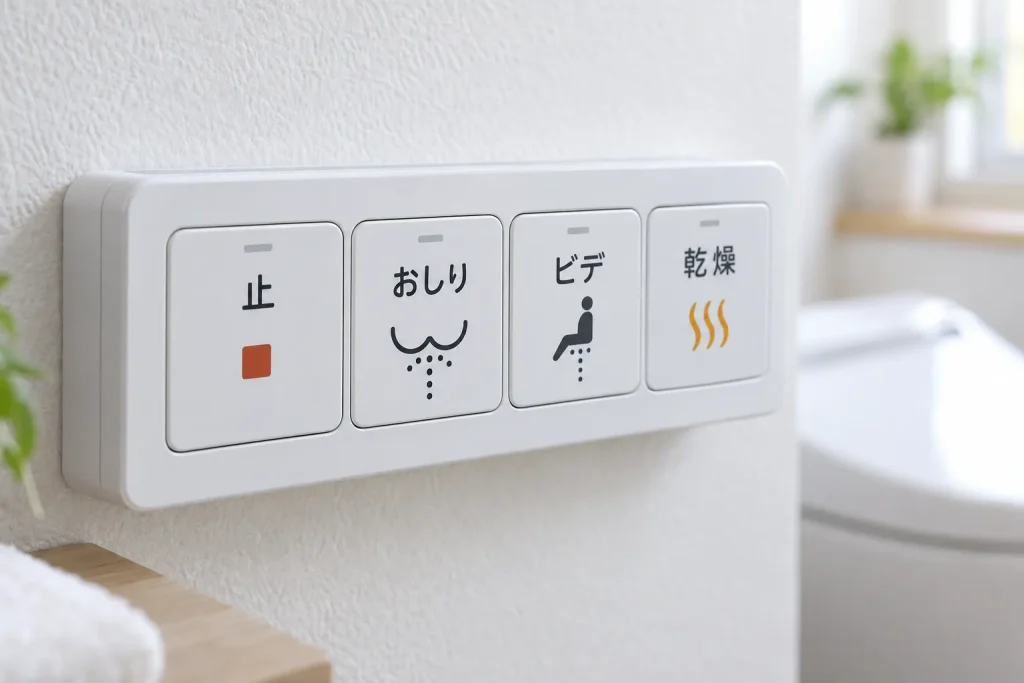
ビデ — bide: bidet wash
ビデ, bide, is borrowed from the French word “bidet.” On a Japanese panel, it generally activates a gentler front-washing spray intended primarily for female users. The standard pictogram distinguishes the spray position from the rear-wash icon.
The English loanword can mislead visitors. ビデ does not mean there is a separate porcelain bidet beside the toilet. It is a washing mode built into the seat.
The common mistake is assuming that the bidet button flushes the bowl because its icon includes water. It controls a personal-washing nozzle, not the toilet’s waste-removal mechanism.
乾燥 — kansō: drying
乾燥, kansō, literally “drying,” activates warm air on models equipped with a dryer. The function normally begins while you remain seated and ends when you press 止.
Not every electronic seat includes it. A panel without 乾燥 is not broken or incomplete; the installed model may offer washing and seat heating without warm-air drying. Even when present, the airflow may feel slower than a hand dryer.
The dryer is optional equipment, not the final step required by Japanese etiquette.
Adjustments around the four main controls
Once you recognize the essential buttons, you can decide whether to use the smaller adjustments. Their layout remains less uniform because equipment varies by manufacturer and model.
水勢, suisei, literally “water force,” changes spray pressure. Look for weak-to-strong bars, minus and plus marks, or 弱 and 強, jaku and kyō, meaning “weak” and “strong.” Begin at a low setting on an unfamiliar toilet.
位置, ichi, literally “position,” moves the nozzle’s target forward or backward. The button may display arrows or a seated figure. It does not move the toilet seat itself.
温度, ondo, literally “temperature,” can refer to water temperature, seat temperature, or both. Look for nearby labels such as 温水, onsui, “warm water,” and 便座, benza, “toilet seat.” Some settings are on a wall remote, while others are behind a side cover.
ムーブ, mūbu, from the English “move,” makes the nozzle oscillate. マッサージ, massāji, “massage,” usually varies water pressure rather than providing a mechanical massage. These are examples of loanwords whose appliance meaning is narrower than the English term suggests.
| Label | Reading | Literal or practical meaning | Most common mistake |
|---|---|---|---|
| 止 | tomaru | Stop | Looking for the flush instead |
| おしり | oshiri | Buttocks; rear wash | Testing it while standing |
| ビデ | bide | Front bidet wash | Mistaking the water icon for flushing |
| 乾燥 | kansō | Drying | Assuming every seat has a dryer |
| 水勢 | suisei | Water force | Starting at maximum pressure |
| 位置 | ichi | Position | Thinking it moves the seat |
| 温水 | onsui | Warm water | Confusing it with seat temperature |
| 便座 | benza | Toilet seat | Assuming it controls spray temperature |
| ムーブ | mūbu | Moving spray | Expecting the nozzle to remain fixed |
| マッサージ | massāji | Pulsating spray | Expecting mechanical massage |
The Otohime sound is not the flush
音姫, Otohime, literally “Sound Princess,” is TOTO’s name for a device that masks toilet sounds. TOTO introduced the product in May 1988 as a water-saving response to people repeatedly flushing for acoustic privacy. Modern versions may play a flowing-water or stream sound when you press a button or pass your hand over a sensor.
The Otohime toilet button does not normally flush the bowl. Its speaker produces a recorded or synthesized masking sound. Depending on the installation, the device may be built into the toilet remote, attached separately to a wall, or activated automatically.
This function is particularly common in public, workplace, and commercial restrooms. It is not guaranteed in a private apartment merely because the seat has washing controls. A home panel may contain an 音 button, a music function, or no masking sound at all.
If the sound starts unexpectedly, wait for it to stop or activate the marked control again according to the panel. Do not press every water-shaped symbol. The real flush may be on the wall, on the tank, on the side of the toilet, or on another part of the remote.
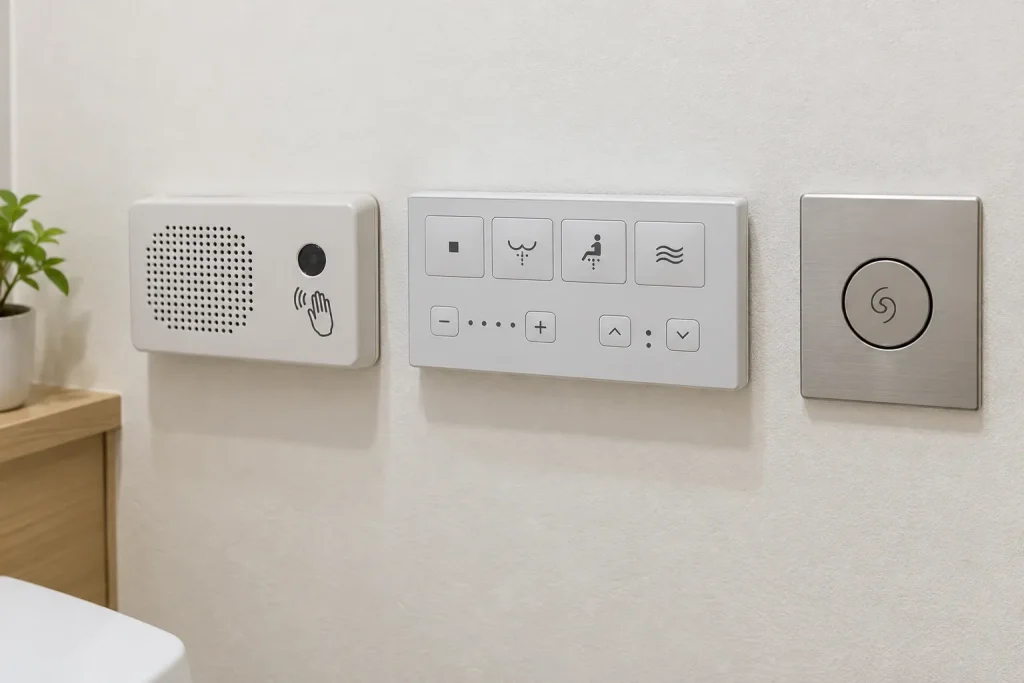
What the symbols mean for you now
For a newer toilet, the safest sequence is short:
- Find 止 before sitting down.
- Use おしり for rear washing or ビデ for front washing.
- Adjust 水勢 gently if necessary.
- Select 乾燥 only if the button is present.
- Press 止 to end the function.
- Locate the separate flush control.
- Treat 音姫 as sound, not flushing.
This sequence works because the core pictograms introduced in 2017 are now widely recognizable. However, it remains a reading strategy, not a promise that every control panel has the same shape.
If you need to ask for help, the phrasebook with 337 everyday expressions is more useful than memorizing a long conversation. A short question such as “流すボタンはどれですか,” nagasu botan wa dore desu ka, meaning “Which is the flush button?” is enough.
The private toilet room also follows the same clean-versus-outside logic seen elsewhere in a Japanese home. Why the Floor Steps Up Inside the Door explains that boundary at the entrance. In the toilet, the matching practical rule is to leave the provided toilet slippers inside the room.
What standardization did not change
The 2017 project did not force building owners to replace older controls. Therefore, you can still encounter text-only panels, faded labels, unusual icons, or remotes designed before the shared system. This is especially likely in older homes and small businesses.
It also did not standardize every optional feature. Deodorizing, nozzle cleaning, automatic lid movement, energy-saving schedules, night lighting, music, and user presets remain model-specific. You should not press a symbol merely because it looks familiar from another appliance.
Standard pictograms did not turn every water symbol into a flush button. 流す, nagasu, literally “to let flow,” usually means flush. 大, dai, “large,” and 小, shō, “small,” indicate different flush volumes on compatible toilets. They do not describe the user’s body or which washing nozzle to select.
Finally, the change did not make floor plans more detailed. Apartment size may still be described through room types and traditional area units rather than bathroom equipment. How Many Mats Is the Room You Are Renting explains what those measurements can and cannot tell you.
What is still changing
New toilets increasingly combine physical buttons, wall remotes, sensors, and automatic functions. Some open the lid when you approach, flush when you stand, or clean the nozzle before and after use. Those conveniences can make the basic sequence less visible rather than more obvious.
Accessibility is also part of the ongoing work. A visually consistent icon helps international visitors, but it does not automatically solve small text, low contrast, awkward placement, or controls that cannot be reached easily. Manufacturers continue to revise products even when the basic symbol stays the same.
The industry guideline itself can be revised, while ISO and JIS standards can also receive updates. For that reason, this guide should describe the common core rather than promise permanent button placement.
No national deadline requires all older toilets to adopt the post-2017 icons. If you see an unfamiliar control, look for the model number and manufacturer’s manual. That is more reliable than an unofficial translated sticker.
Check before you depend on a function
Before relying on any electronic feature, confirm that the seat has power. A powerless unit may still work as an ordinary toilet, but the nozzle, dryer, heated seat, automatic lid, and remote may not operate. In a public restroom, move to another stall rather than attempting to repair it.
Next, check whether the flush is automatic. If nothing happens after you stand, look for 流す, 大, 小, a lever, or a wall sensor. Do not leave merely because the washing panel has no obvious flush button.
Also check whether 乾燥 is present before assuming you can finish without toilet paper. Many electronic seats do not include a dryer. Even equipped models may take longer than expected.
Most importantly, memorize 止. You can recognize the other controls gradually, but the stop button solves the immediate problem when a function is stronger, longer, or less familiar than expected.
Short FAQ
Which Japanese toilet button should I memorize first?
Memorize 止, tomaru, meaning “stop.” Press it to end an active washing or drying function. It is usually marked by a square icon.
Is おしり the flush button?
No. おしり activates the rear-washing spray. Look for 流す, 大, 小, a mechanical lever, or a separate wall sensor to flush.
Does 音姫 flush the toilet?
No. Otohime produces a masking sound for privacy. It was developed to reduce the unnecessary flushing previously used to conceal restroom sounds.
Does every Japanese toilet have a bidet and dryer?
No. Warm-water washing seats are widespread, but equipment varies. Some toilets are conventional models, while many electronic seats provide washing without warm-air drying.