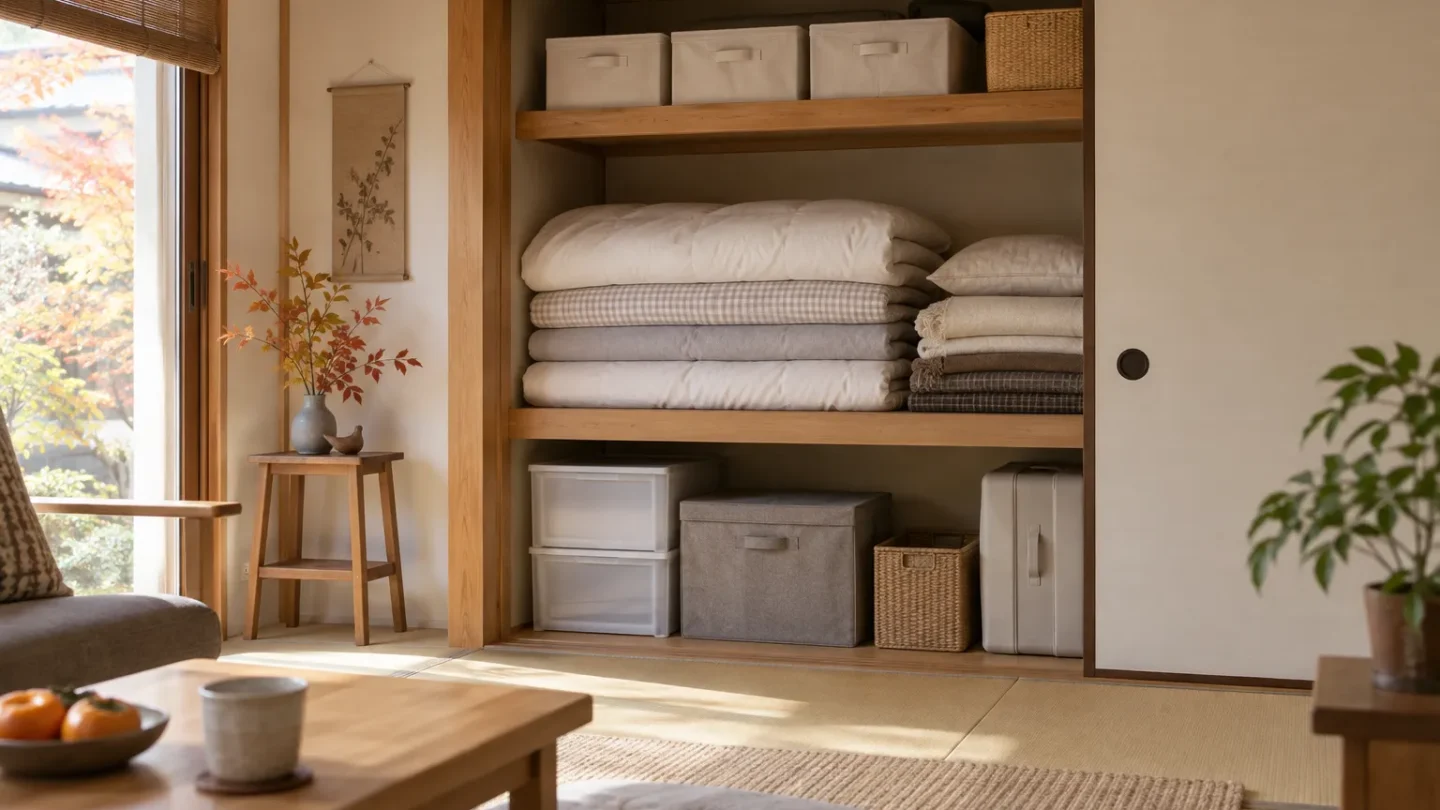
A Japanese family without a basement does not solve storage once. It repeats the same cycle every few months: keep the current season within reach, move the previous season into boxes, and push rarely used belongings upward, backward, or out of the home. The central piece is often 押し入れ, oshiire, literally “push-in storage”: a deep built-in cupboard designed around bedding rather than hanging clothes. Its traditional depth is commonly described as roughly 80 to 90 centimeters, or 31 to 35 inches, although actual usable space varies by building. That depth explains much of Japanese small space storage: folded bedding occupies the broad middle shelf, everyday objects stay low or near the doors, and labeled boxes fill the less convenient space above.
January and February: winter things claim the reachable space
In midwinter, bulky items migrate toward the front. Coats hang near the entrance, blankets occupy the accessible half of the oshiire, and heating equipment stays where it can be used without rearranging the room. A visitor may notice that the home does not necessarily look empty; winter is when the system is under the most pressure. Thick bedding, humidifiers, coats, scarves, and kotatsu quilts consume more volume than summer belongings.
The starting point is the apartment itself. Before renting, Reading 1LDK, Jo and the Move-In Bill helps you decode whether a listing gives you a separate bedroom, a living-dining-kitchen area, and any genuinely useful built-in storage. A floor plan may show 収納, shūnō, “storage,” without revealing whether it is a shallow Western-style closet or a deep cupboard divided by a shelf.
The oshiire’s proportions make more sense when you look at what it was made to hold. A standard single shikibuton is typically around 100 centimeters wide and 200 to 210 centimeters long before folding, depending on the manufacturer. Folded in thirds or quarters, it becomes a broad, deep bundle. The cupboard therefore uses depth differently from an American reach-in closet: it favors stacks rather than rows of clothes on hangers.
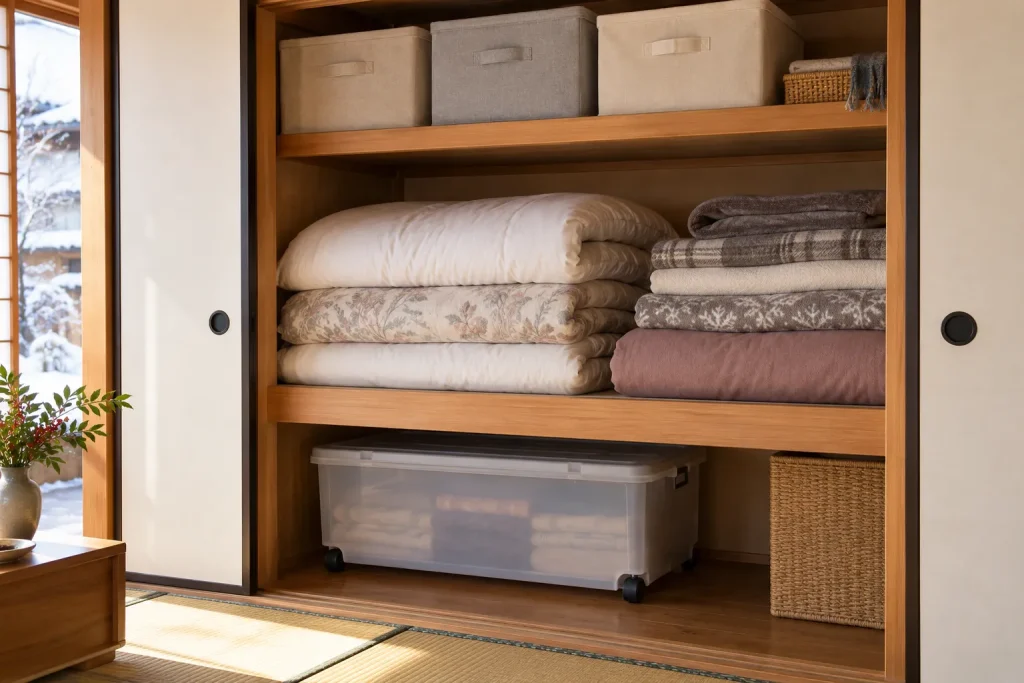
March and April: the first major changeover
The spring rotation usually begins when temperatures become reliably milder, not on a legally defined date. Heavy quilts are aired and dried before being packed, while lighter bedding and transitional jackets move forward. Families also review school materials around the end of the Japanese academic year in March and the new term in April. Old notebooks, uniforms, children’s projects, and club equipment can create a sudden storage problem.
This is where the vertical order matters. Heavy objects belong low, especially in an earthquake-prone country. Tokyo’s disaster-preparedness guidance tells residents to secure shelves and large furniture, prevent stored objects from falling, and keep evacuation routes clear. The top compartment is useful, but it should not become a place for an unsecured suitcase, appliance, or dense box that could fall when the doors open.
A practical spring reset follows a clear sequence:
- Remove winter bedding and check it for moisture or stains.
- Dry it completely according to its care label.
- Pack related items together instead of filling random gaps.
- Label the visible end of every box.
- Return frequently used spring items at waist height.
- Keep heavy boxes at floor level.
- Check that the doorway and exit route remain unobstructed.
This work costs time. Deep storage can hide more than it organizes, and the rear half of an oshiire easily becomes a place where belongings disappear for years. Pulling everything out at least once during a major rotation is less elegant than buying matching boxes, but it is usually more effective.
| Storage zone | Typical depth or position | Best use | Poor use |
|---|---|---|---|
| Oshiire middle shelf | About 80–90 cm / 31–35 in deep | Folded futons, blankets, bedding bags | Small loose objects at the back |
| Oshiire floor | Below the main shelf | Heavy boxes, drawers, appliances | Items needed several times a day |
| Upper compartment | Above eye level | Light seasonal textiles, empty bags | Dense or unsecured boxes |
| Western-style closet | Often shallower than an oshiire | Hanging clothes, narrow organizers | Wide stacks of traditional bedding |
| Loft or overhead cupboard | High and difficult to reach | Lightweight, rarely used belongings | Emergency supplies or daily items |
May and June: humidity changes the rules
Late spring is not merely another clothing swap. Rising humidity turns storage into a ventilation problem. Bedding placed into a bag before it is completely dry can develop odor or mold, while compressed textiles leave less room for air movement. Desiccant products may help inside enclosed containers, but they do not make damp bedding safe to store.
The rainy season has no fixed nationwide start. The Japan Meteorological Agency announces regional estimates after observing weather patterns, and those dates can later be revised. That means there are no trustworthy official rainy-season dates for 2027 in advance. For planning, the useful rule is to finish drying and packing winter bedding before a prolonged humid spell rather than wait for a symbolic day on the calendar.
Visitors often misunderstand the empty floor in a tatami room as unused space. In practice, floor area may have to serve as bedroom, play area, and daytime living space. How Many Mats Is the Room You Are Renting explains why 畳, jō, “tatami mat,” is an area label with regional variations rather than a universal square-foot measurement. When the bedding goes back into the cupboard each morning, the room changes function.
The uncomfortable truth is that a deep cupboard does not create extra floor area. It only postpones the decision about what the household can realistically keep.
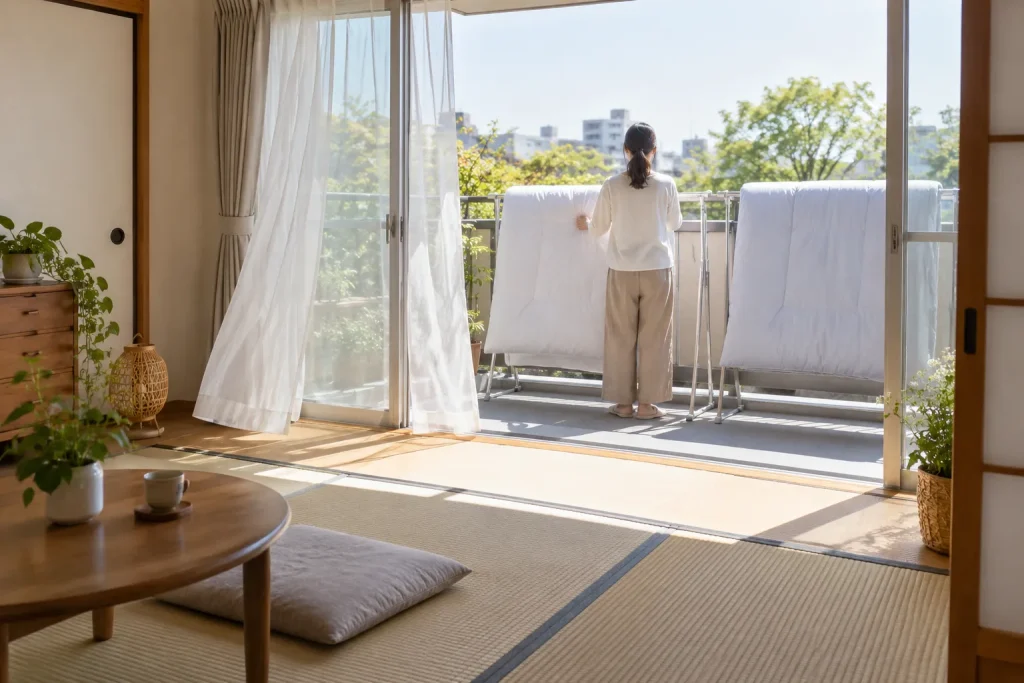
July and August: summer equipment moves forward
In summer, light quilts, fans, beach items, insect-control supplies, and children’s vacation equipment take the accessible positions. Winter coats and thick bedding remain boxed above or toward the rear. Suitcases may temporarily come down for travel, revealing whether the household’s storage plan works when several bulky items are active at once.
A visitor entering the home may see footwear and outdoor equipment managed at the threshold. Why the Floor Steps Up Inside the Door explains the 玄関, genkan, “entrance,” where outdoor shoes remain below the raised interior floor. Shoe cabinets can absorb umbrellas, bicycle accessories, emergency items, and cleaning supplies, but placing too much in this zone can obstruct the exit.
Summer is also when loft storage shows its drawbacks. A ロフト, rofuto, “loft,” may add an elevated platform, but heat collects near the ceiling. It can be useful for empty luggage or heat-tolerant belongings; it is not automatically good long-term storage for photographs, electronics, candles, cosmetics, or anything vulnerable to high temperatures. Carrying boxes up a narrow ladder is another cost that listing photographs rarely show.
September and October: the second major rotation
The autumn changeover reverses the spring routine. Light bedding moves upward or backward, warmer quilts return to the main shelf, and coats become easier to reach. There is no mandatory national 衣替え, koromogae, “seasonal change of clothes,” date for private households. Schools and workplaces may set their own uniform schedules, but a family’s storage rotation follows local temperature, available drying weather, and individual need.
For travelers or new residents, this is one of the more useful periods to inspect a home. You can see whether summer equipment and winter bedding can coexist during the transition. Open the cupboards during a viewing, measure their usable interior, and note door tracks, shelf supports, pipes, and irregular corners. The advertised wall-to-wall dimension is not necessarily the space a box can occupy.
Useful questions can be short. If you need to ask about storage, dimensions, or whether belongings may be placed in a shared area, the phrasebook — 337 phrases for everyday situations belongs in your preparation. Building corridors and balconies are not free overflow closets; management rules and fire-safety requirements may restrict what can be left there.
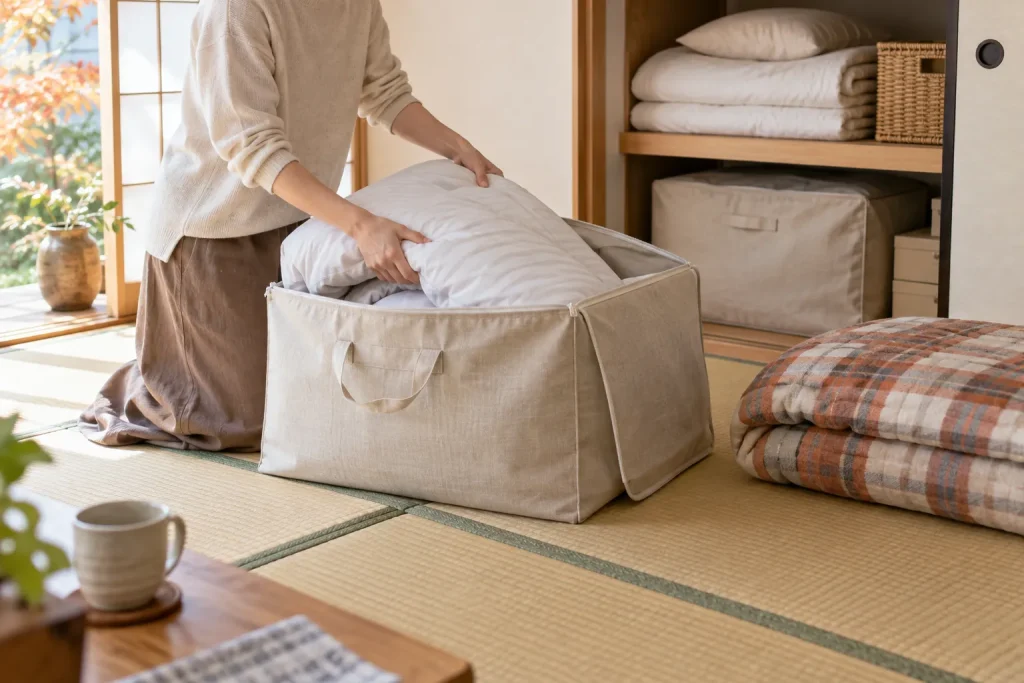
November and December: decide what must leave the apartment
By late autumn, the storage cycle reveals its failures. If every shelf is full before winter bedding returns, stacking more containers will not solve the underlying volume problem. The household must discard, donate, sell, or move belongings elsewhere. Large-item disposal rules and charges vary by municipality, so you need to check the local government’s current instructions instead of leaving furniture at an ordinary garbage point.
The commercial alternative is a トランクルーム, toranku rūmu, “trunk room” or rented storage unit. This is where rented storage in Japan stops being a clever organizing idea and becomes another housing expense. TERRADA’s published lineup, checked September 14, 2026, starts at ¥4,400 per month for small room-type units and ¥6,600 per month for locker-type spaces. Those are starting prices, not a Tokyo-wide average, and availability, dimensions, climate control, access, and charges differ by location.
At an illustrative exchange rate of ¥147 to US$1, ¥4,400 is about $30 and ¥6,600 about $45. The dollar amounts will change with the exchange rate, so they should be updated close to publication. A modest ¥6,600 monthly unit costs ¥79,200, or about $539 at that same illustrative rate, over a full year. That recurring total should be compared with the cost and effort of keeping the objects at all.
| Overflow decision | Space or price example | What it suits | Cost you may overlook |
|---|---|---|---|
| Locker-type trunk space | 0.2–0.5 tatami; up to 95 cm high | Books and small boxed belongings | Travel time and monthly rent |
| Small room-type unit | 0.2–1 tatami | Seasonal equipment and several boxes | Transport and vacancy limits |
| Medium room-type unit | 1.1–1.9 tatami | Sports gear or low-use household goods | Rent can approach a meaningful housing expense |
| Parcel storage | Provider-specific box dimensions | Documents, books, small seasonal items | Retrieval fees and delayed access |
| Disposal or donation | Municipality or organization-specific | Items no longer worth storing | Booking, transport, and disposal rules |
The most economical rule is simple: do not pay indefinitely to store something you would not buy again. If the unit mainly holds cheap replacement goods, the annual rent may exceed their value. Important documents, heirlooms, specialist equipment, and genuinely seasonal gear present a different calculation.
The quiet months are genuinely quiet
There is no official Japanese household-storage calendar, and most months do not contain a formal event. January and February are usually maintenance months. July and August may involve no reorganization beyond pulling out travel or leisure equipment. November can be equally quiet once the winter arrangement is complete.
That plain rhythm matters because storage advice often turns normal domestic work into a ritual. Many households simply rotate when the weather changes, when children outgrow clothes, or when a cupboard stops closing. The calendar is a planning framework, not a national custom with fixed annual dates.
| Period | Main task | Fixed date? | What to plan around |
|---|---|---|---|
| January–February | Keep winter bedding and coats accessible | No | Maximum volume indoors |
| March–April | Review winter goods and school materials | No national household date | School-year transition |
| May–June | Dry and pack thick bedding | Rainy-season timing varies | Humidity and drying weather |
| July–August | Bring forward summer and travel gear | No | Heat in loft spaces |
| September–October | Restore warmer bedding and clothing | No national household date | Several seasons overlapping |
| November–December | Remove overflow or rent outside space | No | Recurring storage cost |
Dates that move—and dates that do not exist
The 2026 and 2027 calendar cannot supply exact dates for these household rotations because none are established by law or a national rule. Rainy-season announcements are observational and regional; a reliable 2027 start cannot be printed in advance. A school or employer may specify a uniform change date, but that does not govern private closets.
For editorial accuracy, the article should resist inventing a neat date where Japanese families do not have one. The two useful windows are late March through April, when school-year belongings change, and late September through October, when bedding and clothing begin their autumn rotation. May is worth watching because dry days become more valuable before humid weather settles in. The least convenient period for a major reorganization is a humid rainy-season week, when washed bedding and textiles may be difficult to dry fully.
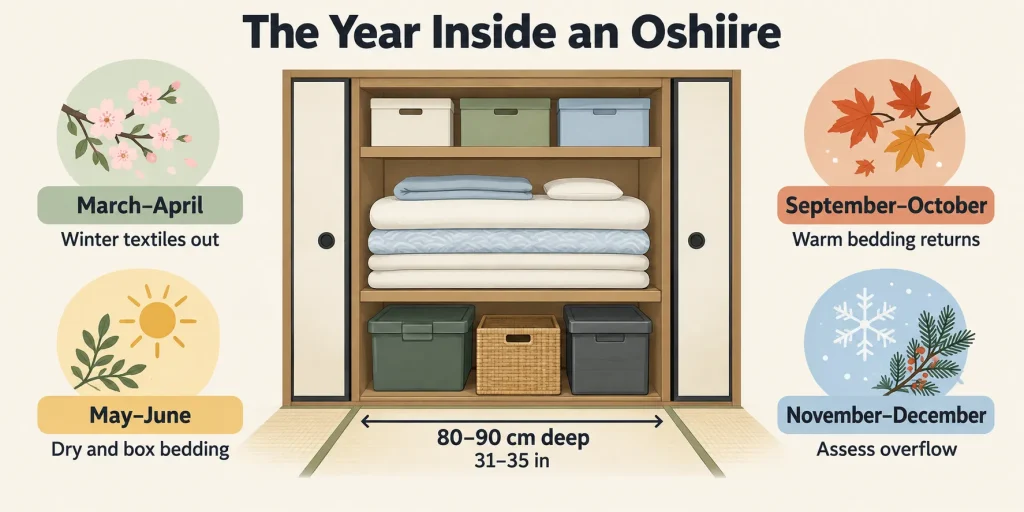
A small FAQ about Japanese home storage
Is every oshiire exactly 90 centimeters deep?
No. Roughly 80 to 90 centimeters is a conventional range associated with bedding storage, not a guaranteed interior measurement. Measure the usable depth, width, opening, and shelf clearance in the actual apartment.
Should seasonal items always go above the futons?
Only light, infrequently used objects belong high. Heavy boxes should stay low and furniture or shelving should be secured so that falling objects do not block an exit.
Is a trunk room cheaper than renting a larger apartment?
Sometimes, but there is no universal answer. Compare the unit’s annual cost, access charges, transportation, and inconvenience with the rent difference for the homes you are actually considering.