Fares by Season, Departure City and Booking Window: The Cost of a Flight to Japan
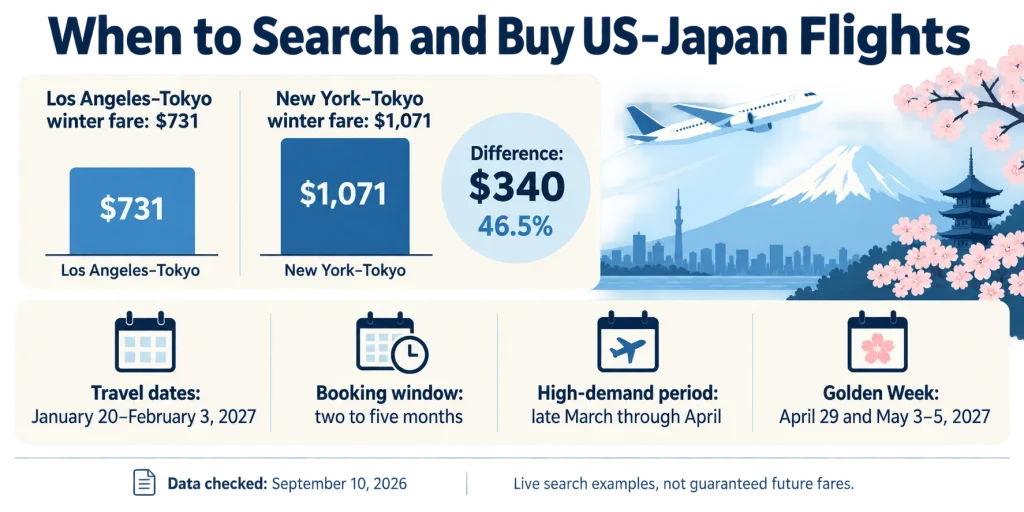
$731 round trip was the lowest Los Angeles–Tokyo economy fare displayed for travel from January 20 to February 3, 2027, when Google Flights was checked on September 10, 2026. The same dates from New York started at $1,071, making the East Coast departure $340 more expensive in this sample. That is the useful opening number for the cost of flight to Japan: about $730 from Los Angeles in the winter fare floor, before you add optional bags, seats, insurance, or a positioning flight.
These are live search results, not a promise that every traveler will find the same price. Airfare changes whenever inventory, demand, currency movements, or airline schedules change. Still, the comparison gives you something more useful than a vague national average: identical Tokyo dates, searched on the same day, with the departure city changed.
If you need to choose airports and understand the arrival process before comparing fares, Flights, Airports and the First Two Hours covers the full route from the United States to your first train or bus in Japan.
What the $731 fare actually represents
The $731 figure was the lowest round-trip economy price shown by Google Flights for Los Angeles to Tokyo around January 20–February 3, 2027. It was displayed in US dollars for one adult on September 10, 2026. Google explains that its service compares offers from more than 300 airlines, online travel agencies, and aggregators, although it does not promise to include every available offer.
The search covered Tokyo rather than a single airport. That matters because Tokyo has two principal international gateways: 東京国際空港, Tōkyō Kokusai Kūkō, literally “Tokyo International Airport,” commonly called Haneda Airport, and 成田国際空港, Narita Kokusai Kūkō, literally “Narita International Airport.” A low fare to Narita may still be the better deal, but you should compare the ground journey before treating two tickets as equivalent.
Two Tokyo Airports, Two Very Different Rides explains that airport decision in detail. This article keeps the calculation on the airfare itself rather than repeating the transfer guide.
The displayed fare should be treated as a starting total containing the mandatory amount presented by the search engine. Optional products can still raise the checkout price. Depending on the airline and fare family, those additions may include:
a checked bag;
advance seat selection;
extra-legroom seating;
ticket-change flexibility;
travel insurance;
food on a low-cost carrier;
transportation to a different US departure airport.
The cheapest search result is not necessarily the cheapest usable itinerary.
“Best” results are ranked by a combination of price and convenience, while the “Cheapest” tab can include self-transfers, airport changes, and online-travel-agency offers with additional tradeoffs, according to Google Flights Help, checked September 10, 2026.
A traveler comparing Los Angeles–Tokyo economy fares on a laptop beside a passport and a paper calendar.
The fare arithmetic you can redo
Here is the cleanest version of the calculation. It uses the lowest displayed Los Angeles fare and assumes two adults taking the same itinerary. No optional services have been inserted because their prices could not be verified without selecting a particular airline and fare family.
Cost item
Calculation
Amount
Source and check date
Traveler 1 round-trip economy fare
1 × $731
$731
Google Flights, LAX–Tokyo search, September 10, 2026
Traveler 2 round-trip economy fare
1 × $731
$731
Same search and date
Verified mandatory supplement outside displayed fare
None identified
$0
Google Flights displayed total, September 10, 2026
Total for two travelers
$731 + $731
$1,462
Arithmetic from the checked fare
To redo this with your own inputs, replace $731 with the total shown for your dates, multiply it by the number of passengers, and then add only the extras you genuinely need. Do not estimate baggage from another airline’s policy. Open the fare conditions attached to the specific ticket because two economy products on the same aircraft can have different allowances.
The same rule applies to a domestic connection. If you live in Denver, Nashville, or another city without the nonstop you want, calculate both a through-ticket and a separate trip to Los Angeles, San Francisco, Seattle, New York, Chicago, or another gateway. A separate ticket can reduce the headline fare while adding a missed-connection risk that the long-haul airline does not have to absorb.
How much departure city moved the price
The clearest verified difference in this check was $340. Los Angeles started at $731 for the selected winter period, while New York started at $1,071. Dividing $340 by the Los Angeles fare produces a difference of approximately 46.5 percent.
That does not mean every New York ticket will cost 46.5 percent more than every Los Angeles ticket. It means departure city moved the lowest displayed result by that amount in one controlled comparison. The dates, destination, cabin, passenger count, currency, and search day were held constant.
Departure area
Travel dates
Lowest displayed round-trip fare
Difference from Los Angeles
Source
Los Angeles
Jan. 20–Feb. 3, 2027
$731
Baseline
Google Flights, checked Sept. 10, 2026
New York
Jan. 20–Feb. 3, 2027
$1,071
+$340
Google Flights, checked Sept. 10, 2026
New York premium over Los Angeles
Same dates
—
46.5%
($1,071 − $731) ÷ $731
The uncomfortable part is that a West Coast positioning flight does not automatically capture the entire $340 difference. You must subtract the domestic ticket, any checked-bag charge imposed twice, food during the connection, and a hotel if a same-day transfer is too risky. If those additions reach $300, the apparent bargain has almost disappeared.
A through-ticket also offers operational protection that separate bookings normally do not. When a delay causes a missed connection on one ticket, the airline has a defined responsibility to move you onward under its conditions of carriage. With unrelated tickets, you may have to buy a replacement transpacific flight yourself.
For a first trip, place the international flight decision in the larger booking sequence described in Planning a First Trip to Japan: The Order That Works. That guide covers what to reserve first instead of duplicating the fare calculation here.
A bright airport departure board showing flights to Tokyo while travelers wait with compact luggage.
The seasonal price calendar
January and February after the New Year travel period are the most useful months to test first when price matters more than blossoms. The $731 Los Angeles result was found in that winter window on September 10, 2026. Google’s date tool also identified January 21 as the cheapest nearby departure in the displayed calendar.
Late March and April require more caution. They combine overseas cherry-blossom demand with heavy domestic travel around Golden Week. Japan’s Cabinet Office calendar shows four national holidays between April 29 and May 5 in 2027: Shōwa Day on April 29, Constitution Memorial Day on May 3, Greenery Day on May 4, and Children’s Day on May 5.
However, the available research did not establish that late March is the single most expensive period from every US departure city. It supports treating late March through Golden Week as a high-demand interval that should be searched early, but not publishing a universal dollar premium without a fresh multi-route fare capture.
Use the calendar as a search order rather than a guaranteed price chart:
Check January and February after New Year week for the winter floor.
Compare late February or early March if you want milder conditions without relying on peak blossom timing.
Treat late March through April as a high-demand search.
Check Golden Week dates separately rather than assuming they behave like the rest of May.
Compare fall dates after summer demand has eased, while checking the weather risks for your region.
The broader weather and crowd tradeoffs belong in The Best Time of Year to Visit Japan, rather than being repeated inside an airfare calculation.
Why two to five months is the practical booking window
For most US–Japan economy trips, begin serious fare tracking about five months before departure and aim to buy within the following three months. In plain terms, the working window is two to five months before travel. This is a monitoring and decision window, not a claim that one exact day always produces the lowest fare.
Google Flights says its booking guidance is based on the historical prices of similar trips. The company’s interface may indicate that prices are lower than usual, likely to rise, or unlikely to fall. It also warns that the prediction can be wrong because future prices do not have to follow past behavior.
A reasonable process looks like this:
At five months, record a baseline for your preferred airports and dates.
Turn on price tracking for the exact itinerary and one flexible-date alternative.
At four months, compare nearby weekdays and both Tokyo airports.
At three months, decide what price would make you buy immediately.
At two months, stop waiting for a dramatic drop if the available fare already fits the budget.
This window is deliberately broad. If you want late March, April, Golden Week, or fixed school-vacation dates, use its earlier end. If you are traveling in January or February and can move the trip by several days, you can afford to watch longer.
There is no useful “best weekday to book” if waiting for that weekday costs you the last seat at the fare you were willing to pay.
A traveler marking a two-to-five-month booking window on a desk calendar beside an open flight-search screen
The variables that can overturn the headline fare
Cabin and itinerary rules can move the final cost even when the first search screen looks stable. Start by checking whether the result is nonstop, a protected connection, or a self-transfer. Google states that its Cheapest tab may include separate-ticket handling and airport changes, so a low result needs closer inspection.
Airport choice is another variable. Haneda is closer to central Tokyo, but a sufficiently lower Narita fare can compensate for the longer ride. Compare the whole arrival cost and arrival time, especially when the aircraft lands late enough to limit rail choices.
Baggage can also reverse a ranking. Compare fares after selecting the number of checked bags you will actually take. If you are shopping heavily in Japan, perform the same calculation for the return journey instead of assuming the outbound allowance solves the problem.
Your schedule has monetary value too. A connection that consumes most of a day in each direction removes usable time from the trip. If a nonstop costs more, divide the premium by the hours it saves. That gives you a personal price per recovered hour.
Finally, avoid treating a rail pass as an automatic companion purchase to the plane ticket. Is the Japan Rail Pass Worth It in 2026? shows when individual rail tickets can cost less than the pass.
When the cheaper gateway is really cheaper
Return to the verified $340 gap between Los Angeles and New York. Suppose you already live within ground-transport distance of Los Angeles International Airport. The $731 itinerary is then a clean benchmark, subject only to the fare’s own conditions and the cost of reaching LAX.
If you live in New York, the comparison changes. The $1,071 departure may be more expensive, but it can remove a domestic positioning flight and an overnight buffer. Without verified prices for those additions, claiming that Los Angeles remains cheaper would be false precision.
The correct equation is:
Gateway saving = home-airport fare − gateway fare − positioning costs − required overnight costs − separately charged extras.
Only use a gateway strategy when the result remains meaningfully positive. A tiny saving is poor compensation for separate-ticket risk. I would also reject an itinerary that requires an unprotected connection on the day of the Japan flight unless the replacement-ticket risk is genuinely affordable.
Use the following verified labels and figures when drawing the graphic placed here. The fare points are a dated comparison, while the seasonal labels indicate when to start searching rather than promising a fixed monthly price.
When to Search and Buy US–Japan Flights
Frequently asked questions
How much is a round-trip flight to Japan from the US?
In the controlled search checked on September 10, 2026, Los Angeles–Tokyo started at $731 and New York–Tokyo started at $1,071 for January 20–February 3, 2027. Those are live examples rather than a national average. Your dates, departure airport, baggage needs, stops, and fare conditions can change the result.
What is the cheapest month to fly to Japan?
The checked Los Angeles example supports January after New Year week as a strong low-fare period. February belongs in the same first group of dates to test. The available evidence does not justify claiming that one month is cheapest from every US airport in every year.
When should I book a flight to Japan?
Use a Japan flight booking window of two to five months. Begin tracking at the early end and be prepared to buy sooner for late March, April, Golden Week, or fixed vacation dates. Follow the route-specific price guidance shown by the search tool rather than waiting for a mythical universal booking day.
Are flights from the West Coast cheaper?
They can be substantially cheaper. In this dated comparison, the flights from Los Angeles to Japan result was $340 below the equivalent New York search. A traveler who needs a separate positioning flight must subtract that extra journey before claiming a real saving.
Is Haneda always worth paying more for?
No. Haneda can reduce arrival time and ground-transport effort, but the value depends on where you are staying and when you land. Compare the airfare difference with the actual airport-transfer plan.
The single figure to remember is $731: the lowest checked Los Angeles–Tokyo winter round trip for January 20–February 3, 2027. Recheck that benchmark before publication on September 17, 2026, and rebuild the comparison whenever the article is updated after October 10, 2026.
Haneda sits nine miles from central Tokyo and Narita thirty-seven. What each ride costs, how late the trains run, and when a cheap fare stops being cheap.
Six apps and one website cover a whole trip. Plus the honest answer on Suica: brilliant on an iPhone, mostly unavailable on Android, and what to do instead.