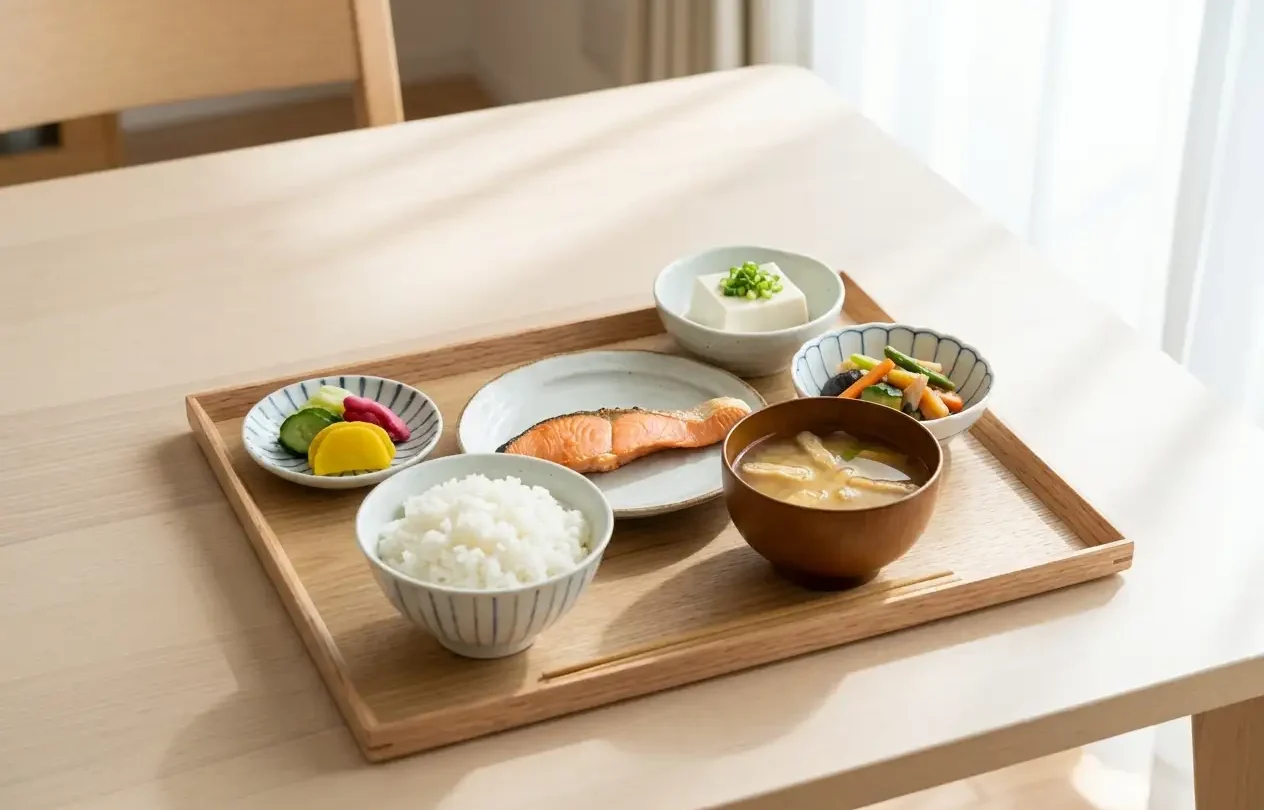
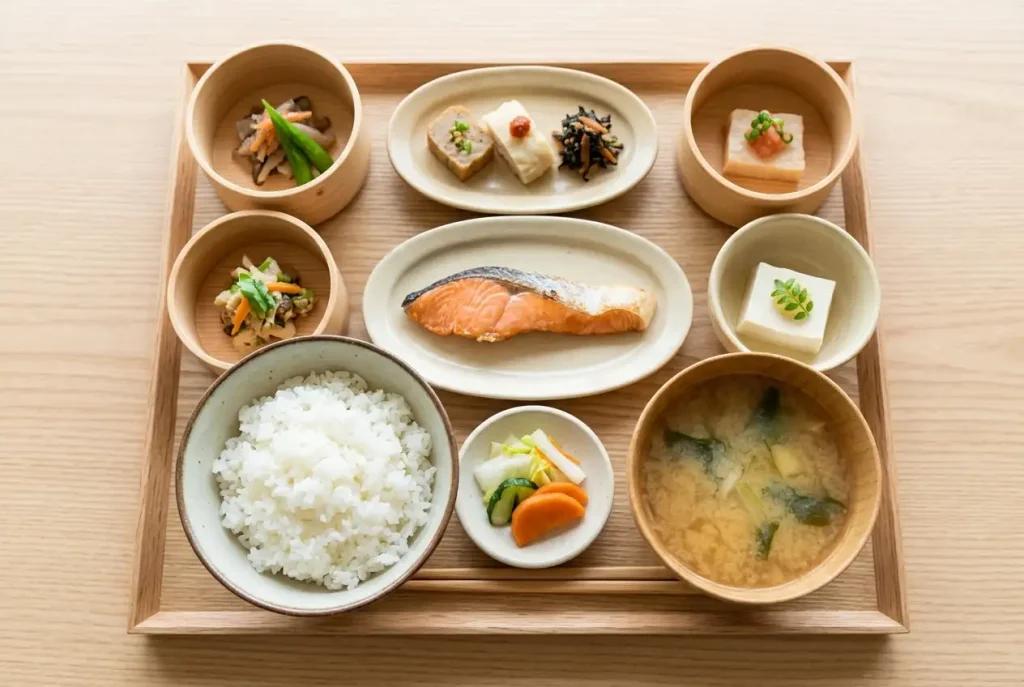
A Japanese breakfast arrives as a group of small decisions: rice on the left, soup on the right, fish behind them, and several dishes that may be no larger than a coaster. No single plate looks like the center of the meal, yet the tray feels complete. To understand it, you have to take the arrangement apart—and then compare it with the hotel buffet, convenience-store bag, coffee-shop toast and ryokan tray that also count as breakfast in Japan.
The polished version is 一汁三菜, ichijū-sansai, literally “one soup, three dishes.” It is a useful framework, but it is not a census of what every household cooks before work. Preparing rice, soup, fish and side dishes from scratch takes time, while commuters may eat an onigiri on a train platform or accept the toast included with a café drink. The uncomfortable truth is that the breakfast most heavily promoted to visitors is often the version least practical on an ordinary weekday.
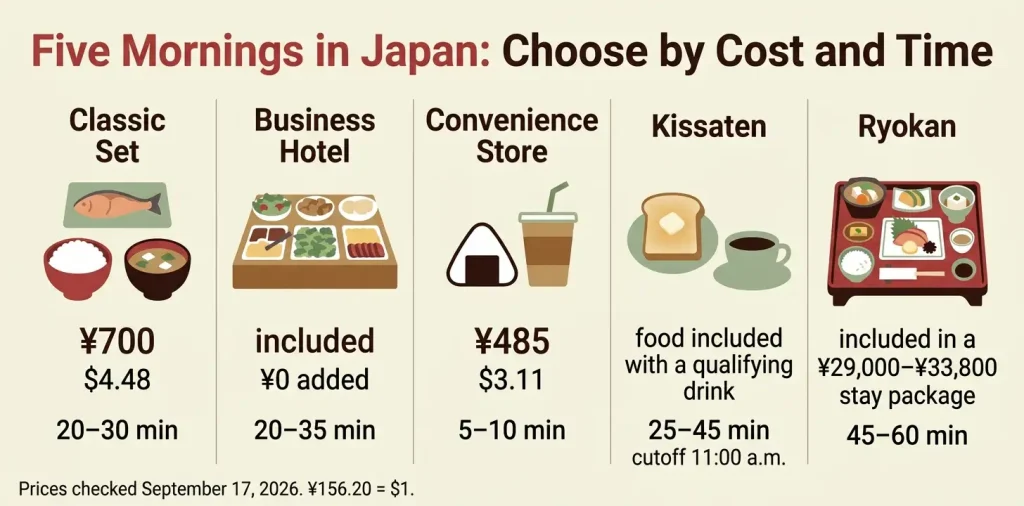
Here are the five forms compared in this guide. Prices were checked on September 17, 2026, and converted at ¥156.20 to $1. The time figures are planning allowances for travelers, not service guarantees published by the businesses.
| Breakfast type | Verifiable 2026 price example | Approximate USD | Practical time allowance | What you actually receive |
|---|---|---|---|---|
| Classic rice-and-fish set | ¥700 at Matsuya | $4.48 | 20–30 minutes | Rice, miso soup, grilled salmon, pickles and a side |
| Business-hotel breakfast | Included at Toyoko Inn Osaka Namba | $0 beyond the room rate | 20–35 minutes | Buffet with Japanese and Western choices |
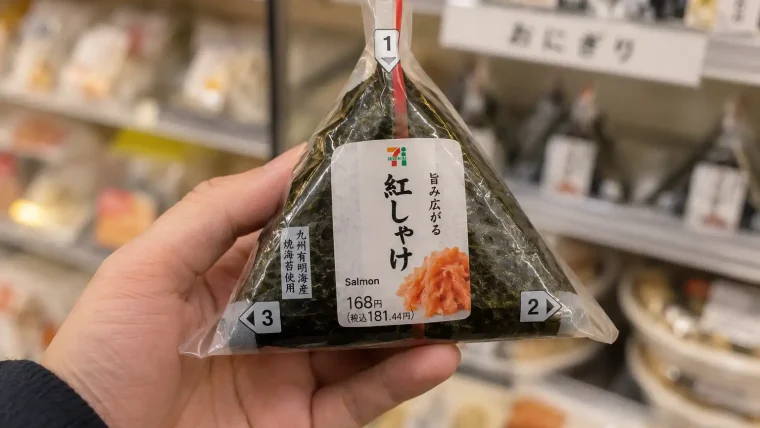
| Convenience-store breakfast | ¥485 model basket | $3.11 | 5–10 minutes | Large onigiri plus instant soup |
| Kissaten morning service | From the price of a drink; menus vary by store | Commonly under $5 in the cited Komeda listings | 25–45 minutes | Coffee or tea with toast and a small accompaniment |
| Ryokan breakfast | Included in cited ¥29,000–¥33,800 packages | $185.66–$216.39 per person for the full stay package | 45–60 minutes | Multiple dishes served as part of the accommodation plan |
The ryokan row is deliberately not presented as a breakfast price. The cited package covers accommodation and meals, so pretending that the morning tray alone costs a fixed amount would be false precision.
Rice is the anchor, not a side dish
The first bowl your eye usually meets is 御飯, gohan, literally “cooked rice” and, in everyday speech, also “meal.” That double meaning tells you where the structure begins. Rice is not treated like toast added beside an American breakfast plate; it is the neutral center that connects soup, fish, vegetables and salty condiments.
In a traditional arrangement, the rice bowl sits in front of you on the left. You lift it while eating rather than leaving it on the tray and bending toward it. The portion may look modest, but the other dishes are seasoned to be eaten with rice, not as independent entrées.
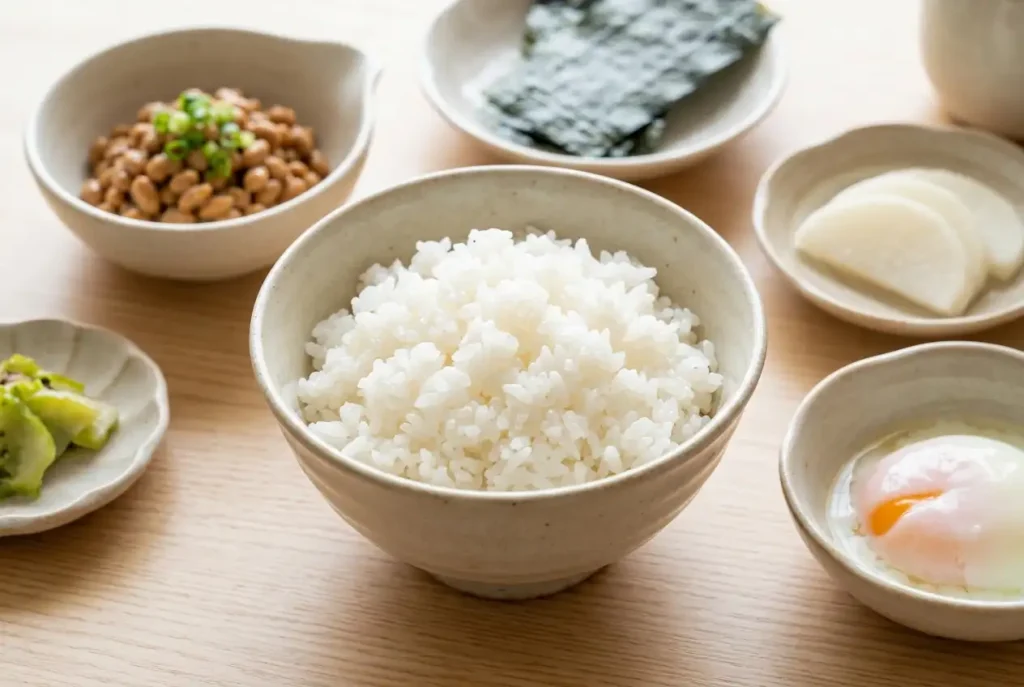
White short-grain rice is standard, although hotels and health-focused restaurants may offer mixed-grain rice, porridge or both. A raw or softly cooked egg may be added for 卵かけご飯, tamago-kake gohan, literally “egg poured over rice.” 納豆, nattō, fermented soybeans, plays a similar role: its strong aroma and sticky texture make more sense when mixed into warm rice than when judged as a separate bowl.
The basic map looks like this:
- 御飯, gohan, “cooked rice”: the meal’s neutral center.
- 味噌汁, miso shiru, “miso soup”: moisture, warmth and another layer of seasoning.
- 焼き魚, yakizakana, “grilled fish”: the principal savory dish.
- 漬物, tsukemono, “pickled things”: small, sharp bites between mouthfuls.
- 小鉢, kobachi, “small bowl”: vegetables, tofu, seaweed or another side.
- 納豆, nattō, “fermented soybeans”: an optional rice topping, not a universal requirement.
- 海苔, nori, “seaweed”: a crisp or seasoned wrapper for bites of rice.
If menu vocabulary is the larger problem, Japanese Food for Beginners: How to Read a Menu explains the labels and ordering patterns without turning breakfast into another dictionary.
Miso soup changes with the household
味噌汁, miso shiru, literally “miso soup,” usually sits at the front right. It brings hot liquid to a meal that may otherwise contain firm rice, crisp pickles and grilled fish. You lift the bowl, drink directly from it and use chopsticks for the solid ingredients.
The name makes the soup sound standardized, but the contents reveal the household or region. The broth may contain tofu, wakame seaweed, daikon, mushrooms, clams or vegetables left from another meal. Miso itself varies in color, sweetness and saltiness, so a pale Kyoto bowl and a darker bowl in central Japan can feel like different foods.
The soup is also where the tidy restaurant image departs from home life. At home, it may be reheated from the previous evening. A hotel may prepare a large batch for buffet service, while a convenience-store version comes in a cup or packet requiring hot water. The function remains the same even when the labor behind it changes.
Miso soup is therefore not merely a decorative cup placed beside the “real” breakfast. It connects leftover ingredients, local seasoning and the morning need for something hot. That practical role is easier to miss than its flavor.
Grilled fish supplies the concentrated bite
焼き魚, yakizakana, “grilled fish,” usually appears behind the rice and soup. Salmon and mackerel are common because a relatively small piece provides a strongly flavored accompaniment to a larger bowl of rice. The fish may be salted before grilling, and grated daikon often appears beside it.
This is where American expectations can distort the tray. The fish is not intended to match the size of a dinner entrée. It is one strong element among several, and its salt, oil and browned surface are distributed across repeated bites of rice.
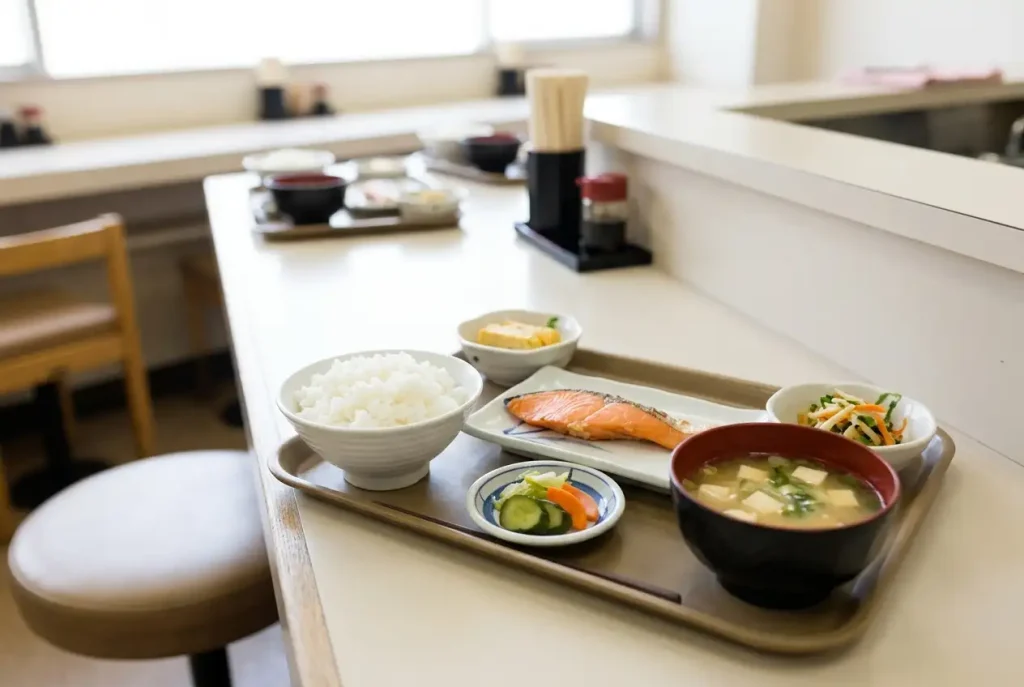
Matsuya’s 炙り焼鮭朝定食, aburi yakizake asa teishoku, “seared grilled-salmon morning set,” provides a useful commercial example. The chain listed it at ¥700, about $4.48, on September 17, 2026, with rice, miso soup, pickles and a selectable side. Its breakfast menu was offered from 5:00 to 11:00 a.m., showing that a structured Japanese breakfast set is not confined to expensive hotels.
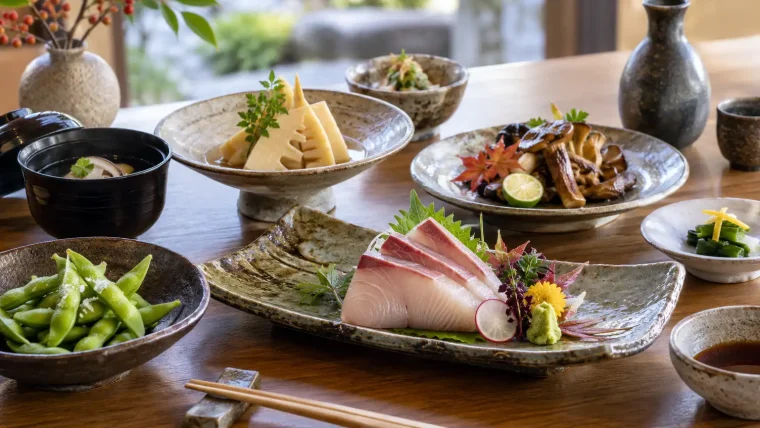
Fish is not compulsory, however. Egg, tofu or nattō can occupy the main-protein position. If your breakfast includes sashimi, remember that raw fish and sushi are not interchangeable terms; Sushi vs Sashimi: The Difference Is the Rice covers that distinction rather than repeating it here.
The small dishes do more work than their size suggests
The rear and side positions hold 小鉢, kobachi, “small bowls.” These can contain spinach dressed with sesame, simmered vegetables, chilled tofu, seaweed, grated yam or a rolled omelet. Together they supply changes in temperature, texture and seasoning.
This is the clearest expression of 一汁三菜, ichijū-sansai. The phrase counts one soup and three dishes, but it should not be read as a compulsory checklist requiring three elaborate recipes every morning. Pickles and rice are traditionally counted separately, and real household meals are often simpler.
A formal-looking tray can also hide efficient preparation. Vegetables may have been cooked in advance, fish may need only grilling, and the rice cooker may have finished before anyone entered the kitchen. The variety is visible at breakfast, but not all its labor happened that morning.
Season controls these bowls more than a fixed national template does. Shun: the Month Decides the Menu explains 旬, shun, “peak season,” and why the vegetable or fish on the tray changes while the meal’s basic structure survives.
Pickles are a reset button, not a vegetable serving
漬物, tsukemono, literally “pickled things,” can look like the smallest and least important part of the tray. Their purpose is not simply to add another vegetable category. A bite of crisp, acidic or salty pickle interrupts the soft textures of rice and tofu and clears the taste of oily fish.
This is the component that is not quite what it looks like. A few slices of pickled daikon are not intended to function like a large Western side salad. They work more like punctuation, changing the next mouthful without dominating the meal.
梅干し, umeboshi, “dried ume,” is another concentrated accent. Although usually called a pickled plum in English, ume is botanically closer to an apricot. Its intense salt and acidity mean that a small piece can season a substantial amount of rice.
Salt levels deserve attention if you eat this style of breakfast every day. Fish, miso soup, pickles and seasoned seaweed can all contribute sodium. The traditional arrangement creates variety, but tradition does not automatically make every commercial set appropriate for every medical diet.
Seaweed and natto turn rice into several different breakfasts
A packet of 海苔, nori, “seaweed,” may appear too small to matter. You use it to wrap a bite of rice, adding crispness and roasted aroma. Once exposed to steam, it softens quickly, which is why hotels often keep it sealed until the guest opens it.
Nattō changes the bowl more dramatically. You stir the fermented soybeans until their strands become pronounced, add the supplied sauce or mustard and place the mixture over rice. Many Japanese people eat it routinely, while many others dislike it; presenting nattō as a test of cultural courage is unnecessary.
Egg, nori and nattō illustrate the modular nature of the meal. The rice remains constant while the topping changes, allowing breakfast to feel different without rebuilding the entire tray. This is also why a buffet can represent the structure without preassembling it for you.
Travelers with dietary restrictions should not assume that small dishes are harmless. Soup stock may contain fish, sauces may contain wheat or soy, and vegetables may be cooked with animal-derived ingredients. Vegetarian, Vegan and Allergies in Japan explains the hidden ingredients, while the phrasebook with 337 practical phrases, including ordering and allergies helps you ask rather than guess.
Five breakfasts, five different uses of your morning
Once the parts are clear, the five versions stop looking like competing claims about authenticity. Each solves a different morning problem. The useful comparison is not “traditional versus fake,” but how much money, time, choice and ceremony you are buying.
| Version | Core structure | Price basis checked in 2026 | Service or availability window | Main trade-off |
|---|---|---|---|---|
| Classic set | Rice, soup, fish, pickles, side | Matsuya salmon breakfast: ¥700 ($4.48) | 5:00–11:00 a.m. | Complete and inexpensive, but you must sit down |
| Hotel | Buffet or fixed Japanese tray | Toyoko Inn example: included; Imperial Hotel Japanese breakfast: ¥5,800 ($37.13) | Toyoko example: 6:30–9:00 a.m. | Convenient, but quality and room-rate value vary |
| Konbini | Rice item plus soup, egg or yogurt | Model basket: ¥485 ($3.11) | Store dependent | Fastest, but usually less varied |
| Kissaten | Drink, toast and egg or spread | Food included with a qualifying drink at Komeda; drink prices vary | Opening time–11:00 a.m. | Good for sitting, poor when you need a full rice meal |
| Ryokan | Rice, soup and several regional dishes | Included in a meal plan; cited packages ¥29,000–¥33,800 ($185.66–$216.39) | Property-assigned breakfast time | Most elaborate, least flexible |
The konbini breakfast is built around speed. A 2026 example using a ¥338 FamilyMart large onigiri and Nissin’s ¥136 soup before tax comes to approximately ¥485 after the soup’s standard tax calculation. Product availability and regional prices vary, so this is a reproducible basket, not a promised nationwide set.
The kissaten morning service works differently. At Komeda Coffee, ordering a qualifying drink before 11:00 a.m. brings a morning selection such as toast with a boiled egg, egg spread or sweet red-bean paste. The food is presented as a service attached to the drink, which reflects the café’s goal: you are buying a seat and a slower start as much as breakfast.
Hotel breakfast covers the widest range. Toyoko Inn Osaka Namba advertised a free buffet from 6:30 to 9:00 a.m., while the Imperial Hotel Tokyo listed a Japanese breakfast at ¥5,800, about $37.13. “Hotel breakfast” therefore tells you almost nothing about price until you know the property and whether the meal is included.
The ryokan breakfast is usually read as part of the stay rather than an independent purchase. It may include local fish, tofu, regional pickles, hotpot or a dish cooked at the table. You are also accepting a set time and a longer meal, which can conflict with an early train. Paying for a meal plan and leaving before breakfast is one of the quiet ways travelers waste money.
What the complete tray tells you
The combination communicates balance through relationships rather than through one dominant food. Rice needs something salty; fish benefits from grated daikon or pickles; soup softens the meal; small dishes prevent repetition. Remove any one piece and breakfast can still work, but the complete tray makes those relationships visible.
This does not mean the arrangement is timeless or universal. The language of 一汁三菜, ichijū-sansai, is often used as an ideal of balance, while daily eating is shaped by work hours, school schedules, household size and access to prepared food. Toast, yogurt, cereal and coffee are normal Japanese household foods too.
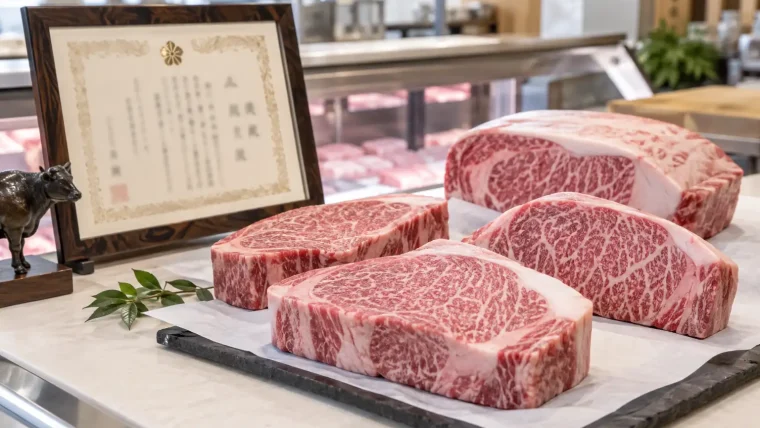
The meal also demonstrates why isolated labels can mislead. Wagyu grading, for example, cannot be reduced to the letter printed beside the meat; The A Is Not a Quality Grade takes that system apart. Breakfast works in the opposite direction: no single bowl defines it, because the meaning is in the arrangement.
The tray is not a row of miniature entrées. It is a system in which plain rice gives the stronger dishes somewhere to go.
Regional changes and modern shortcuts
Nagoya is associated with モーニングサービス, mōningu sābisu, “morning service,” in which a drink order brings toast and a small accompaniment. Coastal ryokan emphasize local fish, while inland properties may rely more heavily on vegetables, tofu or preserved foods. Okinawan, Hokkaido and Kyoto breakfasts do not need identical ingredients to remain recognizably structured meals.
Hotel buffets loosen the arrangement further. You may take rice and miso soup, then add sausage, scrambled eggs, salad and coffee. The result is not a textbook tray, but the guest is still building breakfast from a staple, soup, protein and small sides.
Modern convenience also changes where the labor occurs. A household can use frozen grilled fish, instant soup and packaged side dishes. A business hotel centralizes the cooking, and a convenience store reduces the meal to wrapped products that can be eaten separately.
What rarely disappears is the choice between a rice-centered meal and a bread-centered one. A café morning set is not a failed version of ichijū-sansai; it belongs to a different routine. The next time a breakfast tray reaches you, look first at the rice bowl and then ask what every smaller dish has been arranged to do around it.
Five mornings, one decision map
Short FAQ
Is rice always served at breakfast in Japan?
No. Rice is central to the traditional structure, but toast, cereal, yogurt and coffee are common. Kissaten morning sets are usually bread-based, and many hotel buffets offer both choices.
Is a ryokan breakfast included in the room price?
It depends on the accommodation plan. Many ryokan sell packages with dinner and breakfast, but room-only and breakfast-only plans also exist. Check the meal icons and cancellation terms before booking.
Is natto part of every traditional breakfast?
No. It is a common option, especially at hotel buffets, but it is neither mandatory nor universally liked.
Can you eat a full rice breakfast cheaply?
Yes. In September 2026, Matsuya listed its grilled-salmon morning set at ¥700, approximately $4.48. Prices and availability may vary by location.