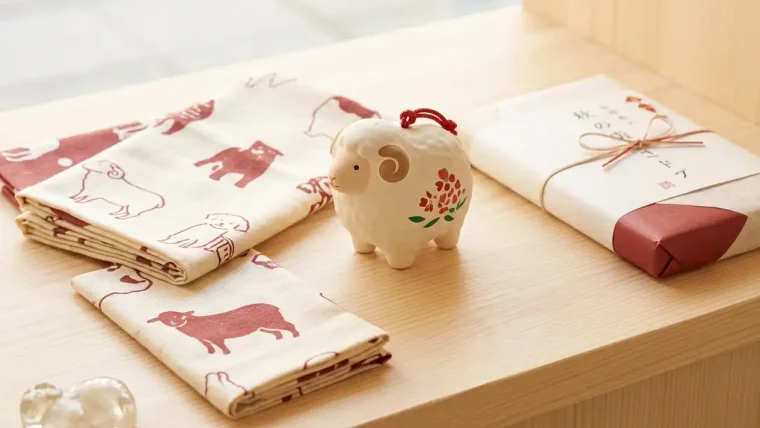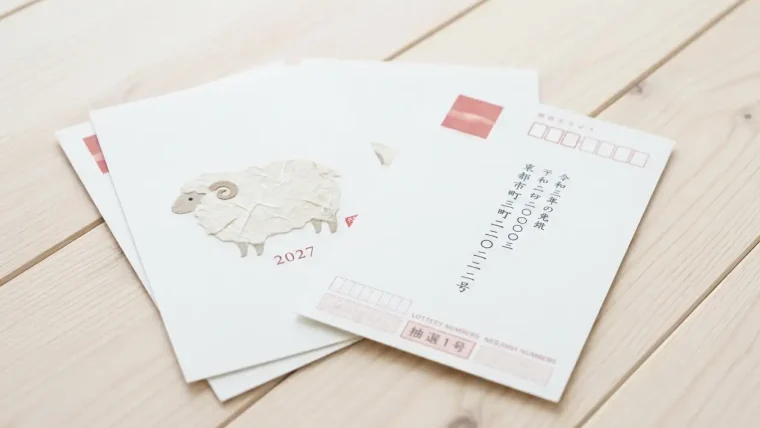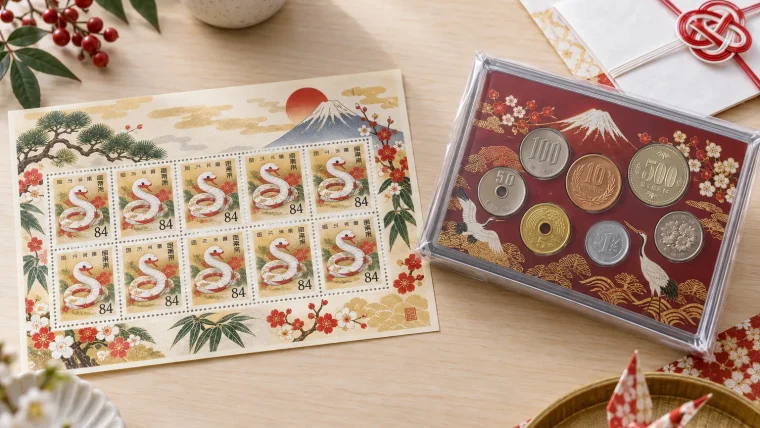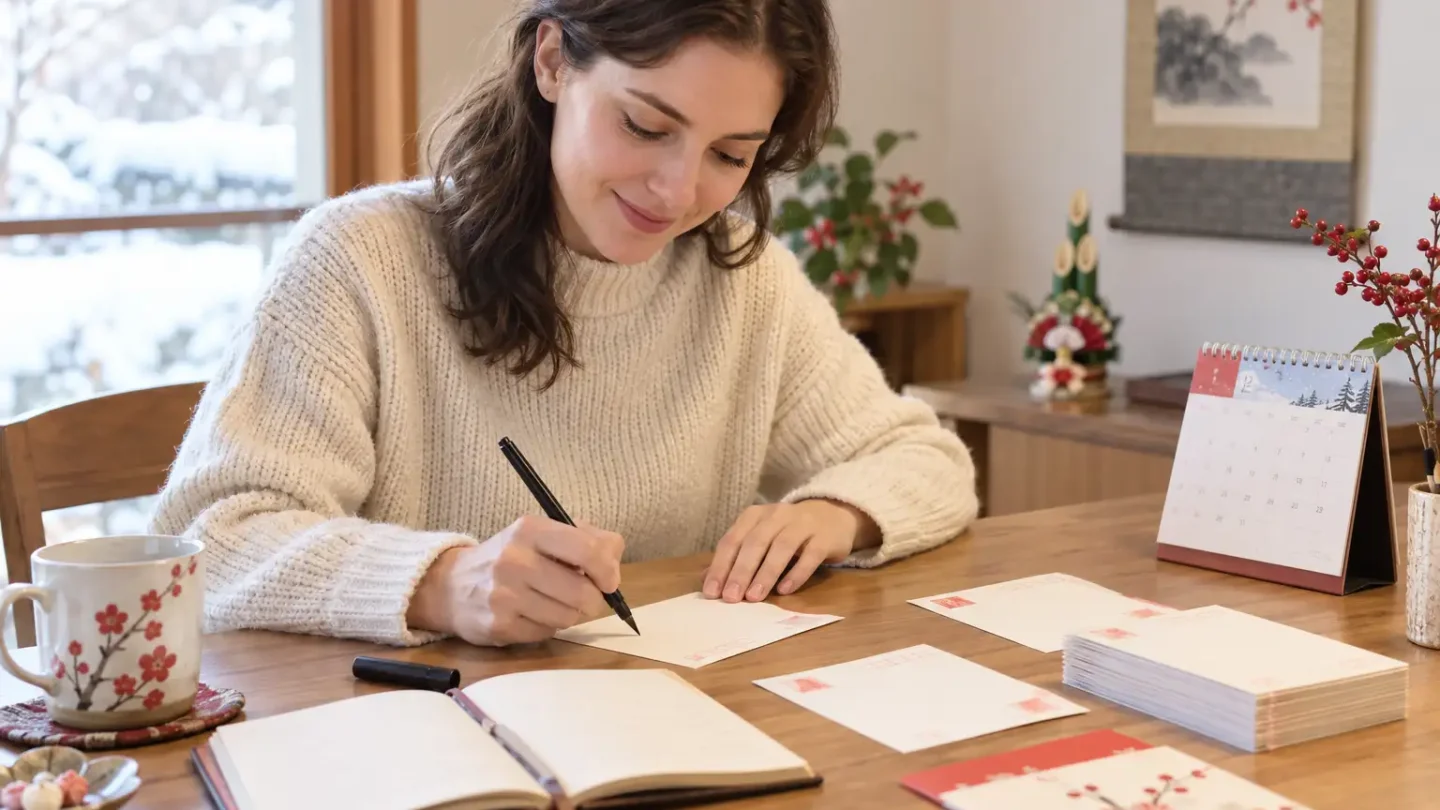
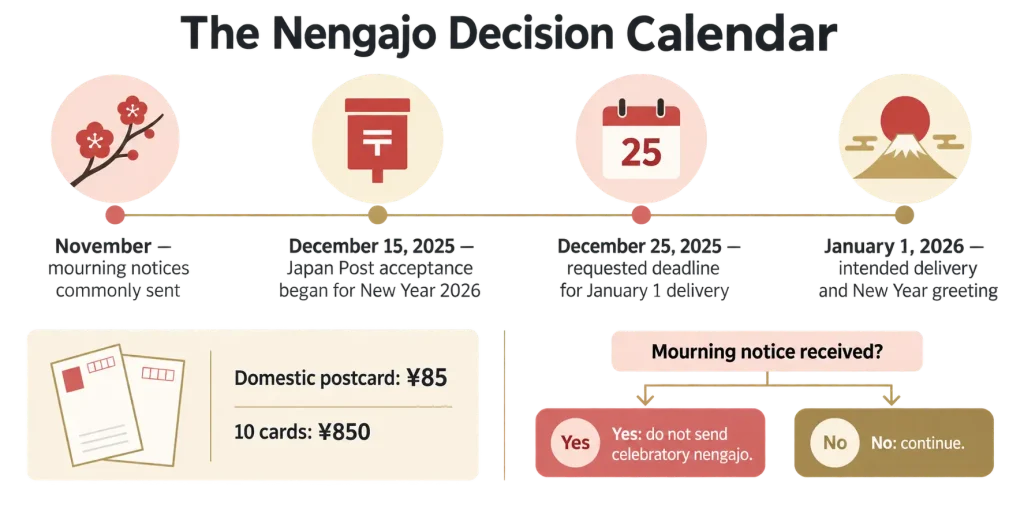
December 25 is the date to remember. Japan Post asked customers sending cards for New Year’s Day 2026 delivery to mail them by December 25, 2025, after seasonal acceptance opened on December 15. That annual announcement is the practical starting point for how to send nengajo, although the dates must be checked again each year. A domestic New Year postcard currently costs ¥85, or about $0.54 at the September 17, 2026 exchange rate of roughly ¥156.2 to $1. The awkward part is that meeting the postal deadline is useless if the recipient’s family has sent you a mourning notice asking to suspend New Year greetings.
年賀状, nengajō, literally “New Year greeting card,” belongs to Japan’s January 1 celebration rather than Lunar New Year. Its animal design follows the Japanese calendar year. How the Animal of the Year Runs December explains why the next animal begins appearing on stationery, stamps, decorations, and store displays before the current year has ended.
The ¥85 calculation before you buy anything
The simplest nengajo budget contains only one compulsory item: the postcard and its domestic postage. Japan Post lists a standard domestic postcard at ¥85 as of September 2026. Official New Year postcards normally include the necessary postage, so you do not buy another stamp for a standard card mailed within Japan.
The table below uses a list of 10 recipients. Dollar amounts are approximate conversions using ¥156.2 to $1, the market level reported on September 17, 2026. Printing, photographs, pens, and commercial design services are excluded because their prices depend on the shop and product you choose.
| Component | Quantity | Unit price | Subtotal | Source and date |
|---|---|---|---|---|
| Domestic New Year postcard with postage | 10 | ¥85 ($0.54) | ¥850 ($5.44) | Japan Post domestic postcard rate, checked September 17, 2026 |
| Additional domestic stamp | 0 | ¥0 | ¥0 | Not required when postage is included |
| Handwritten message | 10 | ¥0 | ¥0 | Written by the sender |
| Total | 10 cards | ¥850 ($5.44) | Rate and conversion checked September 17, 2026 |
The arithmetic is simply 10 × ¥85 = ¥850. For 25 cards, the same calculation becomes 25 × ¥85 = ¥2,125, or approximately $13.60 at the stated exchange rate. Your real total rises if you order photo printing, address printing, premium paper, or custom illustrations, but those are optional services rather than part of Japan Post’s base rate.
How to send nengajo on the right dates
For the 2026 New Year season, Japan Post began accepting nengajo on December 15, 2025. It asked senders to post by December 25 for delivery on January 1, 2026. This is best treated as a dated service target, not a permanent promise that can be copied into every future article.
A workable schedule therefore looks like this:
- Confirm your recipient list by early December.
- Check whether anyone has sent a mourning notice.
- Buy or prepare the cards before seasonal acceptance starts.
- Address and finish them before December 25.
- Place them in the designated New Year mail slot when one is provided.
- Check Japan Post’s current announcement before relying on the deadline in a later year.
Do not mail an ordinary nengajo too early without following Japan Post’s seasonal instructions. The postal system holds properly identified New Year mail for January 1 delivery, but an incorrectly prepared ordinary postcard may enter the regular mail stream.
The deadline is operational, not ceremonial: December 25 is the date Japan Post requested for January 1, 2026 delivery.
Before January 1 and after January 1 are not the same conversation
Before the year turns, the everyday phrase is 良いお年を, yoi otoshi o, literally “a good year,” meaning “Have a good New Year.” After midnight on January 1, you can say 明けましておめでとうございます, akemashite omedetō gozaimasu, meaning “Congratulations on the opening of the new year,” or more naturally, “Happy New Year.”
However, the often-repeated instruction that you must never write akemashite omedetō gozaimasu before January 1 is misleading. People prepare and write their Japanese New Year cards in December, and those cards commonly contain the phrase because recipients are meant to read them after the year begins. What you should avoid is using it as a live December greeting in a conversation, email, or message that the recipient reads before January 1.
| Situation | Appropriate wording | Meaning |
|---|---|---|
| Conversation or message before January 1 | 良いお年を, yoi otoshi o | Have a good New Year |
| Nengajo prepared in December for January 1 delivery | 明けましておめでとうございます, akemashite omedetō gozaimasu | Happy New Year |
| Conversation or message after January 1 | 明けましておめでとうございます, akemashite omedetō gozaimasu | Happy New Year |
| Message to a household observing mourning | No celebratory New Year wording | Respect the mourning notice |
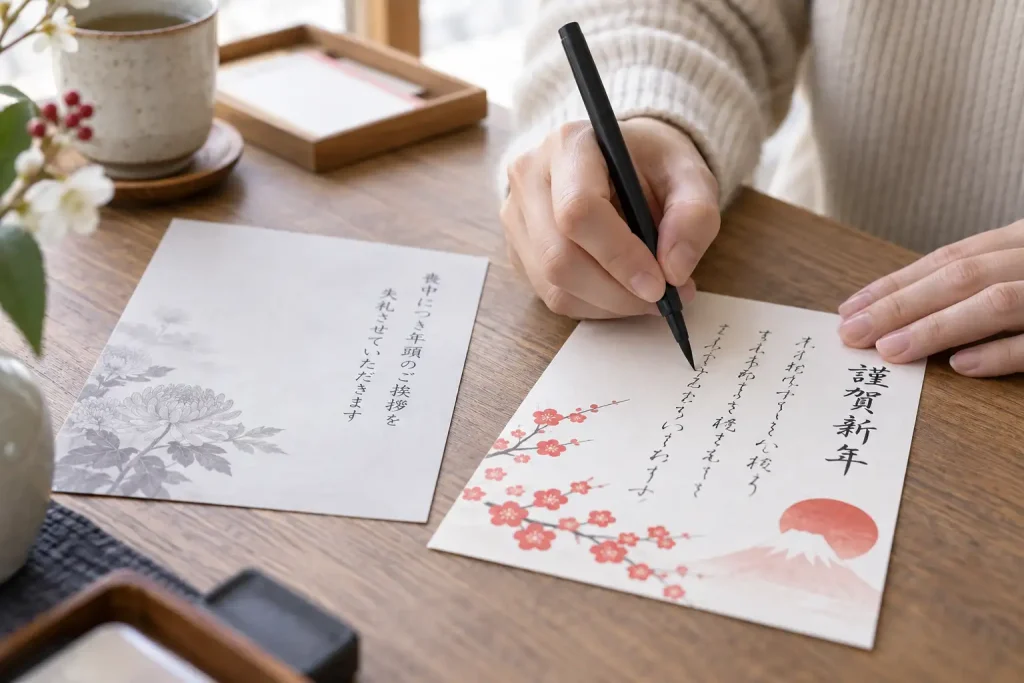
A printed card can also use formal congratulatory expressions such as 謹賀新年, kinga shinnen, literally “respectfully celebrating the New Year.” If you are writing to a teacher, manager, client, or older acquaintance, a complete and polite greeting is safer than a casual abbreviation.
The animal printed on the card is Japan’s animal for the incoming January calendar year. If you need a personal birth-year result instead, the site’s zodiac calculator covering every year from 1930 through 2043 and all twelve signs is the appropriate tool. It should not be used to decide which animal belongs on Japan’s January 1 nengajo, because those are separate questions.
A mourning notice cancels the normal card
喪中はがき, mochū hagaki, literally “mourning postcard,” tells contacts that a household will refrain from celebratory New Year greetings following a death in the family. It is not a replacement celebratory card. It is an advance notice explaining why the household will not send its usual nengajo.
The practical custom is to have the notice arrive before recipients begin preparing their cards, commonly from November through early December. November is therefore a sensible planning month, but it is not a single statutory Japan Post deadline. The exact mourning period and which relatives it covers depend on the household, relationship, and family practice.
If you receive such a notice, remove that household from your nengajo mailing list. Do not send a cheerful card simply because you already bought it or because the recipient is not personally related to the deceased. If you learn of the death only after mailing your card, you have made an understandable mistake; a brief apology is enough, without forcing the family into a long explanation.
A restrained winter greeting may be sent later if appropriate. 寒中見舞い, kanchū mimai, literally “midwinter inquiry,” is a seasonal message rather than a New Year celebration. Its timing follows the New Year holiday period and local convention, so check a current Japanese postal or etiquette source before assigning a universal date.
The animal design is optional, not the protocol
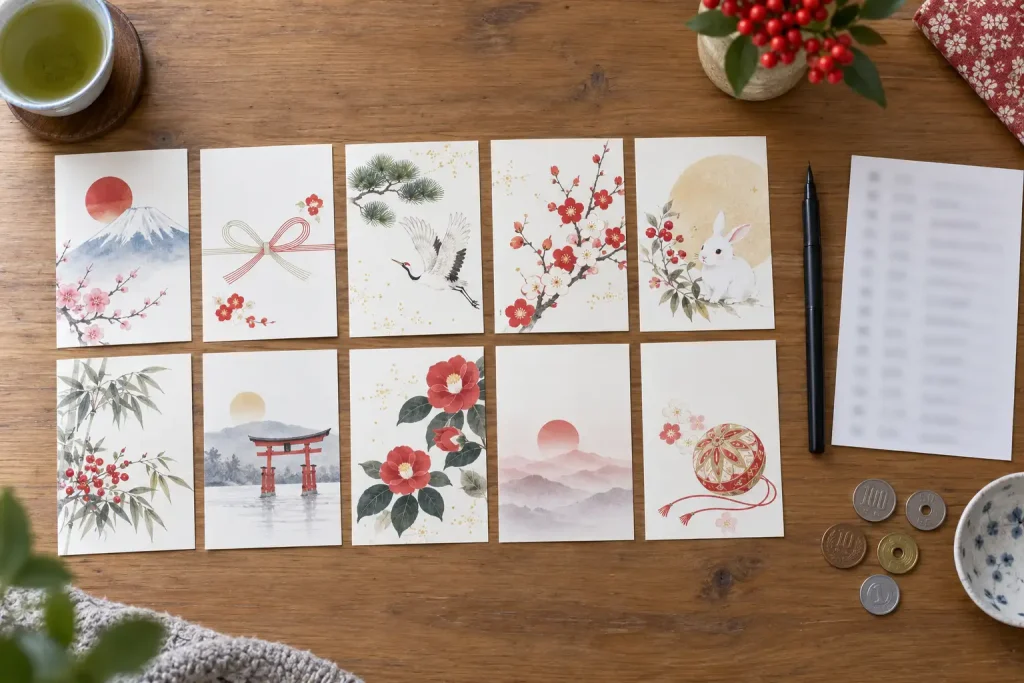
Many cards carry the incoming year’s animal, but the picture is decoration rather than a mailing requirement. A photograph, landscape, simple pattern, or plain handwritten card can still be valid. The protocol is determined by the address, postage, seasonal handling, timing, and the recipient’s circumstances.
For the background to the twelve-year sequence, The Chinese Zodiac Years, Explained Properly covers the animals and cycle without turning this mailing guide into another zodiac explainer. Readers born near the beginning of the year can also consult Born in January or February? Your Zodiac Sign May Be Wrong, which explains why the Chinese lunisolar boundary differs from Japan’s January 1 convention.
Collectors should remember that the postal object can matter independently of the greeting. Collecting the Animal Year in Paper and Metal looks at the stamps, postcards, and commemorative issues surrounding the annual design. For the broader seasonal sequence—from early retail displays to January 1—How the Animal of the Year Runs December provides the full calendar context.
What changes the total or the delivery result
Several choices can move the price above the basic ¥85 per recipient. Commercial printing adds a per-card or package charge. Address printing may carry its own fee. Premium photographic products, custom designs, and expedited preparation also increase the total, sometimes by much more than the postage itself.
These extras are optional:
- Professional photo or illustration printing
- Printed recipient addresses
- Premium card stock or finishing
- Custom calligraphy
- Replacement cards for addressing mistakes
- International postage when the recipient is outside Japan
The uncomfortable comparison is with a digital greeting. An email or messaging-app greeting has no postage cost and no postal deadline, while 10 domestic postcards cost ¥850 before printing. A physical card therefore makes sense when the relationship or workplace custom justifies the preparation, not because it is the cheapest way to say Happy New Year.
International delivery is a separate service. A Japanese domestic New Year postcard does not receive guaranteed January 1 delivery abroad, and domestic prepaid postage may not cover the international rate. Check the destination, current postage, service availability, and mailing time directly with Japan Post before sending.
The three-decision protocol
Your final decision can be reduced to three questions. First, has the recipient sent a mourning postcard? If yes, do not send a celebratory nengajo. Second, is the card traveling within Japan? If yes, use the current domestic postcard rate; if not, check international postage and delivery time. Third, can you meet Japan Post’s announced seasonal deadline?
The process is short:
- No mourning notice: prepare the card.
- Mourning notice received: remove the address from the list.
- Domestic delivery: budget ¥85 per card at the September 2026 rate.
- Desired January 1 delivery: use the current Japan Post deadline.
- Spoken or immediately read December greeting: use yoi otoshi o.
- Card intended to be read in the new year: akemashite omedetō gozaimasu is appropriate.
The single figure to remember is December 25, the deadline Japan Post requested for New Year’s Day 2026 delivery. That figure expires with the season. Recheck it when Japan Post publishes its instructions for New Year’s Day 2027.
Short FAQ
Can a foreign resident send nengajo?
Yes. You do not need Japanese citizenship or a special account. You need a correctly addressed card, sufficient postage, and the current Japan Post mailing instructions.
Is December 25 always guaranteed?
No. It was Japan Post’s requested deadline for January 1, 2026 delivery. Check the announcement for the season in which you are mailing.
Can I write “akemashite omedetō” while preparing the card in December?
Yes, because a nengajo is prepared in advance for the recipient to read after January 1. Do not use the same phrase as an immediate conversational greeting before the year has turned.
What should I do after receiving a mochū hagaki?
Do not send that household a celebratory New Year card. A restrained seasonal message later may be suitable, depending on your relationship and timing.