
Twelve animals, one per year, repeating forever. That’s the version most Americans know, and it’s about seventy percent right. The missing thirty percent is where all the confusion lives: the year doesn’t start on January 1, there’s a second cycle of five elements layered on top, and Japan runs its own variant with different rules and two different animals.
This is the full picture, in the order you need it.
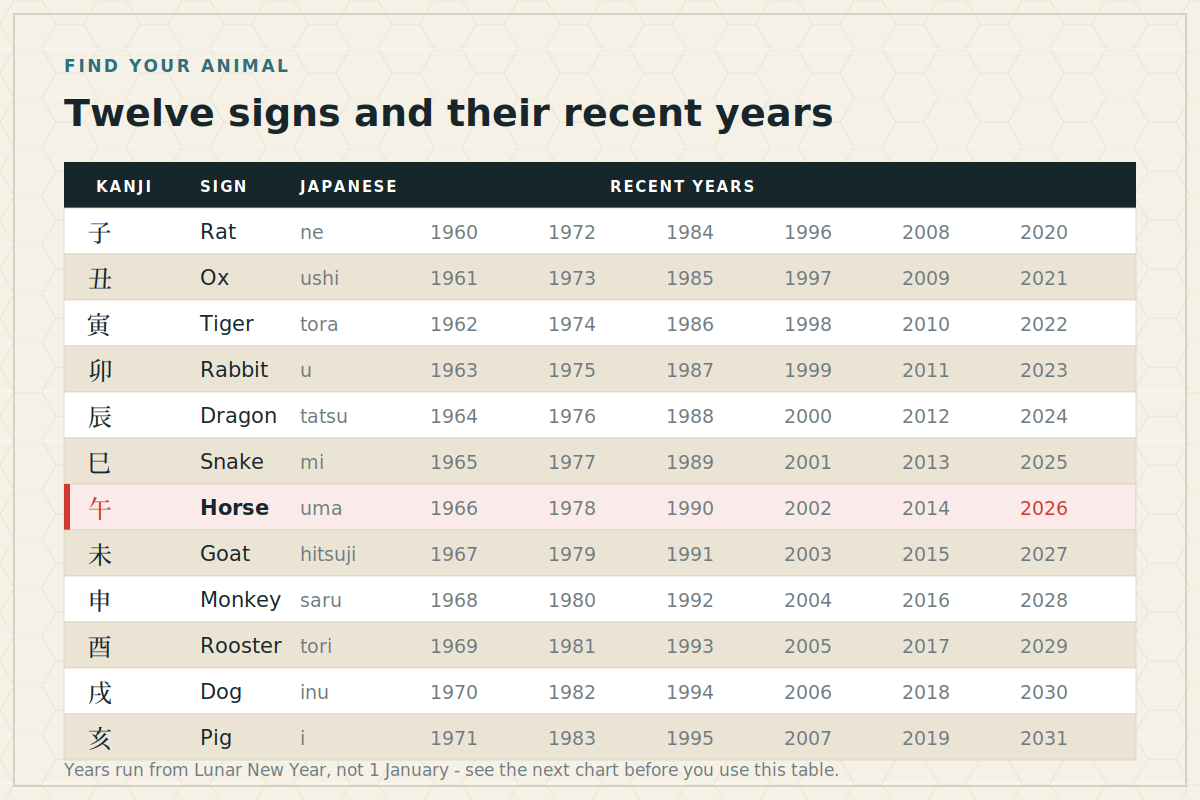
The twelve, in order
Rat, Ox, Tiger, Rabbit, Dragon, Snake, Horse, Goat, Monkey, Rooster, Dog, Pig. The order is fixed and the sequence never varies, so once you know one year’s animal you can count forward or back from it.
The signs are also a system of *branches* — twelve characters, 子丑寅卯辰巳午未申酉戌亥, that were originally a way of numbering things and only later got attached to animals. That’s why the character for the Horse year, 午, doesn’t contain the character for horse. In Japan you’ll meet the branches directly, on New Year cards and shrine decorations, which is covered in our piece on how Japan’s eto differs from the Chinese zodiac.
One regional variation worth knowing: Vietnam swaps the Rabbit for a Cat, so a Vietnamese friend born in a Rabbit year will tell you they’re a Cat. Both are correct within their own tradition.
The catch: the year starts in late winter
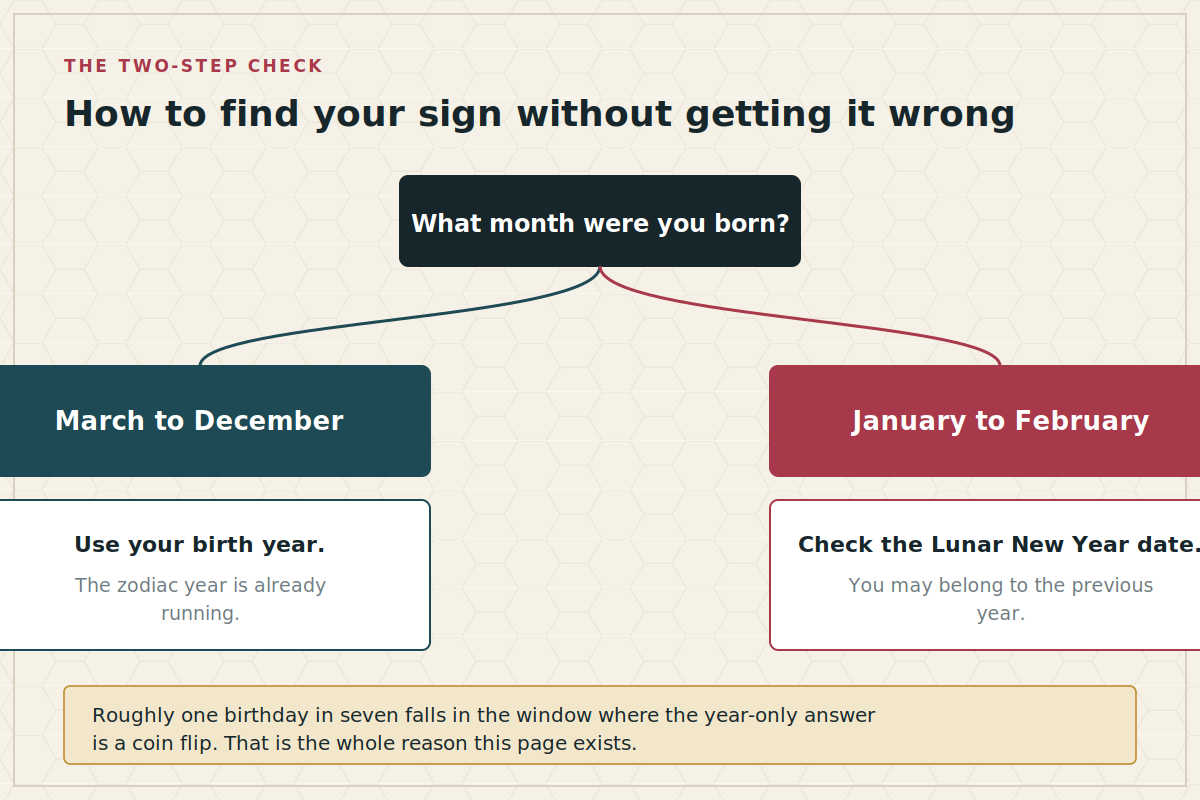
The zodiac year begins at Lunar New Year, which falls on a new moon somewhere between January 21 and February 20 depending on the year. It is not January 1.
If you were born in January or the first half of February, your sign is very likely the previous year’s animal, and any calculator that only asked for your birth year has probably given you the wrong one. In 2026 the boundary is February 17: a birthday on February 10 is a Snake, a birthday on February 20 is a Horse.
This affects roughly one birthday in seven, which is not an edge case — it’s a systematic error in most of the free tools online. We’ve written the whole thing up separately in the article on the floating new year, including the dates for the coming years.
The second wheel: five elements
Alongside the twelve animals runs a cycle of five elements — Wood, Fire, Earth, Metal, Water — each occupying two consecutive years. Combine the two cycles and you don’t get 12 years before things repeat, you get 60.
The element is readable straight off the year’s last digit:
| Last digit | Element | Example years |
|---|---|---|
| 4 or 5 | Wood | 1984, 1985, 2024, 2025 |
| 6 or 7 | Fire | 1986, 1987, 2026, 2027 |
| 8 or 9 | Earth | 1988, 1989, 2028, 2029 |
| 0 or 1 | Metal | 1980, 1981, 2020, 2021 |
| 2 or 3 | Water | 1982, 1983, 2022, 2023 |
Same caveat as before: that’s the digit of the year the zodiac year belongs to, so a January birthday may need the previous year’s digit. How the five elements relate to each other, and why the cycle is 60 rather than 12, is the subject of the article on the elements.
2026 is a Fire Horse, and that matters in Japan
The zodiac year that began on February 17, 2026 and runs to early February 2027 is hinoeuma — the Fire Horse. It comes round once every sixty years, and the last one was 1966.
In Japan that particular combination carries a superstition: women born in a Fire Horse year were said to be headstrong and to bring misfortune to their husbands. It sounds like a historical curiosity until you look at the birth statistics. Japanese births fell about 25% in 1966 and recovered completely in 1967 — a superstition with a visible demographic footprint.
Whether 2026 repeats it is a live question, and the early answer appears to be no: Japanese analysts looking at the first months of 2026 report births slightly up on the previous year, and obstetricians report no drop in pregnancies. We go into the whole story in the eto article.
A calculator that only asks for your birth year gives a February 10 baby and a February 20 baby the same answer. One of those answers is wrong.Why our tool asks for the full date
What the signs are actually for
Worth being clear about, because English-language coverage tends to treat the zodiac either as a horoscope or as a joke, and it’s mostly neither.
In practice the zodiac functions as a calendar and a cultural shorthand across East Asia. It dates documents and historical events — the Meiji Restoration is still referred to by its cycle year. It drives an enormous seasonal economy of New Year cards, decorations and products carrying the coming year’s animal. It’s a polite way to ask someone’s age without asking their age, since knowing the sign narrows a birth year to a twelve-year cycle.
The personality and compatibility layer is genuinely part of the tradition too, and taken with varying seriousness — much as Western star signs are. Our piece on zodiac compatibility lays out how the pairings work, including the part most articles leave out: the groupings come from the geometry of a twelve-point circle, not from anything about the animals.
What each animal is said to stand for
Every sign carries a bundle of traditional associations. They are cultural characterisations rather than claims about people, and they vary between countries — but they’re what the New Year cards and the shop displays are drawing on, so they’re worth recognising.
| Sign | Traditionally associated with | Sign | Traditionally associated with |
|---|---|---|---|
| Rat | quick wits, thrift, resourcefulness | Horse | energy, independence, impatience |
| Ox | steadiness, endurance, stubbornness | Goat | gentleness, artistry, indecision |
| Tiger | courage, authority, recklessness | Monkey | cleverness, humour, mischief |
| Rabbit | tact, caution, good fortune | Rooster | precision, confidence, bluntness |
| Dragon | ambition, luck, grandeur | Dog | loyalty, fairness, worry |
| Snake | insight, privacy, elegance | Pig | generosity, comfort, trust |
The Dragon is the outlier in practical terms. It is the only mythical animal in the set and the most desirable sign to be born under, and Dragon years show measurable birth-rate bumps in several East Asian countries — the mirror image of the Japanese Fire Horse effect, and evidence that the zodiac still influences real decisions.
Working out any year
If you’d rather do it by hand than use a tool, the arithmetic is simple. Divide the year by 12 and take the remainder:
- remainder 4 — Rat
- remainder 5 — Ox
- remainder 6 — Tiger
- remainder 7 — Rabbit
- remainder 8 — Dragon
- remainder 9 — Snake
- remainder 10 — Horse
- remainder 11 — Goat
- remainder 0 — Monkey
- remainder 1 — Rooster
- remainder 2 — Dog
- remainder 3 — Pig
2026 divided by 12 leaves 10, which is the Horse. Check the birth month against the Lunar New Year date and you’re done.
Our calculator does both steps and shows the element as well, which saves the lookup — and unlike most, it asks for the full date rather than just the year. What it does, how it does it, and where we’d want you to double-check it, is set out on our tools page.