
Japan uses the same twelve-animal zodiac as China. It also gets different answers from it — different start date, two different animals, and one combination that measurably changed the country’s birth rate. If you’ve looked up your sign on a Chinese site and then seen something else on a Japanese New Year card, this is why.
What eto is
The Japanese word is eto, written 干支 — literally “stems and branches,” the same sexagenary system China uses. In everyday Japanese, though, eto usually means just the twelve animals, and every Japanese person knows theirs.
It’s more visible in daily life than the zodiac is in the West. New Year cards — nengajō, sent by the billion each December — carry the coming year’s animal. Shrines sell zodiac charms and ceramic figures. Products get themed. If you’re in Japan in January you will see the year’s animal several hundred times.
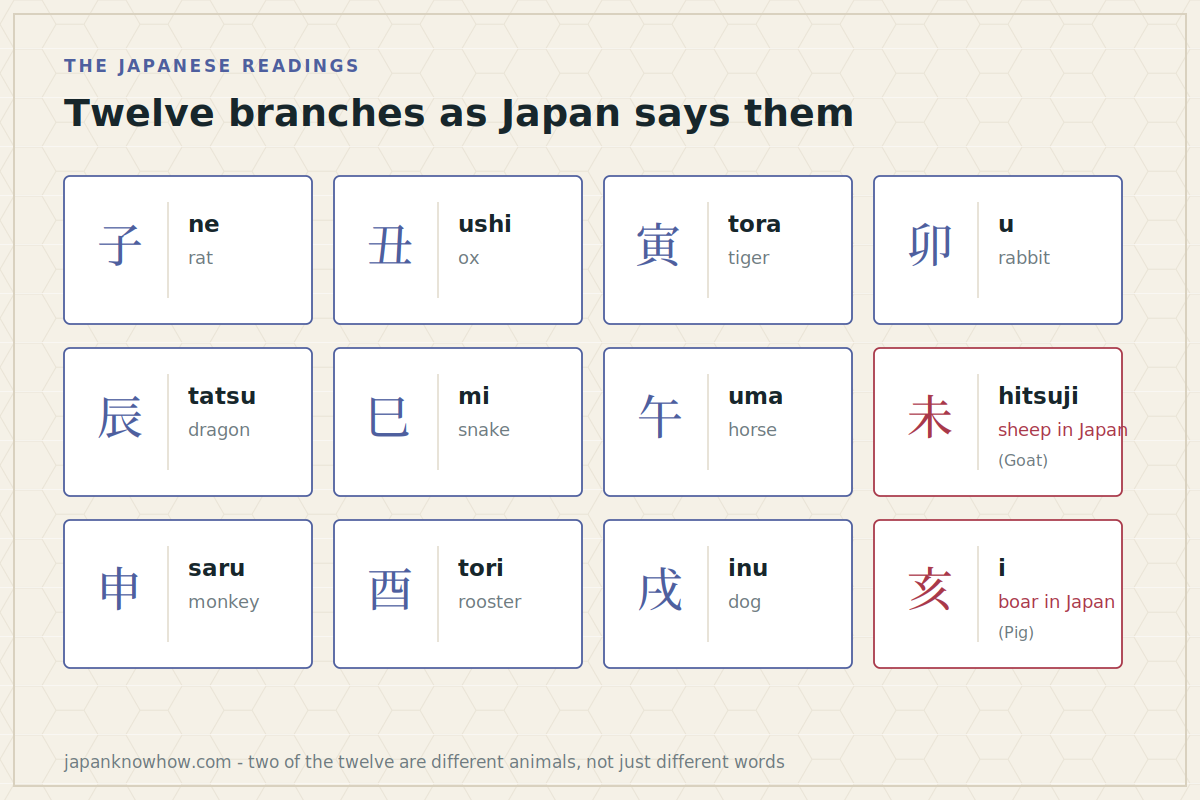
The animals also carry their Japanese readings, which are worth knowing because they’re what you’ll actually hear: ne, ushi, tora, u, tatsu, mi, uma, hitsuji, saru, tori, inu, i.
Difference one: the year starts on January 1
This is the big one. Japan adopted the Gregorian calendar in 1873, during the Meiji reforms, and moved the zodiac year along with it. The Japanese eto year turns at midnight on New Year’s Eve, not at Lunar New Year.
The consequence is a genuine mismatch for anyone born in January or early February. Someone born on February 1, 2026 is a Horse by Japanese reckoning — the Japanese Horse year started on January 1 — and a Snake by Chinese reckoning, because Lunar New Year 2026 fell on February 17. Both answers are correct inside their own system, and neither is a mistake.
It also means Japan doesn’t celebrate Lunar New Year as the year change. The big holiday is shōgatsu, January 1–3. Chinese New Year is observed in Yokohama and Kobe Chinatowns and largely ignored elsewhere. If you plan a February trip expecting lanterns, you’ll be disappointed — the Japanese calendar simply runs on different dates.
Difference two: sheep, not goat
The eighth branch, 未, is hitsuji in Japanese, and hitsuji means sheep. In Chinese the same branch is usually rendered as goat, sometimes as ram — the original Chinese term covers both and translators pick.
So the year English-language media calls the Year of the Goat is, in Japan, unambiguously a sheep. The New Year cards have sheep on them.
Difference three: boar, not pig
The twelfth branch, 亥, is i in Japanese, short for inoshishi — a wild boar. In China it’s a domestic pig.
This one is a bigger shift in flavour than it sounds. The pig in Chinese tradition is comfortable, prosperous, easy-going. The Japanese boar is the opposite: reckless, headlong, unable to change direction. There’s even a common Japanese expression, chototsu-mōshin, for charging blindly ahead, that carries the boar’s associations. Same slot in the cycle, opposite character.
| Branch | In Japan | In China | Note |
|---|---|---|---|
| 未 | Sheep (hitsuji) | Goat | The Chinese term covers both animals |
| 亥 | Wild boar (i) | Pig | Different animal, opposite associations |
| 卯 | Rabbit (u) | Rabbit | Vietnam uses a cat for this one |
| All twelve | Year starts 1 January | Year starts at Lunar New Year | Japan changed in 1873 |
Difference four: hinoeuma, and 1966
Here is the difference with real consequences. Once every sixty years the Horse coincides with the yang Fire phase, producing hinoeuma, 丙午. In Japan — and essentially only in Japan — that year carries a superstition that women born in it are fierce-tempered and bring ruin on their husbands.
The belief is generally traced to an Edo-period story about a greengrocer’s daughter, born in a Fire Horse year, who set a fire in the hope of seeing a man she loved again and was executed for arson. Whether that’s the true origin or a later attachment, the belief was firmly in place by the twentieth century.
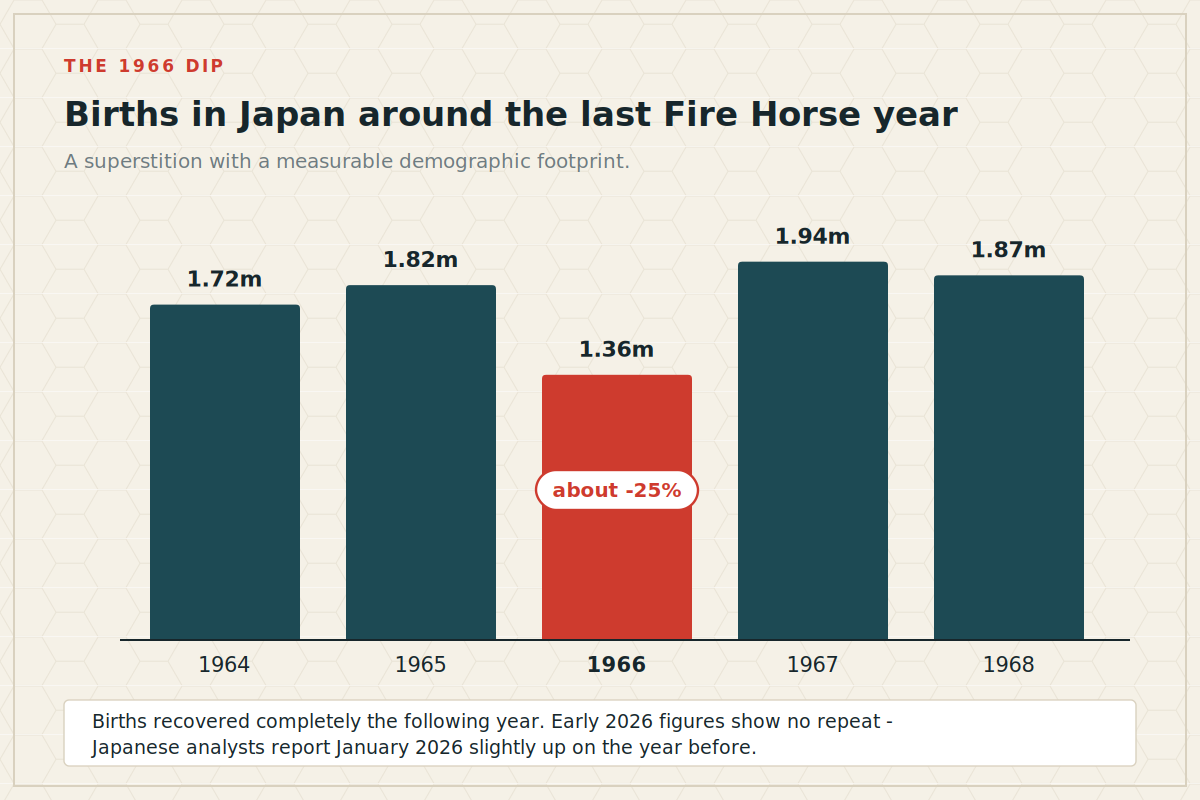
And in 1966 it moved a national statistic. Births dropped roughly 25% from the year before and returned to trend in 1967 — couples had deliberately avoided having a daughter that year. The 1966 cohort is still visible in Japanese demographic charts as a notch.
What about 2026?
2026 is the next hinoeuma, the first since 1966, and it has been discussed in the Japanese press for years — partly as superstition, mostly as a demographic question in a country already worried about its birth rate.
The early evidence says the effect has faded. Analysts looking at the first months of 2026 report births slightly up on the same period a year earlier, and obstetricians report no unusual drop in pregnancies. One Japanese research institute’s assessment, published this year, is blunt: the hinoeuma effect appears to be absent.
That would make 2026 the year a 360-year-old superstition quietly stopped working — worth noting, given how much of the commentary assumed otherwise. We’ll be watching the full-year figures when they’re published and updating this page, in line with our correction policy.
A superstition you can see in a national birth chart is not folklore. It is a fact about how people behaved.Why 1966 is worth knowing about
The zodiac you will actually encounter as a visitor
If you are in Japan around New Year, the eto stops being trivia and becomes the visual theme of the entire country for about six weeks.
Nengajō, New Year postcards, are the centre of it. They are posted in December, held by the post office, and delivered together on January 1 — and essentially all of them carry the incoming year’s animal. Convenience stores sell blank ones from November; the design is the animal.
At shrines you’ll find ema, the small wooden plaques people write wishes on, in the year’s animal shape, and hamaya arrows and zodiac charms sold as New Year goods. Department stores build displays around it. Sweet shops produce animal-shaped confectionery. If you visit in early January you will not have to look for the year’s animal — it will find you.
One practical note: this is also the busiest and most closed period of the Japanese year. Many businesses shut from roughly December 29 to January 3, trains are full, and shrines are extremely crowded for hatsumōde, the first visit of the year. Worth knowing before booking.
Which system should you use?
Depends who you’re talking to.
- Sending a Japanese New Year card — use the Japanese animal for the calendar year. Sheep, boar, and January 1.
- Talking to Chinese, Korean or Vietnamese friends — use Lunar New Year as the boundary, and expect goat and pig.
- Working out your own sign — decide which tradition you mean. If you were born in January or early February, the two systems will disagree, and how to check is in our article on the floating new year.
Our calculator uses the Chinese reckoning by default, since that’s what most English-language readers mean by “Chinese zodiac,” and flags where the Japanese answer differs. The overview of how the twelve signs and five elements fit together is in the main zodiac guide.