
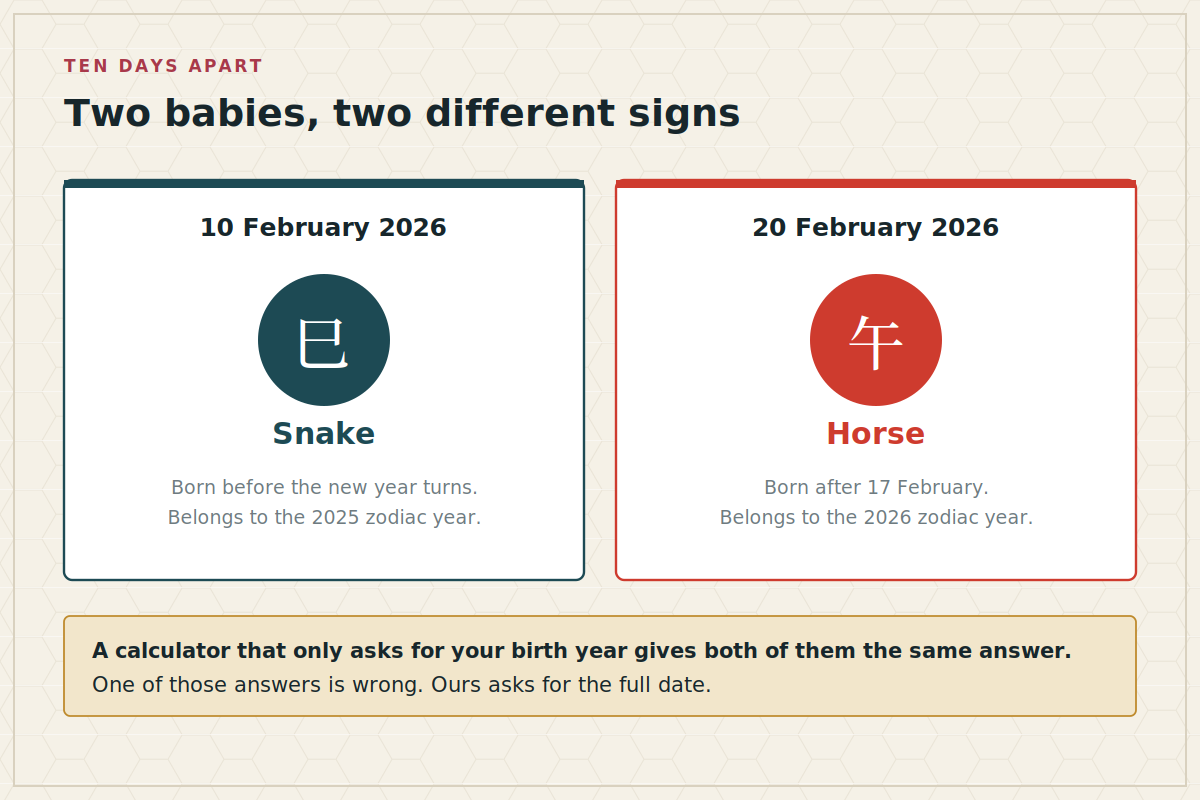
Here is a small test. Two babies are born in Tokyo ten days apart — one on February 10, 2026, one on February 20, 2026. Same month, same year, same hospital. What are their zodiac signs?
Most free calculators will tell you both are Horses. One of them is a Snake. This article is about why, how often it happens, and how to check your own sign properly.
The zodiac year is lunisolar, not solar
The Gregorian calendar is solar: it tracks the Earth’s orbit and starts on a fixed date. The traditional Chinese calendar is lunisolar — months follow the moon, and the year is kept aligned with the seasons by inserting an extra month every few years.
The result is that Lunar New Year lands on a different Gregorian date every year. The rule is that the new year begins on the second new moon after the winter solstice, which puts it somewhere between January 21 and February 20. That’s a spread of nearly a month, and it moves in a pattern that’s regular in lunar terms and looks random in ours.
Every zodiac year therefore starts and ends in the middle of a Gregorian year. The Year of the Horse doesn’t cover 2026; it covers February 17, 2026 to early February 2027.
The dates that matter
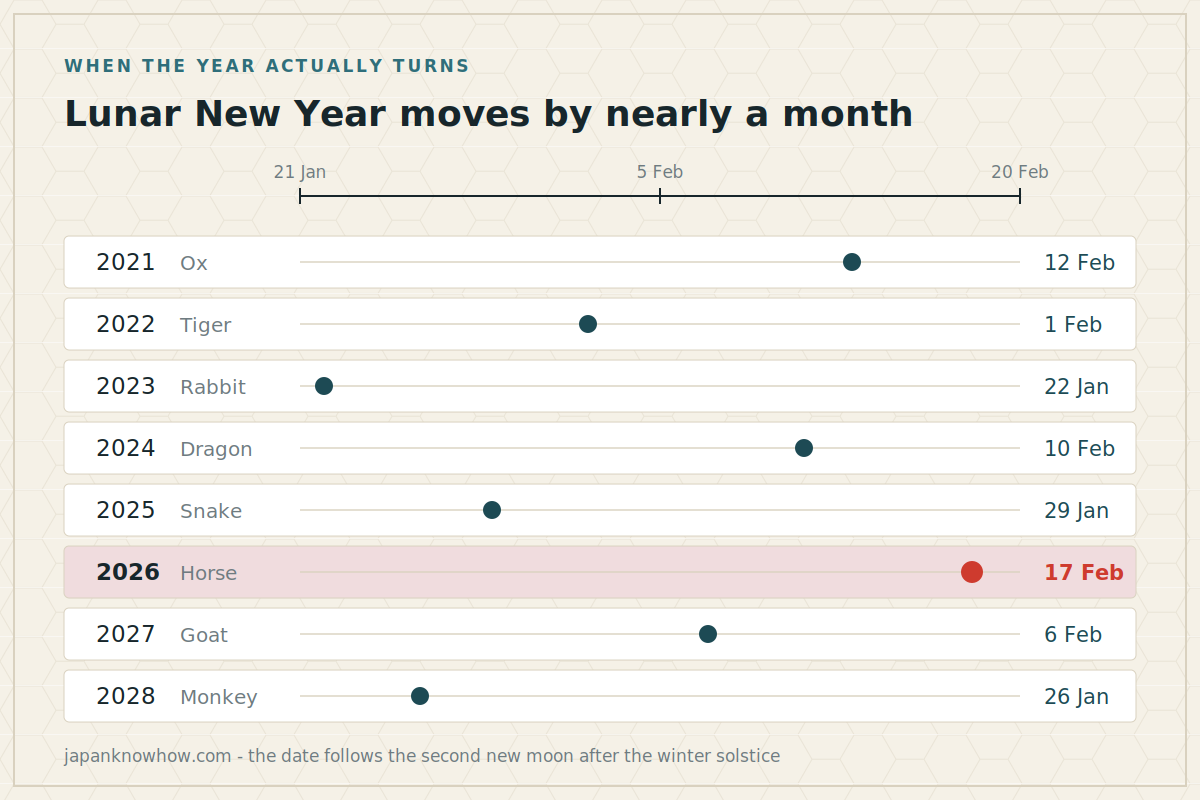
| Year | Lunar New Year | Sign that begins |
|---|---|---|
| 2021 | February 12 | Ox |
| 2022 | February 1 | Tiger |
| 2023 | January 22 | Rabbit |
| 2024 | February 10 | Dragon |
| 2025 | January 29 | Snake |
| 2026 | February 17 | Horse |
| 2027 | February 6 | Goat |
| 2028 | January 26 | Monkey |
Read the table with your own birthday in mind. If you were born in, say, early February 1986, the boundary that year was February 9 — so a birthday on February 5 makes you an Ox, not the Tiger every year-only calculator will hand you.
How big is the affected window?
Bigger than most people expect. The boundary can fall as late as February 20, so any birthday from January 1 through February 20 is potentially in the previous zodiac year. That’s fifty-one days out of three hundred and sixty-five — roughly one birthday in seven.
Within that window, whether you’re actually affected depends on the specific year. Born on February 3? In 2022 that’s after the boundary and you’re a Tiger; in 2026 it’s before and you’d be a Snake. There’s no shortcut — you need the date for your particular year.
Checking your own sign
Two steps, and the first one settles it for most people.
- Were you born between March and December? Then your sign is simply your birth year’s animal, and you can stop. The zodiac year was already running.
- Born in January or February? Find that year’s Lunar New Year date. Born before it, use the previous year’s animal. Born on or after it, use your birth year’s animal.
The same correction applies to the element, which comes from the year’s last digit — so a January birth may need the previous year’s digit as well. If you were born in January 1990, for example, you’re not a Metal Horse; you’re an Earth Snake, because the zodiac year 1989 was still running until January 27, 1990. The mechanics of the element cycle are in our article on the five elements.
Roughly one birthday in seven falls in the window where a year-only answer is a coin flip. That is the whole reason this page exists.The short version
Why so many calculators get it wrong
Not malice — just a design shortcut. Asking for a birth year is one input; asking for a full date and then looking up the correct Lunar New Year for that year needs a table of dates going back a century.
Most sites don’t build the table. They divide the year by twelve and print an animal, which is right for six sevenths of visitors and quietly wrong for the rest. It’s the same failure pattern we found when we measured name transliteration: a rule that’s right most of the time and wrong on a predictable subset looks fine until you check the subset.
Our calculator asks for the full date and uses the actual boundary for your year. If you land inside the window, it says so explicitly rather than silently picking one.
Two complications, briefly
Japan uses January 1. Japan switched to the Gregorian calendar in 1873 and moved the zodiac year with it, so the Japanese eto year turns on New Year’s Day. That means a person born in early February can have one animal by Japanese reckoning and another by Chinese reckoning — both correct, in their own systems. We untangle that in the eto article.
Some traditions use the solar term instead. A minority of Chinese astrological practice starts the animal year at lichun, the beginning of spring, which falls around February 4 and is fixed in solar terms rather than lunar. That produces yet a third answer for some February birthdays. For everyday purposes — which animal to put on a card, what to tell someone at a party — Lunar New Year is the standard, and it’s what we use.
Why the date cannot be simplified
A reasonable question: if the drift is this inconvenient, why not fix the date? The answer is that the calendar is doing a different job from ours.
A lunar month is about 29.5 days, so twelve of them come to roughly 354 days — eleven short of a solar year. Left alone, the new year would drift backwards through the seasons the way the Islamic calendar does, and after fifteen years it would be arriving in autumn. The traditional Chinese calendar prevents that by inserting a thirteenth month roughly every three years, which pulls the new year back into late winter.
The drift you see is the correction working. Lunar New Year swings between January 21 and February 20 precisely because it is being kept in step with the seasons rather than allowed to wander — and the price of that stability across centuries is that any individual year is unpredictable without a table.
It is also why the date is astronomical rather than decreed. The rule is tied to the winter solstice and the new moon, both of which are computed rather than chosen, which is the same reason Easter moves in the Western calendar.
What to do with this
If you’ve been telling people your sign for years and it turns out to be the other one, you’re in large company, and nothing terrible follows. The practical uses are the same either way: it’s a calendar marker, a piece of cultural shorthand, and a polite way to guess someone’s age.
The one place accuracy genuinely matters is a gift. New Year cards, decorations and zodiac merchandise in Japan and across East Asia are tied to the animal, and giving someone the wrong sign is the kind of small error a recipient notices immediately. Check the date first — it takes ten seconds, and the wider picture of how the twelve signs work is in our guide to the Chinese zodiac years.