
Ask someone their Chinese zodiac sign and you’ll get one word: Dragon, Rooster, Horse. Ask in Chinese or Japanese and you may get two: Fire Horse, Metal Rooster. The second word comes from a completely separate cycle running underneath the animals, and it’s the reason the whole system repeats every sixty years rather than every twelve.
This is how the elements work, how to find yours, and why 2026 in particular is the combination people in Japan have been talking about for a decade.
The five, and the order they go in
Wood, Fire, Earth, Metal, Water — wu xing in Chinese, gogyō in Japanese. The usual English word “element” is a slightly misleading translation: these aren’t substances the world is made of, they’re five phases a process moves through, which is why the order matters as much as the members.
The standard sequence is a generating cycle, and each step is a small piece of folk logic:
- Wood feeds Fire — burn wood, get fire.
- Fire makes Earth — what burns leaves ash.
- Earth yields Metal — ore comes out of the ground.
- Metal carries Water — condensation forms on a cold metal surface.
- Water grows Wood — and the cycle closes.
There’s a second, less cheerful cycle running the other way, in which each phase overcomes another: water puts out fire, fire melts metal, metal cuts wood, wood breaks up earth, earth dams water. Traditional practice uses both — one for harmony, one for conflict — and it’s the overcoming cycle that lies behind most of the compatibility claims discussed in our piece on zodiac pairings.
Finding your element
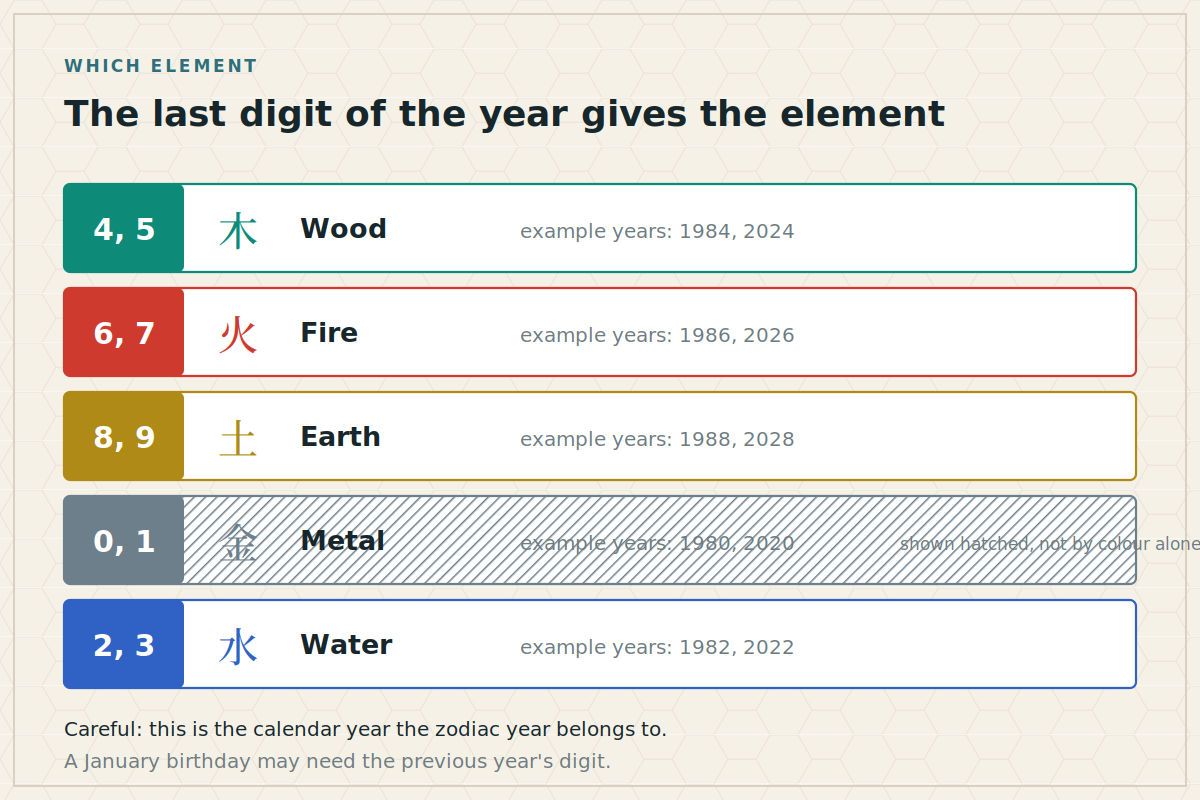
Easier than the animal: it’s the last digit of the year.
| Last digit | Element | Recent years |
|---|---|---|
| 4, 5 | Wood | 1984, 1985, 2024, 2025 |
| 6, 7 | Fire | 1986, 1987, 2026, 2027 |
| 8, 9 | Earth | 1988, 1989, 2028, 2029 |
| 0, 1 | Metal | 1980, 1981, 2020, 2021 |
| 2, 3 | Water | 1982, 1983, 2022, 2023 |
The same warning applies as for the animal. That’s the digit of the zodiac year, not necessarily of your birth year — so if you were born in January or early February, you may need the previous year’s digit. Someone born on January 15, 1990 is not a Metal Horse; the 1989 zodiac year was still running, so they’re an Earth Snake. The window and how to check it are set out in the article on the floating new year.
Why sixty
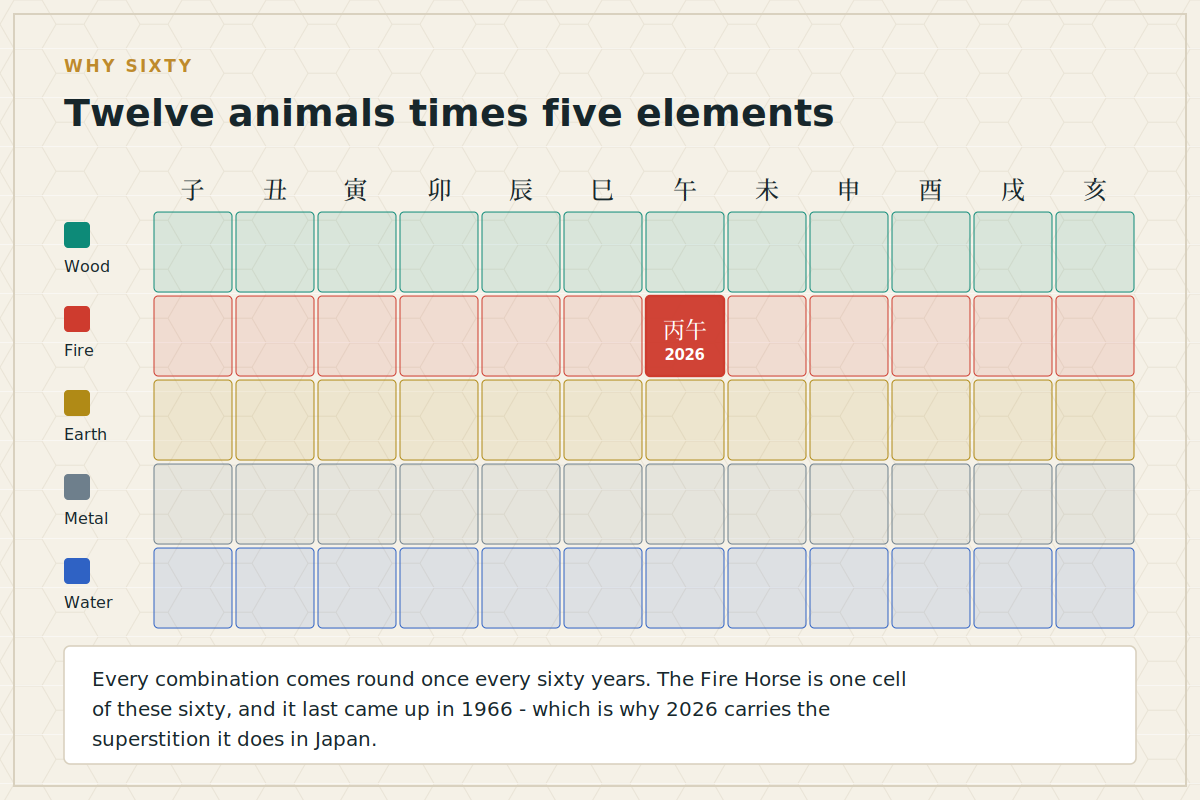
Twelve animals, five elements — the naive answer would be sixty combinations, and sixty is indeed the cycle length, but the arithmetic behind it is slightly more interesting than a multiplication.
The real machinery is two interlocking sequences: ten heavenly stems and twelve earthly branches. The branches are the animals. The stems are the five elements, each split into a yin and a yang form — which is why an element covers two consecutive years. Pair them up, advance both by one each year, and they realign after the least common multiple of 10 and 12, which is 60.
Not every animal-element pair occurs, incidentally. Because both sequences advance together, each animal only ever pairs with elements of matching parity — so there is a Fire Horse but never a Fire Snake in the same phase. Sixty combinations out of a possible 120, appearing in a fixed order that has been running continuously for a very long time.
Sixty as a life stage
The cycle closing has real social weight in Japan. Your sixtieth birthday returns you to the animal-element combination you were born under, and the occasion has its own name — kanreki, 還暦, “return of the calendar.” It’s marked as a rebirth: traditionally the person wears a red cap and vest, the colour of infancy, and is celebrated as beginning a second cycle.
You’ll see red chanchanko vests in gift shops for exactly this reason. If you’re invited to a kanreki celebration, that’s the context — and it’s a good example of the zodiac operating as a calendar and a life-stage marker rather than as fortune-telling.
Every combination comes round once every sixty years. The Fire Horse is one cell of these sixty, and it last came up in 1966.Why 2026 is not just another Horse year
The Fire Horse, which is where this stops being abstract
2026 is hinoeuma, 丙午 — the yang Fire form of the Horse. It arrives once every sixty years, and in Japan it carries a specific and unusually consequential superstition: that women born in a Fire Horse year are fiery-tempered and dangerous to their husbands.
The belief is old, its origins are murky, and its effect is measurable. Japanese births fell about 25% in 1966 and bounced straight back the following year — one of the clearest cases anywhere of a calendar superstition moving a national statistic. Whether it repeats in 2026 is being watched closely, and the early evidence suggests it isn’t; we’ve written the full story up in the article on Japan’s eto.
Where you meet the elements in Japan
The five phases are not confined to fortune-telling. They are woven through the vocabulary and the calendar in ways a visitor runs into without noticing.
The clearest example is the days of the week. Japanese weekday names are built from the elements plus the sun and moon: Monday is 月曜日, moon-day; Tuesday 火曜日, fire-day; Wednesday 水曜日, water-day; Thursday 木曜日, wood-day; Friday 金曜日, metal-day; Saturday 土曜日, earth-day; Sunday 日曜日, sun-day. Learn the five elements and you have most of the week for free — a small return on effort that we’d have mentioned in the guide to numbers and counters if it belonged anywhere else.
The elements also organise a great deal of traditional practice: directions, seasons, colours, flavours and organs in traditional medicine are all mapped onto the five. That is why a Japanese seasonal menu, a shrine’s colour scheme and an acupuncturist’s chart can turn out to be using the same underlying framework.
What the elements are said to mean
Worth including for completeness, with the same caveat as any personality system: this is traditional characterisation, not a claim about how people actually are.
- Wood — growth, cooperation, long-term thinking; associated with spring and the colour green.
- Fire — energy, passion, visibility; summer, red.
- Earth — stability, patience, practicality; the turn of the seasons, yellow.
- Metal — precision, discipline, clarity; autumn, white.
- Water — adaptability, insight, quiet persistence; winter, black.
The element is always read together with the animal — it modifies rather than replaces it, so you need your animal settled first, and the twelve signs are laid out in our guide to the Chinese zodiac years. The usual description is that the element shades the sign: a Water Tiger is a Tiger with the edges smoothed, a Fire Tiger doubled down. How much weight to put on that is up to you. The part that’s simply factual — which animal, which element, which sixty-year cell — is what our calculator gives you, and what it does and doesn’t claim is set out on the tools page.